Wednesday, June 10, 2015

The Last Fight Of The Warrior


When Captain Marvel was left buried underneath debris of a sizable portion of Avengers Mansion following the attack of the Controller, the last thing the Kree warrior probably expected was to suddenly find himself in another dimension confronted by a giant, two-headed horror!


We've finally arrived at the point in the Captain Marvel book when the title character undergoes one last change in direction, as well as a transformation unlike his others--this time put in motion by writer/artist Jim Starlin, who would use the character to spearhead the first major Marvel event involving Thanos of Titan. Granted, Mar-vell was arguably suited to assume such a role in his current form--a former warrior of the Kree who had developed a sympathy and fondness for his adopted home, Earth, and whose insight and knowledge of tactics and Kree training might well have been assets in the struggle against Thanos. Starlin, however, had worked to present Mar-vell as being too limited in those respects--bringing something different to the table as an alien, yes, but still relying on battle strategy, strength, and punches to win the day. Mar-vell, the warrior, lives for battle and, by extension, victory--but what does he strive for when there is no foe standing directly before him? In a way, readers have been fortunate that, due to his merging with Rick Jones, Mar-vell can only exist in our universe for three hours--because if he were "his own man," so to speak, he would likely be as directionless as he was when other writers sought to explore his character beyond what we saw on the field of battle.

And so, defeated by the overwhelming might of the Controller, Mar-vell finds himself suddenly spirited away to another solar system by a being called Eon--created by Kronos (in these earlier stories, "Chronos") from a time when Olympus was the home of the original Titans, to await the day when Thanos would ascend to power and the universe would have need of a unique being to challenge him. That man, as Eon has begun to explain, is Mar-vell--but not Mar-vell as he is, a warrior with a one-track mind focused on the path to victory, but a different kind of man who relies on skill and forethought to determine a course of action.


Tuesday, June 9, 2015

All In A Day's Dimensional Surveillance


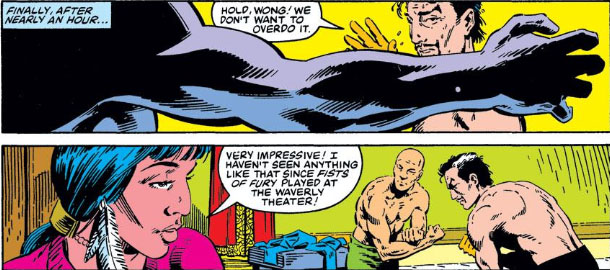
If you're Stephen Strange, Master of the Mystic Arts, and you're not currently in another dimension preventing a malevolent entity from crossing into our own dimension and wreaking widespread chaos and destruction, you likely start your day much the same as everyone else, at least in certain respects. In Strange's case, let's say that day begins with a morning repast prepared by his faithful manservant, Wong--perhaps some oatmeal or French toast with a side of grapefruit and OJ, along with some Turkish coffee and a copy of the "Daily Bugle" (though I suspect Strange has a tablet at hand to peruse a variety of online news sources). Afterward, he shaves and dresses, and then apprises himself of the day's appointments as well as any business or personal affairs that need tending to.

And then, like the rest of us, he goes to work.

But, unlike those of you who work from home, Strange's office is remarkably sparse--and just a tad more interactive.


Strange's love and former disciple, Clea, is off in the Dark Dimension leading a revolt against Umar, so the magician puts that in his "pending" file for now. But at this point in time he's become aware of the so-called Dweller in Darkness, and, like the rest of us at the office, Strange knows when he needs to prioritize.


Thanks to Wong, Strange also gets a healthy workout during the day. Though Strange quickly finds that the man who brings him tea isn't about to cut him any slack on the mat.


As in most working environments, you have someone on staff who is irreplaceable.  It's probably safe to say that Wong qualifies.

(Though I do think that the sparring matches between these two should have occasionally taken the form of the clashes between another famous master/servant pairing.)


Monday, June 8, 2015

Where There's A Fire, There's... Captain Britain!


What you see is what you get, when it comes to this cover of the classic Marvel Team-Up #65:


Well, you won't actually see any construction workers in the story; the point is, it's Spider-Man vs. Captain Britain, and nothing but, when the U.K. hero crosses the Atlantic and gets his first taste of brawling in the Big Apple. But, if these two are going at it for most of the issue, where does the "team-up" part come in?

Captain Britain, created by Chris Claremont and Herb Trimpe, had already been featured as the headliner in the U.K. weekly of the same name by the time he made his first stateside appearance in 1978. And since the Captain America title couldn't hope to match the wave of popularity that Spider-Man was riding at the time in terms of sales, there seemed no better place than a Spider-Man mag to showcase the British hero. For the most part, the tale in this issue of MTU would have the two heroes clashing in a typical case of misassumption, which Spider-Man's status as a virtual outlaw would often bring about. Captain Britain, in his own way, was as staunch a hero as Captain America, though with perhaps more eagerness to indulge in his relatively new costumed identity and tackle a foe than his more seasoned American counterpart--so it's not entirely surprising to see him jumping the gun in that respect with Spider-Man.

As for what's got him gunning for Spider-Man, we have to backtrack a little to a meeting between Peter Parker and the Captain's civilian identity, Brian Braddock, in what could be boiled down to facilitating a housing arrangement for an exchange student:


(Fifty bucks a week may seem like small change these days for someone paying rent for a New York City apartment, but it was probably nice for a student to pocket in 1978.)

But when Peter steps out that night to go on patrol as Spider-Man, some passing fire truck sirens have Brian running to find Peter (good grief, is a passing fire truck cause for alarm in the U.K.?), and...


Friday, June 5, 2015

In Death Do We Join!


Looking at the cover art to Tomb of Dracula #16, it almost seems like issue #22 is its evil twin brother:


The stories are very different, of course--but the two do have something in common in that the regular cast of vampire hunters are virtually absent from their pages (with the exception of a brief, unrelated scene in each tale), which means that Dracula must "carry" both stories on his own. And Dracula, as written by Marv Wolfman and drawn by Gene Colan and Tom Palmer, comes across as such a fascinating character that he's often able to accomplish that. In "In Death Do We Join!", Dracula is even more isolated, since there is no distraction of even a police inspector to balance the pacing of the story. That leaves us with only Dracula and the story's villain, Gorna--an abusive husband who is turned into a vampire and attempts to reclaim his wife, Petra, as one of the undead.

Inbetween, Wolfman places a large part of the story's burden on the townspeople of the Russian village of Kamenka, as well as on the girl's stern family--all of whom are familiar with vampires, but whose ability to deal with one consists of little more than attempting to drive it off. For instance, when Gorna dies from a vampire bite, a robed procession carries his coffin to the cemetery and a funeral is given for appearances' sake (so as not to alarm Petra of Gorna's impending transformation)--but, even knowing that Gorna will rise again as a vampire, no one takes any precautions with the body. Instead, the grim robes and death masks of the pallbearers are worn to represent the dread that is likely to come--the "services for the undead," as Petra later learns. Small wonder that she later finds herself in danger from Gorna, as the people of Kamenka seem to regard such things as inevitable.

Such shortcomings in this story are mitigated, however, by an editor's note in the issue's letters page which helps to explain things:

The current issue of TOMB OF DRACULA is somewhat different than most in that for the first time we've done an adaptation of an actual case history of a Russian Vampire. There were changes made for the sake of action and characterization, but the general theme to the book is from actual lore.

And if there is enough reader demand, we'll be glad to try another true vampire tale and fit in [sic] into our Dracula lore. So, please write.


Given this new information that what we're reading is an adaptation rather than a plotted story that more fully takes Dracula into account, the loosely structured way in which the story comes across is understandable. For instance, we know that Gorna must encounter Dracula, or vice versa--but under what circumstances? We see that encounter as early as page eleven; but the situation between Gorna and Petra (and her family) has yet to be resolved, which means that Gorna's meeting with Dracula will likely be inconclusive. Not to mention ill-considered. Petra seems helpless to prevent Gorna from claiming her, and neither her parents nor the other villagers seem equipped to handle the likes of a vampire--but in his attempts to claim Petra, Gorna is easily startled into fleeing or otherwise driven off by primitive means. Yet we're to believe that this man is confident enough in his power to challenge Dracula?


Thursday, June 4, 2015

3BR, 2B... Solar Wave Fixer-Upper, Price Reduced


As traps go, this one conceived by Dr. Doom to deal with the Fantastic Four was one of the more visually impressive to grab your attention from an issue's cover:


Doom springs this trap on the FF after the team has dealt with Doom's henchmen and are finally able to bring the fight to Doom himself. But Doom has prepared well, and he literally has the FF where he wants them.


And as you've already likely guessed, a "solar wave" is made to order for another case of


Like yourselves, I'm not really comfortable with the idea of a solar wave phenomenon that's randomly hitting areas of our planet every 24 hours--so I can imagine how the inhabitants of Marvel's Earth feel about it. They already have Galactus and other deadly menaces threatening their survival--now they have to deal with a deadly event that hits every day, anywhere. And if you're standing near ionized dust particles, you can practically count on being sucked into space. People are probably using dustbusters around their homes every hour.

As for the FF's predicament--thanks to Sue, the FF have decided that if they're going to be killed, they're going to make sure that Doom shares the same fate:


It doesn't seem like Doom has thought this situation through, does it? In other words, he's in no real danger on the other side of the FF's cell, trapped against its wall or not, since the ionic dust isn't present in his room. Then again, if the cell wall dissolves, Doom is indeed going to be caught in the FF's wake, thanks to being contained by Sue's field. Besides, the solar wave is only attracted to a location by the presence of ionic dust; that doesn't mean its effect is simply going to cease if there is no dust beyond a certain point. So we certainly can't blame Doom for not wanting to chance it.

At any rate, Doom has made his call--let's see how things go for him.


Whoops! As Reed mentions, the FF had better hope that the solar wave only acts on the area where ionic dust has settled--otherwise, whether they crawl into the next room or not, it's curtains!


Fortunately, the FF's luck holds. As for Doom, he's likely wondering if his armor's oxygen and power supply will do the same.

Wednesday, June 3, 2015

Double Trouble


A year may not seem like a long time to some of us, but apparently it's just enough time to provide a sense of déjà vu to these two covers of Incredible Hulk, just twelve issues apart:


You'll probably have to shake your heads a little more vigorously to return your focus, since it's understandable these covers may have you seeing double. Yes, that is the Abomination attacking the Hulk on both covers--and yes, it appears both issues have the Hulk "At Bay!", as unlikely as that sounds. Beyond that, we'll have to peek into each of these issues to find out the circumstances of these encounters with the Abomination.

As it happens, the first story has the Abomination feeling the need to clear his head, as well, once an explosion in the desert revives him after nearly two years of being rendered unconscious, following a plummet to Earth after a battle with the Hulk. Yet he doesn't immediately learn of the gap in years, since he spots the Hulk doing a little plummeting of his own and assumes that it's the result of the same battle that brought him crashing to Earth:


Yet, when the Abomination finally catches up to the Hulk, it doesn't appear as if the fierce trading of blows between the two is having the effect of holding the Hulk at bay. If anything, the Hulk is very much in this fight, and he's in it to win.


What the Abomination doesn't bother mentioning to the Hulk is that General Ross has made a bargain with him to capture the brute, in exchange for the Abomination's cure and release--as the General wants to make sure that his daughter, Betty, doesn't discover that the Hulk (missing and presumed dead until now) is alive, and thus have that knowledge compromise her new marriage to Glenn Talbot. But the Abomination knows that he can play the daughter card and use it against the Hulk--and when he finally does so, his earlier fears are confirmed:


So as the Hulk leaps off to Niagara Falls, it becomes clear that it will be Ross holding the Hulk at bay, as he scrambles to keep the Hulk from reaching his daughter, as well as making sure she doesn't discover that the Hulk is alive and well.

As for the second issue, the Abomination re-enters the picture when he locates and forms an alliance with the Rhino, and the two decide to capture Hulkbuster Base and take their revenge on the Hulk. By now, Betty is well aware that the Hulk (and thus Bruce Banner) is alive--and, after a lovely stint as the murderous Harpy, she rejoins her father at the base only for both to find themselves at the mercy of the brutes' overwhelming onslaught.


Yet Banner has hitched a ride on Betty's transport plane and has kept a low profile on the base, unaware of the attacks launched by the Abomination and the Rhino. In time, he discovers the captives--and the Abomination discovers him. You can take a reasonable guess at what happens next:


With the Rhino and the Abomination having driven the Hulk off, at least for the time being, we seem to have arrived at the point where the Hulk is being kept at bay in this story. And I'm 99.9% sure I know what you're thinking here: "How is it the Hulk can stand against an Army attack in force, wading through tank and bazooka artillery, guns, rockets, and plane strikes, and basically not being held at bay by all of that firepower in the slightest--and yet a single shot from the Abomination's gun intimidates him and sends him running??" I wish I had an answer for you. The only straw I can grasp here is that it's done to put the Hulk in position to later come across Jim Wilson and his girlfriend, who have also infiltrated the base and who can now plan a rescue of the hostages while the Hulk distracts his two brutish foes:


It's not a bad moment for Jim, since he has a nice scene where he's talked through disarming the base's self-destruct mechanism--a gamma bomb--which the Abomination activated so that the blast would catch the Hulk wherever he was on the base. (Perhaps we shouldn't scrutinize too closely the wisdom of a base which specializes in gamma research having a gamma bomb as its self-destruct device. Good lord.) And while the Hulk's dance card is definitely full with both the Rhino and the Abomination gunning for him, you have to wonder how a creature driven by rage can decide to abandon a fight to the death because he's basically bored with it.


Tuesday, June 2, 2015

Return From The Grave!


OR: "Who's Been Sleeping In My Coffin?"


Even when the vampire-lord Dracula wasn't fending off his regular cast of characters or involved in some power-hungry struggle, he could still be a fascinating participant in events both mysterious and macabre. Indeed, those kinds of tales might have played a vital part in keeping the pages of The Tomb of Dracula vibrant with the essence of its title character; after all, there are few better qualified to evaluate and deal with a gruesome mystery than the haughty Dracula, who brings a perspective and forcefulness that works separately yet in tandem with the more behind-the-scenes investigations of Scotland Yard--though one has only to glance at the entries to Dracula's journal to realize that Dracula is more than capable of holding the reader's interest in such situations on his own.

There are many such stories you could choose from during the title's run, though one in particular comes to mind because its cover practically (you'll forgive the word) screams "macabre":


Just as would be the case with any mystery novel you might read, there are several names in this story to make a note of as its events play out--though with writer Marv Wolfman's penchant for giving names to a story's victims, as well as describing in full their hobbies, family members, vocation, character flaws, and dreams, you'll likely need to sift through those names in order to boil this story down to its relevant participants. Given that Dracula's practice of hunting for human victims is a necessary constant, and the fact that the victims he feeds on have no other purpose in the story than to be his victims, Wolfman's technique is perhaps done to better distinguish panels of slaughter that otherwise might tend to blend together and, in time, be skimmed over by the reader. In this particular story, that may be a bit of, er, overkill. (Sorry, another word for you to forgive.) Suffice to say that our key players here are:

  • Paul Beare, deceased;
  • Theresa Beare, his wife;
  • Duncan Corley, deceased;
  • James Jackson, the Beares' attorney;
  • Inspector Chelm, of Scotland Yard

It looks like we already have a few dead people to contend with, even before we turn the cover page. But our splash page adds one more to the list: Helen Cantler, Jackson's secretary, who comes across a deadly intruder (emphasis on the "dead" part) and pays the price.


Monday, June 1, 2015

Crushed By The Controller!


When we last looked in on Captain Marvel, we saw that Thanos, the mad Titan (not to be confused with the mad Thinker), had advanced his plans for seizing the Cosmic Cube, currently hidden on Earth--while Mar-vell, along with Mentor and Eros of Titan, fought to wrest control of that Saturn moon from Thanos' mercenaries, a battle which resulted in the death of the Super-Skrull. It's a story plotted by artist Jim Starlin that continues to raise the profile of Thanos, whose plans first manifested in the pages of Iron Man and who Starlin has now brought to the Captain Marvel book in order to play out those plans to fruition; and with Starlin featuring such popular characters as the Thing and the Avengers, his developing plot with Thanos was also benefiting Mar-vell, a character who had struggled and ultimately failed in his own title but who now was experiencing a resurgence.

Up to this point, it was Starlin's unique artistry which was making an impression on readers. But now, as Mar-vell pursues Thanos to Earth, Starlin and writer Mike Friedrich split the scripting of this next issue, and Starlin takes the first steps toward writing the events of this story. Looking back on those issues, it seemed to suggest a lot on his plate, given that he also assumed colorist chores and would only end up scripting three issues in their entirety before the story concluded and he would move on. Consider, also, that Captain Marvel at the time was being published bi-monthly, which gave Starlin a generous amount of time to turn in his work. Yet there could have been any number of factors in play which kept Starlin from taking the reins for the duration--from prior scheduling of other writers like Friedrich or Steve Englehart, to consideration of future plans for the book, to Starlin's own arrangements. With the book's publication schedule, Starlin would be with the title for a year and a half, a fairly long time--and while artists like Herb Trimpe, John Byrne, et al. have been content to remain with a project for even longer periods, perhaps Starlin simply wanted to move on to try his hand at other work. Whatever the circumstances, there's no denying the contribution he made to not only this title, but others which he's taken an interest in and breathed new life into.

As for this particular story, it would be one of transition--not only for Thanos, on his path to true power, but also for Mar-vell, a staunch Kree warrior who operates by a strict military code and who faces his last issue in battle in that current form. Dealt in with both characters are the mighty Avengers, who are formally drawn into the conflict with Thanos and his deadly hirelings. We also have Rick's girlfriend, Lou-Ann, a character who's become a victim of Thanos' machinations and who, let's face it, nobody really cares about. (With the possible exception of Rick.) But making up for Lou-Ann's non-presence is the more interesting Destroyer, nemesis of Thanos--the only being that stands between the Titan and the ultimate weapon of power he seeks. Together, a collage of characters that we find presented on the story's teasing splash page, in a tale which brings us closer to the dire fate of the universe!