Showing posts with label Jim Shooter. Show all posts

Thursday, November 10, 2022

"The Heroes and the Holocaust!"


In 1981, Marvel Treasury Edition brought to an end its seven-year series with its "final edition" (so to speak) that featured characters from both Marvel and DC Comics in a whopping 68-page story--long overdue for a presentation in the PPC and, as a real treat for yours truly, one which I'm looking at myself for the first time, having initially passed on it at the counter over forty years ago.


Given the listing of credits, it's no wonder that DC gave its approval to those assigned to the job:

  • Pencils: John Buscema, arguably Marvel's biggest gun on story art at the time;
  • Inks: Nine different artists inking Buscema's backgrounds, with Joe Sinnott handling all of the characters;
  • Letters: Joe Rosen, brother to fellow Marvel letterer Sam Rosen*;
  • Front cover art: John Romita (layouts) and Bob Larkin

*In such stellar creative company, I almost expected to see Sam Rosen's name joining them; but by this point, he'd left Marvel, his final (albeit incomplete) work for the company having been submitted about nine years prior. But I think you'll find that Joe turns in exemplary work on this story.

While on scripting, we have Editor-In-Chief Jim Shooter, with plotting suggestions submitted by Marv Wolfman--though initially different arrangements had been made, as Mr. Shooter explains**:

   "I picked Marv Wolfman to write the book for a number of reasons: he was a marquee name and deservedly so, he was in New York, conveniently, he was absolutely reliable, and most of all because he really, really wanted to do it.
   "Somewhere in the middle of plotting, Marv’s employment agreement expired. We weren’t able to come to terms on a new one. He had an offer from DC, and opted to take it. So, Marvel was obliged to provide another acceptable writer. I was the only Marvel writer who had written both Superman and Spider-Man. I didn’t have a lot of time on my hands, but neither did the other leading candidates. So, I took it on. DC had no objection."

**Condensed for brevity. You can find Shooter's full and fascinating remembrances of this project on his blog, in three parts.


Predictably, there are a number of things to look forward to here, as those of you already familiar with this edition know. For one thing, it's a fine overall story. The beginning lays out its direction with Spider-Man's discovery of suspicious activity; the heat is turned up a bit by out of the ordinary behavior on the part of the incredible Hulk (if one can even use the word "ordinary" in regard to his actions); Superman arrives and begins his own investigation, leading him to the doorstep of the Latverian Embassy and you-know-who; there's the added variable of the man named Parasite, an energy-draining character who had been imprisoned by Superman but becomes aligned with Doom; there is also Wonder Woman's presence, lured by Dr. Doom to New York for some unknown reason; while Spider-Man's own progress in the investigation leads to joining with Superman against both Doom and Parasite.

The key player in leading us through this story's developments, however, would be Doom--whom we come across early on and provides us with the knowledge of an ongoing plan that brings him closer to world domination. This early in Shooter's story we're provided with no specifics as yet; yet the master of menace, and manipulation, will be responsible for a good deal of what you and I will see from this point going forward.


Monday, August 30, 2021

The Revealing Of... The Enemy!


The story of Korvac--or, rather, the character we're most familiar with from a ten-month string of Avengers stories in 1978--began following his emergence from a conflict in the 31st century and into our own, where he stumbled upon a source of power that would pave the way for a greater conflict to come.


As we've learned, "Michael," as he refers to himself, had now set out to make himself the universe's benefactor and the savior of all who live by freeing all beings from the chaotic cruelty and injustice of life throughout the universe, while bringing all existence under his own "sane and benevolent rule"--words which for any reader of comics ring familiar as those spoken by many would-be oppressors who felt similarly entitled.

Like other sagas in Marvel's titles which have slowly unfolded over stretches of time (the story of "They" being one such example), this plot winding its way through the Avengers book managed to stay relevant even through shifts in the book's creative talent, as well as the turmoil which can often be found in the team's adventures--sandwiched as it was between their desperate battle with Count Nefaria and their showdown with the deadly Ultron, where the they learned that another threat was now stalking them.


More disappearances occurred both before and after the Avengers (joined by Ms. Marvel) went on to deal with the menace of Tyrak--yet unknown to them, one of the Guardians of the Galaxy, travelling from the future to head off a suspected attempt on the life of one of their members, Vance Astro, had already managed to sense the true nature of their enemy and decided to confront him. It would be a meeting which would cost Starhawk his life.


Starhawk was then sent on his way, oblivious to what had just occurred and no longer a threat to Michael. As we've also seen, Michael had been joined by Carina Walters, a fashion model he coerced to come with him but who in reality is the daughter of the Collector--sent to spy on Michael, but who had instead fallen in love with him.

In dealing with Starhawk, Michael had, in his own words, drawn first blood in the war to come--but as we backtrack and assemble the pieces of this conflict taking shape, how will even the Avengers come to know of this threat before it's too late?


Thursday, July 22, 2021

Power Begets Power


Amid all the battles taking place between heroes and villains during the 1985-86 limited series Marvel Super-Heroes Secret Wars, there were two characters who were instead more concerned with their own priorities in this strange setting they had been thrust into. For the world-devourer Galactus, his was to almost immediately seek out and confront this conflict's orchestrator, the Beyonder, and insist that this being use his clearly overwhelming and limitless power to end his endless craving for the life force of worlds; but for the infamous monarch of Latveria known as Dr. Doom, he, too, sought an opportunity to gain power for himself, having witnessed the great power which the Beyonder wielded to wipe out an entire galaxy as well as create a world on which the captured super-humans would battle.

The Beyonder would effortlessly rebuff both of them during the initial attempt of Galactus to breach the Beyonder's portal to his universe, and, from that point on, both would pursue their goals in their own way using their own methods: Galactus, by summoning his world-ship to facilitate his draining the planet of its life force (which would mean the deaths of all of those brought from Earth), and Doom, by turning his attention to the vast world-ship and its secrets. Finally, Doom's patience bore fruit, when Galactus, in preparation for facing the Beyonder once more, began consuming the incredible sources of energy which were available to him, starting with his world-ship.

Yet in his own preparations, Doom had secured the means by which he could take advantage of such a moment--and as the horrified onlookers on the planet fear the worst, Doom lays claim to nothing less than the power which Galactus looked to absorb himself!


In other words, Ms. Rambeau, it sucks to be you right now.


Given that Doom has always made bold claims of his "matchless mind" being able to adapt to situations that lesser men could not, it's fitting for writer Jim Shooter to show him having not so easy a time of it in attempting to keep his focus--and his sanity--regarding his own corporeal state of existence even as he struggles to cope with the perceptual shifts inundating him at these early moments of an entirely new existence. We're left to assume that Doom's prior experience in being able to absorb and control cosmic power has played some part in allowing him to weather the far, far greater flood of forces meant for the mind and body of Galactus--but we'll find his greater test in this regard is yet to come.

Yet even in as superior and overwhelming a state of being as he currently finds himself, there is still one other whose shadow falls over him (or, more to the point, in whose shadow he still remains), a realization that he cannot tolerate--and so he now girds himself for a winner-take-all struggle with the Beyonder, a contest which he has prepared for to a certain degree but will demand all the resources this man can bring to bear, just to stay alive.


Monday, July 19, 2021

The Coming Of Galactus! The Rise Of Doom!


When it comes to Marvel's Bronze Age tales of the 1980s, I don't often come across raves or even much discourse regarding that period's notable and heavily promoted event, the 1984-85 twelve-issue limited series Marvel Super Heroes Secret Wars, which, at the time, was reportedly a financial success and sold more copies than any other comic in the previous twenty-five years. Almost nine years ago, the PPC featured its own review of the series as a whole--and while ultimately questioning the premise of the concept along with its outcome and immediate impact, there were also some positives to consider, though your own mileage may vary.

It seems clear that the story's selling point was in the select groupings of heroes and villains which were assembled on a newly-created planet to engage in a number of conflicts with each other, on a scale that went (forgive the word) beyond what could be found in regular monthly titles being published. (The scenarios being found in the 1977-1984 What If series, still being sold at the time, were perhaps the series' closest equivalent in that regard.) Yet if you look past the window dressing of the hero/villain battles (where, let's face it, only one group is going to be able to meet the Beyonder's condition to "slay your enemies" in order to claim the reward being offered), there were two characters in particular whose activities arguably made for more compelling reading--individuals who were literally worlds apart in power, but whose struggles coincided and came to overshadow the main focus on the heroes who were caught in the middle of it all.


Thursday, November 12, 2020

"Day Of The Godslayer!"


The Avengers are in crisis mode! As was the case with Graviton, the Avengers again face a single individual who possesses enough power to swing a virtual scythe through their ranks and easily thwart their best efforts to take him down. Today, that individual turns out to be Count Nefaria, who in the past has employed the use of super-powered underlings to further his criminal agenda, but has now used technology to siphon the powers of the Living Laser, Whirlwind, and Power Man for himself while also increasing the strength of those powers a hundredfold. That translates, respectively, to being able to deploy massively powerful laser beams, speed which would make Quicksilver seem to be moving like molasses, and strength which allows him to topple skyscrapers with little more than a shrug. In short, the Avengers face the fight of their lives against Nefaria.

Already, in several engagements, Nefaria has defeated the Avengers decisively while emerging none the worse for wear; yet during a skirmish with the Whizzer, Nefaria was made aware of his own mortality, which has motivated him to seek out and face the thunder god, Thor, in order to force him to surrender his mystic hammer which Nefaria believes is the source of Thor's immortality. And as far as Nefaria is concerned, whether that surrender comes willingly or as a result of Thor's death is of little consequence.

For their part, the Avengers made it clear that they would not cooperate with their foe in summoning Thor to the scene, and battled on to yet another defeat. But in the midst of the carnage suddenly comes a sweeping, deadly barrage of lightning bolts which blanket Nefaria and visibly unnerve him--heralding the arrival, and the cry of vengeance, of the one Avenger who yet stands in defiance of him.

Monday, November 9, 2020

It's The Return Of The Lethal Legion! (it says here)

 
October of 1977 saw the Avengers sandwiched between two high points in writer Jim Shooter's handling of the team: the return of Ultron, who schemed (with the unwitting assistance of, of all people, Ant-Man) to use the life force of Janet Van Dyne to animate a robot bride for himself... and a life-or-death battle with Korvac, an alien from the future who sought to remake our reality, a struggle which nearly wiped out the entire team (along with Captain Marvel, Ms. Marvel, and the Guardians of the Galaxy). Compared to those challenges, seeing the Avengers go up against losers like the refurbished Lethal Legion may not seem like much of a page-turner at first glance--but you may be surprised.

Get a good look at Whirlwind's exclamation on that cover--in this entire story, this trio will only be referred to as "the Lethal Legion" through narrative, and sparingly at that.  (And what's Whirlwind going on about, anyway? Your old group was the Masters of Evil, bub!)


As long as we're stretching the concept of another Lethal Legion being back in business, there's the matter of a new ringleader to take the Grim Reaper's place--a classic villain who has hit the skids since taking part in an abortive scheme that cost the life of an X-Man, but now seeks to remedy his standing by once again employing underlings to do his bidding.  Only this time, he'll be making use of them far more extensively than they can know.


Monday, December 3, 2018

Try Your Hand!


If you had aspirations toward working at Marvel Comics as a writer or artist, you probably took more than a second glance at The Official Marvel Comics Try-out Book published in 1983, which offered you a chance to submit your work samples directly to the source--and, best of all, since by all appearances Marvel was "hiring," you didn't have any concerns of how to get your foot in the door or having your work rejected outright. You were also on a level playing field with other applicants, since each person was applying their talent to the same pages of the sample story in the book which was in various stages of completion. Depending on what area you wanted to concentrate on, you could add your own touches and flair and submit work that would be distinct from anyone else who was hoping to be the next Chris Claremont or John Romita.

Taking a leaf from How To Draw Comics The Marvel Way, a much larger and more detailed instructional aid published in 1978, the Try-Out book clocks in at only 32 pages, but naturally has a format geared for work submission, its weighted pages oversized at 11" x 17" and designed for removal from the book's spine--though many would also have picked up the book just to hone their developing skills. Given its title, it has a only a minimum of introductory and explanatory segments and doesn't go into nearly the detail of its 1978 predecessor; its strength, rather, lies in the fact that it's a hands-on book in the truest sense, and no doubt appealed to those who wished to have a "starting point" in front of them.


Starting with the actual (but unfinished) comic story which gives you a few completed pages by Jim Shooter, John Romita Jr., Al Milgrom, Christine Scheele and Jim Novak, you'll then find sections that break down the work into try-out areas where you can add inking and/or coloring to pencilled and/or inked pages, add lettering to pages which have been scripted, pencil pages that have been plotted, write your own plot, or script pages that have been plotted and pencilled. No doubt there were those who rolled up their sleeves and tried their hand in more than one area, taking advantage of the enthusiasm which a publication that had "Official Marvel Try-Out Book" as its title was bound to generate.

The house ad for the book doesn't appear until April of the following year:


Nearly a year later, perhaps to get a little more mileage from the book's jaw-dropping $12.95 price tag, Shooter decided to capitalize on the book's title and grandfather the concept into a formal contest which in essence "put the word out" that Marvel was actively looking for new talent--and to sweeten the pitch, there was now a bona fide work assignment waiting for the winners, as a new full-page ad appearing in the company's January 1985 books details:


The revised ad was supplemented by a mention in the Bullpen Bulletins section (or what was left of it by 1985). Given its wording, there was apparently a production slip-up that delayed the Bulletins blurb until the following month instead of coinciding with the January ad; yet an explanation has now been added which clarifies that the contest was a way of satisfying rabid fans who were clamoring for the full comics story that remained incomplete in the Try-Out book. To cover his bases, Shooter adds that purchasing the book wasn't required to enter the contest.


Reportedly, over 19,000 submissions were received by Marvel--which, not even tabulating purchases of the book which were made before the contest was conceived and added to the mix, amounts to over a quarter of a million bucks in sales.

It wasn't until February of '86 before the winners were announced, one of whom you'll likely recognize immediately:


Only the Bulletins winners' annoucement includes the wording regarding the winners' "first regular professional assignment," while the ad is careful not to imply that additional work will be forthcoming.

To follow up on the annoucement, the ASM story which would have finished the "Personals" story begun in the Try-Out book never materialized, though Bagley of course went on to pencil a full run of Ultimate Spider-Man and other assignments. Hazlewood, the inking contestant, would mainly make his stamp at DC Comics--while Riggs, formerly a graphic artist, would shift to inking work in Marvel's UK line as well as finding later work at DC. Neither Pasda nor Duffie have been credited in published work (to my knowledge).

A less hyped try-out book was the 1996 X-Men-themed effort (with an intro by Bagley) that makes a point of mentioning the use of computer technology in comic book production, while being less accommodating as far as available pages to work off of directly.

A lot of water has gone under the bridge since the mid-'80s, of course, so Shooter's message in the final announcement welcoming further submissions post-contest has accumulated a lot of dust. And boy, has Marvel changed its tune and retracted the welcome mat:

"Marvel does not accept or consider any ideas, creative suggestions, artwork, designs, game proposals, scripts, manuscripts, or similar material unless we have specifically requested it from you. Marvel is continuously developing and creating its own ideas and materials, and we don’t have the resources to review or respond to unsolicited material. Unfortunately, any unsolicited material you send will not be read or shared. It will be destroyed, and it will not be returned.

"While we can’t accept your unsolicited submissions, please know that Marvel is always looking for new comic book artists and writers. We constantly read and review indie, self-published, creator-owned, and web-comics, review popular online art communities, ask other artists for opinions and recommendations, and host portfolio reviews at conventions from time to time. If you are an aspiring comic book artist or writer, we suggest you publish or publicly post your material, continue to create, and if you have the right stuff...we’ll find you."

Or, as Mark Alford bottom-lines it in his commentary on the subject: "Don't call us, we'll call you."

BONUS!
Mark Bagley talks about his try-out experience and subsequent career.


Wednesday, October 10, 2018

Fathers, Sons, Huns... and Doc Ock!


If there's a listing somewhere of Marvel's Most Unlikely Adversaries to See Print, it's fair to speculate that Captain America vs. Doctor Octopus might be on it somewhere--maybe not in the top 10, or even the top 50, but if you skimmed down the entire list I think it would jump out at some point. It's hard to imagine why their paths would even cross--New York City is large enough to keep a lot of individuals' paths from crossing, nor does Ock really have any reason to try taking on the Avengers to somehow end up going head to head with Cap. Is it a matchup anyone would even be curious about? Ock is a headliner, yes, but I'd think a more interesting fight might be between Ock and Iron Man, as long as we're throwing names out there. (Of course, if Iron Man was shown to have a problem ripping Ock's metal appendages to mangled junk, it's not really an issue I'd plunk down 50¢ for.)

However, in mid-1981, it at least looked like EIC Jim Shooter was curious about how such a fight might play out--because even though he wasn't scripting the Captain America book at the time, he's credited with coming up with the plot for a story by David Michelinie that throws these two very different fighters together in conflict.


And if you're one of those who are still on the fence about whether or not this meeting should have taken place, the caption on the cover has already settled the matter.


But go ahead and shell out those four bits, because this Captain America story is a keeper.

Wednesday, June 27, 2018

The Rampaging TV Sensation


(With a tip of the hat to Steve Does Comics for this post's inspiration!)


Like a number of Marvel's line of B&W magazines from the '70s, I passed on the original run of The Rampaging Hulk magazine from 1977-78, though I remember taking a quick look at a couple of issues when browsing the magazine rack. The book's time period preceded that of the present-day Hulk, going back to the days just after his first series when he had a little more on the ball in the brain department, a facet of his personality which writer Doug Moench took further so that the Hulk's manner and speech resembled that of the character we saw during his brief stint in The Avengers. That alone wouldn't have been a problem for me; in fact, I liked the Hulk when he was almost always in a bad mood and had a hair-trigger temper, when you could never tell what was going to push him over the edge. But the mag also made an alien race called the Krylorians the Hulk's perpetual foes throughout the run of the initial series, and they just didn't appeal to me--mostly because Moench wrote them as if they'd modeled their speech and cognitive patterns after street-savvy Americans, something I couldn't reconcile with alien invaders. Boiled down, they seemed to be really snarky versions of the Toad Men, though frankly I enjoyed the Toad Men.

Also of note is that Marvel's magazines tended to be churned out depending on the trend of the year, whether it was martial arts or monsters or a popular film. In this case, when The Rampaging Hulk was retooled to a color magazine in 1978 with more contemporary stories, it hitched its wagon to the 1978 television series The Incredible Hulk, appealing to the show's fan base with interviews and behind-the-scenes segments. Naturally, the Incredible Hulk comic followed suit with prominent "Marvel's TV Sensation" captions appearing on its covers, though I can hardly fault them for striking while the iron is hot.  At the time, however, I wasn't a regular view of the show--so the large-format Hulk magazine just didn't reach me on any level.

But having recently taken a look at a good number of the magazine issues from each of its runs, I found that there were many things to appreciate about them, creatively speaking. I can't say I didn't have a few problems with Moench's at times meandering style (for instance, an interminable amount of time is spent having Rick Jones, in hot pursuit of the Hulk, trying to determine from the air which direction Queens would be)--but some of the stories were engaging (many of the action sequences more so), and, in all fairness to Moench, each was packed with a whopping 60+ pages of material. In addition, there is some truly spectacular artwork to be found in the series, which will be the primary focus of today's post.

It's only fair to start at the beginning--that is, the Hulk's beginning, following Bruce Banner's exposure to the radiation emitted from the explosion of his gamma bomb. Without the aid of a colorist, the scene is all the more chilling, thanks to artists Walt Simonson and Alfredo Alcala.


Wednesday, May 30, 2018

When Rages The Elfqueen!


Following one of the strangest membership meetings ever, the Avengers (with the dubious assistance of Moondragon) settled on a new lineup--only to face not only a threat from a new, powerful foe, but also a potentially dangerous development involving one of their own!


1981's "Men Of Deadly Pride!" was the story that led to a time of upheaval for the team, setting in motion proceedings that would strike at the very core of the Avengers--an organization that has withstood countless assaults from its foes but would face the ultimate test of its internal foundation when its by-laws are invoked to deal with an infraction committed by a long-standing charter member. But while that dissension begins here and is on full display, the story by writer Jim Shooter and artist Alan Kupperberg deserves to stand apart and on its own as a worthwhile Avengers tale, with the team facing a unique challenge under difficult circumstances. In addition, the issue features the debut of a brand new Avenger, Tigra, whose stay on the team would be brief but who would leave on a high note when she becomes instrumental in dealing with the threat of the Molecule Man.

At first glance, things seem pretty routine, as we're treated to scenes of the non-resident Avengers preparing to attend the weekly meeting at their mansion, each reconciling their responsibilities to the team with the lives they lead as civilians.


But when we come to the Wasp and Yellowjacket, there is noticeable tension in the air, with Yellowjacket extremely uneasy at being a "kept man" in regard to living as a virtual dependent off of his wife's wealth. It's a scene mirrored by this story's other uneasy couple--Linnea, called the Elfqueen, and Gorn of Valusia, isolated in a Virginia glade for 10,000 years and preserved as they were in ancient times by Linnea's power. But for the warrior Gorn, whose life of glory and battle is now stagnant, this existence of ease has become unbearable.


Neither Linnea nor Gorn have the slightest conception of how the world has changed from what they knew, centuries ago--and because they face an unbreachable language barrier as well, they can only rely on their own instincts and impressions to navigate the sights and people they will come into contact with. Given their abilities, as well as Gorn's impatience, it seems a recipe for disaster.

Wednesday, March 14, 2018

...All She Desires!


There were so many characters who were participants in the first Secret Wars series of the early 1980s--and yet, in the midst of the mob, there was the Enchantress, who seemed at loose ends in this environment of senseless conflict. Only at its end would the Enchantress understand what the Beyonder was and why he brought a diverse number of super-beings to a distant, hastily-assembled world and established them in two camps which would engage in brutal battle; but until that time, she would "go with the flow," so to speak, appearing on the battlefield with her fellow villains as they fought their heroic enemies and, in lax moments, biding her time.

But as we know, the Enchantress, an Asgardian goddess who plays her own games of manipulation and deceit, doesn't tarry long when it comes to scheming her way to making certain she controls a given situation, either directly or by the use of a pawn to do her bidding, with or without their realizing it. Yet there are too many players on what would become known as "Battleworld," and all striving to meet the Beyonder's terms for victory: "Slay your enemies and all you desire shall be yours!" And there is no chance or means for her to affect the Beyonder himself, so enormously powerful and completely *ahem* beyond her reach.

So what options are left to her? In the scenes which follow, that's a question we'll explore as this goddess, in the company of a host of villains, nevertheless finds herself isolated and uncertain as to how to gain leverage for herself in the overwhelming shadow of the Beyonder.

Tuesday, February 13, 2018

"Vengeance!" Cries The Ghost Rider!


It may be difficult to imagine the Ghost Rider, of all characters, giving the "big three" of the the Avengers a run for their money. That's not to disparage the Ghost Rider, having a respectful run of over eighty issues in his 1973-83 series as well as being a prolific guest-star in other titles (in addition to being tapped for charter membership in the Champions); but as far as going up against the likes of Iron Man, Thor, and Captain America, the prospect seems (you'll excuse the expression) dead on arrival. Yet the first meeting between the Ghost Rider and the Avengers produces an issue that's a fairly good read, with even the Avengers finding their foe to be a formidable--and at times terrifying--challenge.


Wednesday, December 13, 2017

...And One Shall Fall!


OR: "How Do You Solve A Problem Like Sister Eucalypta?"


The build-up to the Avengers' reckoning with Ultron--who returned from apparent death in the land of the Inhumans to execute a plot to create a robot bride--couldn't help but convey anticipation, risk, and resolve, with back-to-back titles like "...Though Hell Should Bar The Way!" and "...Where Angels Fear To Tread" heading a two-part 1978 story that restored the runaway creation of Henry Pym to the upper tier of Avengers foes. Already, Ultron has reanimated the creation he would name Jocasta and summoned her back to his side--and now, writer Jim Shooter, who has led the Avengers down a long and winding path of spotty performance in the field and internal strife, puts the team's house in order and has them finally on the offensive, in a hunt that will test their resolve and resourcefulness to the limit.


Heck, it's already testing the patience of New Yorkers!

Tuesday, December 12, 2017

The Walking... Dead!?


With the introduction and scrutiny of special agent Henry Peter Gyrich of the National Security Council, the subtle plans of the deadly Korvac taking shape, the growing tension between Captain America and Iron Man, the arrival of the Guardians of the Galaxy who warn of a threat from the future, the brutal but behind-the-scenes murder and subsequent recreation of the Guardian known as Starhawk, and, last but not least, Ultron at large, the Avengers find themselves in pressing need of regrouping and putting their house in order. But in a low-key issue with designs to do just that, is it too late? Or have the Avengers finally reached their breaking point?


We can sure see why Gyrich is miffed at the sorry state of security at Avengers Mansion. A fifth grader could scramble over that wall!

Monday, August 14, 2017

The Told And The Untold


"By October 1979, morale at Marvel was low enough to attract the attention of The New York Times, which quoted anonymous staffers grousing about middling-quality comics and a focus on licensing toys and Sharpee cups and bath towels." -- Sean Howe


Slowly but surely I've been making my way through Sean Howe's 437-page book from 2012, Marvel Comics The Untold Story, which I unwind with just before bedtime. I enjoy reading very much, but if I don't set aside time for a book, I never have the time to sit down with one; the fact that I picked up Howe's book years ago and am only now plowing through it should tell you something. Also, I'm one of those people who becomes so relaxed by rare moments of "down time" that, unfortunately, I can only read a few pages of a good book before I feel myself losing focus and inevitably nod off. (You can imagine how long it took me to get through a stack of comics for the week. Answer: a week.) With all due respect to Mr. Howe, his book is a page-turner, but not one which I could apply the phrase, "you can't put it down" (though that doesn't diminish his work in the slightest). But for what it's worth, it does occupy a place on my nightstand, an honored place for any tome as nightstands everywhere can attest.

Lately, the book has been helpful in bringing to light and exploring fascinating information from behind the scenes of Marvel's production process, such as Sal Buscema taking off the gloves on an issue of Incredible Hulk, for example--though I've found myself raising an eyebrow at times during the reading process. Howe has been diligent in documenting his sources from quoted material--yet there is an almost necessary tendency for any author of biographical or other nonfictional material to fill in the blanks in an effort to provide the complete picture, and that can often take the form of speculation or conjecture, even taking into account "the personal recollections of more than 150 individuals, and relatives of individuals, who worked at or with Marvel Comics," as Howe states in his acknowledgments. (I haven't conducted a fraction of the interviews that Howe has, and look how often I've indulged in conjecture.) There's a point, for example, in litigation where counsel will at times object to testimony and note that "the witness is drawing a conclusion," which cautions that the witness's opinion is essentially that of a lay witness, not a person qualified as an expert; in other words, they can testify to facts, but not offer opinions, inferences or conclusions. In Howe's case, I have to take what supposition he offers with a grain of salt. His interjections make for interesting reading, but what I'm reading may not necessarily be factual. Even quoted material can be suspect; for instance, a passage in the book that reads, " 'I saved Marvel's ass,' Kirby told an interviewer...", which Howe documents in his notes as originating from an "Unpublished Leonard Pitts interview with Jack Kirby." Putting aside for the moment that the key word there is "unpublished," the reference could also be interpreted as the comment possibly having been declared "off the record" at the time of the interview, which calls into question not only its authenticity but the decision to deem it repeatable in a book being prepared for publication.

The behind-the-scenes nugget that's the subject of today's post is a good example of how connecting the dots can take a zig-zag route and have one wondering if the facts are adding up correctly; yet the foundation of the actual chain of events, at least, is stable enough to recount. The situation dates back to when the decision was made to bring the character of Jean Grey back following her demise in 1980 after artists Bob Layton and Jackson Guice successfully pitched to Editor In Chief Jim Shooter the idea of reuniting the original team of X-Men for the new X-Factor title, a concept that carried the potential of a marketing juggernaut. Even Chris Claremont, who initially resisted the idea, came on board with it--and after taking the crossover frenzy of the reading list leading up to X-Men #200 off his plate, he was curious to see how FF writer/artist John Byrne was handling Jean's reintroduction in Fantastic Four. And that's where the fun begins.

"Claremont took a look at how Byrne was handling the backstory of Jean Grey in Fantastic Four and petitioned Shooter for a chance to rewrite Byrne's two-page flashback sequence, which X-Factor penciller Jackson Guice then drew in his best faux John Byrne style. This was Shooter's chance to appease his star writer, still stinging from the way Jean Grey's return had been commanded, and even John Byrne didn't have enough clout to stop it."

Friday, May 12, 2017

This Rage Unyielding!


Compared to the prior story profiled here at the PPC from Incredible Hulk #255 which featured the jade giant trading blows once again with Thor, the God of Thunder, its unofficial sequel in the Mighty Thor title is nothing less than a knock-down drag-out slugfest--a blockbuster battle from cover to cover, where both opponents bring their A-game and each intends to leave no doubt as to which of them is the stronger. By the time it's over, we as readers may be prepared to make that call ourselves, which in itself is something of a milestone in a string of titanic battles which has always left that in doubt.

Plotted by Jim Shooter and published in 1987 (the same issue that announced he was stepping down as Editor in Chief), with Stan Lee (at 65 years young) tapped to script, and art by Erik Larsen and Vince Colletta (reportedly Larsen's first work for Marvel, while also contributing to the plot), "Be Thou God, Or Monster!" arguably has the makings of one of the most memorable Thor vs. Hulk clashes to date. The man of the hour, however, is unquestionably Larsen, who turns in impressive work here for a first effort with the company, working out the plot with Shooter two years earlier at the Chicago Comic Con and then drawing and submitting the story, which finally saw publication as a fill-in Thor story in '87.

You might find yourself having the opinion that Larsen's fighting style for Thor is far from ideal, though perhaps that's the point. For the first time, Thor finds himself having to adapt to and counter with the type of ruthless brawling that the Hulk excels at, and at the Hulk's pace--and he comes off as ill-equipped to fight as savagely as his foe. As an Asgardian whose immortal, adult life has been filled with war, and death, and bloody, vicious battle against wave upon wave of deadly enemies and having fought his way through all of them, Thor finds himself on the receiving end for far too much of this battle. That said, Larsen is choreographing this fight with a specific ending in mind; but more on this train of thought when the time comes.

There's also Lee's rather dated scripting style to consider, which in this story resembles his style of writing as it was 15 years in the past while in the closing days of his time on Amazing Spider-Man, Fantastic Four, and Thor--sparse and lacking in any meaningful characterization or dialog beyond the basic actions and reactions expected of his characters. In addition, Thor himself is often too above-it-all here, deciding on his course of action as if he's not really in a battle for his life, as well as often acting like he's a rookie at this. Is this the God of Thunder duking it out with the Hulk, or the God of Uncertainty and Introspection? To be fair, with a mouthful of the Hulk's fist during much of this struggle, acting and reacting are perhaps all that Thor can do; but visually, it's very disconcerting to see Thor unable to seize the initiative and hold it against a foe whose fighting style he knows so well.

To give you an idea of the kind of Thunder God waiting for us as scripted by Lee, let's catch up to him just after he's captured a gang of bank robbers and receives word that there's a much more serious challenge that needs his attention.


It may read like it, but no--this story is not a flashback to 1972.

Monday, January 9, 2017

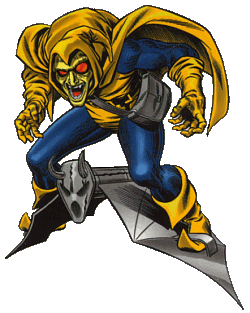
The Prolonged, Tortuous Saga of... The Hobgoblin!


"The Hobgoblin storyline is one of the bigger messes in Marvel's history. It's not as bad, perhaps, as the Clone Saga. But it shows the worst of what can happen when a mystery is passed from one creative team to another with each deciding to change things to suit there own whims. You can't do that with a mystery that's been running for four years. The clues and ideas that each team left end up having no relevance and so your revelations turn out to be out of the blue. And four years is just too long to sustain interest." - Excerpt from SuperMegaMonkey.net's entry on Amazing Spider-Man #289

Whatever your feelings about how the mystery of the Hobgoblin's true identity was handled, the consensus appears to be that the mystery simply went on too long, mostly for the reasons that SMM mentions. The character's creator, Roger Stern, has stated that he wanted to handle the Hobgoblin's identity in much the same way as the mystery of the Green Goblin's identity unfolded. To say that the situation veered wildly off that course is an understatement.

When all was said and done, the story of the Hobgoblin's identity would play out over a fourteen-year period and involve no less than six ASM editors (Tom DeFalco, Danny Fingeroth, Jim Owsley, Jim Salicrup, Glenn Greenberg, and Tom Brevoort), two Editors-in-Chief (Jim Shooter and Bob Harras), and five writers (Stern, Tom DeFalco, Jim Owsley, Peter David, and Jo Duffy), and take place in the midst of considerable upheaval behind the scenes and more than a few bruised feelings in the Marvel offices that coincided with all the shuffling of talent.

Reading the storyline when these issues were originally published, I was probably as curious as anyone about the answer to the mystery--though if we're to believe the letters pages that presented feedback from what appeared to be countless readers who were eager to offer their own guesses as to who the Hobgoblin really was, my interest was only a fraction of those who were seemingly waiting with bated breath for the big reveal.

Yet the departure of Stern from the title, after writing only three stories featuring the character, would derail that train for all of us, as well as shatter whatever consistency and intentions he might have had for how the plot would be resolved. Personally, I found the Hobgoblin an interesting character in his own right, with his anonymity perhaps playing a part in that appeal; but the issue of his identity became the character's major focus, and eventually it all spiraled out of control and resulted in a denouement that felt both rushed and anti-climactic.

Rather than go into lengthy detail on the subject, consider this post to be the CliffsNotes version of this zig-zag subplot, as the PPC takes a stab at covering this period of Amazing Spider-Man that hopefully breaks it down for you in a way that makes it both fun and informative. The information will be confined to events occurring in ASM rather than including any Hobgoblin appearances in either Spectacular Spider-Man or Web of Spider-Man, otherwise we'd be here all day; but we'll cover all the bases, though at the end we'll find that we've got a double header on our hands.