Showing posts with label Champions. Show all posts

Thursday, December 16, 2021

"The Doom That Went On Forever!"


The enigmatic and often hostile being known only as the Stranger has had run-ins or otherwise crossed paths with a number of notable and powerful Marvel characters and super-groups and, for the most part, had little difficulty dealing with them despite their laudable efforts to confront him. A few such instances which the PPC has featured include:

Almost always, these conflicts occur in the course of the Stranger conducting his own affairs--which also happens to be the case when he returns to Earth to deal with the threat of a null-life bomb he once introduced to destroy the human race but has since been re-armed and fallen into the hands of a thief whose girlfriend is being pursued by...

...well, gosh, we'll let Black Goliath give us the 411 on the situation:


The woman in question is Reggie Clayborne, who has absconded with the box her boyfriend Jerry made off with from Bill Foster's lab and headed to the H.Q. of the Champions to ask for their help. But as Foster has mentioned, they're all going to have bigger things to worry about, when the Stranger crashes this party!


Friday, May 22, 2020

Beware The Invasion of Warlord Kaa! (Or Not)


It's 1977, and The Champions, the brainchild of writer Tony Isabella which featured the new Los Angeles super-team of the Black Widow, the Ghost Rider, Hercules, the Angel, and the Iceman, appears to be having a rough time establishing a firm foundation for itself as well as a firm connection with its readers*. Launched in October of '75, its second issue took three months getting to the sales rack, leaving the impression that issue #1 was simply a "pilot" concept released into the sales arena to determine if it generated sufficient interest to merit being produced on a regular basis** (as was the case with a number of early '70s first issues). Once out of the gate, the book was assigned monthly status, which seemed a good sign of its reception; yet the honeymoon appeared to be over after four issues, when the book was quietly shifted to a bimonthly schedule.

*Who were unsparing in their criticisms in the book's first letters page. Curiously, the next letters page, featuring letters apparently collected from an altogether different mailbag, looked to be carefully cultivated to shower that first issue with laurels and words like "blockbuster," while drawing favorable comparisons with the achievements of Stan Lee, Jack Kirby, and Roy Thomas.

**Isabella instead blames a long process of selecting group members and selling Editor Len Wein on the idea: "...that task took nine months. When THE CHAMPIONS, then called GIANT-SIZE CHAMPIONS, finally got the go-ahead, it was already late. That's why there were three months between the premiere issue and the Champs' second outing." I'm not quite following the train of thought here. Isabella's reasoning would only explain why issue #1 would have taken awhile to make it to the sales rack, but not a three-month gap between that issue's publication and issue #2--i.e., once Wein had signed off and the first issue was produced and distributed, why would there have been any gap between issues from that point?

After the next  four issues were published (with two months passing between each), readers were likely surprised to see issue #9 arrive a month early, with #10 also taking just thirty days to see print--a decision which was finally hailed in #11, while making mention of some character reshuffling in the process:


It was a sensible decision to dump Fenster and Bale (the Champions' P.R. representative and lawyer, respectively)--arguably the team's ball and chain, who gave us the sense that the Champions couldn't make a move without their input. (By comparison, think of how Henry Gyrich's directives weighed down the Avengers.) Unfortunately, the announcement of the book's renewed monthly status was ill-timed: with the publication of issue #12, The Champions was returned to bi-monthly publication, where it remained until its cancellation five issues later.

And if it seems like this book is in freefall, think how Black Goliath feels at joining them on the way down!


Monday, May 11, 2020

Mission: Seize The Black Widow!


One of the uncertainties that's proven to be problematic in establishing a comics series which features a new super-group is whether or not the chemistry among the members of that group--and certainly the chemistry between the group and the book's readers--will catch on in time to garner regular interest in the series. It's a small window that doesn't remain open too long, and, looking back, there are a number of examples to point to where the concept being launched fell short of whatever expectations Marvel may have had going in. The original core membership of the Avengers, for instance, didn't really work in terms of a lineup that could sustain the book on their own, with the original lineup of the Defenders making their exit in even less time. The X-Men also struggled to find their niche, whether as "the most unusual teen-agers of all time," "the most mysterious fighting team of all time," "the most unusual fighting team of all time," or "the strangest teens of all"--while later adjusting their costumes and even their masthead to better catch the eye.

During the mid-1970s, then, when admittedly many new concepts were being conceived and launched without a great deal of forethought except to see which would catch fire with readers, and with The Defenders having settled into a relatively comfortable status with both Dr. Strange and the Hulk serving to anchor present and future lineup shifts, The Champions was arguably the most high-profile new book to come down the pipe, grouping together two original X-Men, two Avengers--and the Ghost Rider, a character who at first glance seemed incompatible with the format but whose solo series was doing fairly well and thus was perhaps seen as a draw.

And there's no denying he's an attention-getter, visually.


But despite a decent run of seventeen issues, the book folded in early 1978, with most of that run spent in bi-monthly publication. In the end, even its members were divided on their viability, with the group's leader at one point clearly feeling it was her responsibility to shore up team morale (in a flashback taking place thirty-two years after the book's cancellation):


Strangely enough, rather than any stories in the series, I tend to recall the book's plethora of writing and artistic troupers who pitched in to keep the book going. And since someone in charge must have surmised that the quality of the stories would have been the key to that, the switchover of writers was kept to a minimum, allowing for a measure of consistency between issues. That worked out to Tony Isabella and Bill Mantlo each taking several issues in sequence, switching off on occasion (with only Chris Claremont pinch-hitting for one issue).

Yet while both Isabella and Mantlo turned in good work, I would have to say that neither was willing to take a deep breath and slowly establish some sort of foundation for this group and its members in the minds of readers once the initial opening-with-a-bang crisis had passed. Instead, because of Warren Worthington coming into his family fortune, *poof* in no time we had a brand new state-of-the-art headquarters for the Champions (an entire building, no less); *poof* we had the "Champs-craft," a convertible sky-car, complete with the team logo on its hood; *poof* we had a butler in residence, and ... ::ahem:: sorry, I got carried away there, but you get the idea.* And seemingly for the sake of expediency, we also got a team leader in the Black Widow before you could say "this is only the second issue," during a lull in a crisis that allowed her to make a few sensible suggestions regarding their next step--even though leadership didn't appear to be a problem which needed to be addressed on the spur of the moment, with four of these five people being no strangers to working as part of a team and who had conferred fine with each other up to this point. Someone wanted this team established yesterday.

*Apparently in an effort to avoid the appearance of an instant team with "the works," the Champions eventually discovered they'd bought themselves a basket of lemons, with their building and all of its technology and craft having been constructed with defective materials--which would seem to validate a writer taking a more step-by-step approach and giving these people some breathing room. The Champions were already chaotic enough, getting a handle on their foes as well as doubting their purpose--it doesn't exactly help the situation by arranging for their HQ and gear to become all-too-symbolically unstable.

Artwise, we had several talents on pencils: Don Heck, George Tuska, Bob Hall, and John Byrne, with Byrne perhaps getting the lion's share of the limelight given that his work appeared in the series' last seven issues. On inks, however, it was quite a mix, with Mike Esposito, John Tartaglione, Vince Colletta, Bruce Patterson, Bob Layton, Frank Giacoia, and Byrne (inking Tuska!). But it's Hall we're singling out today, a former student of John Buscema's class on comics art who would develop quite a presence at Marvel and other comics companies in addition to becoming active in projects for the theater. Hall would later score a gig as regular artist of The Avengers; but in his first assignment for the company, a Champions tale that delves into the history of the Black Widow, he delivers impressive work while helping to bring the group to the national stage as a bona fide super-group.

Unfortunately for said group, their debut doesn't go as smoothly as planned.


Monday, October 8, 2018

A World For The Winning!


You would think that Doctor Doom and the master of magnetism, Magneto, would be like oil and water as far as finding any common ground in joining forces to rule the world, at least as far as their status circa the late 1970s. Magneto's agenda had always circled back to mutant ascendancy, where "homo superior" would be the planet's dominant species and ordinary humans would either submit to their authority or perish--whereas Doom seeks supremacy over all, an absolute ruler in every sense and brooking no challenge to his authority. Yet in the time he was the de facto standard bearer of Super-Villain Team-Up and still dabbling with forming alliances with like-minded men who could further his goals, there were still opportunities to explore situations where Doom might consider a partnership with another in order to consolidate their forces for mutual gain, if only for the short term--and it was probably inevitable that Magneto would find his way into those pages, sooner or later, if the right circumstances could be worked out and produce a credible plot.

At this point in time, Magneto has regained his full power after being restored to adulthood following his encounter with the mutant named Alpha and already had an initial confrontation with the X-Men on Muir Isle. Later (a little over a year, our time), he would have a more pivotal reckoning with the team; but in the interim, he's decided to get back in circulation by taking the shortest path to victory and having his first-ever meeting with Doom, in order to propose an alliance between them and bring the world to heel under their joint rule. The result is a two-part story written by Bill Mantlo which crosses over between two separate titles, beginning in SVTU and concluding in The Champions--a life-or-death struggle that would also draw in the Avengers and the incredible Hulk!


But what Magneto isn't aware of is that Doom has already captured the world--
and there isn't another soul on Earth who realizes it.

Thursday, November 20, 2014

Onward, To Val Halla!


Of all the parts of a comic book for one last set of eyes in the Marvel offices to scrutinize before it heads to the printer, you'd think it would be the first thing a buyer in the store is going to see--the cover itself. And given that so many hands are involved in creating, revising, and touching up that cover, it's even more astonishing when an "oops" slips through the cracks. Here's a brief and hopefully fun look at a few of those face-palm moments for editors who couldn't bolt to the phone and yell "Stop the presses!" in time.

The first thing you generally notice in a look at cover trip-ups is that, the more captions that are splattered on a cover, the greater the chance that something is going to be too hastily jotted down. Let's take a look at a couple of Defenders covers, for example:


For the cover of issue #56, aside from the minor slip-up of Hellcat having a hyphen added to her name (maybe she idolizes Ann-Margret?), there's a chance that people would be taking a second look at their radios and wondering if "radio activity," like storm activity or solar flare activity, was now a cause for concern. If you noticed a decrease in the number of kids dancing to tunes from their pocket radios, you can probably point the finger of blame at the Defenders.

As for issue #67, no wonder the Defenders seem to be racing toward outer space--it's as good a place as any to start looking for "Val Halla."

This cover to Captain America had me a little perplexed:


For some reason, I kept wanting to continue Cap's thought: "Falcon! Stop! You'll kill him! And if you do--! The crime wave breaks!" And I'd think: "Gee, it looks like Cap is more worried about the crime wave breaking than he is about the Viper being killed by Falc."

(I guess it was a moot point, since the Falcon doesn't seem to be in the mood to pay attention to Cap, one way or the other.)

On this Fantastic Four cover, Omega (not that Omega) is perhaps too busy tackling everyone in the Great Refuge to realize that he's leaving words out of his sentences:


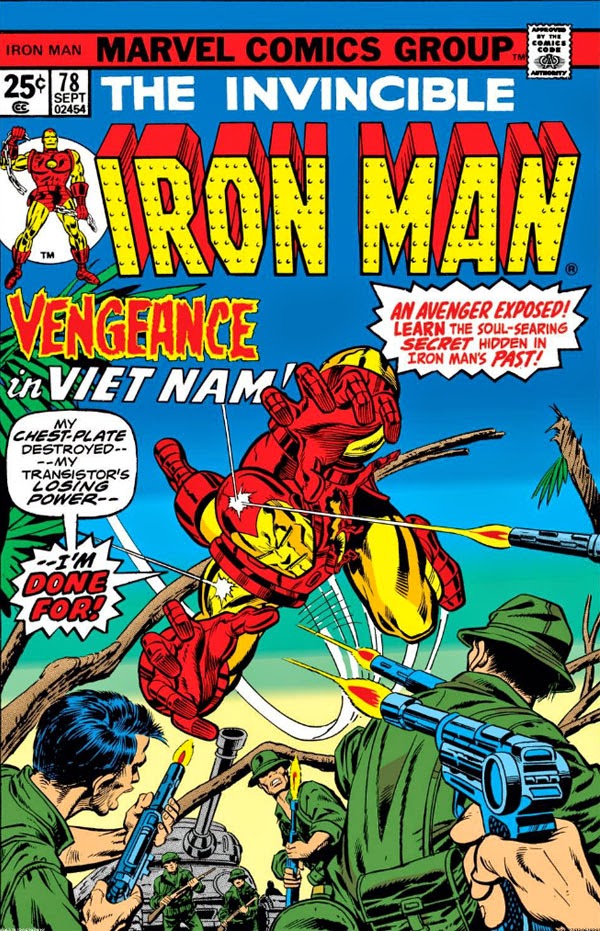
While I bet you didn't know that there was a time when Iron Man powered his armor with a single transistor:


Meanwhile, the Champions may have had a short run, but they had a few noteworthy moments. Yet two things they lacked were (1) chemistry and (2) a proofreader. For instance, how many sons of Zeus do you count on this cover?


On the bright side, "Hercules" appears to be much easier to spell than "Crimson Dynamo":


And after being grappled by Quasar, you can bet that Iron Man will never "interferr" with Dr. Kurarkill again:


(Though he's probably not about to make his attacker angrier by correcting him.)

Friday, November 14, 2014

It Was The Best Of Times, It Was The Worst Of Times


The mid-1970s super-group, the Champions, might have had "Most Likely To Disband" underneath their yearbook picture--but amidst their constant efforts to pull themselves together into a credible fighting team, they did have some camera-ready moments that would have made for a nice retrospective had they managed to go the distance. So, in the spirit of a glass half-full, here are some of the more memorable moments of a team that perhaps more than a few readers prefer to forget.

Think of it as a dusty photo album that has a few snapshots of a Los Angeles super-team that once tried to make its mark--something to casually flip through and then set aside as a curiosity.

Of course, these memories should start on an optimistic note:


You may have noticed that stage looks a little bare. Despite the glitz that the Angel is trying to paint the event with, the Champions are currently in disarray, with the Black Widow captured by enemies, another enemy blowing himself up in their headquarters, the Ghost Rider carting said bomber to the hospital, and Iceman consoling Ivan about the Widow. Not the best time to introduce yourselves to your prospective fans. And to make matters worse, the villains who are after them crash their media event:


In fact, when the Champions test-drive their new sky-car which turns out to be a clunker, you might say the scene is symbolic of where they're headed as a team, especially when you take into account the words of the Widow and Bill Foster:


This next scene would make a pretty good Champions poster, though ganging up on a loser like the Stilt-Man would probably make any green team seem like a well-oiled fighting machine:


(I guess this is the wrong time to mention that the Stilt-Man kicked their butts. And escaped.)


Speaking of which, can someone, anyone, make sense of what the Angel is yelling as he dives for the Stilt-Man?


"...power-dives a call"?? Good thing no one elected the Angel as the leader of the group--otherwise, they'd all be bumping into each other like the Marx Brothers.


I did like this light-hearted attempt to formulate a battle cry:


And there were occasionally some nice "one for all and all for one" moments:


And you just knew that, with two mutants on the team, the Sentinels were bound to show up:


But, disband the group did, and our photo album is left a little bare of Champions memories.  Besides, I think I see you reaching for the FF album...

Friday, November 22, 2013

The Exodus of the Champions


When The Champions came to an end in January of 1978, cancelled after only 17 issues, it seemed appropriate that their final scene involved the Vanisher--because, given its last page that left us all hanging, vanishing is pretty much how this team blinked out of the Marvel universe:


And that's all she wrote for this very odd mixture of teammates. With the series ending, what indeed would they do now? In a note on the issue's letters page, Marvel seemed poised to put the final nail in the Champions' coffin:


However, instead of seeing through this build-up of anticipation, the final end of the Champions came swiftly, with the members of the team virtually swept out the door as fast as artist Sal Buscema could manage it. And instead of taking place in the pages of Avengers, the break-up happened in the unlikely pages of Peter Parker, the Spectacular Spider-Man--its own 17th issue, as it turned out, which was either wryly planned or one heck of a coincidence.

Just watch how, one by one, these "champions" toss in the towel and quickly abandon ship:


You tell 'em, Warren. But as for yourself--well, since you were in the process of selling the Champions building when Peter Parker arrived to photograph the team's breakup (albeit after the fact), you must have thought it through and decided the world doesn't need champions, at least not the fickle group you founded. Which is probably just as well. If your own building is falling apart around you, that's symbolism you probably should pay attention to.

I did like the style of the "C" logo, though.


Sunday, October 21, 2012

Champion to Champion


In their very first meeting, Iron Man and Hercules got into a fight that lasted all of 10 seconds:


Until Thor arrived to break it up, the killjoy.


But was there a time when these two went at it for real?

It all depends on how seriously you take the story.