Showing posts with label Tony Isabella. Show all posts

Thursday, May 25, 2023

Jack Kirby's Secret City Saga, 1993


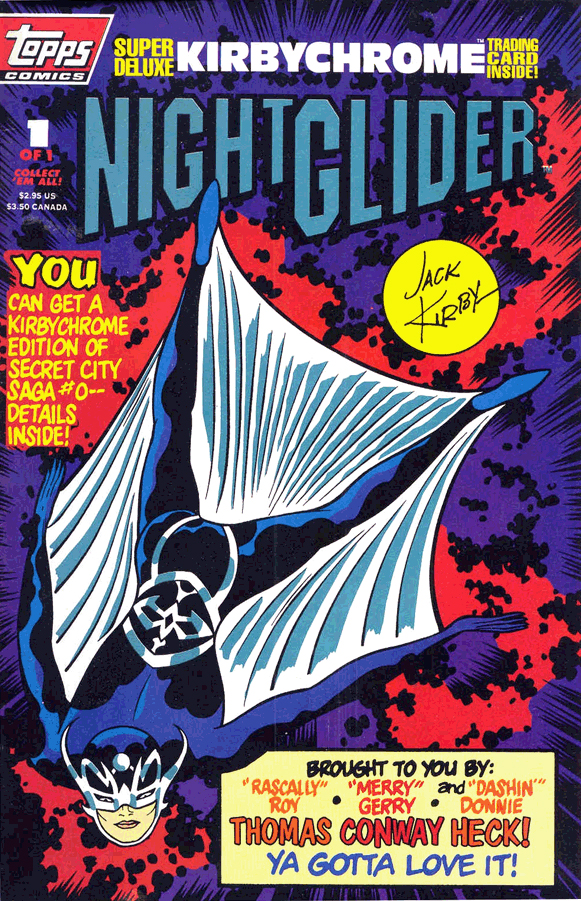
Though the subject of this post technically falls under the PPC's non-Marvel nods tag, it's hard to miss the telltale Marvel hallmarks on this comic book cover from industry newcomer Topps Comics:


Topps, a company founded in 1938, went on to become immensely profitable as a producer of sports-themed trading cards (primarily MLB) as well as other card collectibles (e.g., Star Wars, celebrities, films, etc.), in addition to chewing gum (Topps created the Bazooka comic-strip-in-the-package bubble gum introduced in 1947), candy, confectionery items, and, beginning in 1993, the Topps comic book division. It was here where the retired Jack Kirby licensed several designs and concepts he'd kept in his files which Topps came to collectively refer to as the "Kirbyverse," a series of eight titles published in April of 1993 which would culminate in Kirby's "Secret City Saga"--NightGlider being one of them.

As we can see, a sales pitch that would be right at home on a Marvel cover is in full swing for this issue, even featuring the familiar pet names of its creative team of Roy Thomas, Gerry Conway, and Don Heck. Also now at Topps is former Marvel editor Jim Salicrup, who joined their comics division after departing Marvel in 1992 to become its Editor-In-Chief. Thomas, who had left Marvel in 1980, returned to the company in 1986 but was no longer exclusive, spreading his talent with work for DC and indie publishers (which included several titles for Topps Comics), while Gerry Conway's first and only work for the company would be the NightGlider title.

As for the character, we meet the young woman named (do I have to say it?) Glida as she awakens underneath the city of Chicago, 15,000 years from when she was placed into her slumber (which would have been approximately 13,000 BC).


Thursday, September 1, 2022

IT Lives!


It!, the 1973-74 short-lived feature by Tony Isabella from Astonishing Tales, wasn't exactly the first to break ground in a Marvel story as a character named by that particular pronoun:


But while characters with pronouns for names have met with some success over the years, it wasn't long before the '70s It! found its masthead joined by the more descriptive wording, "the Living Colossus." And that's understandable, since you'd presumably want your cover character to deliver more punch on the sales stand with wording that conveyed more than the shock value of the unknown.

For our purposes, however, and to avoid confusion in just about every sentence constructed with the word "it," we'll refer to this 100-foot-tall creature by the more striking noun that was applied to it with its first appearance in 1961, as we examine just how much mileage it's unexpectedly received as a character whose purpose was to be either a gigantic threat or, oddly enough, a literally larger than life hero.


Wednesday, April 15, 2020

1001 Assassins!


I must admit to having little knowledge of or exposure to the French combat sport known as savate, where one who engages in it uses both their hands and feet against their opponent in a combination of kicking techniques and boxing. Our western equivalent would seem to be the sport of kickboxing, though savate involves the use of shoes in sparring. (Beats me why kickboxers wear boxing gloves, since their bare feet are capable of inflicting the injury that gloves are designed to at least buffer; the "boxing shoes" that savate fighters wear also appear to provide a measure of protection for the bones in the foot.)

In comics, the poster character for the art of savate would of course be the French mercenary named Batroc, who's often met Captain America in battle but has also crossed paths with Danny Rand, the nimble and well-trained Iron Fist, whose fighting style is much different from Cap's and places a greater emphasis on martial arts. Batroc often puts up a good fight against Cap but seldom prevails despite his bluster and enthusiasm; but while Iron Fist would appear to have a greater repertoire of striking techniques than Batroc, combined with his own talent for placing kicks, I couldn't tell you which fighter would come out on top in a hand-to-hand match (though admittedly I'd have to have good reason for putting my money on Batroc).

One issue I thought might provide the answer would be their first meeting in Marvel Premiere, a title where Iron Fist got his start and kept a lock on for a little over a year. And given my curiosity on the matter, the cover seemed to have me in mind in making its pitch.


Wednesday, February 6, 2019

"Crisis On Counter-Earth!"


Having recently seen how it all started for the "man-god" named Warlock, let's jump ahead to the series that came about as a result of that promising beginning: The Power of... Warlock, given the green light after only two appearances in the pages of Marvel Premiere, with its first issue hitting the stands in August of 1972. Published on a bi-monthly basis, the book reunited Warlock's creative team of Roy Thomas and Gil Kane, with Tom Sutton replacing Dan Adkins on inks--though Thomas, as was his custom during his spree of creating new '70s titles, almost immediately handed off the reins to another writer--in this case, Mike Friedrich.

During its time, the book struggled creatively as well as commercially, with artist Bob Brown replacing Kane who had departed after five issues, while the returning Thomas and science fiction writer Ron Goulart would alternate with Friedrich. But by its eighth issue, or likely even sooner, the writing was on the wall--as well as in one of those dreaded announcement boxes that unfortunately appeared in a few of those '70s books that were cranked out and thrown to the wolves:

"At the possibly most climactic point in Adam Warlock's brief career, the vise of economics has gotten us in its squeeze! This issue, regretably [sic], is the final one for the golden gladiator under his own title.

"Frankly, we don't know quite what went wrong. We believe we've presented you a succession of well-written, well-drawn stories, full of the exciting action we all read comics for, yet with a gentle prodding of the mind as well. But in any case, the newsstands report that not enough of you bought our adventures to make it profitable to continue. If anything should report in that would change this disappointing picture, we promise to begin anew at the drop of a soul-jewel."


Writer/artist Jim Starlin would give the character his own "Marvel premiere" nearly a year and half later with a four-issue try-out in Strange Tales that ran bi-monthly from February-August in 1975, which led to launching Warlock once more in his former series and simply picking up the book's numbering where it left off. (Smack dab in the middle of a new, unrelated storyline, no less. Hopefully new readers of the character who were collecting back issues of The Power of... Warlock were able to follow the paper trail!)

But what to do in the interim?

A few irons were left in the fire before the 1972-73 series folded. But only two are of importance to bring forward: First, the status of the High Evolutionary, who is still keeping tabs on Warlock's progress to bring peace to the inhabitants of Counter-Earth:


And secondly, the resolution of Warlock's confrontation of his primary antagonist--the Man-Beast, who has set out to avenge himself against the High Evolutionary by destroying Warlock and all he wished to accomplish on this world that the Evolutionary had such high hopes for. The fortunes of the Man-Beast have definitely improved in the course of his machinations, which include taking possession of U.S. President Rex Carpenter and thus gaining for himself and his minions the power to alter the course of events throughout the entire world--as Warlock discovers when the deception is revealed in the last issue's final panel.


To tie up the loose ends and resolve not only the fate of Warlock but also that of Counter-Earth itself, on the brink of possible global nuclear war, the story was brought over to the pages of Incredible Hulk in mid-1974, which sees the Hulk once again finding himself on this duplicate of Earth on the far side of the sun--only this time, he'll come face to face with Warlock, who seems fated to meet his end on this world he swore to save.


But we know that Mr. Starlin's project didn't feature a corpse--so what really happened?

Wednesday, September 12, 2018

Trouble Times Two!


Following Steve Englehart's departure from Incredible Hulk, there was a small circle of writers in 1974 who pitched in for the nine issues published before Len Wein would begin his extended run: Chris Claremont, Gerry Conway, Roy Thomas... and Tony Isabella, whose list of comics assignments in the '70s is like taking a tour through the plethora of new titles which Marvel was churning out during the early part of that decade in the hopes that a few would catch on with readers. By the time of his work on Hulk, Isabella had been with the company for about two years, originally hired to manage the reprints used in the company's new UK comics line and then floating as writer among a number of titles through the '70s and into the '80s.

Isabella contributed to two of these nine issues--in one, sharing the credits with both Thomas and Conway, while the other was his own baby, a tale six issues earlier which featured the apparent teaming of two of Marvel's mightiest powerhouses.


Col. Armbruster, sir--you said a mouthful.

Tuesday, September 5, 2017

Power vs. Power!


Following issue #16 of Luke Cage, Hero for Hire, the title character was crumpling his copy of "The Daily Bugle" and venting his frustrations while wondering how he could latch onto his share of the press that all of the other comic book titles heroes in New York City were benefiting from. Welllll, just a thought, Mr. Cage, but could your fellow heroes be enjoying public acclaim because they don't list their services in the Yellow Pages? Incredibly, that thought doesn't even cross your mind, as you go down the list of ways you could change your image.


Finally, it's during a battle with a foe who had manipulated you into battling Iron Man when inspiration strikes:


Ordinarily, the name that Cage has stumbled on might do the trick. "Power Man" is certainly news-ready, and is bound to elicit more favorable attention than someone who fights the good fight as a hero for hire. Unfortunately, there's already someone who was given the name (by a goddess, no less) that Cage wants to claim for his own--someone whose criminal career has hit the skids and isn't about to let his name be usurped by a johnny-come-lately who wants to use it to build his rep.

In other words, get ready to rumble, Cage!


(By the way, have fun explaining to the press why you chose a villain's name as your new handle!)

Tuesday, May 10, 2016

The Shocking Story You (Never) Demanded!


OR: "Oh, Snap!"


It looks like Captain America has a major mystery to solve. Aiming to throw the U.S. economy into chaos, the infamous Red Skull is assassinating members of the Federal Open Market Committee, the group which formulates American economic policy, with the first use of his crimson (and, needless to say, fatal) "dust of death" which leaves its victim's face as a ghoulish facsimile of the Skull's own. He's even boldly announced his next victim's name to Cap and the Falcon, giving them adequate time to take precautions and see to the man's protection.

But as Cap recalls after the fact, they failed--and another man dies.


The question remains, as Cap points out: How did the Skull commit this murder?


The mystery is finally solved when Cap and the Falcon have at last closed in on the Skull, with escape appearing to be unattainable for the fiend this time. Cap is understandably exalted at the prospect of ending the threat of the Red Skull, once and for all; unfortunately, the rug is about to be pulled out from under him, as the murderer of the committee member is shockingly revealed to be not the Skull, but someone who would normally be completely above suspicion.


It appears the Falcon isn't who we think he is. And it looks like he never was.

Wednesday, March 27, 2013

One Life To Give


Considering how its predecessor tale in "real life" left the matter so unresolved, it's only natural to assume that the What If? story that served as an unofficial follow-up to Gwen Stacy's death would deal head-on with the circumstances of her plunge from the George Washington Bridge. After all, it would have to, if she actually takes that plunge as before:


But this recap only adds a small amount of revision to what's gone before. In the earlier story, the Goblin maintains that the shock of the fall itself is what killed Gwen, even before Spider-Man's webbing reached her. And as we see here, writer Tony Isabella sticks with that general assumption--but also seems to imply that Spidey's webbing played a part, given the panel's image and the timing of its narrative. As a result, once again the issue is left as up in the air as Gwen herself. You and I, with perfectly good eyes, can see that there is no "shock of the fall" in play here--Gwen is unconscious, unable to experience any shock whatsoever. The shock of the halt to that fall is another matter, but it's apparent that Isabella is reluctant to tread on the ground that Gerry Conway, writer of the original story, has established.

Yet if you can get past that minor frustration that remains niggling to this day, What If? #24 is a very good story by Isabella, who has a great feel for what's gone before and writes Peter Parker and his supporting characters as if he were the book's regular scripter during the time these events originally took place.