Showing posts with label Roy Thomas. Show all posts

Monday, July 24, 2023

The Alternate Fantastic Four


Slipping by the PPC's roundup of other incarnations of the Fantastic Four was a late-1977 story by writer Roy Thomas which started the ball rolling after an earlier tale from 1972 successfully piqued reader interest on the subject. This time, the Watcher steps in for Lockjaw and guides us through the events of an alternate world in which Reed Richards, Ben Grimm, Johnny Storm, and Sue Storm returned from a disastrous flight into space and experienced different transformations than the members of our own famous quartet.


The appearance in this story of the FF we know is limited to the (appropriately enough) opening four pages of the issue (if you're not counting the slightly misleading cover which offers the impression that the two groups somehow come into conflict). Once the introduction has run its course, Thomas has made it clear he intends to further cement the premise he began exploring when he was scripting the main title, which floated the probability possibility that the FF's individual powers were the result of their personality traits*--even roping in the Watcher to validate what at this point is now formalized as canon rather than supposition.


*How we could possibly apply this theory to the powers of the Red Ghost and his three super-apes, all of whom underwent the same cosmic ray exposure which created the FF, is a fair point to raise. Kragoff himself, for instance, gains the ability to become "unsolid," while the baboon of the trio of apes becomes a shape-shifter and the orangutan gains magnetic abilities.

Which begs the question as to how the four individuals from an alternate Earth take on powers and forms so radically different from their counterparts.


Curiously enough, this world's "Fantastic Four" have somehow managed to successfully establish their heroic reputation in the public eye as a group of three, given that their fourth member, "Big Brain," cannot operate in the field for obvious reasons and instead appears content to remain within the confines of the Baxter Building. (His counterpart in the Fantastic Five from 1999 was obliged to find a way around the problem.) But when the three foil a museum robbery attempt, their fourth member cannot escape the scrutiny of the one who set that plan in motion.


Thursday, May 25, 2023

Jack Kirby's Secret City Saga, 1993


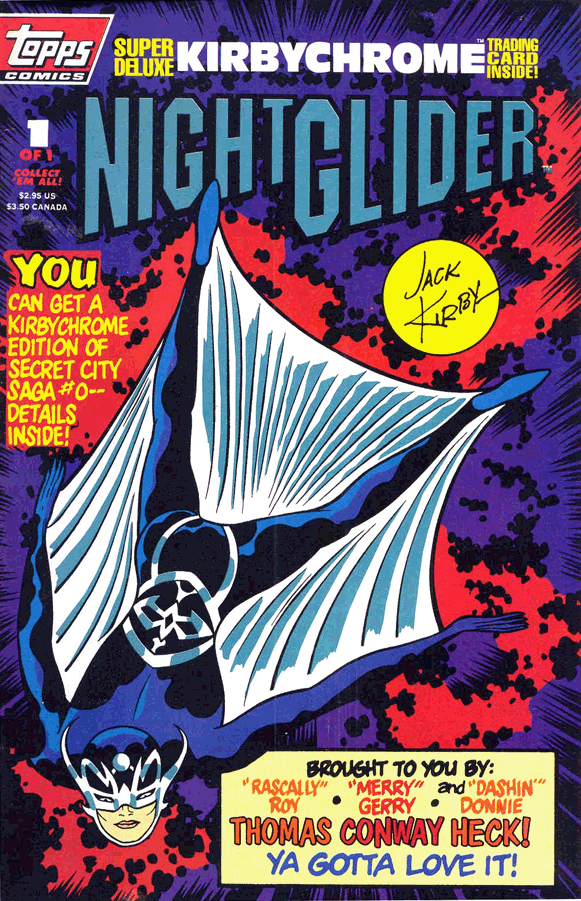
Though the subject of this post technically falls under the PPC's non-Marvel nods tag, it's hard to miss the telltale Marvel hallmarks on this comic book cover from industry newcomer Topps Comics:


Topps, a company founded in 1938, went on to become immensely profitable as a producer of sports-themed trading cards (primarily MLB) as well as other card collectibles (e.g., Star Wars, celebrities, films, etc.), in addition to chewing gum (Topps created the Bazooka comic-strip-in-the-package bubble gum introduced in 1947), candy, confectionery items, and, beginning in 1993, the Topps comic book division. It was here where the retired Jack Kirby licensed several designs and concepts he'd kept in his files which Topps came to collectively refer to as the "Kirbyverse," a series of eight titles published in April of 1993 which would culminate in Kirby's "Secret City Saga"--NightGlider being one of them.

As we can see, a sales pitch that would be right at home on a Marvel cover is in full swing for this issue, even featuring the familiar pet names of its creative team of Roy Thomas, Gerry Conway, and Don Heck. Also now at Topps is former Marvel editor Jim Salicrup, who joined their comics division after departing Marvel in 1992 to become its Editor-In-Chief. Thomas, who had left Marvel in 1980, returned to the company in 1986 but was no longer exclusive, spreading his talent with work for DC and indie publishers (which included several titles for Topps Comics), while Gerry Conway's first and only work for the company would be the NightGlider title.

As for the character, we meet the young woman named (do I have to say it?) Glida as she awakens underneath the city of Chicago, 15,000 years from when she was placed into her slumber (which would have been approximately 13,000 BC).


Monday, May 15, 2023

Heroines, Abandoned!


Wow! It's been 7½ years since we looked in on these ladies:


Launched in late 1972 to coincide with the women's liberation movement, widow Greer Grant, former animal specialist Shanna O'Hara, and nurses Linda Carter, Georgia Jenkins, and Christine Palmer hit the comic book spinner rack starring in, respectively, The Claws of the Cat, Shanna the She-Devil, and Night Nurse--and to further entice female comics readers, all were staffed at least in part with female creative talent.

Immediately assigned to bimonthly publication, however, all three books had only a brief run of 4-5 issues, their final covers pictured above. But how did they fare in quality and interest? Did these titles show any promise? And did they end on a high note, or simply run out of steam? Let's look back some fifty years to those issues for the answers.

Thursday, May 4, 2023

"Nightmare on Bald Mountain!"


OR: "Invasion Of The Body Snatcher!"


Three months after the successful premiere of the Defenders in the pages of Marvel Feature, writer Roy Thomas and artist Ross Andru seek to reunite the team-that-is-not-a-team in order to face another threat to the entire planet, and beyond--a crisis that, at first glance, may be facilitated by the presence of none other than the Master of the Mystic Arts himself!


In light of the date on the calendar that indicates the approaching celebration of All-Hallows' Eve, Thomas would again make use of the backdrop of the rural town of Rutland, Vermont and its annual celebration of that date. Rutland, as it turns out, also happens to be overshadowed by Bald Mountain, where even now devotees of the dread Dormammu attempt once more a ritual meant to bridge the gulf between Earth and the Dark Dimension--an attempt which, to our surprise, meets with success, as we find that Dormammu and his earthly minions have made arrangements to see a carefully-laid plan through to fruition.


It's quite a compelling prelude we're presented with--and with inker Sal Buscema on board this time, thus far Andru's work has never looked better. As for our would-be hooded intruders who are about to pounce, obviously this 1972 story took place in the days when Dr. Strange had no formidable defenses surrounding his sanctum sanctorum on which to rely, nor any sorcerous means by which he would be made aware of those lurking on his roof. And given what's happening at Bald Mountain, this night he is a man preoccupied--for through his mystic orb, he sees signs of what we have seen, a threat which has already made arrangements to deal with him.


The off-panel voice which interrupts Strange's musings belongs to the astral form of his mentor, the Ancient One, whom he joins in similar fashion to take counsel with in the sky above, or so he thinks. Unfortunately, this is also a time in the past where his body is left completely vulnerable even in his sanctum should the occasion arise where he was obliged to free his astral form for whatever reason--and our robed cultists are swift to take advantage of their ruse in distracting Strange with a false summons, securing his vacant body with a spell which prevents his spirit from rejoining it before dealing brutally with his manservant, Wong, and escaping with their prize.


Fortunately, in her desperation, Clea unknowingly has sent images via the Orb of the one she cares most for to those two who were most recently in Strange's thoughts--and so, it seems, the Defenders will fight again. But even as the Sub-Mariner and the Hulk make their way to New York, Strange's captors arrive with him at a lodge at the foot of Bald Mountain, where the intricate plan of Dormammu--and its linchpin, Dr. Strange--is at last revealed.


Yikes! Can even town crier Roy Thomas prevent Rutland--not to mention all of Vermont--from biting the dust this time?

Monday, March 6, 2023

In The Night Comes... Nighthawk!


The story of Nighthawk--erstwhile member of the Squadron Sinister and, later, would join the dynamic Defenders--really begins at the point when he's conscripted to take part in a deadly game of life and death engaged between the alien Grandmaster and Kang the Conqueror which would decide the fate of the Earth. It was the Grandmaster who formed the Squadron to serve as his own "players" who would individually face Kang's chosen team of Avengers in battle--and while the latter team fought for the survival of their world, Nighthawk and his partners had more self-serving ends in mind.


As we'll learn, the Grandmaster had a direct hand in bringing Kyle Richmond's identity as Nighthawk to life--and while it may seem odd that the Grandmaster would bother with providing Nighthawk's mode of transportation, it appears to be the key to Nighthawk proving victorious against his opponent, despite what we may have assumed in regard to victory being achieved by the defeat of the player.


We'd have to look at the fine print of this game's terms to be certain, but here it seems that Nighthawk would win his match against Cap if his plan to destroy the Statue of Liberty had succeeded, rather than defeating Cap personally; otherwise, the Grandmaster would have declared Nighthawk the winner when Cap was caught by the villain's rope and slammed into unconsciousness against the statue's stone base. Regardless, since Cap came out on top by defeating both plan and opponent, the point is rendered moot.

In the end, the Grandmaster would ultimately be the losing party in the game and depart, leaving the members of the Squadron Sinister free to chart their own course. Hyperion's fate at the hands of Thor would be more problematic in that regard; and while we were left to assume that the Whizzer and Dr. Spectrum would have been turned over to the authorities, that doesn't seem to have been the case for Nighthawk*, who turns up roughly four months later to use his criminal talents to con his way into Daredevil's territory.


Thursday, February 23, 2023

"A Monster Called... Morbius!"


On the heels of the 100th issue of Amazing Spider-Man came the introduction of Morbius, the "Living Vampire" who became one of the living dead through scientific means, rather than through sorcery or as a victim of a vampire's attack. (Though if you think about it, "living vampire" and "living dead" are synonymous with each other, no?) It could also be said that Morbius, technically a vampire but not exactly the real thing, came on the heels of revisions to the Comics Code Authority being made during 1971 that eventually eased the restrictions regarding vampires, though such restrictions would have likely proven inapplicable to Morbius given the circumstances of his origin.


As for why we aren't seeing Dracula or some other traditional vampire appear on the issue's cover rather than Morbius, we have Stan Lee to thank for mentioning his preference to writer Roy Thomas* for this new Spider-Man villain to be costumed, with Thomas getting around a scientist having such garish attire by having the costume be worn "as secondary insulation against the shock" of the experiment meant to electrically create replacement blood cells in order to save his life. (Baloney. Why outfit such a suit with a red cape, or any cape?)

*This would be the first ASM issue that Lee had not scripted, though Thomas is only "standing in" for the time being, as the credits indicate. Lee would return with issue #105, before handing the reins to the book's new regular writer Gerry Conway with issue #111.

Still, it's an impressive new character that faces an equally-startling new version of Spider-Man. As for those extra arms that Spider-Man is sporting, what gives? It just so happens that Peter Parker has been doing a little experimenting of his own.


Presumably this would make Spider-Man a mutant--or does that strictly apply to characters whose mutations resulted from radiation or atomic-based exposure? Wait... that would make the Hulk a mutant, wouldn't it?? Let's leave this tangled subject to others to wrestle with, while you and I take a look at "A Monster Called... Morbius!"

Thursday, February 9, 2023

Death(urge), and Rebirth!


As a companion piece to the PPC's recent profile on Quasar--the 1989 hero patterned after Bob Grayson, the early 1950s adventurer known as Marvel Boy--we now circle back to take a closer look at those on the seventh planet whose existence paved the way for both characters: the doomed inhabitants of the Uranus colony, who welcomed Prof. Matthew Grayson and his infant son following their desertion of Earth in 1934. It was Prof. Grayson who would later renege on his decision to leave Earth to the mercies of tyrants and warmongers, outfitting his son to undertake missions on the world of his birth in order to help man "see his way to peace and righteousness." Until Quasar began appearing in his own series, the Uranians served as little more than supportive backdrop for the Graysons, the mystery of their existence on Uranus seemingly dying with them when their story is resurrected in late 1975 by writer Roy Thomas*, who returns a vengeful Marvel Boy to Earth as the Crusader.


*The details of Prof. Grayson's backstory have been modified several times in retellings, which added a middle name for the character as well as a previous surname. Thomas has chosen to use "Horace" as Prof. Grayson's given name.

With Bob Grayson's wrist bands coming into the possession of Wendell Vaughn, who fell into depression following his resignation as head of security for Project Pegasus, his father sees an opportunity to alleviate that state by suggesting Wendell undertake a mission to Uranus in order to gather more information about the bands' operation and capabilities. It's a mission, however, where Quasar will also discover his destiny, as well as the truth behind the destruction of the Uranian colony.


Thursday, January 19, 2023

The Marvelous Wizard Of Oz!


I was literally nonexistent when "The Wizard Of Oz" premiered in 1939, but caught it in one of its many (and, at the time, annual) reruns on the small screen. Bowled over by the story (adapted from L. Frank Baum's book), and captivated by the production, it was through the film that I also went on to became an admirer of select members of its cast--notably, Judy Garland (as Dorothy) and Margaret Hamilton (as the Wicked Witch of the West); but I was also appreciative of the work of Ray Bolger (the Scarecrow), Bert Lahr (the Cowardly Lion, its adjective unfortunately but affectionately forever linked to the character's name), Jack Haley (the Tin Man), and of course Frank Morgan (the Wizard) and Billie Burke (the muddled Good Witch of the North). In addition, as a viewer of "The Beverly Hillbillies" I came to learn that it was Buddy Ebsen who had first been chosen as the Scarecrow and recast as the Tin Man, before finally having to drop out of the production after falling ill from the aluminum dust in his makeup. (Hamilton would have her own mishap courtesy of the effects crew.)

So it may sound strange that I didn't give "MGM's Marvelous Wizard of Oz" the time of day when it was released in Treasury Edition format in 1975. A neo-comics collector at the time, I suppose my first-glance impression of the publication was that, having seen the film several times, a strict adaptation of it wasn't going to bring anything new to the table for me, even as an "Authorized Edition" (i.e., with the permission of MGM) of it. Only now can I appreciate the creative talents involved in its production--as well as the distinction it holds as the first joint publication of DC and Marvel Comics, which at first I assumed was due to the presence of DC letterer Gaspar Saladino (aka Lisa Petergreg), who worked steadily at the company since the 1950s (though also a Marvel freelancer). Stan Lee's brief* Soapbox promo on the subject made it seem wholly a Marvel production--but writer Roy Thomas would later provide additional info on the matter that illuminates DC Publisher Carmine Infantino's own efforts, as well as some other interesting tidbits.


*You might say the Oz entry could barely get a word in edgewise. During 1975, Lee unashamedly smothered his Soapbox space with incessant announcements of his "Origins of Marvel Comics" book, to say nothing of including review clippings for it as well as teasers for its sequel.

Having seen this issue now for the first time, I must say that it's a fine effort from all involved. Thomas (who was right about Buscema's recollection of the film being spot on) does his usual first-rate work; Buscema and his art team ("the Tribe," aka Tony DeZuniga's studio), along with colorist Glynis Wein, have produced roughly eighty pages of material here; and Saladino, as expected, doesn't disappoint. Since this issue stays tightly true to the film presentation (as opposed to, for instance, Marvel's adaptation of "Star Wars"), a detailed review would be both unnecessary and redundant, especially when so many of you are familiar with the MGM production (and if you're not, I'd like a word with you :) ) -- and so I'll simply be presenting key scenes and keeping my comments brief. It really has been a treat to bring this to you, and I'll be interested in your own memories of it.


Thursday, August 18, 2022

Favorite Scenes: The Avengers! (1965-1972)


With the Vision already having rated his own Favorite Scenes post, we turn our attention now to his long-time partners, the mighty Avengers, who have chalked up a few dramatic and memorable moments over the years and doubtless have many of you recalling your own.

For myself, this journey began with the original Avengers lineup, though not with any adventures they had; rather, I was struck most by the original team's exit, a development which brought more focus to their chemistry and internal deliberations than any crisis involving the Masters of Evil, the Sub-Mariner, the Lava Men, et al. Technically, the Avengers meetings began in their second issue in a rather austere meeting room with the founding members (sans Captain America, as yet) seated at a small table in an effort to get to know each other better; but when, a year and a half later (our time), that team disbanded, we can look back on that changing of the guard scene with a mixture of nostalgia and, of course, history being made.


Three years later, the ranks of the Avengers have been shuffled considerably, with two of the replacement members having departed, Giant-Man (as Goliath) and the Wasp returning to the fold, and the Black Panther filling the gap of Captain America's departure--some of those developments as well as others we'll see from this point on stemming from Roy Thomas, who became the series' regular writer at the end of 1966. As it happened, Thomas had just concluded his run on the X-Men title--and by the time of this classic meeting between the two groups of heroes, he was in the process of making his own distinctive history as a Marvel writer.


Monday, July 11, 2022

The Sorcerer, The Ally, and the Avengers!


Even as early as its Silver Age books, Marvel was discovering the value of story crossovers in regard to not only profit but also as a means to entice readers to pick up a title that they'd passed on or didn't know about. In addition, the practice may have also helped to light the match of the budding collectors of the day, well before the marketing insanity of multiple crossover "events" would make even collectors balk. The early days of crossovers also offered the likelihood that the same writer would be handling scripting for each of the issues, while art buffs benefited from the opportunity of either seeing the same artist pull double duty or a different artist's take on the other book's character(s). Some examples that may come to mind in that respect were the Daredevil/Fantastic Four crossover featuring Dr. Doom (with artists Gene Colan and Jack Kirby), the X-Men/Avengers story involving Magneto (both penciled by John Buscema), and the Avengers/Incredible Hulk tale (featuring the work of both Sal Buscema and Herb Trimpe) which introduced an intriguing new villain, Psyklop.

In 1968-69, Avengers scribe Roy Thomas was also handling the first solo series of Doctor/Dr. Strange (the good doctor's masthead title abbreviated at about the halfway point) and would feature two crossovers during its 15-issue run. Regrettably, the second crossover, depicting the threat of the Undying Ones, would occur posthumously following the book's cancellation, in issues of Sub-Mariner and Incredible Hulk--but the prior crossover would have its conclusion take place in a more high-profile title, as well as bring in a guest-star along with a threat drawn from no less than the realm of the gods.


Monday, May 30, 2022

The Doomed Life of Donald Blake


It was only when I began giving some thought to looking into the final appearance of Dr. Donald Blake in the 1966-96 Mighty Thor title that I came to realize the can of worms I was prying open. To fully understand the situation, let's look back to November of 1968, where Blake, plagued with doubts of his own identity, wonders aloud about whether or not he's truly real; and if so, if his transformation into the manifestation of Thor meant that there was another God of Thunder who is unaccounted for.


In answer, Odin appeared to Blake and explained that, in order to teach his prideful son Thor the lesson of humility, Thor was sent to Earth in the guise of a mortal man, bereft of any memory of himself as Thor and, upon arrival, believing himself instead to be a student at a medical college and introducing himself as "Donald Blake." ("The name sounded so right... so proper... I was strangely unaware that I had never known of it before!") Meanwhile, Odin placed Thor's hammer (in cane form) in a cave in Norway, where Blake would discover it when he had fully learned the lesson Odin wished to impart.

In reality, then, Blake had always been Thor, while it was Blake who was, as he posited, "a myth...a casual creation of all-wise Odin," an enchantment which remained in effect even after its original purpose had been fulfilled. And yet... the same scene today has disturbing undertones. As we would learn much later, what Blake didn't realize was that he was operating under a misconception, unaware that Odin was carrying out a plan within the plan he disclosed.

As we explore the whys and wherefores of this story, there are three things you should know going in:

  1. The Donald Blake who attended State College was no facade but, in actuality, the true, mortal-born Donald Blake.
  2. The Donald Blake pictured in the above scene was a creation not of Odin, but of Thor.
  3. Shortly after Thor reappeared and routed the Stone Men, the real Blake's life was abruptly ended by involuntary manslaughter at the hand of an Asgardian.

I'll give you a moment to collect yourself.

Monday, May 9, 2022

In Our Midst... Two Immortals!


After squaring off on Earth with two of Marvel's heaviest hitters--the mighty Thor in March of 1966 and, two months later, the Incredible Hulk--Hercules, the Prince of Power, apparently decided to ditch his self-appointed publicity agent and the world of mortals altogether and return to the spires of Olympus, where we find him sparring with Ares--not realizing that the Olympian war god has made an arrangement with the exiled Asgardian known as the Enchantress to seal not only the fate of Hercules but also that of the mighty Avengers.


It will become clear soon enough that the Enchantress has only enlisted the might of Hercules as a tool of revenge against the Avengers, a team of mortal heroes that she persists in maintaining a vendetta against. Though if she were privy to their current state of affairs, she might be delighted to see that their internal strife over a proposed new member could be doing some of her work for her.

(Gee, Cap--you really can't tell the difference between the voices of Pietro and Wanda?)


It's not particularly clear why writer Roy Thomas has Henry Pym, in his guise as Goliath, virtually (and verbally) beating his chest here, ready to take on any and all who might go up against him--while it's equally curious that it's the Black Widow's proposed membership that has set him off, considering he doesn't even have good reason to raise an objection. Concerning the latter point, mostly it seems Thomas's way of continuing to take advantage of the seed he planted in the previous issue, where the Widow was prepared to act against their foe, Ixar, in a way that no Avenger would consider:


We might also assume that Hawkeye's blowup at the membership meeting has something to do with the fact that, as the only Avenger to witness the scene, he realizes that disclosing the Widow's behavior would likely sink her chances of being granted membership.

Also interesting to note (though not a deal-breaker) is that, with their current six-member lineup here, the Avengers are at what both Captain America and the N.S.C. have generally considered to be the team's ideal number--something brought to light perhaps for the first time here in so many words, though not surprisingly it's a point that Hawkeye is quick to brush aside.


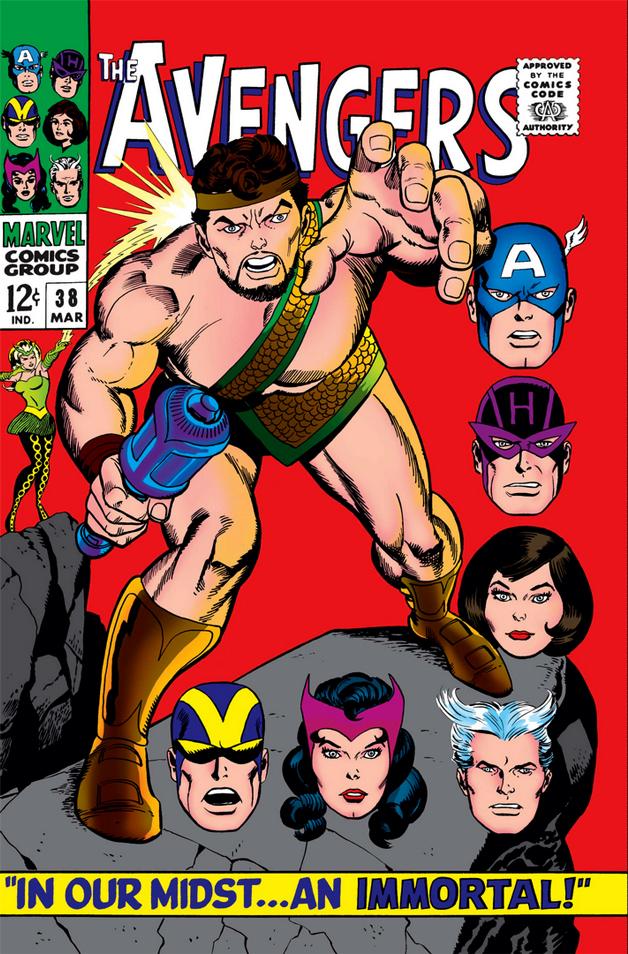
At any rate, the point is a moot one, since, unknown to the Avengers, S.H.I.E.L.D. has swooped in and recruited the Widow for a mission in the far east--a task which she can't discuss with the Avengers or even Hawkeye but gives the impression that she is returning to her roots as an enemy agent, which serves to remove her from consideration. And with Cap being called away to battle a threat from Power Man and the Swordsman (not to mention the Red Skull), and Hawkeye and the Wasp deciding to ditch the meeting in protest of Goliath (who's acting like "a stuffed shirt" on this issue as far as the Wasp is concerned) casually moving on with Avengers business as if nothing had happened, there arguably couldn't be a better time for the Enchantress to arrive with an ally who now resurfaces in the book's 38th issue from 1967--including prominent exposure on that issue's cover by Gil Kane, though a rare instance of the work of this artist perhaps falling short of expectations.


Thursday, March 3, 2022

Clip 'Em and Collect 'Em--Marvel Value Stamps!


In 1974, you may recall seeing the beginnings of a curious promotional concept popping up in the letters pages of Marvel's line of comics:


Thus began the push to "clip and collect" Series A of the new Marvel Value Stamps, consisting of numbered, recycled images of Marvel characters in postage stamp form. I imagine that people might have been hesitant to immediately begin clipping the first stamps which were spotted, since Marvel had yet made no announcement as to their purpose, much less why one might want to collect them; in addition, naturally you might have been reluctant to take a pair of scissors to the comics you'd just bought, particularly since in some cases you might have inadvertently clipped out part of that issue's story on the page's other side.

Nevertheless, the stamp of approval is given to yet another

Marvel Trivia Question


What were the benefits of clipping and collecting Marvel Value Stamps?

Monday, February 28, 2022

"The Monstrous Master Plan of the Mandarin!"


OR: "It's Every Avenger For Himself!"


It was probably about five years past its original publication date of September, 1967* that I purchased a copy of the first Avengers Annual--a bargain at 10¢ from a used book store and, surprisingly, no missing pages, though its cover was tattered having apparently been passed around a bit. In those days, I was still collecting comics solely for the reading experience rather than with any intent to preserve them, so I considered the store owner's pile of late '60s comics (yes, a literal pile where old comics were tossed) quite a find in my area. That copy has since been bagged and boarded, even in its near-dilapidated state--a reminder of more innocent times, with no thought given to seeking out a more presentable copy to shelve by its side.

*The Annual's story takes place at the time of issues 43-44 of the regular series.

Of course, that eye-catching cover by regular Avengers artist John Buscema--along with the cover of the book's second annual in '68--unfortunately carried the distinction of being an example of textbook bait-and-switch, with Buscema's cover art being used to sell the annual while artwork by former book artist Don Heck awaited the reader within. Yet considering that the annual took four years from the series' launch to appear on the stands, and given that it clocks in at a whopping forty-nine pages (not including a few pages of bonus material), its story by Heck and writer Roy Thomas, featuring a fiendish plot by the Mandarin that included a host of past Avengers villains, was likely well received (though your mileage may vary if you opened the issue at home and were looking forward to Buscema handling the story).

(Yikes! No wonder the Avengers are in danger--their foes have become giants! Not to worry, however--this first page of the issue proudly took its place among other symbolic splash pages the Avengers were featured in.)

It's indeed the return of the Mandarin that happens to involve Iron Man in this story, as he responds to the prison breakout of Arthur Parks, the Living Laser (who faced the Avengers in his debut toward the end of 1966). And when Iron Man discovers that Parks might be working with his old enemy, he has sufficient cause to alert the team that he took a leave of absence from over two years prior.


Meanwhile, we're given a peek at the cause of Parks' mysterious disappearance, which proves that the Mandarin is indeed still alive--and whatever he's planning now, it will involve several other super-powered hirelings, as well as a device which will bring him closer than ever to world conquest.


(No, I don't know why Parks, teleported in his prison uniform, arrives at the Mandarin's lair in costume--and an upgrade from his old outfit, at that. My short answer is that the Mandarin may have been averse to having anyone else around him wearing a cape, and arranged to have his teleportation device outfit Parks in transit.  Somehow.)

As for the Avengers, they're also contacted by Nick Fury, head of S.H.I.E.L.D., who requests their assistance with worldwide attacks that are out of SHIELD's jurisdiction as an American agency. (The "International Law Enforcement" part of his organization's acronym apparently having slipped his mind.)


The Mandarin doesn't look too worried, does he? He seems to be embracing the time-tested phrase "divide and conquer"--and before long, the Avengers will find themselves included in that adage.


Thursday, February 17, 2022

The Fantastic 3¾


Where YOU Weigh In on the Pros and Cons of a Character's New Attire

FEATURING:   
Ben Grimm, the Thing   

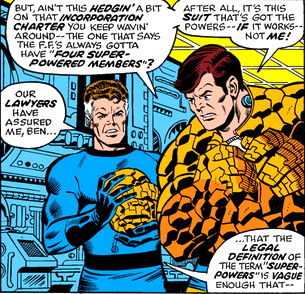
Technically, the orange-scaled contraption which Ben is extricating himself from here was referred to as an "exoskeleton," but I think most of us probably shorthanded it as simply "the Thing suit"--an invention of Reed Richards which allowed Ben to once more take his place on the Fantastic Four as the Thing after lengthy exposure to the Hulk's gamma radiation reverted him to his human form (a situation not without its degree of tension). It took some doing, but Ben got the hang of being in the Thing's "skin" in short order, with a little guidance from his best friend.


The Thing suit was the brainchild of writer Roy Thomas, and put through its paces for a period of eight issues during March-October of 1976 before being summarily kiboshed near the end of Thomas's run on the book. In that time, we learned that it could also double as a spacesuit, even holding up against a bruiser like the Destroyer (infused with the essence of Galactus, no less):


It also didn't depend upon its wearer's freedom of movement for its removal, which would come in handy on those occasions when restraints were used on the FF:


Oddly enough, the Thing suit was conspicuously absent from the Thing's other series at the time, Marvel Two-In-One, thanks to a timely Editor's note which stated the tales in question took place before FF #166 (the culmination of the FF's battle with the Hulk). The only exceptions were by necessity--specifically, Thomas's time travel crossover stories which began in the 1976 FF Annual, continued in the '76 MTIO Annual, and concluded in MTIO #20.


If memory serves, the only other cameo the suit makes in that time is during an Avengers story which centers on a new lineup for the team. By that time, Ben has apparently grown so comfortable with the suit that we even find him lounging in it.


But finally, during the FF's dealings with the High Evolutionary and Galactus on the world known as Counter-Earth, the writing is on the wall for this exoskeleton when the suited Thing is struck by Galactus--a blast which doesn't take its toll until later, causing the Thing suit to bite the dust.


Despite the evidence of our eyes, however, the suit is not as demolished as it appears. Thirteen years later, in the "Atlantis Attacks" crossover that plays out in sixteen annuals published in 1989, we learn in a story scripted by Thomas that the suit has simply been in storage all that time.


(With Thomas evidently not feeling like providing a more detailed explanation of its reappearance, we're left to presume that Reed took what was left of the suit and constructed a new one in his spare time.)

Writer/artist Walt Simonson also featured the suit during his run on the FF book:


As it turned out, the suit would receive quite a bit of mileage, going on to be seen in a number of other titles in addition to its FF appearances. With Ben regaining his normal status often enough to warrant pulling the suit out of mothballs, however, we might be able to conclude that Marvel had by that time decided to leave behind the so-called tragic aspect of the Thing--the one member of the FF who was trapped in a monstrous form and prevented forever from living a normal life. And if you were lamenting the loss of the genuine Thing and didn't care for the precedent of FF characters using artificial means to duplicate their powers, Thomas prefers to instead address the issue in a corporate sense:


So it's time to deliver your verdict on "the Thing suit"--
an invention that let Ben Grimm have his cake and eat it, too.

OR: ?