Showing posts with label Marv Wolfman. Show all posts

Monday, July 10, 2023

"The Curse Of Dracula!"


OR: "London Victims Are Falling Down"


Though there was a surprising lack of special annual issues for the Tomb Of Dracula series, even with over sixty issues to its credit, readers were able to turn to no less than five such efforts in the Giant-Size books which were hitting the stands in droves during the mid-1970s--beginning with Giant-Size Chillers, which, as was the case with the Fantastic Four and Spider-Man, would adjust its masthead to headline its principal character with succeeding issues.


Padded with reprinted material (which was often the case even with genuine annuals), the mid-1974 issue still featured a new 24-page story (officially numbering 32 when factoring in ad pages, a little sleight-of-hand which I never appreciated in the sales game) as well as an intriguing new character--Lilith, Dracula's estranged daughter, who has received generous exposure in the PPC (along with her hated father, it goes without saying). Produced by Marv Wolfman and Gene Colan, the same writer/artist team who headed the main book (currently at its 21st issue at this point in time), it would instead be inker Frank Chiaramonte's work we'll be seeing here rather than that of Tom Palmer, turning in splendid pages and meshing quite well with Colan's style.

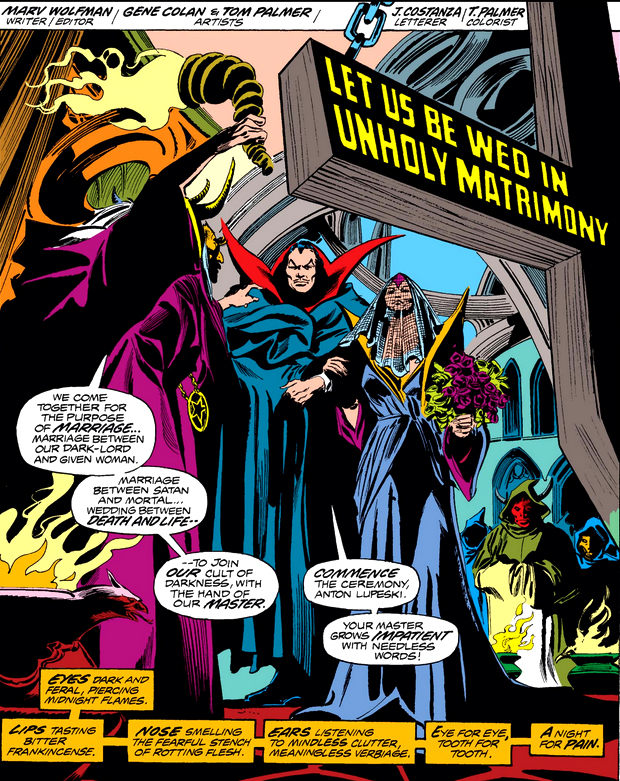
There are essentially two separate stories in play throughout the issue--but the stunning splash page we're greeted with (seen here to include its original published copy) leaves little doubt that the character who will take center stage is Dracula, who while having had dealings in London since his revival now moves to insert himself in the lives of those in government who are positioned to better help him safeguard his continued existence.


Monday, June 26, 2023

Two! Two! Two Annuals In One!


The year 1979 saw the character of Spider-Man at the height of his popularity, featured in three titles (Amazing Spider-Man, Marvel Team-Up, and Peter Parker, the Spectacular Spider-Man (while also having racked up his share of the Giant-Size books) with, unbelievably, even more on the way. It was fair to wonder at times what depths were being dredged to come up with all the new story material that required taking into account Peter's double life and revolving cast of characters (anyone here remember Marcy Kane?), to say nothing of the artists tapped to churn out story after story of the web-slinger's adventures along with the travails of the stretched-to-the-limit Peter Parker, who somehow, somehow, managed to combine his activities as Spider-Man with his college, Daily Bugle, and family responsibilities while squeezing in something of a social and/or love life and hopefully some sleep, all in a 24-hour period. The coordination between the writing and art staff must have been nothing short of a trapeze act.

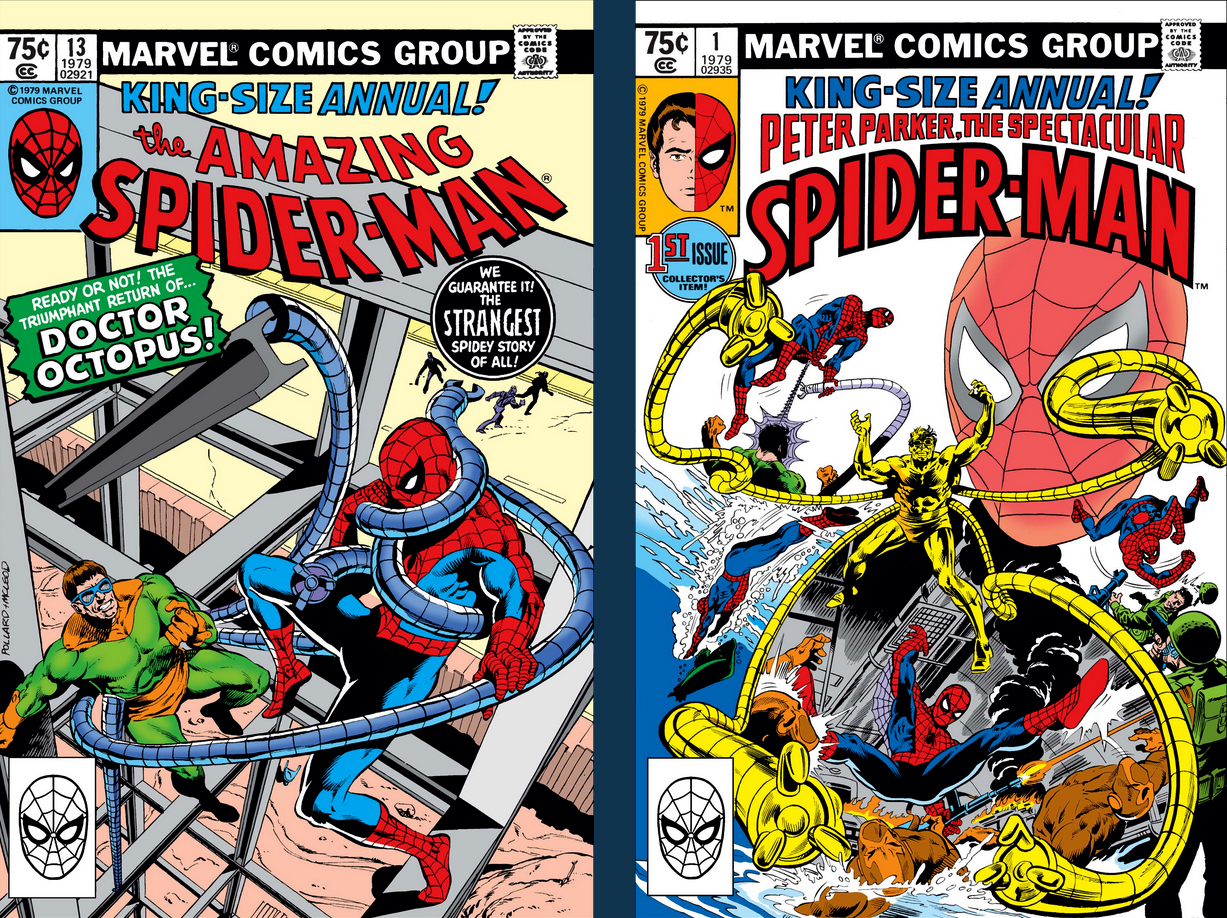
The one thing that Peter didn't have to worry about, of course, was a shortage of villains--with one of his deadliest pulling double duty in that year's Amazing/Spectacular annuals which shared the same plot, thanks to writers Marv Wolfman and Bill Mantlo teaming with artists John Byrne, Terry Austin, Rich Buckler and Jim Mooney. To help keep track of the events occurring in both and figure out where things are headed, the PPC ties these two annuals together in one post, as Spider-Man attempts to head off a scheme which could see Dr. Octopus launch his greatest and most ambitious plan--one that might well lead to a nuclear holocaust!

Monday, May 22, 2023

The Woman Who Unmasked Spider-Man


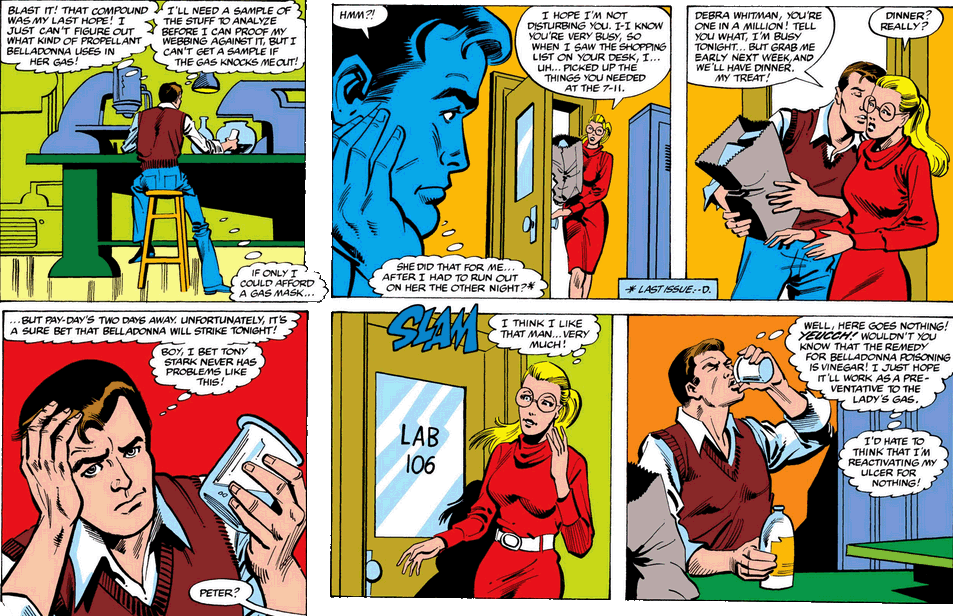
In the fall of 1979, as he was beginning a teaching assistant position in the office of Dr. Morris Sloan, Chairman of Empire State University's Biophysics Department, Peter Parker met and became friends with Dr. Sloan's secretary--a young woman who, in time, began to see Peter as more than a friend, feelings which she struggled to see reciprocated.


As they began to spend more time together, the situation became complicated--just as it was with Gwen Stacy and Mary Jane Watson--by Peter's responsibilities as Spider-Man, which all too often forced him to rush off from outings with this lady at a moment's notice, incidences which she couldn't help but take personally while Peter essentially treated those slights as something to be put on the back burner for the time being, if regretfully.


(And you've only seen the tip of this iceberg.)


We can debate the issue all day, and rightfully so, in regard to one person's hurt feelings weighed against what Peter accomplishes as Spider-Man in terms of a refusal to stand by while danger threatens innocent lives, while also factoring in the picture he presents to Sloan et al. as a slacker whose grades don't merit the efforts of those trying to help him. As for our distraught young lady, however, her storyline would continue without resolution for over three years before coming to a head in early 1983. Until then, however, readers were left to wonder: Just what did her writers have planned for her during this build-up? How long would she be presented as a casualty of unrequited love? Would these encounters between them come to constitute little more than a running joke?

A situation which has us running into yet another


Marvel Trivia Question


What was the story behind the strange saga of Debra Whitman?

Thursday, October 13, 2022

Torpedo, Away


If you weren't much of a Daredevil reader in the mid-1970s, you may mostly remember the adventurer known as the Torpedo from the farce three-part Defenders story occurring a few years later which featured a plethora of Marvel's characters showing up on the non-team's doorstep to join their ranks. It was no one's finest hour that day, much less the Torpedo's:


Created by writer Marv Wolfman and artist Bob Brown, the character's debut in the pages of Daredevil provides a generous two-issue appearance which from glances at their covers would lead us to at first believe there's a new, ruthless villain in town.


But "appearance" has always been part of the problem for me with this character, whose super-suit makes him, as intended, a human torpedo, a description that serves only to cement in the reader's mind that this character's main claim to fame is to streak through the air like a you-know-what--which in a way stacks him up right next to Nova (debuting the following year), who also failed to pique my interest. Maybe something more provocative for this character's name--e.g., as long as we're being direct in his description, "the Blue Streak," a handle another character would lay claim to a few years later.

The Torpedo's first time out of the gate, however, leads to his death when DD goes after him for theft. But the twist that Wolfman introduces for the character inadvertently becomes the only aspect of the Torpedo that I cared for: the fact that the man's corpse would yet serve a purpose for another to step in and adopt a sense of responsibility for what his predecessor set out to do.


Monday, November 8, 2021

The Doom That Awaits... Allandra!


It wasn't until February of 1977* that the first Dr. Strange annual would appear in stores. Such a delay may sound surprising, given the character's long-term success over the years--yet back in the day, his first series in 1968 fizzled, and he depended largely on being one of the headliners of The Defenders to become more established and consequently be given a second series in 1974. Even so, Doctor Strange went back and forth between monthly and bi-monthly publication, unable to sustain adequate sales to justify a monthly status--nor were the comings and goings of creative talent behind the scenes helping matters.

*The issue itself was publicized as the annual for 1976.

Things became equally unstable for Dr. Strange himself, whose status as Sorcerer Supreme had been stripped from him by his former teacher, the Ancient One--himself a victim of deception on the part of the Creators, a trio of sorcerers who were attempting to alter the cosmos to their will. It's during this time that we find Strange in his first annual, a port of calm in the storm of his regular mag in a story co-plotted and drawn by Craig Russell, where Strange's status as a mere Master of the Mystic Arts happens to fit in with the motivation of the story's villainess, Lectra--a sorceress who has her own deceit in play and the power to compel Strange's cooperation.


Thursday, September 23, 2021

This Way Toward... Doom!


Perhaps eyeing the success of the DC horror/fantasy anthology titles House Of Secrets and House Of Mystery, Marvel launched two similarly themed books in late 1969: Tower Of Shadows and, one month later, Chamber Of Darkness. Like their DC counterparts which were published on a bimonthly basis (off and on), both Tower and Chamber hit the stands every other month--but it seems the similarity ends there in terms of sales, as Marvel's offerings sold poorly and were discontinued after ten and eight issues, respectively. Tower, premiering first, seemed somewhat better received by readers, judging by letters page response, though the ratio of raves to more critical assessments appeared to be about 30/70. There was also the question of sustainability, as both series began pulling in reprinted material from their earlier anthology titles from the '50s-'60s (Strange Tales and Tales Of Suspense) with their sixth issue.

Suffice to say that DC's House titles were in no danger of readers jumping ship for Marvel's offerings--though it wasn't for lack of trying on Marvel's part, at least initially, as some of the company's most notable talent were tapped to contribute stories. Roy Thomas, Jack Kirby, Stan Lee, John Buscema, Gene Colan, Len Wein, Marv Wolfman, Jim Steranko, et al. (including John Romita Sr., who mostly did cover work) were seemingly able to accommodate seven-page assignments (or less) within a two-month window (though I believe Steranko withdrew after only one story, reportedly due to a disagreement with Lee)--with some artists even pulling double duty and contributing scripts as well as art, in addition to inkers providing readers with examples of their own pencils.

After their all-too-brief runs, each title shifted to formats made up of almost entirely reprinted material, in addition to adopting new mastheads. Tower became Creatures On The Loose, which mixed its reprints with sword and sorcery tales as well as a regular feature on Man-Wolf, while Chamber morphed to Monsters On The Prowl--each book having a run of 30 to 37 bimonthly issues (the creatures pulling ahead of the monsters--make of that what you will). But since there's a little more ground to cover with both Tower and Chamber, and having already examined Jack Kirby's stories in the latter, let's turn to a few samples from some of the other names we've mentioned who made their mark in the macabre during the brief time when these two titles were being published.


Thursday, April 8, 2021

The Face Of Vengeance


While Tomb Of Dracula often spent quality time on Dracula's obsessions of revenge or power--whether it was his conflicts with Quincy Harker and his group, or furthering his goal of world rule by vampires, or warring with Doctor Sun, or accumulating power through his Dark Church cult, or even his periodic and invariably disastrous meetings with his daughter, Lilith--writer Marv Wolfman would also pause at times and provide a change of pace with compelling diversions into mystery and the macabre for the lord of vampires, a number of which the PPC has had the pleasure of exploring. Some that come to mind may ring familiar:

Fact vs. Fiction - Angie Turner has drawn close to her a number of fictional characters to whom she has somehow given life, but oversteps herself when she seeks to draw Dracula into that circle.

Hell Hath No Fury... - A web of deceit and murder spun by fashion executive Daphne von Wilkinson, who strikes a bargain with Dracula to take revenge against the men who screwed her over (so to speak) to facilitate their own ambitions.

Journal Of Darkness - A compendium of instances where Dracula has paused to reflect on those times in his life which filled him with pride, or rage, or even regret.

In Death Do We Join! - In the Russian village of Kamenka, an abusive husband returns from the grave as a vampire to menace his wife, in spite of the commands of Dracula to fall in line.

Return From The Grave! - A corpse rises from the grave to reclaim his own--a mystery which draws the attention of Scotland Yard, and defies even Dracula.

More such tales are in the offing here, never (heh heh) fear--but one tale which surely falls into this category comes from mid-1976, when Dracula was establishing his power base in his satanic cult and makes preparations to take part in a ceremony where he will be joined with a wife. Yet the nuptials of the "Dark-Lord" will be overshadowed by a gruesome threat from a dead man--one who seeks revenge against those responsible for bringing his life to an untimely, acidic end!


Thursday, July 23, 2020

Demolished!


When you take into consideration the fact that the story of the character known as Deathlok--the cyborg assassin/military operative tracking his targets in a not-too-distant post-apocalyptic future--took place not in his own series, but as a mid-1970s feature in the Astonishing Tales title, you would have to consider him something of a success story at the time, having managed to establish a steady readership even on a bi-monthly publication schedule that would delay each story installment for an interminable sixty days. Reader loyalty appeared far from the mind of Editor Marv Wolfman, however, when the final Deathlok story hit the stands in 1976*, without warning or acknowledgment of its cessation--its cover giving every indication of continuation for the series.


*As it happened, the last issue also coincided with the end of the Astonishing Tales book itself.

Certainly not the first issue to end a publication run abruptly and leave a big question mark hanging over its place on the spinner rack as to the resolution of its current storyline. (Silver Surfer #18 being one such example that comes to mind.)

Yet Deathlok's sudden disappearance following his encounter with the mysterious individual called Godwulf would be followed up with several spotty appearances that would have him interacting with individuals and timelines which existed nearly a decade before his own dismal future--appearances taking place in three separate titles in a span of over six years, though given that length of time it perhaps comes as no surprise that there seemed to be no story plot in effect that would tie these instances together coherently. Still, thanks in part to the covers being produced for those appearances, it's to Deathlok's credit that his character was still capable of attracting reader interest.


In essence, each story would make use of Deathlok as both a deadly threat and a victim of the circumstances he'd found himself in, as seen through the eyes of the respective books' writers at the time: David Kraft, Marv Wolfman, Mark Gruenwald (with Ralph Macchio), and J.M. DeMatteis. It was DeMatteis who would finally break the cycle of Deathlok "guest-starring" in Marvel continuity and make an effort to resolve his situation in his own timeline--but stringing together his prior appearances in the past to get to that point would take some doing.

Monday, February 17, 2020

Howl Of The Werewolf! Rage Of The Vampire!


During 1944-45, Universal Pictures sated demand for the Wolfman, Dracula, and the Frankenstein monster by giving us The House of Frankenstein and, just a week short of one year later, House of Dracula, the only two films up to that point where all three horror figures appear together--though, astonishingly, never on screen in the same scene at the same time. That honor was reserved for the 1948 film Abbott and Costello Meet Frankenstein--and while it was only a momentary glimpse, one of my favorite still shots at least gives us an idea of how things might look had our three horror figures actually joined forces (if only against two hapless comedians).


Interestingly enough, if you take Bud Abbott and Lou Costello out of the mix, that film would have made for compelling viewing--well directed by Charles Barton, and excellent acting by Bela Lugosi and Lon Chaney Jr. (who both played it wonderfully straight despite the antics of Abbott and Costello).

In the comics world, these monsters of old would also meet on occasion, often with no love lost between them. We've seen such an example with a clash in 1973 between Dracula and the Frankenstein monster--and in the following year, a crossover story with double the fangs (and hopefully double the fun) would be presented featuring the very pairing of monsters which in the A&C film engaged in a battle that led to their mutual end. Neither of these fearsome characters is likely to perish here, with each having their own title--nevertheless, there will be enough bloodshed to go around.


Once again, artist Gene Colan delivers on a symbolic splash page, eh?

Monday, February 10, 2020

...At Death's Door!


In the last months of 1979, the Fantastic Four found themselves dealing with two major problems, both of them life-threatening--and to add to the list, they were traveling through space to seek out a being whose involvement could potentially make matters worse! We'll let the esteemed Reed Richards break it down for us:


Uh, that's aging ray, Elmer... er, Reed.

Reed speaks of the FF's efforts to save Xandar, a world under siege by the Skrulls, only to be captured and sentenced to death by use of a metabolic booster designed to accelerate their aging process. But with the Sphinx en route to destroy the Earth, they've had to push their personal concerns aside and take what could be seen as the biggest gamble of their career--that Galactus will agree to their plea for assistance. But Galactus' idea of quid pro quo could doom Earth, as well--particularly when Reed appears to hastily withdraw the one condition that has kept Galactus from once again attacking the world which until now has kept his ravenous hunger at bay.


Apparently the phrase "time is of the essence" has no meaning to Galactus other than when it applies to his need for finding a planet which will satisfy his hunger--not when he has a chance to use the Fantastic Four as errand boys. Speaking of which, this should be a cinch for the FF--after all, Norrin Radd was a mortal man before being transformed to the Silver Surfer, so Reed, Sue, and Ben, even in their current condition, should have no trouble dealing with their target, especially since the Torch hasn't been afflicted as they have.

But as they'll later find to be the case with Frankie Raye, the one they seek is no ordinary man--nor is he the type to surrender before those he considers to be inferiors.


Wednesday, July 17, 2019

The Tomb of Dr. Strange


Welcome to Part 2 of a gripping story where Dr. Strange, the Master of the Mystic Arts, sought out none other than Dracula, the Lord of Vampires, for retribution in bringing the curse of the undead to Strange's faithful manservant, Wong.

Clearly, the battle didn't go as the Sorcerer Supreme had hoped.


With Strange now dead--yet more than dead, his corpse waiting to return to "life" as a vampire--it would seem to be game, set and match for the character, unless Marvel plans to continue with him as a vampire/sorcerer (with obvious vulnerabilities that his foes can exploit). But the situation is even worse for him, since Dracula plans to enslave Strange when he rises in three days' time.

But there is a part of the human Dr. Strange which still survives--though that fact will do the survivor precious little good, under the circumstances.


This isn't exactly the time to pile on and add to Strange's problems... but with his body dead and drained of blood, and his heart and other organs no longer functioning, what was he planning to accomplish in merging his astral form with it? (Then again, Strange started out as "the master of Black Magic," so I wouldn't put it past him to be able to reanimate a corpse. Though that's bound to throw a damper on his love life.)

With this new setback, Strange's options are practically exhausted--but he presses on, nonetheless.


Can Strange pull a rabbit out of his amulet? Or will the time come when he must resign himself to his fate?