Showing posts with label Thor. Show all posts

Thursday, September 28, 2023

In This Corner... Champion!


The year 1982 saw the publication of the seventh and final Marvel Two-In-One Annual, which, like its companion monthly series, featured the Thing and a special guest-star in action together--only in this instance, the series ends with a bang (and more than a few punches) when Ben Grimm is joined by a group of Marvel's heaviest hitters in Madison Square Garden to answer the challenge of an alien bruiser to meet him in the boxing ring, where they will fight for the fate of our world!


Together with writer Tom DeFalco and penciller Ron Wilson, the six-man finishing crew of Bob Camp, Mike Esposito, Frank Giacoia, Dan Green, Armando Gil, and Chic Stone joined to produce a 39-page story which features the first appearance of Champion, an Elder of the Universe who seeks out and contends with those who can satisfy his thirst for competition. Soon enough, however, we find that DeFalco has apparently taken a leaf from the planet Kral, a world in the Skrull empire whose population became fascinated with Earth's gangster era and mimicked the people and culture of that period. Here, we find the sport of boxing having an equally compusive effect on Champion and his entourage of alien trainers as well as a slick fight promoter, who bring along with them an Earth-style boxing ring, a training gym, the lingo of boxing and boxers, and even attire that carries the Everlast sporting goods logo--traveling to other worlds and seizing powerful individuals to offer them (what else?) a "title shot" against Champion, a confident and seasoned boxer who has embraced the sport of boxing to the fullest and who can weave and get in under your guard with the best of them.

We first meet our promoter, Proja, who surprises the Thing with one of the most offbeat offers our gravelly hero has ever heard--and who, as Ben learns, slyly won't take no for an answer.


Yet Ben is only the first of several stops Proja makes--extending his "offer" to a number of potential challengers for his master before finally arriving with them in a training area placed outside the fabric of reality, geared for terran clientele.


Finally, their host makes himself and his purpose known to the assembled heroes, while also making it immediately clear that refusal to participate in the upcoming match will exact a lethal cost.


Monday, June 19, 2023

Thunder Across The Worlds!


Thanks to the nature of the incredible Hulk, whose hair-trigger rage often causes him to present a danger to populated areas, the handful of battles that have arisen between himself and the mighty Thor over the decades haven't necessarily involved a great deal of forethought on the part of the comics writer (though it's appreciated when it's present). The Hulk appears, destroying property and endangering lives... Thor gets wind of it and makes a beeline for the scene... and voilĂ . A textbook example would take place in 2001, courtesy of artist/writer Erik Larsen, whose first penciling work for Marvel in 1987 produced such a battle with writer Stan Lee and, fourteen years later to the month, exchanges his pencils for a typewriter to join with artist Jorge Lucas to give us that year's Incredible Hulk Annual, where two of Marvel's most powerful characters once again clash in destructive fury.


Cover art by J.H. Williams III


As for that lack of forethought, we see that as early as page one when the provocation for the Hulk's rampage turns out to be Fialan, an assassin we met decades earlier when he was sent from the micro-world of the Hulk's betrothed, Jarella, only to subsequently meet a fiery death at the Hulk's hands. (Or so we thought at the time.)


Granted, Fialan's incineration in the inferno he was hurled into--complete with agonizing scream--happened off-panel, but come on. Regardless, it's allowed Larsen to slip in the presumption that Fialan has "inexplicably returned" and leave it at that, though he further confuses the facts by claiming that the assassin has returned to "complete his mission" of slaying Jarella and the Hulk. Jarella, however, met her death during the Crypto-Man's assault twenty-five years prior to this point (not even Marvel time can evaporate years to that extent and imply Fialan has resurfaced only recently)--while the Hulk's death was never part of Fialan's mission, but simply taken on when the Hulk appeared in Jarella's defense.

In other words, Fialan, dead or inexplicably alive, has no purpose here. Nevertheless, he cheats death a second time when the Mandroids show up to settle the Hulk's hash (or try to).


As for Thor, he's crosstown rounding up an armed gang of criminals when he gets word of the Hulk's activities, and his duty is clear.


Which is nearly a panel-by-panel replay of the scene that Larsen laid out previously in the 1987 story:


But you didn't start reading this review to hear me quibble about recycling material, did you? In any event, Larsen's story here has one important difference, in that this time Thor doesn't regard this as a perfect opportunity to satisfy his battle lust and a triumph to savor, but a responsibility to end the Hulk's menace for good. And when the two finally square off, he puts that resolve into words for his opponent--for all the good it does him, against a foe who has also had it up to here... in this case, with being a constant target for those who want to destroy him.


Monday, April 10, 2023

Symbolic Splash Pages: The Early Years, Part Two


A few stragglers to the PPC's previous segment on symbolic splash pages of Marvel's early years now come to light, again focusing on those "double/triple feature" books published from the early 1960s to the mid-1970s but this time taking a look at the work of artists Jack Kirby, Dick Ayers, Don Heck, Chic Stone, and Joe Sinnott, in pages from Journey Into Mystery, Tales To Astonish, and those issues of Strange Tales before Nick Fury and Doctor Strange elbowed out the book's previous headliner, the Human Torch.

Such splash pages in the Mighty Thor series, which picked up where Journey Into Mystery left off, were practically nonexistent, with Kirby veering away from symbolic association and instead using the title page to lead directly into the main story--which makes these pages something of a rarity where the God of Thunder is concerned. One thing that wasn't rare in either title, however, was the presence of Loki, Thor's evil half-brother, who shared Page One with the Thunder God so often that it's no wonder he practically received billing of his own.


Monday, January 16, 2023

War For A World!


Given their extremely long life span, it was inevitable that the population of the planet Rigel would come to realize that at some point their numbers would begin to threaten their existence due to the finite space available on their world. And so they turned to colonization of other worlds in order to survive--and in time, that pursuit became their preoccupation, eventually leading them to Earth where one of their operatives, Tana Nile, laid claim to it. It was the intervention of Thor which foiled that plan, and, in so doing, led to the confrontation of the menace of Ego in the bio-verse of the Black Galaxy which the Rigellians feared would expand to engulf their own planet.

It was the encounter with Ego which inadvertently led to the Rigellians' attempt to use that being's unique properties to evolve heretofore unsuitable worlds into habitable planets that would ensure enough space for their ever-growing race in perpetuity. Yet that effort ended in disaster--and, months later, the Rigellians' greatest fears were realized when their home world was destroyed by the approach of the Black Stars (a coincidental play on words in light of their past dealings with the Black Galaxy), leading the Rigellians to undertake the most massive evacuation in their history in spacecraft that collectively housed nine billion of their people in close quarters. For a pioneering race, such a fate no doubt amounted to living their worst nightmare.

Which brings us to a six-issue arc of Invincible Iron Man from 1978, written by Bill Mantlo and featuring art by Carmine Infantino, Keith Pollard, Fred Kida, and Alfredo Alcala, which begins with the discovery of the Growing Man on Earth:


And since the Growing Man's former master, Kang, was believed to be deceased at the time, the search for its point of origin leads to the moon (thanks to the calculations of the Jack of Hearts, whom Iron Man has agreed to take on as an apprentice), where Soviet super-agents had previously arrived to investigate signals being emitted from a mysterious egg-shaped object now present on the surface.


When the same piercing sound that downed both their craft reoccurs, Iron Man and the Jack of Hearts race toward and penetrate the object, which transports them into deep space and a confrontation with Rigellian colonizers of unknown intent who react preemptively.


Uh oh--it seems Mr. Pollard has joined the ranks of Messrs. Buckler, Frenz, et al.!


Anyway, since Thor had no difficulty escaping from his own Colonizer-induced proton particle casing...


...Iron Man proves he's no slouch at the task, either, as we arrive along with himself and his card-motif companion at this story's third installment--hopefully to learn just what the Rigellians are up to!


Monday, November 21, 2022

Return Of The Gods!


When my comics collecting had begun to wane after the turn of the century, it was a welcome surprise to see a new volume of Thor appear on the stands in 2007--its third volume (if you're not counting the 1962-66 issues of Journey Into Mystery separately) and of particular interest, with its characters reappearing to chart their own destiny after having at last broken the cycle of Ragnarok and freeing themselves from the specter of doom which, given its perpetrators, had literally shadowed their existence. Initially plotted and written by J. Michael Straczynski, the volume would comprise thirty-five issues that would conclude in a series of crossovers which would see the end of Norman Osborn's rise to power, as well as the return of Steve Rogers to the land of the living.

This new series would have a bumpy ride in terms of its publishing schedule, going back and forth between a monthly and bi-monthly (even tri-monthly) status--in addition to mirroring the fluctuating issue numbering of other titles which resumed their original numbering at a certain point, with Thor taking advantage of its 600th issue by picking up that number after its first twelve issues. Yet it's the initial stories by Straczynski (who would depart the book after fifteen issues) which offer the most promise for the character--as Thor experiences a rebirth after nearly three years (our time) off the stands and, afterward, strives to seek out and return to a state of existence his fellow Asgardians. Yet Thor, himself, would be guided back to life by the last character we would expect--Donald Blake, whose final fate Straczynski glosses over using the essence of wonderment and the unknown, and who will come to play a compelling part in the formative issues of this series.


Monday, October 10, 2022

Heroes Defeated!


Few moments in comics are more dramatic than your favorite comic book hero(es) meeting defeat at the hands of a villain. And while in some cases there are extenuating circumstances to the situation, you can always count on the story's cover to not mince words and make it seem as if there's no coming back for the beaten--a stain that cannot be purged.


(Though things can't be too bad for Dr. Strange if the same cover buffers the impact of the announcement with images of the Thing and the Human Torch in Beatles wigs.)

Here, then, is a sampling of covers which made the most of the stinging word:

(Even if the jury may have still been out on the matter.)

Monday, September 5, 2022

The Annuals of '83!


What do these seven Marvel Annuals appear to have in common?


For one thing, they were all published in 1983; but more to the point, it looks like they're all depending on their lead character(s) to sell the book on the stand, in a solitary pose with nothing and no one else pictured that might help in that regard--a curious decision on (presumably) Editor-In-Chief Jim Shooter's part that banks on the titles' readers and nonreaders alike to make a purchase without having an idea of what the story is about or what antagonists are involved. We do see, however, that three of the annuals make exceptions in that regard, if minimally:

  • The background of the Captain America annual, for instance, cube-shaped to accompany the caption that tells us of the Cosmic Cube's involvement (as well as its UPC symbol appropriated to indicate who else is in the issue);
  • Wording on the Iron Man annual indicating that the Eternals are featured, while we can make out in the collection of facial outlines that their foes, the Deviants, are also involved;
  • Thor's caption is vague but gives off a Tales Of Asgard vibe; and
  • The Marvel Team-Up issue gets around the problem by virtue of the fact that it is a team-up book and can feature any and all characters who are joining forces with Spider-Man.

It's the only year that I recall seeing this sort of thing done across the board in this way, as opposed to isolated instances (e.g., the '81 Cap and the '94 Iron Man annuals). Interestingly, there were some notable absences of annuals that year, including The Avengers and X-Men, along with Daredevil (no surprise there, having lapsed from 1977-88) as well as Marvel Two-In-One, which gets a pass since the series came to an end in June of that year.*

*I've been corrected on the Avengers and X-Men annuals--see the info from alert reader David P. in the comments section!

And so in terms of what's left, how did these particular annuals do with you at the store? Were you tempted to browse the issue based on its star power, or even pay your buck and take it home on faith? Or did you decide it was better to just wait a few decades and let the PPC size them up for you? No problem, friend, we've got your back.


Thursday, August 25, 2022

Cities In Colossal Crises!


When it came to terrorizing  mere mortals, you only had to look as far as Marvel's monster titles of the late 1950s to find a massive creature of some sort stomping its way through a city and sending its population fleeing through the streets.


The planet Earth was definitely not a place you would consider settling down on if you were looking for stability or peace of mind. (Gosh, even in sixty years things haven't changed in that regard, have they?) But did things improve when Marvel pivoted its brand toward the adventures of super-heroes? That's what we're here to find out today, as we discover that there were still titanic threats to cities and civilians to be found--and it becomes clear just why people began moving to the suburbs in droves.

And we can't really pin the blame on just this roaring city-stalker:


Monday, August 15, 2022

Comes To Hel... The Destroyer!


Many of you no doubt recall the sharp change in direction which several of Marvel's titles took in 1986--stories which collectively became unofficially known as the "mutant massacre" plot, where no mutant, Morlock, or even Thunder God was safe. Yet during this time there was another plot forming in Hel, where the death goddess Hela prepared to take her vengeance on Thor for past transgressions--the effects of which became clear when he sustained an injury from Blockbuster of the Marauders which shattered the bones of one of his arms.


Depending on how you felt about the spike in a more graphic portrayal of violence displayed during the mutant massacre events, it's arguably to Marvel's credit that it pushed ahead to mainstream this new direction and cross over to other titles rather than take an isolationist approach and having the affected characters appear elsewhere untouched and unaffected by what these attacks entailed (along with a well-placed editor's note to smooth over the discrepancy). For Thor, those effects became more pronounced with injuries sustained in further battles, to the point of having to don a custom suit of armor which literally held him together as his wounds and injuries became more severe.


In Thor's own title, Hela's curse takes eight issues to play out before a reckoning. By that time, however, he had engaged in a battle to the death with Jormungand, the Midgard Serpent, prophesied to be the instrument of his demise--their final clash reducing Thor's body to little more than a bloodied, barely recognizable corpse within his armor (thankfully Marvel established some boundaries as to how much graphic realism to portray), even as Hela's curse kept him alive and, it goes without saying, in unbelievable agony at this point. Yet in the Mephisto vs. limited series, the title character found even a battle with Thor's still-indomitable spirit to be fruitless as far as obtaining the son of Odin's soul.


Still, on a startling cover which preceded Thor's 300th anniversary issue, we would see an indication that Hela should have heeded Mephisto's parting words, as the armored threat known as the Destroyer, garbed in familiar raiment and wielding the hammer of Thor, advances toward a confrontation with the Goddess of Death that will leave no doubt as to the purpose behind his dreaded name.

Thursday, June 16, 2022

Death To The Son Of Loki!


In the pages of Mighty Thor, we've twice seen the fulfilling of prophecy regarding the appearance of Jormungand, the Midgard Serpent--the final foe to burst forth on the dreaded day of Ragnarok, and the creature who is fated to bring about the death of Thor and precede the final, monumental explosion which causes the end of Asgard and all who dwell within. In addition, Jormungand arrived on cue during Odin's plan to fulfill the prophecy's signs himself, so that the conditions of Ragnarok were met but in a way which did not bring about the devastating climax.

As a prelude to that particular story arc, we learn of a time in Thor's past when the Thunder God decided to try to cheat fate (or, in this case, the Norn Fates) by taking on the Serpent earlier than the prophecy foretold--yet Hymir, the giant who accommodates his request to bait a creature without having full knowledge of what Thor intended, doesn't share his passenger's desire for an early confrontation of the Serpent, and certainly not an early death.


And yet, Jormungand, the offspring of Loki (I can't even imagine the mechanics involved in that delivery), is not present when Ragnarok finally does occur. To understand why, we have to turn to artist/writer Walt Simonson's take on the final battle between the Serpent and the God of Thunder which took place in mid-1987--fittingly, near the end of Simonson's run on the title. But as we see, there appears to be another monstrous, tailed, snorting form involved in that story--that of Fin Fang Foom, who has received a good deal of exposure of late in the PPC and whom we've learned Jormungand used as a disguise during his meeting with an unknown warrior that he'd hoped would lead him to Thor. And Thor played along, to a point--but when misconceptions turned to shocking revelations, the die was cast.


Which brings us to the final, destined meeting between Thunder God and Serpent--its unscheduled, flying-in-the-face-of-prophecy nature serving to heighten the tension between both combatants while making this bout a page-turner in more ways than one.


Thursday, June 9, 2022

The Fiery, Blustering History of Fin Fang Foom!


One has only to look at Marvel's "spec sheet" for our featured character today to get an idea of the long history and hidden appeal of Fin Fang Foom, a sentient dragon which dates back to 1961 (specifically, one month before the launch of Fantastic Four #1) and who went on to become a powerful threat as well as displaying an unexpected talent for comic relief. You never knew which you were going to get in picking up a Fin Fang Foom story, but you could count yourself lucky if you ended up with both.

Fin fittingly found his first footing (if writer Stan Lee can find a use for alliteration, it's fair game for all of us) in Strange Tales, one of Marvel's late-'50s/early-'60s mags tasked with churning out monster/mystery stories with covers designed to sell fear and danger to the comics browser--yet you can't help but wonder if Fin creators Lee and Jack Kirby were even then seeing Fin's potential for more, given the story's absurd "catch me if you can" theme which had this dragon lumbering after a taunting human he aimed to slay, a ludicrous premise when we're talking about a monster that can not only cover more ground with a single step than its quarry can with fifty but whose wings also give him the power of flight.

The issue's colorist (reportedly Stan Goldberg) also appears to be in on the joke, seemingly undecided on what Fin's coloring should be and giving the reader both at no additional cost:


Fin's predecessor, Grogg, had a similar affliction regarding his covers:


As to Fin's story, it focuses on a young man, Chan Liuchow, whose home on the island of Formosa is facing imminent invasion by the red Chinese and who declines to follow his brother's example of suiting up for military service in favor of investigating and making use of an old legend that could drive back the enemy--providing he survives the encounter.


Monday, May 30, 2022

The Doomed Life of Donald Blake


It was only when I began giving some thought to looking into the final appearance of Dr. Donald Blake in the 1966-96 Mighty Thor title that I came to realize the can of worms I was prying open. To fully understand the situation, let's look back to November of 1968, where Blake, plagued with doubts of his own identity, wonders aloud about whether or not he's truly real; and if so, if his transformation into the manifestation of Thor meant that there was another God of Thunder who is unaccounted for.


In answer, Odin appeared to Blake and explained that, in order to teach his prideful son Thor the lesson of humility, Thor was sent to Earth in the guise of a mortal man, bereft of any memory of himself as Thor and, upon arrival, believing himself instead to be a student at a medical college and introducing himself as "Donald Blake." ("The name sounded so right... so proper... I was strangely unaware that I had never known of it before!") Meanwhile, Odin placed Thor's hammer (in cane form) in a cave in Norway, where Blake would discover it when he had fully learned the lesson Odin wished to impart.

In reality, then, Blake had always been Thor, while it was Blake who was, as he posited, "a myth...a casual creation of all-wise Odin," an enchantment which remained in effect even after its original purpose had been fulfilled. And yet... the same scene today has disturbing undertones. As we would learn much later, what Blake didn't realize was that he was operating under a misconception, unaware that Odin was carrying out a plan within the plan he disclosed.

As we explore the whys and wherefores of this story, there are three things you should know going in:

  1. The Donald Blake who attended State College was no facade but, in actuality, the true, mortal-born Donald Blake.
  2. The Donald Blake pictured in the above scene was a creation not of Odin, but of Thor.
  3. Shortly after Thor reappeared and routed the Stone Men, the real Blake's life was abruptly ended by involuntary manslaughter at the hand of an Asgardian.

I'll give you a moment to collect yourself.

Monday, April 11, 2022

Marvel Comics: The End Of The Century, Part 1


Having traveled back fifty years to get a look at the comics which were showing up on Marvel's checklist in April of 1972, let's now be drawn forward again until we arrive just twenty-five years in the past. The calendar date is now April, 1997--and though some of us realize that perhaps the most significant day from that year is six months away on October 16 (the launch date of the space ship Jupiter 2 on its tragic flight toward Alpha Centauri), the fate of Marvel Comics was equally unknown, having gone through some financial difficulties and now in the midst of pulling itself together in terms of stability and direction.

If you were born in 1997, you would of course be 25 this year, another reason to note the twenty-five-year mark. Let's take a peek at what else was happening in April of that year:

  • The launch of the pay-per-view Extreme Championship Wrestling event Barely Legal (I take "extreme" to mean that all the body blows and elbows to the face seen in the regular wrestling ring aren't staged in ECW--someone will have to educate me);
  • Two environmental anomalies: the April Fool's Day blizzard which dumped rain, sleet and as much as 3 feet of snow from Maryland to Maine, as well as the Red River of the north breaking through dikes and flooding Grand Forks, ND and East Grand Forks, MN, to the tune of $2B in damages;
  • Celebrities' births include actors Asa Butterfield, Maddison Brown, and Maisie Williams; YouTuber Crawford Collins; model Molly Bair; south Korean rapper Kim Min-gyu; football players Donny van de Beek, Matteo Pessina, and Oliver Burke;
  • The first space burial: a Pegasus rocket carries the remains of 24 people into Earth orbit (this one threw me--not exactly a "burial," is it?);
  • The TV series PokĂ©mon premieres on TV Tokyo;
  • Michael Chang (who turned 49 this year) defeated Grant Stafford in the U.S. Men's Clay Court Championships singles final;
  • The comet Hale-Bopp meets or exceeds predictions when it passes perihelion (the point when Earth is nearest the sun), visible to the naked eye for a record 18 months.

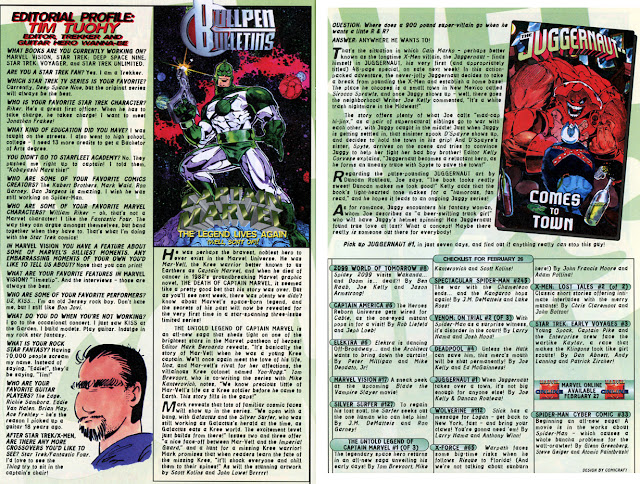
Over at Marvel, the Bullpen Bulletins page has been expanded to two pages, which now include an editor profile, a February (?) Marvel checklist for books sold in April... and, well, a grand total of two bulletins, where the "Items" of yore have made the journey to what you and I might refer to as full-blown "ads."


As for the February April checklist, the PPC is going to do a little expanding of its own and run down a few more of the 1997 books sold that month.

Thursday, January 27, 2022

When Firemen Fear The Man Without Fear


With crowds of civilians often playing a major role in comics stories, you'd think that comics covers would be just as generous in featuring spectators witnessing a battle, or a face-off, or even engaging in an occasional "Look! Up in the sky!" sighting. But as we found in the PPC's initial exploration of this subject, covers all too often have elbowed crowds out of the picture, given a cover's emphasis on sales and the presumption that the casual comics browser isn't going to be particularly interested in anyone on an issue cover but the story's main characters. In Part 2 of this impromptu series, we search out more of those covers where crowds were injected into the scene presented--and why not start out with two heroes who were often forced to confront a threat during what appeared to be a busy workday for the average New Yorker?


Thursday, January 20, 2022

Crowd Control


Comics stories derive a good deal of their drama from groups or crowds of ordinary people being present while heroes go about their business in major cities or other populated locales, whether interacting with those on the street or in offices or being mindful of those caught up in battles with foes which tend to endanger innocents who are unfortunate enough to be in the wrong place at the wrong time. Yet on issue covers, which having the opportunity to convey a powerful image with large crowds who find themselves in the midst of a situation involving the title character(s), crowds are often elbowed out of the picture in order to present the story's main characters, including of course whatever individuals are responsible for selling the book.

But while rare, those cover images are noteworthy, and in some cases memorable depending on the circumstances of the story and the creative talent of the cover artist--and today you'll see a collection of such covers from the first volume of various titles where ordinary people do their part to help establish whatever crisis our heroes must face in the pages of the issue's story. As for a starting point, there's only one cover which stands above the rest in capturing this post's theme perfectly--pictured here with its homage cover rendered nearly twenty-eight years later.


Thursday, October 28, 2021

Marvel's Classic Corner Boxes: Mighty Thor Vol. I, Incredible Hulk Vol. II


Marvel corner boxes seem to be a thing of the past, but at the PPC we're reaching back and reassembling them in all their glory. Having already run down the collection of corner boxes featuring the Fantastic Four, we now pivot to the God of Thunder, Thor, as well as the rampaging behemoth men call the Hulk, two characters who have gone head to head in previous meetings and who now face off again in a contest where they can't possibly injure one another. (We hope!)

Since a coin toss would probably have proven fatal for yours truly, depending on which side it landed, it seems fair to start our showdown with the character whose comic premiered first--but even though that would be the Hulk (by three months, but a win's a win), his six-issue first volume had no corner boxes to display. It wouldn't be until 1964, when the character was brought back in Tales To Astonish as a companion feature to Giant-Man, that the Hulk began appearing in corner boxes; the Journey Into Mystery book, however, where Thor first appears, displayed its first box of the Thunder God in 1963.

None of which I explained to our two heavy hitters, since they seemed a bit impatient to get this ball rolling. I just assigned the honor of going first to the oldest one present, which was Thor by a landslide.

Yet Thor's corner boxes in his initial appearances didn't exactly knock it out of the park for him--in fact, I'd made a comment at one time which likened Thor's image here to some kid's yearbook photo.


As we see, the grinning face shot was changed to a more serious, godlike portrayal, which would still be put to use well into the run of Thor's own title.

As for the Hulk, his boxes in TTA weren't exactly sensational, either, though things improved just before the book was discontinued. (Yet it bears mentioning he had more staying power than Giant-Man, who had enjoyed first billing in the book, so he must have been doing something right).


Thursday, September 9, 2021

A Fearsome Forgathering of Frivolous, Far Out Frenzy!


Aside from mental institutions and Congressional debates (which may sound redundant), you and I are generally not exposed to much if any sort of frenzy in our lives. Yet on planet Earth as seen through the eyes of comic book creators, incidences of large-scale mania, madness, insanity, or sheer frenzy can be found across the globe--any year, every year, whether due to invasions, or the plans of a super-villain brought to fruition, or world-ending disasters brought on by a malevolent power, or attack-induced panic, or any of a dozen other threats which the human race has proven ill-equipped to deal with. The word can also be applied to the unpredictable and seemingly unstoppable circumstances occurring within a particular story, as the characters involved struggle to deal with the situation.

So, fair warning:  If you're easily affected by such heightened states of hysteria, reach for that mouse or touchpad and click over to a less alarming site! (Like the news.  Ha! Kidding!) Because the PPC is about to do a frenzied roundup of those incidences, and try to figure out just why they're in such a state of:

Come on, shriek it with me...

AAAAAH! Stop it! Can't... STAND IT!