Showing posts with label Brian Bendis. Show all posts

Monday, March 28, 2022

You'd Better Shape Up At Camp Hammond, Ladies


As my interest in collecting comic books started to wane sometime around the mid-1990s, I found myself beginning to "taper off" the habit of steadfastly sticking with a complete run of a series and instead shifting to a more selective posture in reading new comics, giving a new series a fair chance to hold my attention before cutting it loose when that threshold was reached. No regrets since; in fact, I sometimes wonder if that should have been the way to enjoy a comics habit all along. :) Twenty-five years later, however, I've surprisingly found myself giving a second glance to those books that were dropped from my reading list, a number of them having long since been forgotten but are now proving to be interesting to revisit after unbagging and turning their pages once more. It's something of a mixed bag (heh) laying eyes on them again, since I was hardly expecting them to have any more staying power with me than they did before; yet having diverted from collecting to reminiscing in written form via the PPC, I've found that my perspective has changed quite a lot in the decades since, which makes these old issues virtually new again to the eye. Consequently, for at least a few of these series I've found myself more appreciative of both story and art in certain respects--something which became more apparent as this Easter egg hunt took me from the late 1990s and into the 2000s when Marvel would get its second wind.

Here, then, is a brief rundown of a selection of those books which had a limited run (for Marvel and even more so for myself) as opposed to their mainstream series--and since the notion for this retrospective occurred alphabetically as I was thumbing through the top of my comics shelves, we start with those books which spun off from one of Marvel's most successful franchises. (Synopses are edited from various sources.)


Avengers: The Terminatrix Objective - September 1993 (4-issue series, monthly)
Writer: Mark Gruenwald
Issue(s) Collected: #s 1-4

Synopsis: The sequel to "Citizen Kang" guest-stars Thunderstrike, US Agent, and War Machine (with other Avengers dealt in as needed). Terminatrix, who deposed Kang, attempts to expand Chronopolis beyond Kang's seven-millennium boundaries, and discovers a shocking secret about time.

"Citizen Kang" was a crossover event taking place in a number of annuals prior to this series, an event I also collected mostly because I was collecting annuals at the time but otherwise failed to make an impression on me beyond its loose reference to the Orson Welles film. I was intrigued by the fact that Terminatrix is portrayed as both a more-than-a capable adversary while also written as someone who may have bitten off more than she can chew in assuming the role of Kang for all intents and purposes.


Friday, March 27, 2020

Six Against The Skrulls!


Since the Kree-Skrull War has recently been a focus of the PPC, we'd be remiss if we failed to note a group of individuals who formed a coterie as a result of that event:


Yes, the Illuminati, who met at the request of Iron Man following the Avengers' confrontation of the Skrulls in space during that race's hostilities with the Kree (and vice versa). War was averted during that encounter, thanks in part to the machinations of the Kree Supreme Intelligence which unleashed the power of none other than Rick Jones--but soon after his return to Earth, Stark initiated a meeting in Wakanda and proposed to Reed Richards, Stephen Strange and the others that the six of them meet on a regular basis to keep each other apprised of anything and/or anyone that might pose a threat at some point to Earth--"warning signs," if you will, that would allow them to pool their resources and avert disaster.

And yet, the group resolved to keep their meetings and even their existence secret, perhaps so as not to alert those who aroused their suspicions--even failing to notify the National Security Council of their activities, the very agency which shares vital and classified information with the Avengers as part of a special arrangement with the team and which would likely take issue with the covert nature of this group in acting outside of its auspices.

And act they do--nor does it comes as much of a surprise, then, when we discover what threat (if dormant for the time being) they've decided to proactively deal with first.


Friday, August 30, 2019

Revelation(s)!


Oh, Peter Parker. These little deceptions used to be so easy for you to pull off, didn't they.


Well, kiss those days goodbye, sport, because that was 1965--and these days, May Parker is going to want some answers from you, young man!


While it's true that Peter has had a number of narrow escapes from situations where his secret identity was at risk, he finally had to face the music in the 1990s (and even into the 2000s) when no less than three writers in five separate spider-titles decided to play a part in at last opening the eyes of Peter's Aunt May, the one person he strove to keep in the dark above all others about his double identity.

But, wait--three writers? Five different Spider-Man books? And this wasn't a crossover story? To that, we'd have to answer both yes and no--"yes," in that one of the stories was explained in more detail in another spider-title that crossed over to yet another, but "no" in regard to Aunt May discovering Peter's secret. Which means that, as odd as it sounds, May learned the truth about Peter, from Peter, on three separate occasions. That either adds up to a lot of confessing on Peter's part, or there's more to the situation than is evident.

To clear it all up, let's take each of these stories in sequence and try to bring some context to all of it. (A tall order when dealing with the chaotic nature of Marvel comics published in the decades bookending the turn of the century.)

Monday, September 18, 2017

Will Cast Spells For Change


It's an unexpected pleasure to profile another of the Stan Lee Meets... series from 2006-07, where Lee meets and chats with a handful of Marvel characters, an issue at a time, with one or two supplemental stories of the same flavor included. I honestly hadn't expected to return to the series, putting as much stock as it does in the novelty of Lee meeting with his creations, which on its face doesn't seem like much of a draw. An interesting question to ponder might be whether this series would be so entertaining if the reader didn't get the "inside joke" and had no idea who the actual Stan Lee was or how he relates to Marvel Comics, but of course that wouldn't likely be the case. Lee developed each of these characters from the ground up--and while each story is told from a humorous angle rather than a nostalgic one, it still boils down to a bit of harmless fun and, needless to say, very light reading.

Previously we took a look at Lee meeting up with the Silver Surfer; this time, though, Lee takes a turn toward the occult, even if it's not quite what even he expects to find.


Wednesday, July 12, 2017

Thrall Of The Purple Man!


With Brian Bendis enjoying a gig as Consulting Producer on the Netflix series Jessica Jones, it's easy to see parallels between the season-long arc featuring Kilgrave and the last few issues of the Bendis-written 2001-04 comic, Alias, which focus on Jessica's dealings with the Purple Man, who spells his name "Killgrave" and whose villainy hails back to his introduction in Daredevil in 1964. In both cases, Jessica has gone through hell with this man who kept her captive for months, an experience that haunted her even after she escaped his control; and in each case, we learn of Jessica's ordeal gradually, piecemeal, which more effectively conveys her struggle to put this period of her life behind her. Jessica as a victim is difficult enough to digest; Jessica as a helpless victim is a thought that boggles the mind.

For those of you whose interest in the character's clash with the Purple Man/Kilgrave is piqued and who have sampled (respectively) neither the television series nor the story in Alias, there is no one medium to choose first as far as which version offers more drama and a more powerful impact on the reader/viewer, as each of them has their merits and their own way of presenting the material. There is of course the perk of actor David Tennant in the role of Kilgrave in the series, who does a fine job of bringing the character to life in a real-world setting--yet you'll find the character in print no less compelling, so it comes down to the old debate about whether the book or the movie offers more entertainment for you. Having consumed both stories, I can at least attest that you won't be disappointed with either, no matter which one you prefer to dive into first.

Also, while the Netflix version no doubt brings with it the expectation of pulling no punches as far as portraying the gritty realism and frank reactions inherent in such a situation, the book is able to match the series in those respects, since Alias was the first series published under Marvel's new "Max" designation, with the company finally giving the Comics Code Authority the heave-ho and substituting its own ratings system while coming out with a line of R-rated comics titles. Both versions of Jessica are unarguably damaged, though with the television version being considerably more hard-edged and intimidating than her more vulnerable comics counterpart; but each medium does the character justice in how she copes with this painful reminder of her past.

In Alias, the Purple Man is incarcerated in the prison facility known as the Raft when Jessica is placed in the uncomfortable position of having to deal with him once more, after a group of "survivors" of his assaults on loved ones approaches her in order to obtain some closure for themselves--assuming, that is, that Killgrave decides to cooperate.


And since we're treading into the pages of a comic bearing the Max logo, it's probably a good idea to give you a heads up as to what to expect before we continue:


Tuesday, June 6, 2017

Exclusive To The Bugle: The Fall of Norman Osborn!


It often came as a surprise to come across stories in Marvel's line of comics when the "Daily Bugle," the mainstay newspaper created and given life by Stan Lee in the early 1960s, was given more exposure than simply a few panels of comic relief in Amazing Spider-Man or other titles. In those early days, ASM helped to make the Bugle, along with its crack staff of reporters and its cantankerous publisher, J. Jonah Jameson, a vital part of the mag, and not simply because of Jameson's designated role as a thorn in Spider-Man's side. (Heck, in practically everyone's side.) But as Marvel branched out, the Bugle followed--its ability to take New York City's pulse, as well as its extensive coverage of the city's crime scene, often put to good use in Daredevil, ASM, and other titles whose characters confined their activities to the streets.

In some of those stories, we saw another side of Jameson on occasion--the hard-nosed newspaper man who ran the Bugle like a taut ship and whose better judgment at times needed perspective from his editor and friend, Joe Robertson, the perfect foil for Jameson's fly-off-the-handle outbursts and his bent toward persecution. "Robbie" was a needed balance for the character, someone who could keep Jameson from becoming two-dimensional and whose presence at the Bugle gave the paper integrity to Jameson's grit. With these two anchors, the Bugle evolved to become an institution in Marvel's comics over the decades. There were stories to be told by this paper, and the potential was always there to evoke a different kind of drama that didn't necessarily have to depend on costumes and powers for its backbone.

In that respect, the 2004 series The Pulse offered something different for someone like me whose collecting bug was winding down and who was sampling other titles to see if anything grabbed me. At the time, Fantastic Four was numbering in the 500s, while the 1998 Avengers run was about to come to a "disassembled" end; and suddenly, here were Jameson and Robertson, breaking ground with virtually their own comic. For this to work, the writer and artists would have to really map out the kind of bustling newspaper office and staff they wanted to present, in a format that would put us in the city room instead of Peter Parker, Betty Brant, or any of the usual suspects who were mainly passing through or taking up space. It was the Bugle that would be the center of attention, the Bugle that would have to carry the story, the reporters who would essentially drive the stories and set the pace. It was a concept that was finally going to get its day.

As to the format, well, with its cover, you've already seen part of its foundation--"The Pulse," a new supplement of the paper that cleverly pulls double duty as the comic's masthead. A few readers will probably get a sense of bits and pieces of prior Daily Bugle concepts being salvaged and folded into the Pulse; for instance, the Pulse is aimed at appeasing newspaper readers who want to see the Bugle's content feature more informative news on super-heroes, something which was attempted with "Now" Magazine:


There's also the presence of Jessica Jones at the Pulse, a super-being who no longer suits up but is hired by Jameson to offer her unique input on stories that will see print in the supplement, which borrows elements from Carol Danvers' stint as the editor of Jameson's "Woman" Magazine:


For the Pulse, writer Brian Bendis produces a more detailed, 21st century version of the Bugle, where circulation is down because the paper's editorial slant against super-heroes has grown tiresome with readers, and whose publisher must be realistic about the paper's future and bite the bullet in terms of giving readers what they want.


Needless to say, what Jessica needs from Jameson, like Carol Danvers, is a salary and benefits, which this time Jameson readily agrees to.

Bendis, together with artists Mark Bagley and Scott Hanna, appear to be the right men for the right job here, immersing the reader into this world of news and investigative reporting and, most importantly, the Daily Bugle we were seldom privileged to get a look at behind the scenes for any length of time. As this series is starting, all three are still in the middle of their well-received run on Ultimate Spider-Man, while Bendis also chronicled Daredevil as well as introduced Jessica as a P.I. in the Alias series. No doubt some of you have reservations about cracking open any project written by Bendis, whose writing style can often be frustrating to follow. Yet if you can overlook the staggered conversations between characters, the constant interruptions they engage in, the maddening loops of subject ==> irrelevant tangents ==> back to subject, all of which try like hell to typify contemporary "casual-speak"... if you can overlook such distractions, there's some good work here and some excellent character development. Jameson, while still Jameson, is less outrageous and exaggerated--more centered and seasoned. Luke Cage, as characterized by Bendis, is one of the most solid versions of Cage I've ever read (and who fit like a glove in New Avengers). Ben Urich is a roll-up-his-sleeves reporter who's been frustrated by the number the job has done on him, but who pushes on because he's a damn good reporter. And if Jameson is the Bugle's soul, then Robbie is its heart, who keeps his eye on things and doesn't hesitate to step in when needed. It's clear there's no lack of commitment in any of the creative talent involved in these first few issues, with everyone bringing their A-game.

For its debut story, the Pulse tackles no less than Norman Osborn in his role as the Green Goblin--someone the Bugle, and Urich in particular, had attempted once before to expose but were swept up in a legal firestorm for their trouble. The series' first issue only touches on what's to come, when a body is discovered in Central Park's lake, a development that its second issue would pick up on; but this first issue is devoted to establishing the Pulse itself and those who make up its core staff. We've already taken a look at Jessica and the next steps she's decided to take in her life with Cage, yet her story unfolds from the beginning of the issue--pregnant by Cage and deciding to segue to a job with more stability. Of course, with Cage's dealings with Jameson having been on a more rocky road, he has reservations about his girlfriend considering a job offer with the man.


As we've seen, Jameson's commitment to the Pulse is real, so much so that he's made quite an offer to Jessica to bring her on board in what amounts to a position as a consultant. It speaks well of his instincts; and as for Jessica, her transition from P.I. to Bugle staffer no doubt strikes those who only know her character from her Netflix series as a bit odd.

As for Urich, the cagey Jameson has a conversation with him similar to the one he had with Jessica, only this time convincing Urich that it's Jessica who will need Urich to hand-hold and motivate her so that she'll do her best work for the Pulse, whereas Jessica is under the impression that it's Urich who needs the Pulse to jump-start his work as a reporter. But Urich is equally motivated by the fact that Jameson is changing his editorial stance and giving the Bugle a different direction.


With the look and feel of the book established, the story turns to what will truly ignite it--an investigation into the death of the young woman found in Central Park, a person who just the day before was a new Bugle reporter who was desperate to find a story that would appease Jameson's expectations of her. And so Terri Kidder takes a lunch with her friend Sheryl, who works at the Oscorp company--and a casual leading question from Terri has her very nervous and shaken-up friend spilling details that could land Terri her first big scoop for her new boss.


Since Terri was already working on a "100 most powerful people in NYC" story, it made sense to use that angle in order to go straight to the source and hope that Osborn would have a statement and/or reaction when she smoothly changed the subject to these reports of missing persons within his company. Unfortunately for Terri, she receives both.


Friday, August 26, 2016

The World's Ultimate Comic Magazine


After experiencing two adventures of the "ultimate" Fantastic Four*--one where they met and battled the Sub-Mariner, and the other where they were instrumental in opening the comics door to the Marvel Zombies--it seems appropriate to backtrack a bit and take a brief look at the circumstances in which this alternate universe team came to be born. Created by Brian Bendis and Mark Millar, the Fantastic Four of (coincidentally?) 2004 had very different histories than their 1961 counterparts, and, by extension, a very different origin.

*There's also the account of the team's own Fantasti-Car--which doesn't look like a "flying bathtub," but was mocked just the same.

It's clear from reading the book's first several issues that a lot of thought was given to not just how these four characters would gain their powers, but how they would come together in the first place. The original Stan Lee story read rather rushed, as far as introducing the four principals, giving us their backstory, and presto, making them heroes in time for issue #2; Lee would then use succeeding issues to flesh out their personalities and begin to cement the bond between them. By contrast, we get to know the characters in the updated story over the course of two issues before the "accident" which created them ever takes place--a scientific experiment that has Victor Van Damme to blame for its failure. (And while "Doctor Damme" has a nice ring to it, rest assured that the good doctor eventually retains the nomenclature that made him a household name for comics readers everywhere.)

To break it down for you, the ultimate FF chronology roughly goes something like this:

We first meet Reed, who's remarkably brilliant even at a young age, as he's being harassed at school by bullies who are sent packing by Reed's friend, the older Ben Grimm, a student nobody messes with and who has become Reed's friend and looks out for him. And when Ben comes over to get some help with his trig homework, Reed confidentially lets him in on his latest brainstorm: a teleportation device.


It would be a few years before Reed actually builds a "working" device to the point where he's ready to present it--at his middle school science fair, that is. To the astonishment of everyone, the demonstration is successful--and it catches the attention of a "scout" who attends such events in order to spot potential candidates for a program that will further their education in an environment which encourages their natural intelligence and creative drive.


And so Reed is invited to live and work at the Baxter Building, a military-sponsored think tank headed by scientist Franklin Storm, where of course Reed meets (biotechnologist) Susan Storm and her brother, Johnny. Reed finds that the staff is very excited to meet him, since they've also stumbled onto the same dimensional-transport discovery that Reed has made but haven't been able to make any further progress.


With Reed aboard, in an environment in which he thrives, in a few years' time he's ready to test the prototype of the device that he first theorized about with his friend Ben when they were kids. Also part of the project is Victor, who Reed met when he arrived at the Baxter. In a turnabout of the history we know, it was Victor who was discovered in Reed's room, looking over Reed's figures for the device and pointing out a few errors--and it was Reed who blew his stack and kicked Victor out in anger. Yet looking over Victor's notes, Reed discovered that Victor had been correct, and later smoothed things over with him and invited him to join in on the project. Now, as the time approaches for the device's first test, Victor is adamant about making last-minute changes to the settings.


And speaking of Ben, he arrives just in time to reunite with his old friend and wish him well.


The test of the device involves sending an apple from Nevada to Guantanamo, a distance of over 2,700 miles. As you might guess, the results are unexpected and dramatic. The apple itself remains stationary; but the effect of the teleporter transports Ben, Sue, Reed, and Johnny while altering their physical bodies at the genetic level (which I probably don't need to go into detail on for you). Johnny ends up in France; Ben in Mexico; Sue in Subterranea, where the Mole Man greets her; and Reed just a short distance from the device. Also affected is Van Damme, who is transported to Copenhagen and now resembles the "Doctor Doom" we're familiar with--only his body is metal, and he has clawed hands and goat-hooved legs.

Reed later discovers that it was Victor who reprogrammed the teleporter; yet Victor believes that the accident occurred because Reed's programming was so bad that even Victor couldn't fix it. (Sanity, it appears, eludes this version of Doom as well as his counterpart.)

The UFF title would run for sixty issues over a period of five years before it concluded, with the book caught up in the events of the Ultimatum series that closed out the Ultimate line of books.

Monday, August 1, 2016

The Women In Our Lives


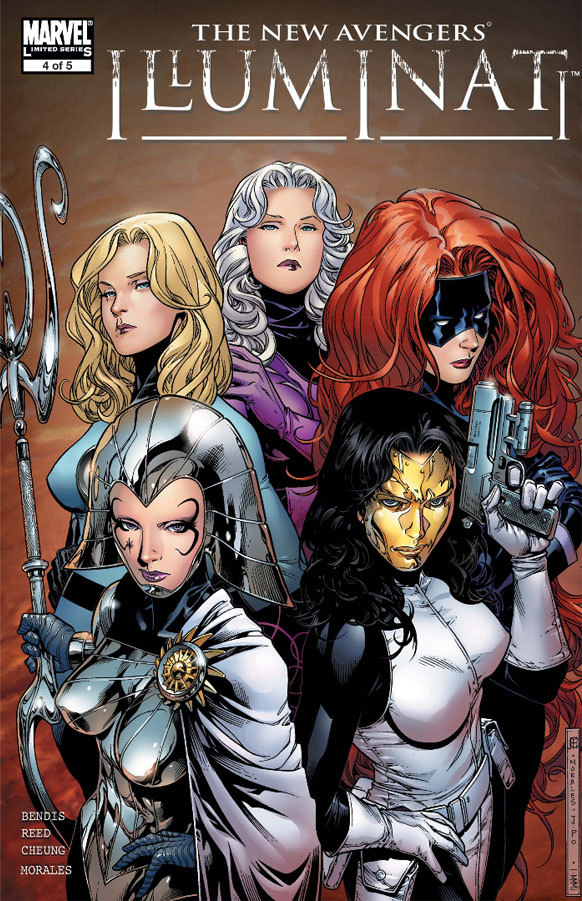
In their fourth issue of the Illuminati limited series from 2007, writers Brian Bendis and Brian Reed have our members of this clandestine group letting down their guard a bit to ponder the women in their lives--an opening segment which provides some rare bonding moments for these men who come together from such diverse paths to discuss their world's present and future concerns, and how best to bring about their mutual decisions on the matters which are brought to light in their secluded location. Their subject for today--the young Kree known as Noh-varr--can be tabled for a few minutes, it seems, because the ladies on their minds don't seem like the type who enjoy being kept waiting, even in absentia.


Since the Illuminati normally move right to business, the casual discussion is completely unexpected and comes as something of a nice surprise for the reader, since these men as a rule bring weighty matters to each others' attention that require their full attention and deliberation. It's Dr. Strange who somberly opens the door, as he bemoans the absence of his former disciple and lover, Clea, who returned to her home dimension to assume her position as its ruler. And as the members arrive, Strange's frustration with the situation has the others offering a sympathetic ear.


You may find these two writers, however well-intentioned, perhaps make too much of an effort here to have these men rubbing elbows with each other over common ground. The short quips, the cut-off sentences, the abrupt momentary segues--sure trademarks of Bendis's style, who tends to apply it to any character no matter how out of character it may seem. Has Reed interacted with Clea over thirty times? Even twice seems unlikely. When would their paths have crossed, socially or otherwise?

On the other hand, there are things worth enjoying here. Strange is often at his best when he allows his human judgment and perspective to enter into his work--and it makes perfect sense for him to be dismayed by the absence of a loved one and fail to understand her behavior, when he understands so much. In addition, no doubt most if not all of these men welcome the opportunity to speak with each other in more relatable tones and words--and what better common ground could they find among each other than "misery loves company"?


Namor is the last to arrive, and thus the last to chime in on this subject. It's interesting that his lost bride, Dorma, isn't the woman that Bendis and Reed choose for him to offer his thoughts on, though perhaps it's not all that surprising since Dorma's history with Namor has very few personal moments to draw on. And in contrast, Namor's history with Sue Richards is by far the more compelling subject for this impromptu conversation.


Prior observations aside, there's nothing wrong with a little levity to bring this conversation to a close, since there is a main story to get to in this issue. And even on the subject of women, it's somehow gratifying to see that Tony Stark can be tripped up by his own foot.


Friday, July 29, 2016

The Enemy Within!


There were at least two occasions when the Illuminati--the clandestine group consisting of Marvel's oldest super-heroes who would meet privately to raise concerns or handle matters without disclosure to their friends or peers--chose to part company and go their separate ways. One was after a falling out they had over the decision to send the Hulk away from Earth to another world; the other was when Iron Man sought to gain their support for the Superhuman Registration Act, in a meeting which caused deep divisions among them and led them to all but formally disband.

The events of the "civil war" that resulted from factions of the heroes forming to oppose each other as a result of the SRA are a matter of record, and have been for almost ten years (our time). Yet after the fallout of that conflict, and other upheavals that took place around the same period, the members of the Illuminati would find themselves called to a meeting once again--this time to discuss a threat that might already have reached the point of being too late to stop.


Saturday, February 15, 2014

I Am From Attilan!


Over twenty years after the events of Secret Wars II--and leap-frogging over the odd stories of "Kosmos" and "the Maker"--we're once again treated to an appearance by the Beyonder, while finally learning his true origin courtesy of writer Brian Bendis and a startling announcement by Charles Xavier:


The explanation is explored in the third issue of The New Avengers: Illuminati, where the group has assembled not merely to hear about the Beyonder, but to investigate his appearance on a planetoid in an asteroid belt. There seems to be consensus that this story is a sort of flashback, taking place after the first Secret Wars series but before the second, which frankly never occurred to me to assume. Other than an offhand reference by Reed who says he's had the FF's sensors on auto-detect for the Beyonder ever since their experience on Battleworld, there's nothing in the story that establishes this isn't taking place in the "present." But the actual point in time isn't really necessary to understand or enjoy the issue's story; and, I have to admit, I wasn't really expecting Bendis to nail it down. I don't think the man even knows what a hammer looks like.

The intriguing part of this revelation, of course, is how this news affects Black Bolt, leader of the Inhumans. Given his reaction as Xavier explains, it seems evident that he's connecting the dots from a past memory:


A memory he's not ready to either admit to or share with even these men, which perhaps explains why Namor's tactless comment seems to irritate him:


From my perspective of reading this story as if it were part of normal continuity, this Black Bolt would have been "covering" during this time, having been replaced by a Skrull and simply giving the impression he didn't recall this person as a way of not exposing his lack of knowledge of the event. Yet, reading the scene again, I prefer the more interesting drama of this being the real Black Bolt, attempting to evade the group's questions because he feels somewhat shamed at the truth. And while this now puts me on board with this being a flashback story, I'm also feeling disappointment that the feelings of Black Bolt, of all people, aren't more fully dealt with in this story. As a Skrull, that would have been understandable as part of keeping a low profile; but as Black Bolt, even his silence stands out as conspicuous.

At any rate, Xavier proposes their group make contact with the Beyonder:


Taking a captured Skrull ship from their prior encounter with that race, the group approaches Ceres. And the scene that greets them gives them an idea of the potential magnitude of the task which awaits them.


Friday, January 24, 2014

The More Things Change...


Three months have passed (in Marvel time) since the end of Part Four of "Chaos," the story which concluded the events of the "Avengers Disassembled" storyline that ran in the main Avengers title as well as seven others. "Chaos" ended with several loose ends left unresolved--and that brings us to the wrap-up story in Avengers Finale, an epilogue issue which would gather the team one last time to formally disband them and send them on their way, with hopefully many memories of their rich history that they can take pride in.

Just why the Avengers must disband is only one of those questions left hanging in the air after the team confronted the Scarlet Witch in a battle which capped what was arguably their worst crisis. Now, they gather once more in a reunion of sorts called by Tony Stark, who has grim news to deliver in the ruins of what was once Avengers Mansion:


It looks to be something of a bittersweet reunion.

Thursday, January 23, 2014

Mother's Day


With Dr. Strange's arrival at the end of Part Three of "Chaos," the story at the center of "Avengers Disassembled," we're more than ready for a few answers. Why have the Avengers been under almost constant attack? Who or what is responsible? How were three Avengers used against their comrades? Three Avengers dead, three more injured, two critically--how many more? Who has the power to pull this off?

Dr. Strange doesn't come right out and say it--but he does point the Avengers toward the answer, and one Avenger in particular seems to have his worst fear realized:


To understand the answer that Dr. Strange is about to announce off-panel, we need to put this "chaos" into context by looking back to its catalyst. And what sets everything into motion is not so much the one behind the power itself, but rather a mere slip of the tongue during a casual conversation between the Wasp and the Scarlet Witch:


With the seed inadvertently planted into Wanda's mind, she acts to discover the truth. Her mental state already on shaky ground, she seeks out the one person who might have knowledge of a past kept hidden from her:


I think we can assume that Wanda wasn't sympathetic toward Agatha Harkness, whatever her reasons for suppressing Wanda's memories of her children, and that this meeting didn't end well for the senior citizen. Agatha left quite a trap door open for any number of people who knew about Wanda's children to stumble through. In effect, everyone with knowledge of the children would had to have been accounted for and sworn to secrecy, and agreed to never broach the subject to Wanda again. Yet, unless she had originally decided to keep the birth of her children a secret, and arranged a media blackout, and took a dozen other precautions to keep the knowledge of their birth under wraps, how was that possible?

The Avengers, though--having known Wanda as both a comrade and a friend--are full of doubts as to her being the cause of these incidents, and cannot bring themselves to believe that Wanda would be capable of this level of enmity against them. But Dr. Strange helps to put in perspective Wanda's fragile psyche, particularly after learning from the Avengers how her children, nonexistent to begin with, were lost to her.