Showing posts with label Gary Friedrich. Show all posts
Monday, December 2, 2019
Monster vs. Monster!
For us, the time was late 1973--but for a certain comics character, it was the 1890s, when the Frankenstein monster roamed through Europe, seemingly doomed to face a mixture of panic and persecution from those who regarded it with loathing and, most definitely, fear. Yet they also feared another menace, those creatures that came in the night and left blood and death in their wake--and in the seventh issue of his series, the monster would face the threat of vampires... and one vampire in particular.
The Frankenstein Monster (renamed from The Monster of Frankenstein after five issues) was a fairly interesting effort by writer Gary Friedrich to bring the classic monster from Mary Shelley's novel "mainstream" in a continuing series--with Marvel even bringing the monster forward in time to the 1970s at one point, an understandable decision considering that you could only do so many stories featuring angry villagers with torches and pitchforks.
Friedrich would pass the reins to Doug Moench for that segue, who would take the series through nearly the rest of its run of eighteen issues before cancellation. In hindsight, perhaps a limited series might have been a more practical way of handling this concept; even Tomb of Dracula, featuring another horror character who occupied a "niche," struggled to maintain its readership before ceasing publication with its sixtieth issue. But while Dracula was far more mobile and pursued a variety of interests, the monster was like a land-bound Hulk who could only roam from village to village.
Yet before the meeting pictured above would take place, we get a fair idea of what The Frankenstein Monster brings to the table, with its weaving of mystery and the macabre that worked surprisingly well for its title character. Even so, vampires offer a spike of interest to a story that no self-respecting monster shouldered with carrying his own series would turn down.
Friday, September 13, 2019
The Fury of Satan's Son!
During the early 1970s, both the Ghost Rider and the Son of Satan would benefit from extensive (albeit bimonthly) exposure in Marvel Spotlight before being given their own titles. In the case of the latter, the Satan-son would actually make his first appearance in the nascent Ghost Rider title--though it wasn't the fiery, trident-wielding character we would first lay eyes on, but rather exorcist Daimon Hellstrom, who had been contacted by two residents of an Apache reservation to treat a woman feared to be possessed. Hellstrom is obviously a man with a secret, who is wrestling internally with something that he strives to keep in check during the hours that span dusk to dawn--but is his resolve strong enough to resist the force inside him that demands to be released?
The answer is forthcoming, as the Ghost Rider segues to his own title, while Hellstrom (along with the curse he lives with) takes the Rider's place in Marvel Spotlight, where his readers would explore his tempestuous character for the next two years.
Wednesday, September 5, 2018
The Race For Element X!
Things looked pretty hopeless when we left Captain America and the Falcon following a harrowing battle outside of a secret S.H.I.E.L.D. mountain base. With an elaborate plan that should put him in the Hall of Fame of elaborate planners, the Grey Gargoyle, whose touch can turn an animate or inanimate object to solid stone, has maneuvered Cap and Falc into making it possible for him to board the SHIELD helicarrier, thereby giving him transportation to the secure mountain lab where SHIELD scientists are experimenting with the deadly Element X--a substance which, in the hands of the Gargoyle, will make him a threat to the entire world.*
And now, with the destruction of the helicarrier, only Cap, Falc, Nick Fury, and Sharon Carter (a/k/a Agent 13) remain to try to stop the Gargoyle from reaching his goal. But having already penetrated the lab's entry, the Gargoyle has wasted no time in seeking out his prize, whatever resistance he has to crush in the process.
*It's anyone's guess how the Gargoyle even learned of Element X. SHIELD security is looking like it must be child's play to hack.
And so we reach the climax of this story begun by Stan Lee, but who passes the baton to Gary Friedrich with his departure from the book. Do the Falcon and Cap have a chance against an invulnerable foe who's so far vanquished anyone who's tried to stop him?
Monday, June 11, 2018
To The Hidden Land Comes... The Hulk!
Jim Steranko's eye-catching 1968 cover to the first Incredible Hulk Annual no doubt contributed a great deal to selling the issue to not only readers of the character's regular series but likely just about anyone browsing the comics racks. To this day, it remains a stunning work of art--though judging by its original mock-up, it received a few additional touches from artist Marie Severin, who went on to pencil the story.
Yet with Incredible Hulk having only seven issues under its belt at the time, Steranko's cover might well have had a lot more riding on it in terms of promoting the Hulk's nascent series so that it wouldn't follow in the footsteps of its 1962-63 bi-monthly predecessor, which collapsed after a run of only six issues. In that sense, the image of the Hulk, struggling to hold up his own crumbling masthead, is disturbingly symbolic, to say the least.
In addition, a decision has apparently been made behind the scenes to rely almost entirely on the Hulk's dramatic image to entice current and new readers, with the cover being a bit deceptive in dropping the name of the story's antagonists--the uncanny Inhumans, whom we would expect to be represented by Black Bolt, Karnak, Gorgon, Medusa, Crystal, and Triton. Instead, only two of that group would be featured, taking a back seat to a collection of seditionists who would later fall under the sway of Black Bolt's unstable brother, Maximus. Only when you turn the page does the issue drop a hint that the Inhumans featured in the tale might not be the characters you were expecting--something that would have been crystal clear had the choice been made to go with Severin's proposed cover.
In a way it's almost unfortunate that our "substitute" Inhumans weren't deemed marketable enough to score placement on this issue's cover, since the entire story revolves around them as much as it does the Hulk, and they receive a generous amount of exposure throughout. As villainous Inhumans, they'll remind you a bit of the Brotherhood of Evil Mutants, with Maximus eventually stepping in as their Magneto. When we meet them, they're being called on the carpet for inciting rebellion against Black Bolt's rule--and when one of their own, Stallior, attempts to save his own skin, the savage response by his fellow dissenters is immediate.
Soon enough, Black Bolt orders through his telepathic "oracle" that the conflict end so that he may pass judgment on the lot of them. With nothing to lose, another of the group, Leonus, appeals once more to the assembled crowd to reject Black Bolt's rule--and naturally, any such attempt to incite rebellion against Black Bolt will gain the attention of Maximus, who sees the opportunity to turn the group's misfortune to his own advantage. It's a rare glimpse into Inhuman politics, such as they are in a monarchy, with the scene almost hinting that the discontent with Black Bolt's rule may not be limited to these six (seven, if you count Maximus, though his hunger for power puts him in his own category)--nor can the subtext of the story's title, "A Refuge Divided!", be ignored.
Unfortunately for Maximus, Black Bolt's presence carries more weight with the crowd, and Maximus' words end up largely ignored. As for the accused, Black Bolt's judgment is swift and, all things considered, merciful. Their lives spared, they're instead banished to the dreaded "Un-Place," a dimensional land of exile which won't win any awards for its unimaginative name but is fated to serve as the location which brings our Inhuman convicts together with the incredible Hulk--thanks to the Inhumans' teleporting hound, Lockjaw, who delivers his charges to their prison but returns to encounter the Hulk wandering the land a few miles from the Great Refuge. Following his training to prevent strangers from discovering the Refuge, Lockjaw attacks; but as you might imagine, the Hulk proves a formidable adversary, and the beast instead uses its power to teleport the Hulk to the one place of captivity where even his strength will be useless.
And three guesses what place... er, un-place Lockjaw has in mind.
Labels:
#1s,
Gary Friedrich,
Hulk,
Inhumans,
Marie Severin,
reviews
Friday, July 28, 2017
"In Battle Joined!"
Writer Roy Thomas often indulged in crossovers back in the day, even before they were formally referred to as such--and a stand-out from mid-1968 was the face-off between the Avengers and the X-Men, bringing the two teams together again 2½ years after their initial clash but this time with the X-Men of course facing a different Avengers lineup. And that lineup had gone through yet another change only recently, which served as the link between the two stories--the departure of Quicksilver and the Scarlet Witch, after Wanda had suffered a gunshot wound to her head and her brother Pietro had blamed human antipathy toward mutants for the act (though it was all due to manipulation by Magneto, who had been lobbying for the two to rejoin him).
With Wanda recovering on Magneto's island base, the X-Men have gone in search of Magneto after hearing reports of his return, and are captured. The Angel, however, escapes and flies off to seek help from the Avengers--while Cyclops manages to escape captivity and searches Magneto's stronghold for his teammates. Unfortunately, he runs into someone else, whose loyalties are in question but who means to prevent Cyclops from freeing his friends--and this action-packed two-parter kicks into high gear!
Monday, April 25, 2016
Power To The People!
Of the collection of the Marvel 25¢ large-format books that very briefly hit the comics shelves in late 1971, one of the stand-outs turned out to be issue #143 of Captain America and the Falcon--not so much because of the story's climax or the revelation of the behind-the-scenes mystery villain, but for the issue at the heart of the story, as well as the characterization of and interaction between two of its central characters. The easy assumption to make is that those two people are Cap and the Falcon; instead, the pair who will likely hold the reader's interest to a greater degree are Sam Wilson, the Falcon's civilian identity, and Leila Taylor, a woman with a militant bent who resides in Harlem during the time when racial tensions were escalating and pitting the neighborhood's activists against law enforcement and white establishment.
It's an ambitious story set in motion by Stan Lee but expanded on and taken to its conclusion by Gary Friedrich, set in the backdrop of a neighborhood whose residents had become bitter and angry at living conditions and the poor prospects of improving their economic standing. It's easy to see where Sam might fit into this story--a social worker based in Harlem who does his best to steer its residents toward available jobs and educational opportunities--while Cap, who's recently struck up a partnership with the Falcon, begins to further acclimate to the neighborhood when he's asked by the police commissioner to assume an undercover role as a police officer in order to investigate a string of mysterious disappearances in the area. That case is solved when he and the Falcon go after the Grey Gargoyle--but by then, two meetings have taken place in prior stories that will leave impressions on each of these men and carry them through the events of this issue's climax.For Cap, he meets the Reverend Garcia, a charitable man who runs a local boys' club and who Cap, in his role as Officer Steve Rogers, finds common ground with following an altercation with some riled-up locals. Garcia has a great deal of faith in those who believe themselves to be beyond help, and is often willing to go the extra mile to help them find the confidence they need to pull themselves up, a perspective which naturally reaches Cap on a fundamental level. As for Sam, he receives a visit at his office from Leila, a woman who's dead set on getting him to change his point of view on his approach to the problems facing Harlem's residents. Leila's thrown in with the "People's Militia," a group of locals who have adopted a more militant stance to confront and lash out against those they believe are taking advantage of them--at least, that's what it would probably look like on paper. In the story we'll see that the so-called Militia is focused mostly on venting their anger, and at times their targets are picked without reason or forethought--though both of those things are clearly being applied by their masked figurehead known as "the Man," who appears to have a purpose beyond siding with Leila and her group for "the cause."
For now, Lee lays the groundwork for the conflict to come, both through Cap's work on the streets as a rookie cop and by having Leila make the rounds to presumably form ties with those who could benefit the militia. Leila is a striking figure as rendered by artist John Romita, who does outstanding work on this issue--yet her personality and assertiveness are equally impressive as she takes Sam's measure. Sam is obviously drawn to her--and while she may feel the same, she doesn't give an inch of ground in letting Sam know where her priorities lie.
When Friedrich takes over as the book's writer, Leila also goes straight to the source of a perceived cover-up (would you expect her to settle for less?) and confronts the police commissioner as he visits Garcia, who's recuperating after his treatment by the Gargoyle. Yet Garcia believes just as fervently in his own approach, so discordant with Leila's uncompromising methods--and while she'll turn a deaf ear to his words, Garcia will at least make sure that she hears them.
As this story finally reaches its conclusion in issue #143, things have reached a fever pitch, and the Militia is ready to back up its threats with action--thanks to "the Man," who has stoked the fires of their discontent and turned it into sheer rage. Will we indeed see "power to the people"? Or does the true power to this situation lie elsewhere?
Tuesday, March 29, 2016
The Earth Trembles When... The Sleepers Strike!
The time was when you couldn't open a Captain America book without tripping over yet another Sleeper--a doomsday device created by the Red Skull during the time of Nazi Germany in the event of the Third Reich's downfall, activated by Nazi agents in twenty years' time to launch an offensive that would help the surviving Nazis to regain power. What the Skull didn't divulge to his patriotic subordinates, however, is that the Sleepers were instead designed to destroy the world, in a final rampage of vengeance.
There were technically five Sleepers in all, which would seem to indicate that the Skull had put into place one contingency plan after another after another, which under other circumstances would be almost laughable. Even in comics, it would have been improbable for Cap to come across a Sleeper on separate occasions, since you'd begin to think that building Sleepers was the only way the Red Skull spent his time during the war--which ties in with the notion that the Skull apparently thought it necessary to have other Sleepers built in case the original plan failed. Why not instead funnel those resources into your current problem: winning World War II? Why spend so much time and effort (and considerable secrecy) on projects that were contingent on the Germans losing the war?
The story of the Sleepers opens in 1966, as Cap shared one-half of the Tales Of Suspense title with Iron Man and a number of his stories recounted his wartime exploits. One of his memories of that period involves his final battle with the Red Skull during the closing days of the war, and a deadly warning that issues from his foe even as he may be breathing his last.
Heh heh--these may well have been the first *ahem* "sleeper agents."
Wednesday, January 6, 2016
My Friend, My Enemy!
The conclusion to Part One of the story which saw the debut of the Guardsman probably left you a little stoked, eh? A tense standoff involving the police, Iron Man, and an angry group of demonstrators, with the police finally being provoked into taking action, with casualties likely? When we open the next issue, we're all expecting a bloodbath waiting to happen--or at least Simon Gilbert, Stark Industries' ruthless Chairman of the Board, yelling the equivalent of "Get off my lawn!" from the offices above, right?
Imagine our surprise when we discover that, somewhere between Parts One and Two, everybody has left the scene. The demonstrators have inexplicably dispersed; Gilbert gives us a two-page ranting of the events of the prior issue and wraps it up convinced things will end in his favor regarding his hostile takeover of the company; and writer Gary Friedrich adds a quick behind-the-scenes recap while driving home the point that it's somehow the fault of the Guardsman armor that the mind of Tony Stark's close friend, Kevin O'Brien, has been impaired.
Meanwhile, each of us would be perfectly justified in asking: "Wait! What... Did I blink??"
But almost immediately, Friedrich and artist George Tuska practically bring us right back to where we left off.
With the difference being that this time, the police are absent, and will be for the duration. (That is if you're not counting Mr. Todd of "Plant Security," whose job description doesn't seem to cover "all hell breaking loose" on the premises.)
Tuesday, January 5, 2016
At Your Service--The Guardsman!
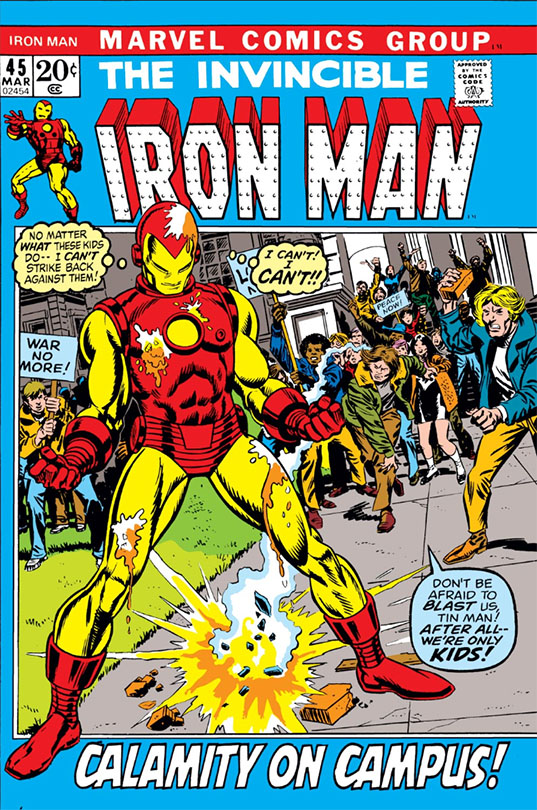
Marvel has done its fair share of campus unrest stories, particularly in the late '60s and early '70s--so it's probably no surprise to find Tony Stark (and, by extension, Iron Man) coming into conflict with the violent protest movements of the time, in light of the fact that he was still primarily manufacturing munitions and hadn't yet rededicated his company's resources to research and development. Yet in a two-part story, national unrest with the Vietnam War served as the backdrop for a more personal crisis for Stark, involving his best friend--who also would be the first person to don the armored suit of the character known as the Guardsman.
(Get a good look at that campus where Iron Man is getting pelted with rotten fruit and molotov cocktails, because this story doesn't go anywhere near a campus; instead, it takes place entirely on the grounds of Stark's factory. The cover to the story's conclusion in the following issue hits much closer to the mark.)
We've become so used to seeing men in Guardsman armor "guard"ing facilities where super-villains are incarcerated that it's easy to forget that this armor has a tragic history. Designed by Stark to be used by his close friend, Kevin O'Brien, as a fail-safe measure (in conjunction with a special ship), O'Brien suits up in the armor in order to rescue an overdue Iron Man who's battling an agent of the mysterious villain known as Mister Kline.
O'Brien is successful--but there are some complications involved in "the Guardsman" (so named by O'Brien himself) becoming a character in his own right, at least for the time being. First, of course, we should keep in mind that Stark didn't create this suit with the idea of its wearer using it for anything beyond a short-term operation as needed. (Though knowing Stark, you can make a fair assumption that the Guardsman armor is still a cut above the status of a prototype.) That's all well and good, until we discover something festering within O'Brien's mind like a time bomb--the fact that he's developed feelings for Marianne Rodgers, a woman who has slowly but surely acknowledged her own feelings for Tony Stark, with Stark feeling the same. And now that O'Brien has had a taste of the armor's power, his feelings of friendship toward Stark have become conflicted, to say the least.
Unfortunately, O'Brien then overhears Stark and Marianne professing their love for each other--after which, Stark proposes marriage and Marianne accepts. (Good grief! Haven't these two ever heard of dating?) In Kevin's state of mind, it pushes him over the edge; and when the ruthless Simon Gilbert, Chairman of Stark's Board of Directors, prepares a hostile takeover of Stark Industries, Gilbert finds that he's been handed a trump card to play against Stark.
And so for better or worse, the Guardsman is finally committed as a character--though we can all probably assume that the situation will indeed become worse for him. But where does this issue's cover image fit into all of this? Iron Man, appearing to be caught in the middle of a campus war protest? The cover basically has the right idea, but the circumstances are very different. We just have to move the hostilities to a munitions factory like Stark's, a likely venue for demonstrators to target; but before Iron Man can get involved, the demonstrators are going to find themselves being confronted by another armored figure who isn't obliged to be nearly as charitable in hearing them out, thanks to Gilbert.
And if you think the Guardsman being unleashed on essentially unarmed kids is a recipe for disaster, then you're beginning to get a sense of the potentially explosive direction the story is headed in.
Friday, May 15, 2015
The Curse of the Black Widow!
It's difficult to speculate on what exactly the plan was in regard to the relaunch of the Black Widow character in mid-1970--or even if there was a plan. Perhaps just a testing of the waters. The Widow received a makeover in Amazing Spider-Man that tossed out her mask, shoulder cape, and fishnet costume in favor of a sleek jumpsuit, while also shifting her from a brunette to more auburn hair--a transformation which made her less the deadly, seductive spy but more a member of the "jet set" and more approachable and accessible than when she used to unexpectedly drop down out of ceilings unannounced. There was little if anything left of the glamorous and sophisticated Black Widow who began her career at Marvel by mink-stoling her way into the confidences of men like Clint Barton and Tony Stark in order to conduct espionage, or the woman who was later given a costume, wall-crawling abilities, and limited weaponry and went on to become a double-agent. Now, "Madame Natasha" emerged to become a heroine--still the "Black Widow," but mostly in name only.Once she debuted her new look and more active style in ASM, she immediately transitioned the next month to guest-starring in the new Amazing Adventures book with the Inhumans--not quite as hard to swallow as the Astonishing Tales format around the same time that co-featured, of all combinations, Ka-Zar and Dr. Doom, and interesting in the sense of the Widow finally getting her own solo feature (if only for ten-page increments). A try-out to determine what direction to take her in? A work in progress? With the revolving door of writers chronicling her stories in what only turned out to be an eight-issue stay (among them, Gary Friedrich, Roy Thomas, and Gerry Conway), the Widow herself seemed indecisive as to what her plans should be.
One storyline had her becoming involved in inner city struggles--perhaps too quickly pushing her into the public spotlight, but also offering believability in terms of stumbles that any person seeking to change their image might have made in her place. It also helped that she was fully aware that her "new life" wasn't going to be a cake walk as far as finding the right fit for herself:
Yet trying to identify herself with the common man seemed in stark contrast to the status she sought to maintain for herself. Riding around in a Rolls Royce; living in a luxurious penthouse apartment; being chauffeured by her friend and confidant, Ivan. For one so uncomfortable with such a life of ease and luxury that she once declared she "hated every moment of it," she certainly perpetuated it often enough. It didn't quite make sense that she would so quickly acclimate to those causes she became involved in and sought to mediate--and whatever strides she made were mostly in terms of publicity. Yet, when the story is ready to be wrapped up, how easily she parts the waters and sets things right:
Later stories would attempt to shift her "Black Widow" name from that of a former spy to the more contemporary association of the phrase with a woman who exploits her relationships with males to their detriment or even death. In Natasha's case, she begins to associate her name with a curse, following a story when she becomes involved with a kid who'd become involved in a crime ring and had attempted suicide. (After he's saved and is brought to the Widow's penthouse by Ivan--and yes, in the Rolls--the boy's reaction probably mirrors that of readers who have been trying to get a handle on the Widow thus far: "I can't figure why an uptown queen like you cares if I swan-dive off a bridge or not." Indeed.) When the mobsters he'd become involved with come looking for him, resulting in a fight where the Widow is stunned and is about to be tossed over her building ledge, the kid's selfless act to save her results in tragedy:
From that point, the running theme in these Black Widow stories is much the same: Must those who cross her path find death? Had Natasha's history been far less involved and her self-awareness far less developed, such a pessimistic outlook on her new career might have been possible; but for the Black Widow, someone who's been able to put both risk and death in cold perspective during her career, she doesn't seem like the type to be rattled by tragedy or self-doubt, and certainly not to the point of preoccupation which hovers like a cloud over practically every case she takes:
Once her stint in Amazing Adventures ended, Natasha would find herself quickly folded into the Daredevil book, which she would eventually co-headline. With the first issue sporting a title like "And Death Is A Woman Called Widow," you can assume correctly that Gerry Conway had not left behind the Widow's concern that her life was akin to a curse for those she became involved with--though since she ended up saving Daredevil's life with that first appearance, perhaps the Black Widow could return to making things tough for her opponents, rather than for herself.
BONUS:
Artist Bill Everett's pin-up of the Black Widow from Daredevil #81!
Thursday, May 8, 2014
Val, The Gals, Our Pal -- Wow!
Good grief! Captain America is facing the hordes of Hydra, when tragedy strikes:
As always, our money's on Cap, but that's not what makes this issue and the next one stand out. The Captain America book has had three heavyweight artists of note since Jack Kirby left the title in late 1968: Jim Steranko, Gene Colan, and John Romita, each leaving their distinctive touch on the good Captain and a dazzling set of issues in their wake. And now, with this cliffhanger panel, Romita hands over the reins to a new artist coming on board with the next issue:
But who's our next artist??
Why, none other than...
Subscribe to:
Posts (Atom)