Showing posts with label Eternals. Show all posts

Thursday, November 25, 2021

The Surfer, The Skrull-Deviant, and the Eternals!


It wasn't until 1988 and around fifteen issues into his second series that the Silver Surfer received his first annual, written by Steve Englehart with art by Joe Staton and Joe Rubinstein--an issue which shares a cover distinction similar to the four annuals which followed, indicating their reliance on promotion-fueled crossover events which typified Marvel's line of comics going into the early 1990s. In this annual's case, that would be the eleven-issue Evolutionary War, where the High Evolutionary sought to accelerate human evolution worldwide in separate, piecemeal efforts as well as through the use of a genetic bomb.


Titled "Adam" (for a reason I've failed to grasp), the main story obviously involves the Eternals, led now by Ikaris following the final conflict with the Celestials which their Uni-Mind barely survived due to the sacrifice of their former sire, Zuras. In his globetrotting to assemble allies and put the pieces of his plan in motion, the Evolutionary appears in Olympia, the city of the Eternals, and secures their aid in regard to what he requires from the Surfer.


Monday, May 10, 2021

Memories From Mimir


The 1978 Thor Annual takes place at a crucial point in Asgard's existence, with the Asgardians on the brink of facing their worst nightmare: Ragnarok, the prophesied twilight of the gods which will doom not only the realm but also Earth, as well (or so the Asgardians believe). Yet for all intents and purposes, this story takes its cue from an earlier annual from 1976, where the gods of Asgard faced off against those of Olympus, and each realm believed itself to have triumphed when in reality neither did. Thor, still young (well, for an immortal) and headstrong at the time, was not at all pleased with his father Odin's explanation as to why each side was denied a true victory--but we find that Thor's mood is equally dour in the more current tale, where it seems that the coming crisis, which most have laid at the feet of Loki's machinations, is unavoidable, leaving these warrior gods of Asgard bristling at their collective helplessness.

To learn how one story connects with the other to bring about a third, we must catch up with Thor as he wanders the royal palace aimlessly and finds himself before one who takes delight in mocking Asgard's current state of affairs--Mimir, the fiery guardian of the Well of Wisdom where Odin was recently compelled to cast one of his eyes into in order to learn how he may prevent the coming of Ragnarok. What knowledge Odin gained from that encounter proved to be ultimately fruitless--yet Thor has no intention of paying such a price for the answers he seeks this day.


Mimir leads off by recounting the Asgardian/Olympian conflict, a "war" which left Thor feeling manipulated and sent him stomping out of Asgard earthward. It's something of a stretch on writer Roy Thomas's part, since in the story the rest of us read, Thor's mood was improved considerably by a conversation with the Norn Queen, Karnilla, leaving him in a more upbeat frame of mind:


And yet to accommodate the current tale, off to Earth he goes, now unwilling to accept his limitations and determined to explore expanding Asgard's influence among mortals in anticipation of the throne eventually being seated by himself. But in so doing, he is destined to cross paths for the first time with a highly-advanced race of Earth-born "gods" who have their own plans for the primitive mortals of the world--and who await the return of beings who, unknown to Thor, had long ago begun shaping the evolution of mankind as part of an operation which would take millennia to come to fruition!


Monday, May 3, 2021

Prisoners Of The Fourth Host!


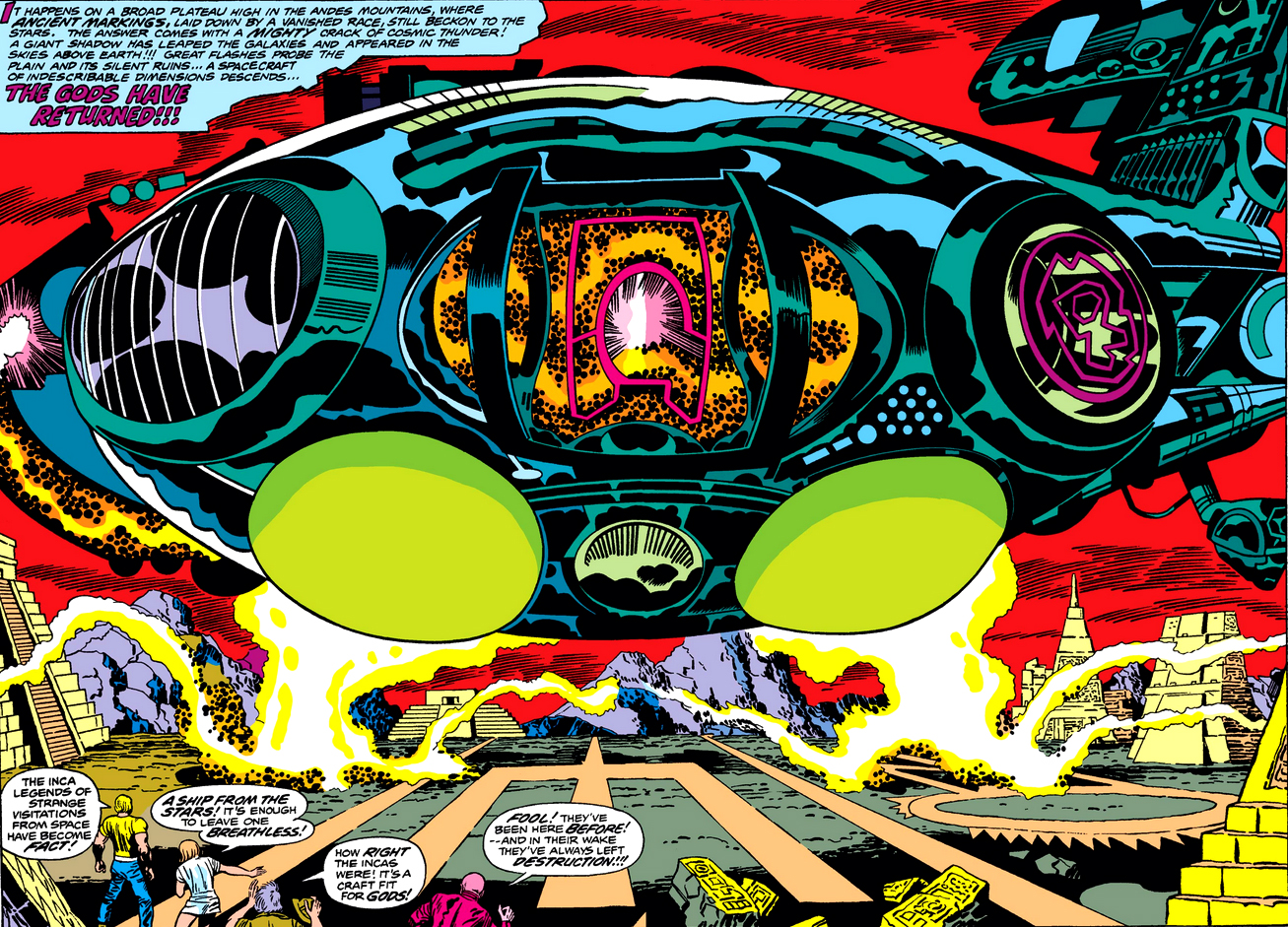
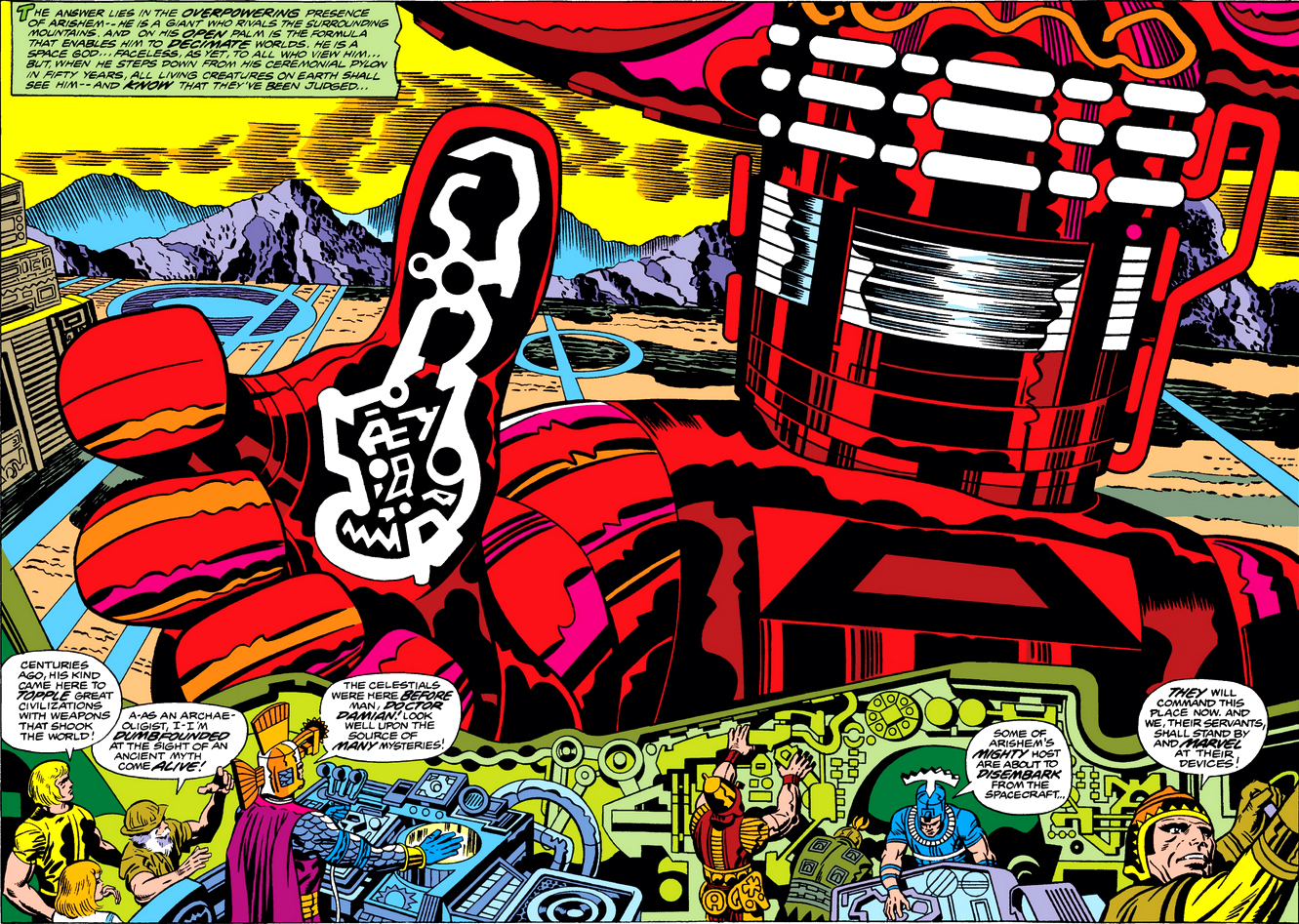
In 1979, when the mighty Thor made the decision to pursue and deal with the looming threat of the "space gods" known as the Celestials, his course took him to the Andes mountains in South America, and an ancient Inca city hidden inside an impenetrable dome where the fourth host of the Celestials had descended three years earlier to initiate a fifty-year judgment of the human race which might result in our destruction when that judgment was rendered. As we've seen, Thor was forced to alter his mission and instead rescue a plane full of innocent mortals whose passenger jet had been captured by the Celestials for further study; yet in that time he met and learned of Dr. Daniel Damian, an archaeologist who elected to stay in the city at the time the dome was sealed--while also trapped with Dr. Damian were the discorporated atoms of three S.H.I.E.L.D. agents who had been sent to the area to investigate, but encountered much, much more than they could have conceived.


To learn their fate, as well as the circumstances involving Dr. Damian's choice to spend the rest of his life in this "city of space gods," we circle back to get a look at these events through the eyes of the man who put them in motion: artist/writer Jack Kirby, who was producing a notable new series at Marvel known as The Eternals, a race of beings who came about when the first Celestial host arrived on Earth millennia ago and began experimenting with what was then the highest form of life on the planet--the ape--to produce, in time, three entirely different species, one of which was an advanced form of human which would live separate from their more primitive brethren and be immune to death (ergo, the Eternals).

One of their number, Ikaris, is present when Dr. Damain and his daughter Margo arrive to study the Inca city and artifacts which, incredibly, seem to represent beings not of Earth. And there is one other Eternal left to be discovered in this city--a fellow Eternal left in a crypt to await the day when the fourth Celestial host would arrive and deposit those who would decide the fate of a world.


Ajak, as we discovered previously, also became known to Thor when the Thunder God met the Eternals just prior to the arrival of the space gods' third host--and the two would renew their association one-thousand years later during Thor's time in the city where the Celestials had congregated to undertake their judgment of our world. But now, we return three years before that point, when Kirby has begun to share these inspired concepts for the first time--where Ajak and others emerge from the crypt where their atoms were stored by the Celestials pending their return to Earth, and we piece together the events which would eventually lead to Thor's involvement. Considering the stakes and beings involved, it's become all too clear that this would be a matter to eventually be settled among gods.


Monday, April 26, 2021

The City Of The Space Gods!


After resolving to confront the mysterious Celestials upon learning of their impending judgment which would decide the fate of the planet Earth, the mighty Thor hasn't fared well in his all-too-brief encounter with the first Celestial he has decided to challenge directly:

...unless you consider being atomized on the spot as a sign of progress!


And indeed, when the mammoth alien named Gammenon turns to enter the ancient Inca city shielded by the dome the Celestials have erected over it, there is nothing to indicate that a god had once stood among the peaks of the Andes mountains and waged a futile struggle against him. It's only when Gammenon sets down the aircraft full of passengers which he'd gathered for study that we learn what became of Thor in the instant of Gammenon's strike--and that even an Asgardian realizes there are times when discretion is the better part of valor.


As Blake disembarks along with the other passengers, however, he discovers not only another human already present in this city, but one of the race of Eternals he had met (as Thor) 1,000 years in the past prior to the coming of the Celestials' third host. The other, archaeologist Daniel Damian, had decided soon after discovering the existence of the Celestials in 1976 to stay in the city just before they sealed it off for the next fifty years, and take the opportunity to learn what he could of the space gods decades before the time would come when they would render their fateful judgment. Blake meets Damian after three years had passed--but the latter is startled to learn that not only does Blake have knowledge of the Celestials, but that "Donald Blake" is also something of an archaeological "treasure" that Dr. Damian is startled to see face-to-face.


Yet having more than met his match in defying one Celestial, how will Thor proceed now that he finds himself in a virtual nest of them?

Thursday, April 22, 2021

Within The Andes Wait... The Celestials!


It feels appropriately belated to make this admission fifty years after the fact, but I really had no substantive knowledge of or exposure to Jack Kirby's astounding concepts from his series The Eternals until a little over a year after that series had folded--because it was then when Roy Thomas crafted a two-part story published in Mighty Thor which served to usher in those concepts to the more mainstream Marvel universe which Kirby had kept at arm's length. (Though technically I'd say that my education began when I picked up the 1978 Thor Annual, where Thor was a witness--or, rather, not a witness--to the arrival of the third Celestial host.) My reason for giving The Eternals a wide berth had solely to do with the problem I had with Mr. Kirby's style of writing, thoughts that I've shared elsewhere in the PPC--a caveat which didn't apply to Mr. Thomas's handling of Kirby's characters, though a moot point when it comes to the Celestials since they aren't exactly verbose.

Thomas's 1979 saga involving the Celestials and the Eternals would also come to include the Olympians and the Asgardians, and would culminate in the 300th issue of Thor (though Thomas had by that time left the book)--a span of eighteen issues in all, which arguably extended the story perhaps longer than necessary and, in the case of several of those issues, digressed unnecessarily. But it had a promising beginning in those first two issues which saw Thor committed to investigating the current-day activities of the Celestials on Earth following Asgard's survival of a false Ragnarok and yet another falling out with his father, almighty Odin.


Which leads us* to Thor finally making tracks for the South American Andes mountains, and a meeting with "space gods" who would regard the Thunder God and his ilk as borderline inconsequential to their affairs.


*After, that is, a four-issue pause of filler stories (strange detours to make, considering how crucial Thor considers time running out on the impending judgment of the Celestials), featuring work by writers Mark Gruenwald, Ralph Macchio, Peter Gillis, Don Thompson, and Maggie Thompson, with artists Alan Kupperberg, Pablo Marcos, Wayne Boring, Tom Palmer, and Keith Pollard.  One of the four, co-scripted by Thomas, I still consider to be the most unreadable Thor story ever to see print (though there's another story which features Thor that comes in a close second!), and, to this day, have yet to summon the fortitude to review it for the PPC.


Monday, October 5, 2020

What's green, immensely strong, leaps, and wears ripped purple pants? Don't ask the Eternals...


During his second and final stay at Marvel Comics from mid-1976 to early 1978, Jack Kirby took on a number of creative projects of which he assumed control as both artist and writer, while choosing to distance his work from any connection to Marvel's "universe" of characters--with the exception of assuming the reins of the existing Captain America book as well as beginning a new Black Panther series, while allowing the former to make use of the Falcon, Leila Taylor, Sharon Carter, Magneto, the Red Skull, and the trappings of S.H.I.E.L.D.

Yet though Cap readers might disagree with me, it may have been Kirby's work on The Eternals which garnered the most attention--an imaginative fresh take on human evolution, featuring a new race of super-powered immortals with names fashioned after the Olympians as well as an enigmatic race of space gods that left an indelible mark on ancient Earth.


Having still been involved in comics collecting at the time, I'd bitten the bullet and picked up Kirby's Cap and Black Panther books, knowing going in that both would be difficult reads due to Kirby's dated writing style that hearkened back to his own memories of what comics were like and what comics should always be like--but I steered clear of Machine Man and certainly Devil Dinosaur, while being content with the Eternals I remembered from the pages of Fantastic Four. Over time, however, thanks to their appearances in other books, I've become more familiar with the Eternals and the rich backstory which Kirby provided for them as they gradually became more integrated with Marvel's characters and continuity during the 1980s, now free from Kirby's segregation.

And so I can imagine how surprised readers of The Eternals in 1977 must have been to see one of Marvel's most visible headliners appear and be acknowledged in a book that would normally have kept him and others of his number at bay.


Thursday, August 27, 2020

A World For The Taking!


As if we humans don't have enough to worry about from preying on each other, whether in brutal war or heinous criminal acts, humans in the fictional world of comic books were subject to attack and slaughter by primeval forces that regarded primitive man as no more than indigenous beasts to be subjugated and abused or killed without regard. It seems ancient Earth was very popular with malevolent beings that paid little to no heed to their treatment of humans and whose rule of the Earth would last for ages, eons, millennia, or whatever lengthy term suited the story's writer. Given such a vast time span, you would think the ruling periods of one or two of these despotic entities would have overlapped, resulting in a turf war that would have laid waste to the world and its unfortunate inhabitants--nor do we ever seem to learn of such horrific times from historical tomes, but rather from the vile creatures themselves who somehow manage to return with the intention of picking up where they left off.

Following you'll find a brief PPC overview on the subject, in no particular chronology or preference. You'll note certain omissions that didn't strictly conform to the topic (with one exception)--e.g., evolutionary tinkerers such as the Celestials, the Kree, Mr. Sinister, Apocalypse, et al., as well as latter-day threats along the lines of Belasco, Kulan Gath, the Serpent Men, and others acting on behalf of their masters. Nevertheless, do chime in if you feel there is a party that should be represented here--I'm definitely not up on all of the ancient horrors that tried to stake their claim on our world back in the day... er, eon. ;)

Though speaking of the Celestials, we can start with one of their discarded failures, the Deviants, who went on to conquer the entire world and enslave mankind for the duration.


Again, word of the ark has been passed down--but nothing about a race of misshapen monsters that kept humans as slaves and ruled in tyranny for centuries? How does something like that slip through the cracks?

Then we have Chthon, one of the Earth spirits who wasn't content to "step down" from an active role as did his sister, Gaea, but instead scripted one of the most evil grimoires in existence, the Darkhold, to pave the way for his return. Chthon, unlike the others we'll see listed here, didn't so much as gain a foothold on our world but, like Dormammu, didn't want for lack of trying.


We have Chthon to thank for vampires, werewolves and the like--as well as for the N'Garai, our next entry:


As we can see, creatures such as the N'Garai had many thralls such as Kierrok to act in their interests. And while the individual known as Psyklop acted to appease the so-called "Dark Gods," it turns out that Psyklop's race also had advanced to the point of ruling the Earth in ancient times.


And let's not forget about the Undying Ones, who ruled the Earth for "unnumbered ages" under the control of their master, the Nameless One:


Earth also fell to the Four Horsemen of the Apocalypse, the vanguard of a race which ruled the Earth for an indeterminate length of time until they were vanquished in a 100-year war by another race that presumably took their place as the planet's rulers.


(That's a lot of mushroom clouds going off on ancient Earth. You would think one of them would be noted in a scroll or two somewhere.)

Which brings us to the last of our tyrannical abominations, this one eventually slithering its way into New York City:


Before ripping into present-day Times Square, however, Shuma-Gorath was lording it over prehistoric man, before the time traveler known as Sise-Neg dealt it a setback.


It's a wonder that you and I are even here to talk about all of this, given the number of times the human race has been decimated by those creatures who held our species collectively under their thumb (or what passed for a thumb) over the ages. It's also a testament to the resiliency of the Earth itself, having weathered cataclysm after cataclysm and no doubt giving Gaea cause to yearn for a long vacation. Somehow the Inhumans, who were present during prehistoric times, managed to isolate themselves from these conflicts, when you'd think their advanced race would have been a prime target for the Deviants and most of the others listed here (we could say the same for the Eternals); surely their historical records would have complete accounts of global conflicts which occurred on the scale of what we've only seen here in glimpses.  Then again, perhaps we humans are better off not fully knowing the grim travails suffered by our unfortunate ancestors.

Monday, June 1, 2020

Exodus!


While I'm sure none of us would want to take on the engineering ordeal of having to devise a way to move and relocate an entire city, along with its foundation, intact, there doesn't seem to be much to it in the world of fiction, depending on the level of science and technology that's available to draw on. We know the Borg can have a city excavated and airborne faster than its population would even realize what was happening, which is saying something. In comics, the uncanny Inhumans have accomplished such a feat twice, though each time they received invaluable assistance from allies.

Back in the day, Attilan, the Inhumans' Great Refuge, was located on an island (the "Isle of Attilan"), where Black Bolt, troubled in the 1950s by a growing fear that their civilization would inevitably be discovered by the advancing technology of humans, began a search for a more isolated location for his people; yet originally, the plan to relocate was far less ambitious, involving nothing more than locating a suitable, secluded site and moving their population, supplies, and technology by use of massive ark-ships. Having encountered the Eternals and their leader, Zuras, who gladly offered the assistance of himself and his people in their undertaking, the new location was selected in a valley in the Himalayas which had a perpetual cloud cover to hide it from the air. Using their mental energy, the Eternals, along with Black Bolt, excavated a pit in the spot where the Inhumans' new city would be built.

And so, when Black Bolt returns with his news, the plan to relocate is initiated.


But leave it to a single child to derail an entire operation, eh?


With a new plan in place, the arks are refitted to include special gravimetric generators which could lift and suspend the city and its foundation--and when all preparations are made, the great migration begins!


As you might have already noted, a floating city traveling across the skies would surely make it more likely for knowledge of the Great Refuge's existence to be spread across the world, particularly when air defense craft would approach and begin making detailed reports. But the Eternals appear to have that eventuality covered--and soon enough, Attilan is lowered to rest in its new environment.


But when the need arises when Attilan must be moved again, yet there is nowhere on Earth to relocate where the Inhumans can survive--what then?