Showing posts with label John Buscema. Show all posts

Thursday, June 15, 2023

The Fantasy Scenarios of Marvel's Epic Illustrated


Throwing its hat into the ring with publications such as Heavy Metal, Weirdo, Raw, and heaven knows how many horror magazines, 1980 was the year that saw the launch of Epic Illustrated, Marvel's comics anthology magazine which brought a variety of talent to its pages from such notables as Harlan Ellison, Frank Frazetta, Robert E. Howard, Neal Adams, Berni Wrightson, and Pepe Moreno and Rick Veitch (both new artists at the time)--along with familiar names from Marvel such as Bill Sienkiewicz, Marv Wolfman, Marie Severin, John Byrne, Doug Moench, Denny O'Neil, Bill Mantlo, Frank Brunner, Archie Goodwin (Epic's Editor), Barry Windsor-Smith, Rich Buckler, Stan Lee, Craig Russell, Ralph Macchio, Terry Austin, Roy Thomas, Stan Lee, et al. Epic, not bound by the Comics Code and opening its door to more explicit content than what's normally found on the comics page, offered an outlet which no doubt appealed to its contributors, who retained ownership of their material and were paid royalties.

In addition, many stories were continued from issue to issue, effectively allowing their creator(s) a gap of 2-3 months to turn in their pages. Yet that leeway would work against one such tale, "The Last Galactus Story"--consisting of nine installments, but its last unfortunately coinciding with the magazine's cancellation in 1986 before it could see print. Epic's twenty-sixth issue bears a splendid cover by Bill Sienkiewicz (pictured above) which represents that story, while inside we find the story's first installment by John Byrne and Terry Austin.


Byrne would later provide on his blog a synopsis of the intended tenth installment, which visually would have been something to see:

"At the virtual End of the Universe, Galactus is confronted by a Watcher. This Watcher turns out to be the same one who witnessed the "birth" of Galactus in our universe. The Watcher (not Uatu) was eventually driven mad by the accumulated guilt he feels for the acts of Galactus. He has been trying to move galaxies to somewhere Galactus cannot find them, but has been destroying them in the process. Galactus and the Watcher battle -- a huge cosmic confrontation that stretches over centuries, as the universe falls into near total entropy. Finally, to defeat the Watcher, Galactus sucks all the remaining energy out of the Universe. Nothing is left but Galactus and his loyal herald, Nova. Realizing at last what his purpose is, Galactus cracks the seal on his suit, starts to remove his helmet, and in that instant all the energy he has absorbed explodes out of him. He becomes the "big bang" of the next universe, and when the smoke clears, we see Nova has been reborn, as that universe's Galactus."


Stan Lee (with artist John Buscema) also contributed his own Galactus story, this one involving the Silver Surfer and taking place at the end of the universe... but what lies beyond?


And it wasn't at all surprising to find writer/artist Jim Starlin contributing material to its pages.


In its first year, Epic was published seasonally and thereafter shifted to bimonthly publication from that point on. Its selling price then at $2.50 an issue, combined with with its expensive printing process and reportedly poor sales, led to the magazine closing shop after 34 issues in 1986. But what an impressive step forward for the genre, and a successful experiment that's seen its stories appear in other collected works through the years. In addition, Epic Illustrated led to the Marvel imprint Epic Comics launching in 1982, which operated under the same freedoms and benefits for its contributors and consisted of titles such as Jim Starlin's Dreadstar, Frank Miller's Electra Lives Again, Havok & Wolverine: Meltdown by the Simonsons with artists Kent Williams and Jon Muth, and Swords of the Swashbucklers by Bill Mantlo and Jackson Guice.


Thursday, May 11, 2023

Time Keeps On Slippin', Slippin', Slippin'...


Good grief, I thought in our senior years we became less busy.  Where does the time go? Wherever it's fled to, I'm running low on it this week, so I thought I'd once more raid my cache of graphics that I've stored from here and there and cobble together a little John Buscema goodness for you--mostly prior work that never saw the comics rack, with one or two homage prints thrown in.

Leading us off is someone else who appears to have run out of time--the Silver Surfer, who in an unpublished Buscema cover from his first series falls victim to none other than the heir of Frankenstein!


Thursday, March 2, 2023

Earth's Mightiest Floating Heads!


"I like to goof off now and then, too, you know." - (Mrs.) Young-Ja Kim

Always one to take the sentiments of the redoubtable Mrs. Kim to heart (if I know what's good for me), I've finally gotten around to a little goofing off of my own by exploring a subject we readers of silver- and bronze-age comics are all too familiar with: Those aghast, worried, concerned, taken aback, consternated, and certainly conspicuous floating heads on issue covers which appeared out of nowhere to draw attention to whatever and whoever they were casting their piercing gaze(s) on.

It seemed a rare day when we saw such bodyless faces appear in titles featuring a solo character, since both hero and villain(s) were occupied in full-size poses slugging it out on a given issue's cover--but in group books, they were all the rage, carefully placed on valuable cover space to provoke a reaction in the comics browser that what awaited within was momentous enough to merit spending their hard-earned change on. It also goes without saying that they were also useful in a marketing sense when other characters in the group didn't make it on the cover but rated a head shot in order to let the prospective reader know that whoever they might have been most interested in still showed up in the story.

Both Fantastic Four and The Avengers featured a prodigious amount of floating heads in their first volumes, but it's the latter title which offered more variety when it came to its characters given the sheer amount of different Avengers to choose from. As for the approach we'll take with this, it became more interesting for me to present these "floaters" on their own and out of context rather than blending in with whatever else was on the cover. It turns out that, in just over 400 issues, there were only a mere twenty-five instances where these heads appeared before tapering off around 1990. Nevertheless, they made their mark, and are not to be confused with groupings of other, equally familiar floating heads:


And so let's get to it--though it seems that three of the Avengers have already taken a glance at this collection and are less than pleased with the direction we're headed in. You'll have to take up your grievances with Production, gentlemen!


Artwork by Gil Kane and John Romita
(Prior framing art by John Buscema and George Klein)

Thursday, January 19, 2023

The Marvelous Wizard Of Oz!


I was literally nonexistent when "The Wizard Of Oz" premiered in 1939, but caught it in one of its many (and, at the time, annual) reruns on the small screen. Bowled over by the story (adapted from L. Frank Baum's book), and captivated by the production, it was through the film that I also went on to became an admirer of select members of its cast--notably, Judy Garland (as Dorothy) and Margaret Hamilton (as the Wicked Witch of the West); but I was also appreciative of the work of Ray Bolger (the Scarecrow), Bert Lahr (the Cowardly Lion, its adjective unfortunately but affectionately forever linked to the character's name), Jack Haley (the Tin Man), and of course Frank Morgan (the Wizard) and Billie Burke (the muddled Good Witch of the North). In addition, as a viewer of "The Beverly Hillbillies" I came to learn that it was Buddy Ebsen who had first been chosen as the Scarecrow and recast as the Tin Man, before finally having to drop out of the production after falling ill from the aluminum dust in his makeup. (Hamilton would have her own mishap courtesy of the effects crew.)

So it may sound strange that I didn't give "MGM's Marvelous Wizard of Oz" the time of day when it was released in Treasury Edition format in 1975. A neo-comics collector at the time, I suppose my first-glance impression of the publication was that, having seen the film several times, a strict adaptation of it wasn't going to bring anything new to the table for me, even as an "Authorized Edition" (i.e., with the permission of MGM) of it. Only now can I appreciate the creative talents involved in its production--as well as the distinction it holds as the first joint publication of DC and Marvel Comics, which at first I assumed was due to the presence of DC letterer Gaspar Saladino (aka Lisa Petergreg), who worked steadily at the company since the 1950s (though also a Marvel freelancer). Stan Lee's brief* Soapbox promo on the subject made it seem wholly a Marvel production--but writer Roy Thomas would later provide additional info on the matter that illuminates DC Publisher Carmine Infantino's own efforts, as well as some other interesting tidbits.


*You might say the Oz entry could barely get a word in edgewise. During 1975, Lee unashamedly smothered his Soapbox space with incessant announcements of his "Origins of Marvel Comics" book, to say nothing of including review clippings for it as well as teasers for its sequel.

Having seen this issue now for the first time, I must say that it's a fine effort from all involved. Thomas (who was right about Buscema's recollection of the film being spot on) does his usual first-rate work; Buscema and his art team ("the Tribe," aka Tony DeZuniga's studio), along with colorist Glynis Wein, have produced roughly eighty pages of material here; and Saladino, as expected, doesn't disappoint. Since this issue stays tightly true to the film presentation (as opposed to, for instance, Marvel's adaptation of "Star Wars"), a detailed review would be both unnecessary and redundant, especially when so many of you are familiar with the MGM production (and if you're not, I'd like a word with you :) ) -- and so I'll simply be presenting key scenes and keeping my comments brief. It really has been a treat to bring this to you, and I'll be interested in your own memories of it.


Thursday, November 10, 2022

"The Heroes and the Holocaust!"


In 1981, Marvel Treasury Edition brought to an end its seven-year series with its "final edition" (so to speak) that featured characters from both Marvel and DC Comics in a whopping 68-page story--long overdue for a presentation in the PPC and, as a real treat for yours truly, one which I'm looking at myself for the first time, having initially passed on it at the counter over forty years ago.


Given the listing of credits, it's no wonder that DC gave its approval to those assigned to the job:

  • Pencils: John Buscema, arguably Marvel's biggest gun on story art at the time;
  • Inks: Nine different artists inking Buscema's backgrounds, with Joe Sinnott handling all of the characters;
  • Letters: Joe Rosen, brother to fellow Marvel letterer Sam Rosen*;
  • Front cover art: John Romita (layouts) and Bob Larkin

*In such stellar creative company, I almost expected to see Sam Rosen's name joining them; but by this point, he'd left Marvel, his final (albeit incomplete) work for the company having been submitted about nine years prior. But I think you'll find that Joe turns in exemplary work on this story.

While on scripting, we have Editor-In-Chief Jim Shooter, with plotting suggestions submitted by Marv Wolfman--though initially different arrangements had been made, as Mr. Shooter explains**:

   "I picked Marv Wolfman to write the book for a number of reasons: he was a marquee name and deservedly so, he was in New York, conveniently, he was absolutely reliable, and most of all because he really, really wanted to do it.
   "Somewhere in the middle of plotting, Marv’s employment agreement expired. We weren’t able to come to terms on a new one. He had an offer from DC, and opted to take it. So, Marvel was obliged to provide another acceptable writer. I was the only Marvel writer who had written both Superman and Spider-Man. I didn’t have a lot of time on my hands, but neither did the other leading candidates. So, I took it on. DC had no objection."

**Condensed for brevity. You can find Shooter's full and fascinating remembrances of this project on his blog, in three parts.


Predictably, there are a number of things to look forward to here, as those of you already familiar with this edition know. For one thing, it's a fine overall story. The beginning lays out its direction with Spider-Man's discovery of suspicious activity; the heat is turned up a bit by out of the ordinary behavior on the part of the incredible Hulk (if one can even use the word "ordinary" in regard to his actions); Superman arrives and begins his own investigation, leading him to the doorstep of the Latverian Embassy and you-know-who; there's the added variable of the man named Parasite, an energy-draining character who had been imprisoned by Superman but becomes aligned with Doom; there is also Wonder Woman's presence, lured by Dr. Doom to New York for some unknown reason; while Spider-Man's own progress in the investigation leads to joining with Superman against both Doom and Parasite.

The key player in leading us through this story's developments, however, would be Doom--whom we come across early on and provides us with the knowledge of an ongoing plan that brings him closer to world domination. This early in Shooter's story we're provided with no specifics as yet; yet the master of menace, and manipulation, will be responsible for a good deal of what you and I will see from this point going forward.


Thursday, October 20, 2022

Big John Meets S.H.I.E.L.D.!


While artist John Buscema had done work for Atlas Comics in the late 1950s, it was only after the pivot to super-hero books by its successor, Marvel Comics, that we were treated to his initial work for the company in that genre in November of 1966.  Published that month was his first Incredible Hulk work with inkers John Tartaglione and Mickey Demeo in Tales To Astonish--while over in Strange Tales, he turned in pencils over Jack Kirby's layouts for a Nick Fury, Agent of S.H.I.E.L.D.! tale which sees signs of the return of Hydra just ten issues after SHIELD supposedly put an end to the organization for good.


With all respect to SHIELD and Mr. Kirby, this test amounts to (as Fury would say) some of the most lamebrained science this side of a Grade B sci-fi flick, with half the budget. Why risk the head of SHIELD--or the life of anyone--on this stunt? Unless this "Overkill horn" actually needs a human being to emit the sound it needs to unleash its sonic beam, why wouldn't something as simple as an air horn from any football game (or its SHIELD equivalent) fit the bill? And if a human was needed, couldn't a recording by Fury (or anyone), triggered from a control booth, suffice?

Nevertheless, the test is successful--though the fact that the Overkill horn works as designed is disturbing in itself, since its success all but confirms the existence of the device in someone else's hands.


Monday, July 11, 2022

The Sorcerer, The Ally, and the Avengers!


Even as early as its Silver Age books, Marvel was discovering the value of story crossovers in regard to not only profit but also as a means to entice readers to pick up a title that they'd passed on or didn't know about. In addition, the practice may have also helped to light the match of the budding collectors of the day, well before the marketing insanity of multiple crossover "events" would make even collectors balk. The early days of crossovers also offered the likelihood that the same writer would be handling scripting for each of the issues, while art buffs benefited from the opportunity of either seeing the same artist pull double duty or a different artist's take on the other book's character(s). Some examples that may come to mind in that respect were the Daredevil/Fantastic Four crossover featuring Dr. Doom (with artists Gene Colan and Jack Kirby), the X-Men/Avengers story involving Magneto (both penciled by John Buscema), and the Avengers/Incredible Hulk tale (featuring the work of both Sal Buscema and Herb Trimpe) which introduced an intriguing new villain, Psyklop.

In 1968-69, Avengers scribe Roy Thomas was also handling the first solo series of Doctor/Dr. Strange (the good doctor's masthead title abbreviated at about the halfway point) and would feature two crossovers during its 15-issue run. Regrettably, the second crossover, depicting the threat of the Undying Ones, would occur posthumously following the book's cancellation, in issues of Sub-Mariner and Incredible Hulk--but the prior crossover would have its conclusion take place in a more high-profile title, as well as bring in a guest-star along with a threat drawn from no less than the realm of the gods.


Monday, May 2, 2022

Silver Surfer: Judgment Day!


One project from Marvel which completely slipped under my radar in 1988 was the Silver Surfer: Judgment Day graphic novel--plotted by artist John Buscema and Marvel Editor-In-Chief Tom DeFalco, scripted by Stan Lee, and clocking in at sixty-two pages. The story's climax features a confrontation between the Surfer's perpetual menace, the demon Mephisto, and his former master, Galactus--with Nova, the current herald of the planet devourer, playing the role of unwitting accomplice caught up in Mephisto's web of deceit.

In addition, as will become quickly evident, Buscema has decided to contribute full-page art for the entire story--perhaps a complication as far as tying together the visuals in a meaningful way while awaiting sufficient captions and dialog to hopefully provide a riveting and engrossing experience for the reader. This work would be years removed from the books of the Silver Age where Lee hit his peak in doing just that, for the most part--but while Lee would prove to be more than adequate in handling the Surfer's 1978 graphic novel delineated by Jack Kirby, a story where a writer had the luxury of dealing with more conventional panels which offered the opportunity for details and subtleties that would do a great deal to invest the reader in the story, here there is instead mostly grandiosity to account for, along with Mephisto's trademark guile and relentlessness which tend to transfer easily from story to story without much variation. Given the format which Buscema has settled on, is Lee up to what's being asked of him?

This excerpt from the story's Foreword almost gives the matter a sense of mitigation after the fact, though that may be reading too much into it:


All of that being said, it was an interesting venture for Buscema and Lee to undertake, and, I don't doubt, a successful one. John Byrne took his own steps with such a format two years earlier with a 22-page story for Marvel Fanfare--the difference of course being that it played out on a third of the scale, but also having the advantage of the artist and writer being on the same page, as it were, in terms of a tighter meshing of story and art (at least to the extent that such a format would allow). The same could be said for Walt Simonson's similar effort in a story published toward the end of his run on Mighty Thor just a few months later.  Here, the bar is raised a bit for Lee, who fared well with his collaboration with Kirby as well as his one-shot story with Byrne (the latter also having involved Mephisto) but must now go beyond DeFalco's and Buscema's outline to craft a compelling and engaging tale, with virtually each page holding a measure of responsibility for its success.

The story begins with another failed attempt by Mephisto to entrap the Surfer and thus seize his soul. And as the demon ponders his latest setback, it's clear that his resolve to achieve his goal is as steadfast as ever.


"Again the deadly plan of Mephisto has been put to rout! But what does it matter?" A refrain that has become as worn as a doormat by now where the Surfer is concerned.


Thursday, March 31, 2022

Tempests In Time!


In 1974, Marvel's House of Ideas was brimming with them. The company's fan magazine, FOOM, remained a hit, reaching 25,000 members; the first issue of Spidey Super-Stories went on sale; Stan Lee would announce the publication of The Origin of Marvel Comics (a working title which would be tightened up to Origins of Marvel Comics), as well as the release of the first Marvel Superhero Calendar (another working title, becoming The Mighty Marvel Calendar); and perhaps most notably, its ambitious Giant-Size line of books launched, which supplemented a number of regular monthly titles on the stands but with a higher page count and, it goes without saying, a higher price tag.

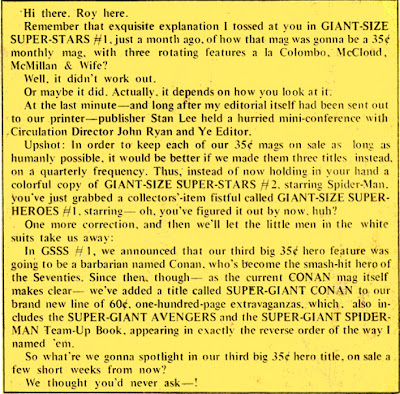
The Giant-Size books have already received their due in a separate PPC post; but in thumbing through my copy of Giant-Size Fantastic Four #2 recently, I was reminded of how the company's handling of these books see-sawed throughout their production, with ideas being tossed into the air like confetti but lacking in execution, as typified by a full-page notice/advertisement by Editor Roy Thomas:


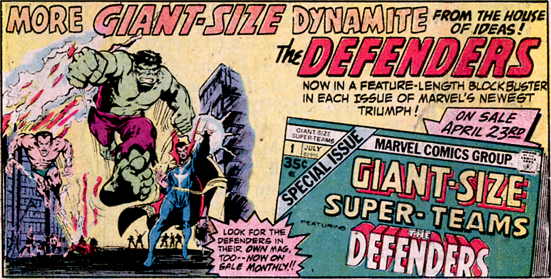
Unless they saw a very limited release that never hit my town, the SUPER-GIANT 100-page books never saw print (that I know of). Neither did the title which Thomas previewed following his announcement:


Personally I thought a book named Giant-Size Super-Teams had "winner" written all over it, since it would have at least four teams to rotate in addition to having the option to preview a new team idea should anyone come up with one. (Though the ad appears to imply that the new book would exclusively feature the Defenders, instead.)  But all of these fruits died on the vine, as did, eventually, the entire line, engulfed by reprinted material when fresh new stories could no longer be supplied.

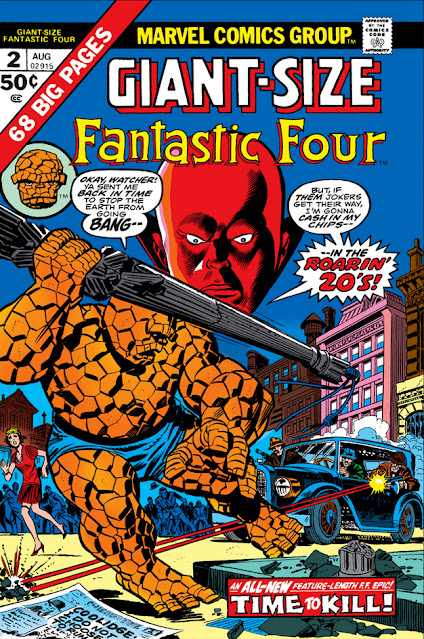
The second issue of Giant-Size Fantastic Four was already signalling the title's future fate--its "68 Big Pages" amounting to less than half that amount with original material, while ads and a reprint FF story were used to fill the page count. Still, there is the Fantastic Four (with Medusa instead of the Invisible Girl); and there's writer Gerry Conway with artists John Buscema and Chic Stone; and there's the Watcher; and there's time travel; and there's Willie Lumpkin; and there's a brand new foe to contend with.

Though we're not talking about just gangsters giving the FF a hard time.


Thursday, January 20, 2022

Crowd Control


Comics stories derive a good deal of their drama from groups or crowds of ordinary people being present while heroes go about their business in major cities or other populated locales, whether interacting with those on the street or in offices or being mindful of those caught up in battles with foes which tend to endanger innocents who are unfortunate enough to be in the wrong place at the wrong time. Yet on issue covers, which having the opportunity to convey a powerful image with large crowds who find themselves in the midst of a situation involving the title character(s), crowds are often elbowed out of the picture in order to present the story's main characters, including of course whatever individuals are responsible for selling the book.

But while rare, those cover images are noteworthy, and in some cases memorable depending on the circumstances of the story and the creative talent of the cover artist--and today you'll see a collection of such covers from the first volume of various titles where ordinary people do their part to help establish whatever crisis our heroes must face in the pages of the issue's story. As for a starting point, there's only one cover which stands above the rest in capturing this post's theme perfectly--pictured here with its homage cover rendered nearly twenty-eight years later.


Thursday, October 28, 2021

Marvel's Classic Corner Boxes: Mighty Thor Vol. I, Incredible Hulk Vol. II


Marvel corner boxes seem to be a thing of the past, but at the PPC we're reaching back and reassembling them in all their glory. Having already run down the collection of corner boxes featuring the Fantastic Four, we now pivot to the God of Thunder, Thor, as well as the rampaging behemoth men call the Hulk, two characters who have gone head to head in previous meetings and who now face off again in a contest where they can't possibly injure one another. (We hope!)

Since a coin toss would probably have proven fatal for yours truly, depending on which side it landed, it seems fair to start our showdown with the character whose comic premiered first--but even though that would be the Hulk (by three months, but a win's a win), his six-issue first volume had no corner boxes to display. It wouldn't be until 1964, when the character was brought back in Tales To Astonish as a companion feature to Giant-Man, that the Hulk began appearing in corner boxes; the Journey Into Mystery book, however, where Thor first appears, displayed its first box of the Thunder God in 1963.

None of which I explained to our two heavy hitters, since they seemed a bit impatient to get this ball rolling. I just assigned the honor of going first to the oldest one present, which was Thor by a landslide.

Yet Thor's corner boxes in his initial appearances didn't exactly knock it out of the park for him--in fact, I'd made a comment at one time which likened Thor's image here to some kid's yearbook photo.


As we see, the grinning face shot was changed to a more serious, godlike portrayal, which would still be put to use well into the run of Thor's own title.

As for the Hulk, his boxes in TTA weren't exactly sensational, either, though things improved just before the book was discontinued. (Yet it bears mentioning he had more staying power than Giant-Man, who had enjoyed first billing in the book, so he must have been doing something right).


Thursday, September 23, 2021

This Way Toward... Doom!


Perhaps eyeing the success of the DC horror/fantasy anthology titles House Of Secrets and House Of Mystery, Marvel launched two similarly themed books in late 1969: Tower Of Shadows and, one month later, Chamber Of Darkness. Like their DC counterparts which were published on a bimonthly basis (off and on), both Tower and Chamber hit the stands every other month--but it seems the similarity ends there in terms of sales, as Marvel's offerings sold poorly and were discontinued after ten and eight issues, respectively. Tower, premiering first, seemed somewhat better received by readers, judging by letters page response, though the ratio of raves to more critical assessments appeared to be about 30/70. There was also the question of sustainability, as both series began pulling in reprinted material from their earlier anthology titles from the '50s-'60s (Strange Tales and Tales Of Suspense) with their sixth issue.

Suffice to say that DC's House titles were in no danger of readers jumping ship for Marvel's offerings--though it wasn't for lack of trying on Marvel's part, at least initially, as some of the company's most notable talent were tapped to contribute stories. Roy Thomas, Jack Kirby, Stan Lee, John Buscema, Gene Colan, Len Wein, Marv Wolfman, Jim Steranko, et al. (including John Romita Sr., who mostly did cover work) were seemingly able to accommodate seven-page assignments (or less) within a two-month window (though I believe Steranko withdrew after only one story, reportedly due to a disagreement with Lee)--with some artists even pulling double duty and contributing scripts as well as art, in addition to inkers providing readers with examples of their own pencils.

After their all-too-brief runs, each title shifted to formats made up of almost entirely reprinted material, in addition to adopting new mastheads. Tower became Creatures On The Loose, which mixed its reprints with sword and sorcery tales as well as a regular feature on Man-Wolf, while Chamber morphed to Monsters On The Prowl--each book having a run of 30 to 37 bimonthly issues (the creatures pulling ahead of the monsters--make of that what you will). But since there's a little more ground to cover with both Tower and Chamber, and having already examined Jack Kirby's stories in the latter, let's turn to a few samples from some of the other names we've mentioned who made their mark in the macabre during the brief time when these two titles were being published.


Monday, March 15, 2021

Mission To The Center Of The Earth!


When Roy Thomas kicked off his initial seven-issue run on Fantastic Four in 1972 with a look at their origin story as narrated by Ben Grimm, it seemed fitting that he would follow up with a story which featured the return of the Mole Man, who holds the distinction of being the book's first villain from its premiere issue in late 1961. But judging by the covers for the two-part tale, things aren't looking good for one FF member in particular... specifically, the Thing, who undertakes a mission on his own to confront the Mole Man on a personal issue.  Because from what we see at first glance, it appears that if the Mole Man doesn't kill him, the Human Torch will!


But, exactly what is Ben Grimm after in his single-minded quest to the center of the Earth? As the Thing reaches the abandoned site where the Mole Man had created a trap for the FF three years earlier (if we're going by real time), Thomas's narrative brings us up to speed on what preoccupies Ben's thoughts, and why he believes that the Mole Man is best suited to help him.


Part of Thomas's premise regarding Ben's rationale is on shaky ground, which Thomas himself will concede at this story's conclusion while failing to explore the second part of the premise altogether. Yet chances are the reader is at this point swept up on the momentum of the Thing's mission--and as Reed would put it later, as long as Ben holds out hope of success, then we have to share that hope.

And speaking of the rest of the FF: While it was Ben's decision to keep the rest of his team out of this, Johnny Storm has caught wind of Ben's encounter with their belligerent landlord, Collins, and put two and two together regarding Ben's destination. And so, like it or not, the Thing will soon have his closest friends supporting him on this mission.

Unknown to the FF, however, is that they'll also be fighting for the fate of the entire world!
 

Thursday, September 17, 2020

Lo! The Less-Sinister Lethal Legion!


Having had occasion recently to come across a cover of an unpublished cover of The Avengers from 1970, I found myself asking the same question that usually comes to mind in such instances: What prompted the decision to re-do this cover? It's enjoyable to look at the original draft with a critical eye and put yourself in the position of the one tasked with clearing it--or not clearing it--for publication, while trying to determine what it was about the original rendering that wasn't deemed either suitable or marketable; but we can probably agree how much more interesting it would have been to have learned the actual reason straight from the source. A pity some sort of index of these types of cover substitutions was never collected in book form, complete with notes detailing just that. We could call it "How To Draw Comics Covers the Marvel Way!" :D

There are no doubt a number of such covers that for whatever reason didn't make the grade, a few of which can be found in the PPC as well as other fine comics blogs and forums. This particular Avengers cover certainly invites speculation, given that it so closely aligns with the final cover with only a few "touch-up" alterations of note.


A purely symbolic cover by artist John Buscema, of course, unless the Grim Reaper got his hands (was his scythe over in the corner?) on some of Henry Pym's shrinking gas and used it on the Avengers so they would fit in their hourglass prison. The reality is a little different:


We'll have to take the Reaper's word that his victims' gaseous prison is part of a large hourglass-shaped structure, since it resembles more of a clamped bell jar here (leaving writer Roy Thomas no choice but to account for Buscema's cover image by means of dialog)--a very cramp fit for the likes of Goliath, no doubt.

Some differences between the two covers are understandable at a glance. The hourglass itself has been altered and shifted in position somewhat, perhaps to make room for the caption at the lower right announcing the members and name of the Lethal Legion without it overlapping Quicksilver (who has enough to worry about as it is); it's also worth mentioning that in the original, at least part of the hourglass is transparent. Also, the final version of the, eh, legionnaires has them looking appropriately sinister, but noticeably less sinister than their draft counterparts. (For what it's worth, I found their appearance on the original much more eye-catching from a sales standpoint, so I can't help but be curious as to the reason why that aspect was subsequently toned down.)

In addition, the Man-Ape has been lowered a bit, presumably to prevent part of his headpiece from being obscured by the masthead (or vice versa, though there have been plenty of instances where part of a cover's masthead has been eclipsed by the artwork)--while the corner box has shuffled the Avengers around (though leaving Goliath as is) and adjusted those heads which were tilting. As for our captives, with the exception of Captain America and the Black Panther, their expressions and positioning have been altered, along with the loss of some detailing--both observations holding true for our villains, as well.

Since the basic cover concept has remained intact, it remains unclear what would warrant the decision to have Buscema make what amounts to cosmetic revisions. Do pipe in with your own thoughts on the subject if you have something to add--the Legion certainly won't mind, considering that either way they still have the Avengers where they want them! ;)

Thursday, September 3, 2020

...In The Cause Of Death!


The universe is in deadly danger! The shadowy hand of the being known as Infinity extends its grip across the stars to engulf world after world, causing them to disappear into its Stygian darkness where their inhabitants are drained of their collective will and exist from that point to serve the one who holds them helpless. Made aware of the dire threat from the halls of Asgard, omnipotent Odin has travelled to the World Beyond to probe the secret of Infinity, but now battles for his immortal life--even as his son, Thor, having no recourse but to part with his mystic hammer in order to save his comrades, is forced to transform once more to his mortal form of Dr. Donald Blake and watch in horror as the servant of Infinity named the Guardian approaches to slay him!

"What to do?"--the question each of these men must ask themselves as they both face a moment of crisis. Blake dares not retreat from where he stands, since his hammer will descend to that very spot once it returns from its task, and changing back to Thor is his only chance to survive... but will it arrive too late? As for Odin, aware of his son's danger, he dares not turn his attention from battling a deadly foe who appears to be more than his equal, even for the moments it would take to save the Thunder God.


It seems that Odin has made his choice--and with the Guardian within arms' (and arms') reach of Blake, not a moment too soon!

Monday, August 31, 2020

Worlds Will Fall To... The World Beyond!


Having spent nine years (!) writing the continuous adventures of Thor in Journey Into Mystery, Mighty Thor, fifteen issues of The Avengers, and numerous guest appearances, Stan Lee would relinquish the reins on Thor's solo series by recycling a previous plot of Loki getting his hands on the Odin-ring (you'd think Odin would learn to avoid leaving his you-can-rule-Asgard-with-this-ring jewelry just lying around) into a new story that would be wrapped up by Gerry Conway. Yet just before reaching that point, at the beginning of 1971, Lee and artist John Buscema would turn in some noteworthy work on a five-part epic that featured a well-conceived plot that appeared to have everything a Thor reader could ask: a looming and ominous threat to the entire universe... a seemingly hopeless cause... the Goddess of Death... a mysterious new character... the approaching doom of Ragnarok... a siege on Asgard from Loki... a surprising twist on the story's main villain... and the end of life on planet Earth--all for the bargain price of 15¢ a copy, which worked out to 75¢ for the entire story. Think of what you're paying today for a single issue, and the budding Bronze Age of comics publishing looked pretty good, eh?

As for the nature of this threat--Thor, summoned back to Asgard, receives the grim news from Odin himself of the danger which the realm now suddenly faces. Harbingers of doom which appear to emanate from an indistinct... region? place? planet? ... known as the World Beyond.


(You may have noticed that Thor doesn't look so "unarmed" here. What's Mr. Caption up to?)

Monday, August 17, 2020

A Tale Of Two Ragnaroks


If you're a longtime Mighty Thor reader, you've been witness on more than one occasion to the Asgardians having to deal with the coming of Ragnarok--the prophesied twilight of the gods when their world will end in savage conflict and conflagration. In every instance, the Asgardians have managed to survive their foretold doom (even the genuine Ragnarok); but there was nevertheless a time when the threat of world's end hung heavy over their realm and their very existence, a day of destruction which Odin himself thought it best to draw back the curtain on and bring perspective to in order to strip away the pall of doom associated with it, which up until that point had the Asgardians collectively on edge and often feeling as if they were walking on egg shells.

To accomplish what he had in mind, Odin would make use of his seer, Volla, bequeathed by the All-Father with the gift of prophecy, to reveal to all of Asgard's warriors visions of the future which would leave no doubt as to the coming of Ragnarok, yet also have them come away with more than just the inevitability of the cataclysm that would result in their deaths. Curiously, that story by writer Stan Lee would be chronicled in Mighty Thor not just once but twice--first, in 1966, with artists Jack Kirby and Vince Colletta, and again six years later with John Buscema and John Verpoorten. Both stories are essentially the same--though both Kirby and Buscema would naturally offer different interpretations of Asgard's fate, which is something of a treat for readers.

Unfortunately, Odin being Odin, there is deception on his part at work in the Lee/Kirby story--first, to open the door to the looming threat:


...followed by Thor and Loki, along with a hand-picked group of warriors, being sent on an expedition to find "the forces of evil" which are responsible for the alarming damage to the Odinsword of Asgard, which, if left unchecked, could bring about the end of everything.


Yet the expedition is nothing more than a wild goose chase conceived by Odin*, a "quest" to assuage warriors who had fallen into fighting among themselves out of boredom (only in Asgard, folks), as Thor finally recognizes: "We had been too long without battle--too long without purpose! Our tempers were frayed--our sword edges blunted!" And so when Odin feels that goal had been accomplished, the men are recalled, to join those assembled in order to hear the dreaded and dire words of Volla--words and, for us, images which will reveal a day when even immortals will perish!


Thursday, July 30, 2020

War Between The Realms!


If you were Pluto, permanent custodian and virtual prisoner of the Grecian netherworld, it's not clear what inciting war between Olympus and Asgard would get you as far as freedom from your assigned station. We obviously know what it would get someone like Ares, the god of war, who's been known to stoke such fires in the past between those realms (while making sure Earth became collateral damage in the process)--so an alliance between Pluto and Ares seemed the likely next step for these two, in a scheme which appeared tailor-made to provoke conflict between two pantheons of gods which maintained no formal relations between each other and thus might be quick to jump to conclusions if provided evidence of an act of aggression.

For instance, say, the lord of Asgard, Odin, learning of Krista, an Asgardian girl kidnapped and held captive by both Pluto and the son of Zeus.


(With Ares making a convincing Hercules, if only in striking an arrogant pose.)


As for what Pluto gets from hatching such a scheme, it still remains to be seen. To continue connecting the dots, we know what Hercules gets (the real Hercules), when Thor learns of Krista's fate: a good trouncing by the god of thunder, after which Thor is convinced by Zeus that Hercules is innocent, and that it's Pluto who's deserving of his wrath.

You'd think Thor's first thought would be to get word to Odin that Hercules and Olympus are in the clear as far as any warmongering; instead, he and Hercules engage in a contest to determine who gets to face Pluto in battle, a course of action which Zeus feels obliged to step in and correct with a few words of what we mortals might call "common sense."


But neither Ares nor Pluto are content to watch their carefully laid plans wither on the vine--and both know that it would only take the death of Thor to trigger a war of the gods!