Showing posts with label weird science. Show all posts

Thursday, November 12, 2020

"Day Of The Godslayer!"


The Avengers are in crisis mode! As was the case with Graviton, the Avengers again face a single individual who possesses enough power to swing a virtual scythe through their ranks and easily thwart their best efforts to take him down. Today, that individual turns out to be Count Nefaria, who in the past has employed the use of super-powered underlings to further his criminal agenda, but has now used technology to siphon the powers of the Living Laser, Whirlwind, and Power Man for himself while also increasing the strength of those powers a hundredfold. That translates, respectively, to being able to deploy massively powerful laser beams, speed which would make Quicksilver seem to be moving like molasses, and strength which allows him to topple skyscrapers with little more than a shrug. In short, the Avengers face the fight of their lives against Nefaria.

Already, in several engagements, Nefaria has defeated the Avengers decisively while emerging none the worse for wear; yet during a skirmish with the Whizzer, Nefaria was made aware of his own mortality, which has motivated him to seek out and face the thunder god, Thor, in order to force him to surrender his mystic hammer which Nefaria believes is the source of Thor's immortality. And as far as Nefaria is concerned, whether that surrender comes willingly or as a result of Thor's death is of little consequence.

For their part, the Avengers made it clear that they would not cooperate with their foe in summoning Thor to the scene, and battled on to yet another defeat. But in the midst of the carnage suddenly comes a sweeping, deadly barrage of lightning bolts which blanket Nefaria and visibly unnerve him--heralding the arrival, and the cry of vengeance, of the one Avenger who yet stands in defiance of him.

Thursday, July 2, 2020

By The Vision Betrayed!


OR: "Mr. Smith Goes To Outer Space!"


Sandwiched between the new Goliath's conflict with the Swordsman and a looming threat from Kang the Conqueror was a three-part Avengers tale from 1969 which would bring two of Marvel's newest pencillers to the pages of the book--UK artist Barry Smith and Sal Buscema, each of whom would make their mark on The Avengers and would go on to establish distinguished careers for themselves. The story by Roy Thomas would also feature the first appearance of the impenetrable metal named adamantium, as well as the reappearance of a mad automaton that would be one's worst nightmare as far as being cast in such a metal--Ultron-6, who becomes so invincible from this point on that he decides to discard his numerical designation (at least this time around).

And as for proof of the potential threat of adamantium as a weapon, we need only step aboard the S.H.I.E.L.D. helicarrier, where the most powerful Avengers have been requested to test its resistance.


Strange words coming from Henry Pym, who was one of the Vision's most vocal advocates when the android petitioned to join the Avengers; in addition to that offhand comment, we'd see in later scenes that he now feels the Vision was accepted into the team too quickly, even going so far as to worry about the threat he would pose should he turn against them. It's all presumably Thomas's way of setting the stage for what's to come, though it seems an odd leap for Pym not to give the Vision the benefit of the doubt. (You can be concerned about the behavior of someone without suspecting the worst of them.) Also seemingly intentional was Thor's throwaway remark here that the adamantium cylinder would never be anything but a cylinder--even when we're presented with a device which is capable of altering its shape and form, a statement which would otherwise prompt a concern of that device becoming an invaluable piece of equipment in the wrong hands.

On another note, Smith's first job on The Avengers (inked by Syd Shores) looks to be first-rate thus far, and there's more to come--but it's artist John Buscema's dramatic cover for this issue which lets us know that, where the Vision is concerned, the situation concerning his behavior, and perhaps his loyalty, is about to escalate.


(So one of the floors of Avengers Mansion stops short and looks out over--what, a pit? And deep enough to hold Goliath? What kind of parties did the Starks throw in this place before the Avengers moved in?)

Tuesday, July 31, 2018

Defenders 1... Avengers 0!


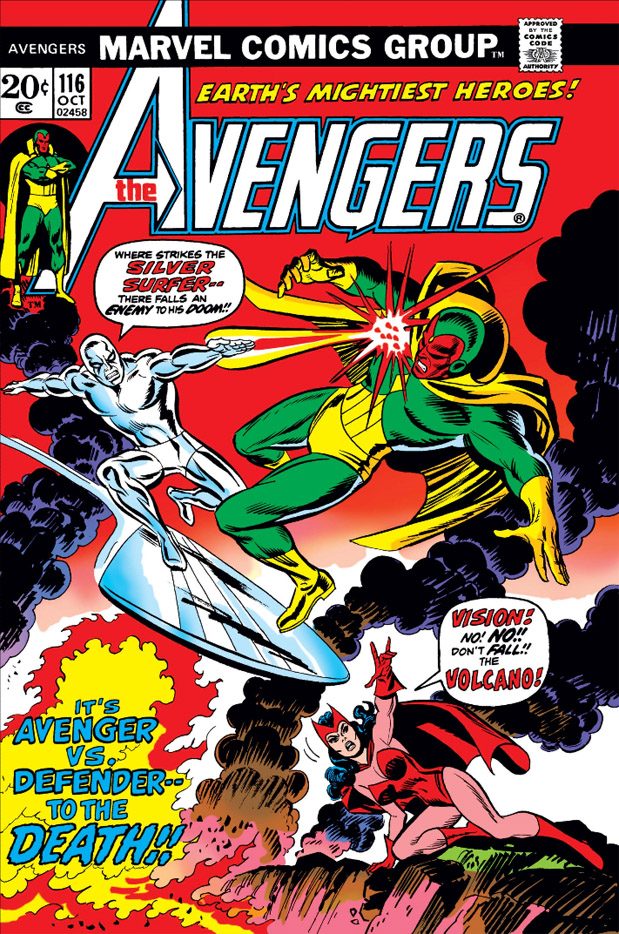
Looking back on the Avengers/Defenders crossover battles from 1973--a conflict that collectively (and likely for TPB purposes) became better known as the Avengers Defenders War--it almost seems more accurate to label the fights we witnessed in those comics as skirmishes rather than knock-down drag-outs. With the exception of the event's climax, each issue was either devoted to a double-header of meetings between opponents which portioned off their page count, or there were other matters needing issue space to move the overall story along. As an example, the penultimate battle between the Hulk and Thor, as action-packed as it was, only took up seven pages in an issue of nineteen.

And yet, even the first of these skirmishes would have us believe that both teams are out for blood.  That...


But since each of these teams has gone up against the deadliest of enemies without resorting to the use of lethal force--and with each battle only allocated a few pages--how serious are these matches likely to get? Well, you and I may get the impression that all of them boil down to relatively harmless hit-and-run encounters--but on the other hand, would we want to slug it out with someone in the middle of a live volcano?


Tuesday, April 24, 2018

Ball of Doom!


When we last took a look at the scene of carnage near a demolished building under construction in New York City, the dynamic Defenders were in a pitched battle with the ones responsible for the destruction--none other than the Wrecking Crew, in their Marvel debut. The Crew's ultimate goal, however, was to locate a certain device believed to be at the site; and during a lull in the fighting, Thunderball recovers the object's empty casing, only to react in stark terror at the realization that, due to the nature of this particular device, someone else now holds the power to kill them all!


On the bright side, at least no one has to worry about characters like the Wrecking Crew having a gamma bomb at their disposal. You might as well toss one to the Masters of Evil while you're at it. But now we have to ask ourselves: Who, or what, has a weapon of mass destruction in their grasp??

Monday, April 3, 2017

...And The Crowd Goes Wild!


Recently I was flipping through a back issue of The Comics Journal and enjoying another look at a 1980 interview with artist John Byrne--all of 30 years old at the time and at the peak of his runs on X-Men and Captain America (though you might describe his time on the latter as more of a guest-artist stint, in light of its brevity). The Journal, known for its frank and comprehensive articles that one could find hard to put down once you'd begun reading, featured an extensive 22-page discussion with Byrne conducted by Journal staff Mitch Itkowitz and Consulting Editor Michael Catron, while also including inker Terry Austin, writer Roger Stern, comics critic/researcher Peter Sanderson, and publisher Ed Via.

In one of the outtakes of the interview, an exchange between Byrne, Itkowitz, Stern, Austin, and Via caught my eye, where Byrne was expressing a wish to dispense with any of the Captain Americas who appeared after 1945 when the original Cap disappeared. The discussion eventually turns to, as Stern puts it, the "made-up comic book stories" (heh, as opposed to regular comic book stories, but you probably get his point) that featured Captain America during this time, and one story in particular.

Byrne: So the Human Torch did not fly to Jupiter, passing clouds on the way...
Itkowitz: Yes, that was a silly story. "I'm breathing in outer space, fellows. With no air I'm keeping in flame!" Wonderful story. I don't know how they did that.
Byrne: He didn't fall from Jupiter to Earth, either.
Stern: And Cap didn't catch him when he fell from Jupiter, either.
Via: That's a good catch.
Byrne: That's a real good catch. [imitating radio commentator's voice] "An' he's caught him, an' the crowd goes wild!"

I'd only vaguely remembered coming across that story*, but the impression it had left on me was that it was a fun, harmless read, as comics stories from the 1940s were doubtless meant to be, no more, no less--an indulgence in sheer fantasy. At the time, comic books were items casually passed around and flipped through as little more than light-hearted kids' entertainment, far from the more involved storylines and conflicted characters that came our way in the '60s. Those earlier Golden Age characters were taken at face value--"Sun Girl," for instance, appears in costume and becomes attached to the original Human Torch as both sidekick and love interest, but mostly seems to be along for the ride on his adventures. I never figured out why she's called "Sun Girl," or what exactly she brings to the table besides a comely figure; apparently she carries around a ray gun that fires (what else?) sunbeams. Now how can you not laugh at something as superficial as that.

*Human Torch Comics #33, 1948

And so I dug up and dusted off an old reprint of this story, "The Ray Of Madness!", just to get an idea of the levity involved in the back-and-forth with Byrne. Was there more to this 10-page story than the running joke it's been for decades? I mean, how preposterous could it really be?


Well, a little preposterous, yes. How about "adventurous," instead? (And a lot of fun!)


The source of all the trouble for everyone turns out to be mysterious rays being fired at Earth that are causing all of the planet's animals to go mad and attack and kill the human population. Called in to assist "the nation's foremost scientists" in investigating the crisis are Captain America, the Torch--and Sun Girl, whose input has no doubt been sought out because it's bound to be insightful. Actually, no, her input essentially amounts to fretting and reacting to startling news. Given that these are American comics, it came as no surprise to readers that America leads the way in world crisis management--and so all the parties meet with Dr. Jefferson at, yes, the Jeffersonian Institute in New York to compare notes.


Yikes! That would seem to be that, doesn't it? Who the heck in 1940s America is going to stop an attack from Jupiter?

Come on, you know who!


Don't you just love the fact that the story has the Torch starting his flight to Jupiter from the airport? He could have just walked out of the Institute and taken off from there, or from a rooftop, or even the bus stop. Maybe the Torch is more media-savvy than we thought. And just for the record, Torch, nobody needs to "take care" of Sun Girl, bub, because she's--Sun Girl! 'nuff said!


So the Torch begins his journey. It turns out his mission away from Earth only lasts a few hours, round trip--and so we've obviously waded into preposterous territory, haven't we. In this case, that also means coming perilously close to a situation rife with


And in 1940s comic books, what other kind of science is there?

We don't want to get bogged down in facts here, since, clearly, facts are the last things we're likely to find in this story.  But here are the head-shaking statistics which our story freely tosses to the curb:

  • At its closest distance to Earth, Jupiter is 365 million miles away; in a worst-case scenario, with the distance being its greatest, that jumps to 601 million miles.
  • Back in 2006, our fastest spacecraft launched from Earth took an average of over five months just to reach Mars, which is about 34 million miles away at a minimum; in 1964, the spacecraft of the time would take over seven months.

Sun Girl could no doubt do the math if we substituted Jupiter and bumped the technology down to 1940s standards--but suffice to say that even the zooming Human Torch would be in one-way transit for over a year at least, assuming (a) his flame didn't fizzle as soon as he left Earth's atmosphere, and (b) his flaming power could last indefinitely, despite how staying constantly ablaze and at top speed would tax it.

However, to play devil's advocate... if for some reason the Torch could attain the speed of light, and Jupiter happened to be at its average distance of 483 million miles from Earth, it would take him about 43 minutes to get there. The Avengers' Captain Marvel could swing that; but for even an android Torch, zooming through Earth's clouds is the best he could hope for as far as setting any speed records from point to point around the globe.

On the other hand, maybe those clouds sticking with him all the way to Jupiter were meant to compensate for the void (to say nothing of the distance)? *shrug* So, before you know it:


Fortunately, the Torch has landed directly in the vicinity of the red hot "pool of peril," where the ray of madness originates. Otherwise, our poor guy would have to spend, oh, several human lifetimes searching a planet the size of Jupiter, a world so large that over 1,300 Earths could fit inside it. But he's right on target, and proceeds to not only destroy the pool, but also survive the attack of those who protected it--the savage Kleezar and his tribe of animal-like "Jupiter-men." The Torch catches a break when Kleezar's men are destroyed by a barrage of fiery meteors and Kleezar himself becomes a victim of the flood of fire-water resulting from the Torch's destruction of the pool.


Only seconds after fighting a major battle, and the Torch is ready for the return trip to Earth. What a guy. What a hero.

But it may not be smooth sailing for the Torch. Back on Earth, with a telescope that would put the Hubble to shame, Dr. Jefferson monitors the Torch's approach; but the even sharper-eyed Captain America notices from at least 33,000 feet below that the Torch's flame has gone out, and leaps into action, while Sun Girl... well, Sun Girl basically tells Cap that there's nothing to be done. For once, I'm with Sun Girl. What exactly is Cap going to do about someone plummeting from space? Salute? Well, when you've got a story that paraphrases John 15:13 when the situation is at its most desperate, you'd better believe that Captain America is going to be the best outfielder for the job and make the big play.


And yes, it was lucky the Torch happened to be falling within the perimeter of Jefferson's observatory, instead of, say, Uruguay.  But rest assured that Sun Girl would be proud of him no matter where he fell to his doom.


You can catch (ha ha, get it?) our own Human Torch from the FF in a similar predicament in a separate post, though there would be more than enough trouble on planet Earth to keep him busy.

Friday, September 23, 2016

The Allies and The Avengers!


I wasn't collecting comics at the time, but I imagine readers of The Avengers from day one were curious to read its third issue, which followed up on the Hulk's unexpected exit from the team so soon after its formation. Granted, membership in the Avengers wasn't set in stone; unlike the Fantastic Four, the group wasn't required to stick to a set number of members, and characters could come and go at the writer's discretion.  Though in the Hulk's case, it would be like a job applicant who has assets that clearly benefit the company he wants to work for, passes muster in terms of being able to take on a challenging workload, is eager to start, and signs on the dotted line--only to realize his second day on the job that it's not for him and decides to leave, with zero notice, and slamming the door on his way out. In addition, there were only so many heroic characters in Marvel's stable in late 1963. Would writer Stan Lee leave the group pared to four? And if not, who would be approached for membership? Daredevil wouldn't make his debut for another three months. That leaves: Spider-Man? Dr. Strange?

It was an interesting development from a sales standpoint, as well. At the time, the book was the only exposure for the Hulk, his own title cancelled roughly eight months prior--and without the Avengers to wrap around the character, he would literally go nowhere. If Lee had wanted to reignite interest in a solo title for the Hulk, how would jettisoning him from the Avengers help? Apparently, that was a worry for another day--specifically, about 300 days down the road, when the Hulk would reappear as a feature in Tales To Astonish, sharing the book with Giant-Man (who was still part of The Avengers). For now, however, the Hulk would get a little more mileage out of his Avengers stint even without an Avengers I.D., as the team considered it imperative that they ascertain the status of their former member--a process that, given the book's bi-monthly publication, would take another six months, with the Hulk still remaining in the cover's corner box grouping for an extra issue after that, as if to squeeze the last drops of water from this stone.

It's his exit, of course, that begins a string of "guest star" appearances in the Avengers title for the Hulk, with the issue which follows up on his departure pulling double duty where he's concerned. In the story's first part, we find the Hulk has returned to the southwest, as the Avengers attempt to track him and... do what, exactly, if and when they find him? Try to convince him to return? Retrieve him by force if he resists? Determine whether he can be trusted to remain at large? Having a set goal would determine how they proceed with their former member, instead of playing it by ear depending on the reception they get from him. It's understandable that the Avengers should want to find him, given that they bear a certain amount of responsibility for him now that he's angrily left their ranks--but as we'll see, the team will work at cross-purposes when dealing with the Hulk, and having no real plan going in wasn't likely to accomplish much.

The story's second part is a little more straightforward, with the addition of a joker in this deck who has his own axe to grind with the human race and who, as it turns out, also wishes to find the Hulk.


Monday, March 7, 2016

When Plots Collide!


OR: "Runaway Story!"


This Incredible Hulk story arc from late 1986 almost makes you want to reach out to your comics shelf and pull out a few other titles from Marvel's 25th Anniversary celebration--because if they're overflowing with as much out-of-control craziness as these issues, you've got yourself a weekend.


First, a little background:

The incredible Hulk is no more! After the Hulk was maneuvered by trigger-happy S.H.I.E.L.D. agents into a chemical tank of Doc Samson's design, the monster emerged in his original gray form before transforming back to Bruce Banner--who subsequently found that he was seemingly cured of sharing his existence with the Hulk. To be on the safe side, Banner remains under observation at Gamma Base, a facility abandoned by the military and which a SHIELD contingent, headed by Clay Quartermain, is now operating out of.

And those cocky SHIELD agents are keeping busy, having recently taken custody of the electrical killer known as Zzzax and containing him for the time being.


Show of hands: Who thinks this is going to end badly? Good, we're on the same page.


From here, writer Al Milgrom basically proclaims "Anything goes!" as far as what improbable things happen to our cast of characters. First things first: How to make sure Banner is cured of being the Hulk? Well, you could use the vast array of equipment on a base specifically constructed to evaluate, study, and detect the Hulk--OR, you could simply put him in a room with some SHIELD agents and let them beat the crap out of him!


And while we're all probably thinking that the ones really in need of those "psychological tests" are these SHIELD agents rather than Banner, it looks like our beaten-up scientist gets a clean bill of health along with his many bruises. Heck, he's even grateful for the pummeling!


No problem, Doc--SHIELD was happy to oblige!


So--what else can we do to have some reckless fun? Heyyyy--how about taking the ludicrous step of transforming Rick Jones into the Hulk? SHIELD is discovering signs that the Hulk is back in their midst--but their first guess as to how that's possible turns out to be off the mark, when the Hulk crashes out of Gamma Base and kidnaps none other than Bruce Banner! And no one is more surprised at the Hulk's identity than Banner when the sun rises.


We already know from a prior issue that "Thunderbolt" Ross and Rick were in a fight that caused Rick to plummet into the nutrient tank at the same moment when the Hulk stumbled into it--but how the heck could that have led to Rick taking on the curse of the Hulk? To answer that, we'll have to once again wander into the land of


To wit:


Let's put rationality aside and say for one outrageous, insane moment that being submerged in chemicals indeed affects a person in the same way as a gamma bomb blast, that these two methods of being exposed to gamma radiation aren't entirely different. We're still left to draw the disturbing conclusion that anyone in Rick's place, doused in that nutrient bath, would have become the Hulk--say, Betty, or Quartermain, or any of the base's janitorial staff--because the story has totally disregarded the fact that there's a great deal more to Banner's circumstances that brought about the existence of the Hulk.

But this is a runaway story, after all, so reason be hanged. Let's move on to doing something really off the hook, eh? Let's turn these SHIELD agents loose and have them hook up a very bitter and vengeance-crazed "Thunderbolt" Ross to a bank of equipment and run a completely ghoulish procedure on him that siphons and transfers to his body the power of Zzzax!


Good lord, they're even aware that Ross is unhinged, and they're still going through with this! Unfortunately, things are about to get much worse, because SHIELD has been deceived by Zzzax's apparent helplessness--and now that they've practically handed the creature what it needs, they're bound to be (dare I say) shocked when this experiment erupts out of control, with Ross and Zzzax merging into one crazed being that desires the Hulk's destruction.


We're doing splendidly so far, aren't we? Milgrom is well on his way to dismantling the Hulk's world and cast of characters bit by bit and twisting their lives like pretzels, not to mention making a pretty good case for disbanding SHIELD--and things are just getting started. For instance, Betty, who is already at the point of having a tenuous grip on sanity, receives the pleasant news that her father can now smoke a lot more than just cigars.


But elsewhere, what of the Hulk? Correction:  Hulks??


That's right--Banner inexplicably changes to the Hulk, and the reason? Not from being beaten senseless by SHIELD agents, but because Rick-Hulk must go!

And to get these two to fight, which we know they must if we're to believe this issue's cover, Rick has to be mad about something. If one of us was in Rick's place, we'd probably be pretty teed off about the Hulk trying to bash our brains in; but Rick seems to think that he sacrificed his humanity in order to keep Banner from becoming the Hulk again, when the circumstances which led to Rick's transformation were unintentional on his part, having nothing whatsoever to do with Rick taking on the curse of the Hulk so that his friend would be free of it. But try telling that to a young man convinced that he's a martyr.


It looks like things have finally reached a head in this dizzying tale, with the gray Hulk ready to deliver the killing blow and put an end to his rival... Zzzax/Ross waiting in the wings... and Betty probably still giving both Doc Samson and Quartermain a piece of her mind (or what's left of it). But if you think Milgrom has created Zzzax/Ross only to keep him on the sidelines, think again--because Ross is out for blood, and he's willing to adopt a scorched Hulk policy to get it.


Heh heh, talk about a "shock" ending! We'll have to leave the conclusion of this battle for another time--because, given all we've seen, it falls to Samson and Quartermain to close this post and give voice to what are likely our own thoughts right about now.


Clay, that probably depends on when Mr. Milgrom decides to get off this crazy rollercoaster!


Thursday, June 4, 2015

3BR, 2B... Solar Wave Fixer-Upper, Price Reduced


As traps go, this one conceived by Dr. Doom to deal with the Fantastic Four was one of the more visually impressive to grab your attention from an issue's cover:


Doom springs this trap on the FF after the team has dealt with Doom's henchmen and are finally able to bring the fight to Doom himself. But Doom has prepared well, and he literally has the FF where he wants them.


And as you've already likely guessed, a "solar wave" is made to order for another case of


Like yourselves, I'm not really comfortable with the idea of a solar wave phenomenon that's randomly hitting areas of our planet every 24 hours--so I can imagine how the inhabitants of Marvel's Earth feel about it. They already have Galactus and other deadly menaces threatening their survival--now they have to deal with a deadly event that hits every day, anywhere. And if you're standing near ionized dust particles, you can practically count on being sucked into space. People are probably using dustbusters around their homes every hour.

As for the FF's predicament--thanks to Sue, the FF have decided that if they're going to be killed, they're going to make sure that Doom shares the same fate:


It doesn't seem like Doom has thought this situation through, does it? In other words, he's in no real danger on the other side of the FF's cell, trapped against its wall or not, since the ionic dust isn't present in his room. Then again, if the cell wall dissolves, Doom is indeed going to be caught in the FF's wake, thanks to being contained by Sue's field. Besides, the solar wave is only attracted to a location by the presence of ionic dust; that doesn't mean its effect is simply going to cease if there is no dust beyond a certain point. So we certainly can't blame Doom for not wanting to chance it.

At any rate, Doom has made his call--let's see how things go for him.


Whoops! As Reed mentions, the FF had better hope that the solar wave only acts on the area where ionic dust has settled--otherwise, whether they crawl into the next room or not, it's curtains!


Fortunately, the FF's luck holds. As for Doom, he's likely wondering if his armor's oxygen and power supply will do the same.