Showing posts with label Invaders. Show all posts

Monday, February 5, 2018

Even In Death...


Just as the Avengers/Invaders series was winding down in 2009, a compelling story was taking place in the pages of Captain America which also revisited the members of the super-team from the 1940s--or, in this case, what was left of them. Written by Ed Brubaker and drawn by Steve Epting, Butch Guice, and Luke Ross, the story covers events from three time periods, which are briefly broken down as follows:

  • Shanghai, 1942--Captain America, Bucky, the Human Torch, and the Sub-Mariner were part of a secret operation to rescue Professor Zhang Chin, a top Chinese scientist who, at age 12, was already something of a super-genius.
  • Beijing, 1968--as the Winter Soldier, Barnes is sent by his Russian handlers to eliminate Chin, now a grown man. Barnes fails when he runs into Chin's bodyguard/agent, the Man With No Face, and is forced to withdraw.
  • New York, present day--Barnes, now in the role of Captain America following the assassination of Steve Rogers, is following leads on the activities of Batroc, who's been commissioned to steal something currently in the custody of the United Nations. The mystery deepens when Batroc attacks a U.N. convoy transporting the "package," and Barnes finds himself again facing the Man With No Face.

If you're getting the impression that connecting the dots in this story is going to take some time, welcome to a textbook Brubaker tale--yet it's one of this writer's strengths, since his way of pacing a story places the reader practically in the midst of its characters where they virtually become part of the chain of events, putting the pieces together along with those who are directly involved. True, things tend to fall into place piecemeal, and slowly--but the characters don't suffer for it, while the reader becomes more deeply involved in the overall plot and finds their attention almost riveted. It's a consistent style that served Brubaker well on his very acclaimed run on the book.

The trigger for Barnes realizing that there's much more to Batroc's endgame appears to be the sudden presence of the Man With No Face in the convoy attack, who already knows that it's Barnes in the Captain America uniform and whose taunting words to Barnes indicate not only their prior meeting but also a much deeper plot in play here. A "failed" experiment of Chin's from the 1950s, the Man With No Face (consistently named "The Man Without A Face" in the book's introductory recaps, for whatever reason) had been China's attempt at their own super-soldier gone wrong, ending up being more spy than soldier, though no less effective--no longer human, unable to eat or sleep, but an agent who could fade in and out of shadows and whose abilities include becoming intangible and bringing down his enemies much like the Vision can. It was during the attack by the Man With No Face in the Winter Soldier's mission to kill Chin in '68 that Barnes was able to get a good look at Chin's experiments on human subjects before aborting his mission, which makes Barnes wonder if and why Chin has an interest in this particular operation.

It's a question that isn't unanswered for long, as the U.N. "package" is successfully extracted by Batroc's crew--and to his utter shock, Barnes recognizes its contents.


Wednesday, April 19, 2017

A Glitch In Time!


OR: "To Be Continuumed..."


Not many of Marvel's comics published during 1976 made mention of the bicentennial celebration with more than a passing reference, but the company made a decent effort to incorporate the event into stories featured in Doctor Strange, Spidey Super Stories--and, it goes without saying, Captain America, not only in his regular title but also a special Marvel Treasury Edition devoted to the subject. By extension, another story featuring Cap would be one of those which at least acknowledged the event but went on to tell its own story, which really wasn't all that relevant but hearkened back to a memorable period of American history all the same.


"And Now Then--The Invaders!" in the 1976 Fantastic Four Annual no doubt carried the stamp of patriotism with the presence of the Invaders, a heroic team of classic characters from comics' Golden Age--yet there is no real connection to the bicentennial, since the core of the story focuses on World War II and not the Revolutionary War. But you'll still be able to get into the spirit in this tale written by Roy Thomas, with its foundation consisting of a chilling premise of the Nazis having won the war and conquering the world. While a complete and separate story in its own right, the issue is something of a double-header that segues into the '76 Marvel Two-In-One Annual, with the Thing of course being the common denominator in both stories. Again, the time period of the 1940s doesn't exactly connect to the wave of the country's celebration of independence from Britain; rather, the story banks on the spirit of freedom, which was fought for with great vigor and sacrifice in the second world war, a conflict which dwarfed the war with the British. It's easy enough to grasp Thomas's thinking here, if mostly in a sales sense.

Thomas lays the groundwork for this story in the FF's regular title, when a skirmish with Luke Cage, under the influence of the Puppet Master, dislodges a canister of vibranium which falls onto the platform of the time machine Reed Richards duplicated from Dr. Doom's original design, sending it back into the past. (Good job, Reed, in keeping the device on the power grid--heaven forbid somebody tripped while standing next to it.) The ramifications of the incident are realized when everyone enters the room of the unit to find unexpected guests, who tend to open fire on Americans on sight.


The team starts putting two and two together and, to their horror, discover through a visual hookup scenes displayed through the years that show the Nazis taking over the world--and that the men they've captured travelled from 1946. Yet Thomas turns the story into a virtual What If tale (the mag would debut in early 1977) by making it clear that this scenario occurred in another time continuum--a history that, if not corrected, could spread to other continuums, including the FF's Earth. That's a bit of a stretch; usually that kind of cascade effect requires some sort of rupture in space-time (if other such stories are any indication), and there's no evidence of that here. But in order for the FF to take action, their own history has to be unaltered at least for now--so the threat of a spreading alteration in history appears to be a plot device that Thomas finds necessary to establish for the story.


At this point the reader's head is probably spinning as much as Ben's. As for the Watcher, you can safely ignore his presence in this story, since it seems his purpose is mainly to point us in the direction of the MTIO issue at this story's end. At any rate, the stakes are clear for the FF--and with Ben's offhand reference to the bicentennial, the team heads back to 1942 to prevent disaster.

Tuesday, August 23, 2016

The Deadly Thirst of... Baron Blood!


It's reasonable to wonder why the notorious Baron Blood never made an appearance in the Tomb Of Dracula book, as an antagonist or otherwise. Though it can be fun to imagine how such a confrontation might play out:

"Gaze into my eyes, fool..."
"No, fool, YOU gaze into MY..."

Yet there's no reason to believe that Blood wouldn't be subservient to Dracula, and willingly, since he's often prided himself at being "a scion of Dracula" and seems to have no qualms about doing his master's bidding.

We know of the original Baron Blood's exploits primarily through stories featured in The Invaders and the more contemporary Captain America, the latter book being where the Baron finally met his end.


From what I understand, Blood was a frequent and formidable adversary in The Invaders, as well as other mags that featured wartime exploits. Thanks to artist Frank Robbins, he certainly has one of the more interesting villain costumes out there, with his hood resembling the head and ears of a bat--and the rest of the outfit completing the look, clinging to a bony frame and accentuated by a large "winged" membrane. It's unclear how Blood can actually take to the air and fly without changing his shape to a bat; perhaps he weighs next to nothing and can simply glide for short distances. Regardless, he remains one of the most eye-catching and striking villains around.

To fast-track the character's origin, the creature who became known as "Baron Blood" is the result of family bitterness combined with leanings toward Nazi Germany. After their father passed away in the early 1900s, the elder of the two Falsworth sons, Montgomery, became Lord Falsworth, while the younger and embittered John struck out on his own and wandered Europe. It's during this time that he ended up in Transylvania--and his ambition led to a fatal underestimation of the being he sought to bring under his control.


It was never quite clear to me how the title "Baron" was attached to this vampire; perhaps the Germans gave it to him when Blood began working with them. My understanding of British titles is that "Baron" has the same meaning as the preferred "Lord," so perhaps Blood felt it was a way to deride his brother's status and claim a bit of his own.

With Montgomery becoming the British iconic hero known as Union Jack and fighting in World Wars I and II, John's resentment of his brother brought Blood into conflict with the Invaders, who met him in final battle at the Falsworth estate, where he kidnapped Montgomery's daughter, Jacqueline, and prepared to slay her. During the conflict, he also revealed how the Nazis helped to condition him to resist the harmful effects of the sun.


But the filthy fiend is prevented from claiming his prize as Union Jack confronts him in caverns beneath the estate and, in a heated battle, is severely injured when hit with a large boulder which crushes his legs. But when the Invaders converge on them, an accident ends the reign of terror of Baron Blood, at least for now.


Since Blood's remains aren't properly disposed of, he would rise again to battle the Invaders, with his menace finally ended by the Sub-Mariner's use of a wooden stake. At that point, his remains are sealed in the Tower of London, and there they stayed for over thirty years--or so it was thought. When a series of grisly murders take place in the area, Falsworth, now old and infirm, calls for Captain America's assistance in tracking down the one who Falsworth feels certain is responsible, against all evidence to the contrary. Consequently, Cap's first stop is to verify that Blood is indeed still present in his sealed coffin, a visit which leads to a horrifying discovery.


Not only is Blood free and at large--he's apparently been so for over a decade. The mystery is why he's kept such a low profile for so long. It's a question that Cap may not live long enough to answer, as Blood makes a preemptive strike by coming to Falsworth Manor in the dead of night and attempting to catch Cap by surprise. Cap, of course, expected this sort of reaction to his presence, and engages Blood in a hard-fought battle--but Blood has the full abilities of a vampire, and Cap is eventually undone, standing helpless as his foe prepares to take his life.


Unfortunately, Blood may well go down as the only vampire to come close to needing dentures, thanks to the unexpected resilience of Cap's uniform. And despite Blood's advantage of strength, Cap manages to drive him off with the approaching dawn.


After a thorough search for Blood the next day and some investigative work, Cap, with the help of "Union Jack," lays a trap for Blood that evening, as Blood again confronts his now bed-ridden brother who appears to have readopted his distinctive uniform from the war. And as the man lies helpless, we learn of how Blood was revived, and why he's stayed under the radar for so long.


But Falsworth isn't as helpless as Blood may think; in fact, it's not Falsworth in costume at all, but a friend of Falsworth's great-nephew who has suited up in order to help Cap spring a well-laid trap for Blood.


However, Blood is able to hold his ground, counting on the setting sun to see his full power restored; and when Union Jack is out of the fight and Captain America is on the ropes, Cap makes the only decision he can make, one which clearly costs him in mind and spirit.


It's the only part of writer Roger Stern's story that doesn't really add up; after all, a man such as Cap who battled through a bloody and relentless world war can be no stranger to death. How many lives was he forced to take on the battlefield? None? Really? Captain America, the country's super-soldier, battling to preserve the lives of the men he fought with yet drawing the line at killing enemy soldiers? It seems unlikely in the extreme, even if we swallow the notion that Bucky was given the dirty work in the partnership. So while it would make sense for a man like Cap to hesitate at the crucial moment, it makes little to no sense to see him balk at killing Blood, a creature whose mortal life was already ended decades past.


Lord Falsworth passed away peacefully while his brother's pyres did their work at last and assured the vampire's final death. But in one form or another, "Baron Blood" would return to seek out new victims and make sure the outline of that feared and ghastly costume would continue to fall across the silhouette of the moon on a still night.

Wednesday, September 9, 2015

Monster Team-Up!


When it comes to the monster of Frankenstein, all is fair in love, war--and especially fiction, where the monster made a second home for himself after Mary Shelley had loosed him upon us in her novel of nearly 200 years ago. I wouldn't have expected the monster to have made much headway in the world of comic books, where characters often scoff at or mock such figures from "real world" literature; yet characters such as Dracula, the werewolf, the mummy, et al. have managed to do pretty well when weaved into a comics story, so it's clear that having a background in real-world literature need not be an obstacle to crossing over into the world of comics.

The tricky part is: What is to be done with the monster, other than rely on him for shock value or the expected rampage? On several occasions, the Marvel stories which featured the monster worked around the situation by only dealing him in for the short term--even to the point of working around the monster himself, by providing a facsimile rather than the actual monster of literature and horror movies. The real monster of Frankenstein would need considerably more care if he were to be weaved into comics stories on even a semi-regular basis. For instance, having characters constantly react to him with phrases like "The monster of--Frankenstein? But... but, that's just a story! A fictional character! You can't be him!" would get old fast. (Even the monster would probably get to the point of rolling his eyes at it.)

If memory serves, the earliest instance of seeing the monster of Frankenstein in a Marvel comic (if you're not counting its predecessor, Atlas Comics) was in early 1968 in a copy of X-Men. Not only was the resemblance of the monster true to our expectations, but the cover left no doubt as to his identity--or so it seemed.


"The X-Men Meet Frankenstein! 'nuff Said!" Au contraire, as that caption would be screaming "false advertising" by the time this issue concluded.


From there, we'd shift to the pages of Silver Surfer over a year later, where the cover copywriter had learned a thing or two about blatantly misleading the reader and instead realized that the word "Frankenstein" is sufficient and enticing enough on its own:


In this story, the monster again was a no-show--but he's at least established in comics as a once-living character, thanks to the many assessments by Frankenstein's evil ancestor of that fateful night's work.


(You can learn more about "Experiment X" and its results in a full review of that issue.)


Four years later, The Monster of Frankenstein is launched by Marvel--a bi-monthly series for much of its run, which would be renamed as The Frankenstein Monster after five issues. The title would end after eighteen issues, but would eventually shift its time frame and establish the monster in the mainstream Marvel universe beginning with its twelfth issue, where the creature is discovered in the present-day in suspended animation.


Heh--"...it's alive." A nice touch, and famous last words in every sense.


But the waters are muddied a bit when, in an appearance which in hindsight might have been seen as a sign that the monster might not be enough of a draw for his own title and could be headed for the grave again, he shows up as one of the Legion of the Unliving, where he engages in a rather one-sided battle with Dr. Donald Blake's alter-ego.


It's not until a month before the TFM book's cancellation when the monster makes an appearance in the pages of Marvel Team-Up mag, where an evil scientist named (I am not kidding) the Monster Maker has brought the monster and Spider-Man to a mountain castle as part of an experiment to merge their abilities.


And since the monster's appearance in the 20th century may come as news to those who aren't reading TFM, the story provides a nice summary that brings readers of MTU up to speed:


Ordinarily, the monster sharing the billing with Spider-Man in the popular MTU mag would be a practically guaranteed sales bounce for his own title--but with its cancellation imminent, the influx of new readers (assuming that would be the case) would unfortunately be too little, too late.

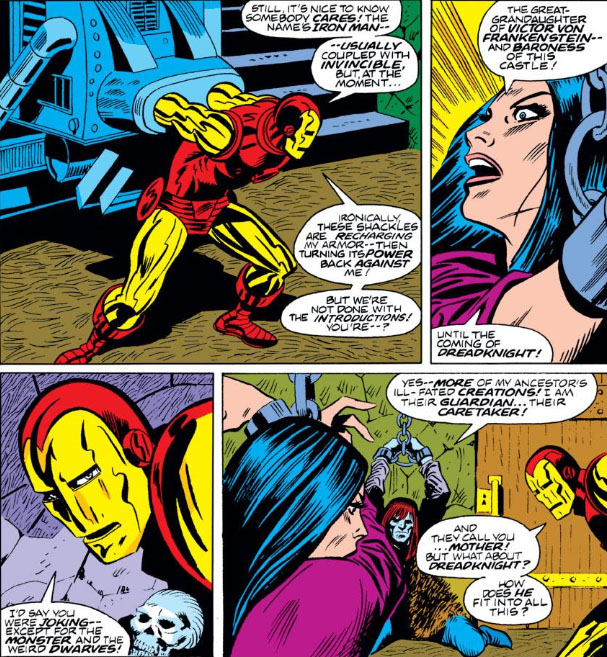
After the end of The Frankenstein Monster, it would be two years before the monster would appear again, this time in Invincible Iron Man, where writer Bill Mantlo would link the developing story he'd written for the final issue of TFM with his two-part story taking place in Iron Man, both involving the mysterious great-granddaughter of Victor Frankenstein. A woman that Mantlo writes somewhat malevolently in the closing panels of TFM:


...but whom he rewrites into a more sympathetic character in Iron Man, someone who's gathered other victims of the Baron's experiments in order to care for them.


(That's assuming her "children," as she refers to them, had also been in suspended animation for over a century, since they would otherwise have long since passed away. Mantlo really doesn't address that aspect of this story; we could assume that she was referring to the ancestors (plural) of the original Frankenstein, and not Frankenstein himself.  If that's the case, it would be just an oversight here of an apostrophe ending up in the wrong place.)

Another ancestor of the Baron showed up a year later, this time in World War II in a story from The Invaders--Basil Frankenstein, tasked with creating an army of artificial Nazi soldiers. You can probably guess what form his own creation took, complete with swastika armbands:


Aside from that, there seemed to be a dearth of stories that featured the original monster interacting with other characters in the Marvel universe. Filling that void would be an odd story that found the monster on the planet created by the Beyonder for the "secret wars," where Ben Grimm remained behind for a time. Once again, however, this monster was something other than what was expected.


As for the original monster, for all intents and purposes he seemed to be a dead issue as far as Marvel was concerned--an experiment of their own, which didn't work out as successfully as hoped. However, if the subject of the Frankenstein monster and its adaptation to Marvel comics interests you, be sure to continue on to a far more comprehensive (and quite well-written) look at the monster's evolution in this medium by writer Adrian Wymann, who offers more perspective on the subject and behind-the-scenes anecdotes.

Tuesday, December 9, 2014

Heroes Reborn


We've come to the end of our three-part look at the Avengers/Invaders twelve-issue series from 2008-2009, where the Invaders find themselves brought forward in time to 2008 and the Avengers struggle to gain their trust while trying to find a way to return them home. In Part One, that seemed unlikely, with the Invaders convinced that the Avengers were part of some Nazi deception and the Avengers unable to provide any proof of their bona fides for fear of corrupting the timeline. But in Part Two, the two teams found themselves fighting in common cause against S.H.I.E.L.D. Life Model Decoy units and slowly coming to an understanding of each other, while other members of the Invaders worked with the "New" Avengers to discover just how and why they were taken from the year 1941.

Seemingly at the nexus of this affair is a young soldier, Paul Anselm, whose comrades were killed while the Invaders battled behind enemy lines and a mist from the Cosmic Cube appeared to transport them through time. Paul had been caught up in the wake and arrived with the team in 21st century New York City, where he visited his still-alive older self and came to terms with the fate of his comrades in '41. Or, did he? Once the two teams of Avengers put aside their differences and prepared to use the Cube to send the Invaders back, Paul decided to make a grab for the Cube and attempt to not only save his friends, but also to affect the outcome of the war. To say that the timeline reacted disastrously is an understatement.

But with the third and final part of this story focusing on events in 1941 once the Invaders return (with the Avengers caught in the wake, this time), we have the opportunity to see where things went wrong. Did Paul manage to succeed in not only saving the lives of his buddies, but also in changing the past and thereby making sure that all the death and destruction of a world at war was avoided? It would seem like child's play with a device like the Cosmic Cube at your disposal. But with the haunting words of the 1940s hero called the Vision, we know that there's more to the Cube than simply its ability to alter reality. And we may see that there may be more to Paul Anselm, as well.

Sunday, November 2, 2014

Behold... The Vision!


We're up to the next four issues in our look at the 2008 Avengers/Invaders 12-part series. In Part One, the Invaders are mysteriously brought forward in time, and the Avengers capture and contain them in isolation aboard the S.H.I.E.L.D. helicarrier until a way can be found to return them to their own time. But the situation is complicated, since the Avengers can't give the Invaders any details of their identities, for fear of corrupting the past timeline--and, thanks to an encounter with one of the Thunderbolts who has a German accent, the Invaders are inclined to think this is all some Nazi trick.

Naturally, the Invaders aren't content to be captives of those they believe are Nazis; in fact, they have some unsolicited help, in the form of the "New" Avengers who have slipped aboard and have come to break them out of captivity in order to return them to 1941.

Both teams of Avengers, then, are looking to help the Invaders return to the past, though neither team is inclined to trust the other due to the events of Civil War. As a result, all hell has broken out on the helicarrier flight deck, as all three teams struggle to prevail.

Yet, this fifth issue opens rather sedately, for there is another player in this drama--Paul Anselm, a soldier from 1941 who was caught in the Invaders' wake and transported with them into the future, where he has already met his older self and learned about the end of World War II as well as the fate of the comrades he fought with. And so we find him at a cemetery, paying his respects to his friends, and within sight of a conspicuous headstone:


Paul's sentiments are harmless enough, though we're beginning to see he feels a profound sense of guilt over not being on the field with his unit when they were fighting for their lives. Paul is about as helpless as anyone could be in his shoes under these circumstances--but whether this is simply a human interest angle to the plight of the Invaders or a portent of things to come remains to be seen.

Saturday, October 11, 2014

I, Life Model Decoy


It took a little self-nudging for me to pull the Avengers/Invaders series from my shelves and give it another look after six years. It was a twelve-issue series which began fairly well, but which seemed to lose its way for me about two-thirds of the way through; in fact, I noticed that I didn't even have the last four issues. For me to have pulled the plug on this series so close to the finish line surprised me in this second look, since I was enjoying reading it again. I have an idea of what might have been at least part of the reason I eventually lost interest in it; but since I might end up with a different perspective on the story this time around, I'd rather not jump to any conclusions at this point and just take events in progression.

In a way, the layout of the story almost wants to accommodate me in that respect, splitting the series into three "Acts" of four issues each--presumably to take into account the curious two-month publication gap between issues 4 and 5 and issues 8 and 9. On the other hand, that gap might have helped to make my decision easier in dropping the series, having sixty days to wait for the next issue and finding I lacked any anticipation for it. At any rate, it seems a reasonably good idea to structure this look at the series in four-issue increments. The transition between Acts is rather seamless, so chances are you'll notice no shift in the story's momentum.

While the Avengers get top billing, you'll find that the Invaders receive a generous amount of story attention throughout this first Act, which was really a nice surprise--particularly when you take into account that there isn't just one team of Avengers in this series, but two. That's a lot of characters to keep spinning on plates and make sure they stay relevant, something which the Secret Wars series didn't manage all that well. To be honest, I wasn't expecting the Invaders to be much more than window dressing--but just look how well scripter Jim Krueger and artist Steve Sadowski start things off, with Bucky (yes, Bucky, whom we don't normally associate with the word "profound") supplying the narrative in impressions taken from his "war journal":


In just a few panels, Bucky gives a well-rounded profile of the entire team that made even a non-Invaders reader like myself want to keep turning the pages and read more.

You'll also notice in this series how well Krueger isolates the thinking and priorities of characters from both 1943 and 2008. For instance, the Avengers aren't fighting a world war, and their operations involve meeting threats as they present themselves; while the Invaders are fighting a long, drawn-out conflict in the trenches, seeing large-scale death on practically a daily basis. War is all the Invaders know, its ending their only goal. It wouldn't surprise me if Bucky's war journal is his only journal.

As for what brings the Invaders forward in time to 2008, we'll have to wait a bit to find out the specifics. But a mysterious mist will do for now.


Thursday, October 2, 2014

Days Of Future Past


Avengers/Invaders was a 12-part series published in 2008-2009, with a story that takes place in--well, that's where the fun begins. The Invaders are unknowingly sent forward through time to 2008--the aftermath of the Civil War, after Captain America had been assassinated, where they encounter the Avengers and initially misinterpret them as Nazis. Of course, with the Invaders, Captain America is alive once again, though once again a man out of time.

And time is what this series is fueled on, with both teams of heroes (as well as the underground New Avengers) battling in their own way to set things right. First blood goes to Tony Stark's group of Avengers, who capture the '40s heroes and contain them on the SHIELD helicarrier--with the exception of Namor, who makes his way back to his homeland to find allies to return with. Only this Namor has little reason to think that his home would have long since ceased to exist:


This post is something of a sampler for you, before we later explore the series in depth here. I found Avengers/Invaders to be a fun story as far as the confrontations and interactions it provoked--but I wouldn't call it an epic in the sense of it being a grand, heroic tale that will be long remembered. Think of it more as an interesting idea that was put on the table, given the green light after further discussion, and then executed fairly well. In addition, you may find it to be an engaging supplemental story to Civil War--a crossover event which has been dead and buried for awhile, but receives an interesting interpretation here when its results are seen through the eyes of heroes who fought so hard for American ideals. "Nazis," indeed.

As for Namor, the beautiful cover of issue 3, painted by Alex Ross, gives us an idea of what else he's liable to find in his search:


Yet this match-up isn't as black-and-white as we might think--for the contemporary Namor remembers this conflict taking place, and tempers his response accordingly.


I never did read The Invaders on a regular basis, but I imagine it was a struggle to remember sometimes that the "Sufferin' Shad!" Namor of that time period was more likely to settle matters with his fists than the Namor of our time (though the apple certainly didn't fall far from the tree in that regard). Perhaps that made him a perfect wartime ally; but, here and now, engaging in yet another conflict with surface dwellers is the furthest thing from the minds of his "people," and they side with his counterpart. It comes as a surprise to the younger Namor, and he fights on; his elder, on the other hand, knows that this encounter needs to be brought to a swift end.


Avengers/Invaders is both a look back and a look forward, to more depth than in the Fantastic Four annual which was content with simply a meeting/brief alliance between the Invaders and the FF. Oddly enough, this 2008 story gave me an appreciation of the Invaders that their own book never managed to do, though not enough to bring me on board with The Invaders itself. As we move forward with the series, perhaps those of you in the same boat will enjoy a more "one-shot" appearance of the team, which gives us a fine display of their prowess but knows when to return them to the past.