Showing posts with label Steve Ditko. Show all posts

Monday, April 3, 2023

The Purloined Power of... Xandu!


While the story content of Amazing Spider-Man Annual #2 consists mostly of reprints of prior ASM tales by Stan Lee and Steve Ditko (along with additional rogues gallery profiles), the issue's lead story is impressive original material by the same writer/artist team and offers the first meeting between Spider-Man and Dr. Strange, Master of the Mystic Arts, as well as the first appearance by the sorcerer who calls himself Xandu the Unspeakable, or Xandu the All Powerful, or whatever adjective suits his whimsy when announcing himself to others. But to clear up one thing right away, Xandu is not to be confused with Shangdu, one of three capital cities of Kublai Khan's Yuan Dynasty--a city otherwise known by a name which became attached to one of the biggest box office disappointments of 1980.


Too bad, Xandu--one more letter and your name would have been up in lights. Briefly.


As it happened, this 1965 story also came in handy about 3½ years later during the short run of the first Doctor Strange series, presumably as a way to entice readers to try the book. It was something of a red flag to see a reprint appearing so soon in a still-nascent series--in this case, just four issues prior to the title's cancellation.


(Trivia note: Ditko's standing image of Spider-Man just took a bit of mirroring to become a classic corner box.)

As for what Xandu has in mind, he'll first need a little hired muscle to pull it off--that is to say, enslaved muscle, in the form of two bar room bruisers who were accustomed to throwing their weight around.


And just in case you were wondering who had custody of the other half of the mystic wand Xandu covets, it indeed happens to be Dr. Strange--though not for long, as his attackers are not susceptible to a mystic defense given their current state.


All of which paves the way to a fine original story with what seems to be a very off-brand title for a Spider-Man issue. (More than likely another pitch to Spidey readers to check out a character still playing second fiddle to Nick Fury at this point in time. Sheesh!  Can the hard sell already, Stan!)


Thursday, January 5, 2023

Bonus Features: Spider-Annuals, 1964-1999


Aside from rogues' galleries, pin-ups, and, in all too many cases, reprinted material, a staple of Marvel "king-size" annuals has been the informative bonus features that came in the form of exploring a character's abilities, being provided with a tour of their headquarters, a rundown of their supporting cast, or a supplemental tale consisting of only three or four pages, on the occasion that the main story didn't fulfill the expected page count. You'll find many of these bonus features given their due throughout the PPC over the years--but for a little variety on the subject, we'll begin digging through and dusting off some of the more under the radar material where a little extra creative effort went into these features.

In this inaugural post on the subject, we turn our focus to one of Marvel's inaugural characters, the amazing Spider-Man--and as long as we're going that far back, it seems fitting to include a few of the bonus features from the character's first annual from 1964, itself packed with additional material to no doubt titillate Spidey's growing fan base and including a number of pages which spotlight the work of the book's artist, Steve Ditko.


Thursday, October 27, 2022

The Sting(s) Of The Scorpion!


Having recently looked in on the goings-on of the Scorpion, resurfacing following his incarceration by the insidious Mister Kline, let's now look back over seven years prior to those events, to when Mac Gargan began his career as the tailed villain--courtesy of the checkbook of J. Jonah Jameson, who also finances a hard-working yet under the radar scientist named Farley Stillwell to make use of a new serum that will hopefully give Gargan powers greater than Spider-Man's. In so doing, Jameson begins a misguided but nevertheless illegal operation of hiring hitmen to take out Spider-Man.


At the risk of skipping ahead, Gargan wasn't in our roundup of covers which declared the title character(s) to have met DEFEAT!, but defeat is just what befell the web-spinner more than once when he went up against the power of the Scorpion.


(Magnanimous of Stan Lee to give his artist top billing in the credits, only to then enlarge his own name and emblazon it in red, eh?)


Monday, March 21, 2022

The Minions of Mordo!


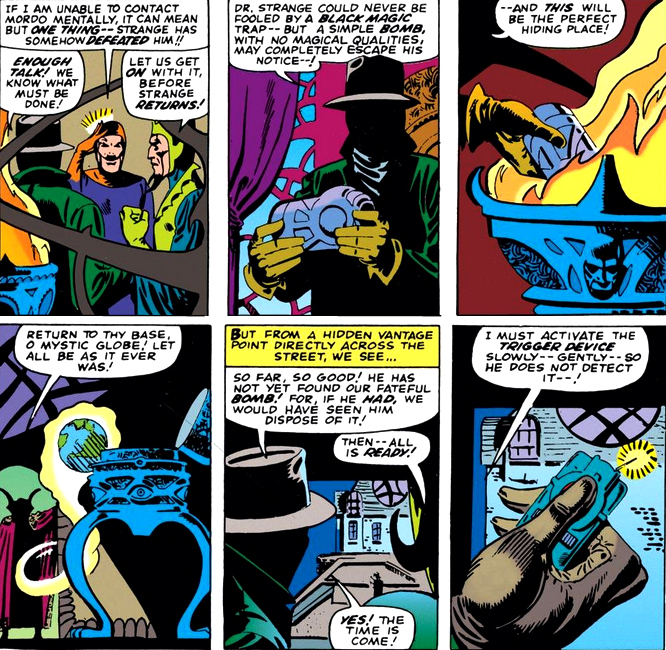
Following his hard-fought and almost unbelievable victory over the dread Dormammu (and on his foe's home ground, at that), a weary Dr. Strange, Master of the Mystic Arts, returns to his sanctum sanctorum for some much-needed rest--while Baron Mordo, who had allied himself with Dormammu but fell out of favor during the battle, has been banished by the Dread One. Yet unknown at present to Strange, three of those who had served Mordo in the villain's hunt for his rival have resolved to carry out their master's vengeance--and they now strike in secret at the place where Strange would least suspect a trap.


Unfortunately for our assassins, however, they haven't covered their tracks as thoroughly as they believe--but while Strange escapes death from their explosive device, he is left too vulnerable to escape capture, leaving those who lie in wait to act on their master's behalf and render him completely helpless. And to the victors go the spoils.


(We'll have to assume that Strange took a moment to mystically protect his hands and wrists from the searing fire, as well as the bomb's by this time red-hot casing.)

And so with Strange at their mercy, the minions of Mordo have achieved victory where Dormammu and their master had failed! Who is there now to help Dr. Strange except... himself?


Monday, February 21, 2022

The Crushed Plans of the Master Planner!


As time permits, I've been slowly working my way back through the Stan Lee/Steve Ditko Amazing Spider-Man issues produced during 1963-66, and one such story has always been on my radar to sit down and read. Having finally done so, it's *ahem* amazing how well it stands the test of time fifty-six years after it first hit the stands, as it does a fine job at hitting all the right notes for both the wall-crawler as well as Peter Parker as far as what made them both unique in Marvel's growing stable of characters during that period. This was a time when Peter Parker hit his stride as someone readers could identify with, a character who experienced growing pains and even hardships which seemed ever-present when his uncle was killed and he became the sole source of income for himself and his elderly Aunt May. And though he originally had every intention otherwise, becoming Spider-Man did not improve Peter's lot in life; on the contrary, often his alter-ego complicated things for him and made his life even more difficult to manage, all thanks to a sense of responsibility that he would not disavow.

It's fair to say that it was Peter's struggles in life which likely attracted a good deal of the book's readership; and it's Spider-Man's growth as a character in tandem with his (yes) amazing abilities which helped to offset the seemingly one-step-forward/two-steps-back life of Peter Parker and give him a sense of purpose and even accomplishment that a reader can't help but envy. All of these facets of the character are on display in Amazing Spider-Man #33, where Peter is depended upon as never before to come through for his family, and for himself--a physical and emotional struggle which you may find does a masterful job of gripping the reader, as well.


Monday, June 28, 2021

The Coming(s) of... Dr. Strange!


As he did in Sub-Mariner, Fantastic Four, and Invincible Iron Man, writer Roy Thomas came aboard Doctor Strange in mid-1968 (the first issue of Strange's first solo series) and provided an expanded version of the title character's origin--perhaps partly as a way to pivot to a new direction, but also to use a different "lens" of sorts to offer new perspective to Stephen Strange the man, characterization which was skirted by in the original telling by Stan Lee and Steve Ditko but which artist Dan Adkins appears eager to offer.

Thomas's updated version, which appears 4½ years after the original origin story, offers an interesting comparison of storytelling styles between the new material and Strange's origin as depicted by Lee and Ditko. For one thing, Adkins had the luxury of presenting his work within a full issue of twenty pages--and though Ditko included the essential scenes in his story, he had only eight pages in which to frame it, given that the character of Dr. Strange at the time was a feature of Strange Tales which shared its issue space with a second Marvel character in a separate story (while also making room for a fictional "strange tale" insert). Thanks to the additional leeway, Thomas and Adkins can take a more presentational approach with Strange in his new series, while taking advantage of his brief history in battling occult threats to have him wondering if he's the right person for the challenges he faces.  (Thomas would later take a similar approach with Iron Man.)


While in Lee's version, the introduction comes in the form of a narrative splash page which immediately lets us know we're about to read Strange's origin; yet from there, we jump directly to Strange's arrival at the Ancient One's abode in India*, and work our way backwards.


Thursday, June 17, 2021

There's Never Been A Hero Like Spider-Man


A few months after his introduction as a feature in Amazing Fantasy, the character of Spider-Man received his own series in March of 1963 and went on to become one of Marvel's most successful flagship super-heroes. Very different from the other heroes who had appeared on the scene, Peter Parker epitomized writer Stan Lee's efforts to establish the characters of Marvel Comics' titles as "the kind of characters I could personally relate to; they'd be flesh and blood, they'd have their faults and foibles, they'd be fallible and feisty, and--most important of all--...they'd still have feet of clay."

For Peter Parker in particular, the character was doubly hampered by real-life concerns and problems, as Lee explains in his conception of the character from his 1974 book Origins of Marvel Comics:

"...[H]e was probably the first superhero to wear his neuroses on his sleeve. The poor guy is far more troubled than most of the characters he has to battle. And how many other superheroes are there who have to worry about their dear old Aunt May dying of a heart attack? Come to think of it, have you ever heard of a superhero with continuing problems with his love life? ... We structured the series in the pattern of any daytime radio soap opera, and miraculously we seem to have made it stick."

The Amazing Fantasy story certainly gave readers a fair idea of what they were in for with this character, even if at the time the Spider-Man tale was only a one-shot in a mag which was scheduled to be cancelled with that issue. In high school, Peter was an honor student who excelled in aptitude and studying, yet always miserable at being excluded from get-togethers with his classmates, a "bookworm" labelled as the school's "only professional wallflower" and a washout when trying to score a date. The accident which gave him his amazing spider abilities offered him an exciting new direction for his life--eventually turning to show business to capitalize on his powers, while resolving to take care of his beloved aunt and uncle but turning his back on those in school who always mocked him.

Yet fate deals a tragic blow to his life when he doesn't lift a finger to stop a fleeing criminal, only to later discover the fugitive had broken into his family's home and killed his uncle. Fortunately, fate also smiled down on Lee and Marvel, as reader reaction indicated they had a hit on their hands--and so with Steve Ditko continuing as the character's artist, The Amazing Spider-Man is launched, which picks up on Peter's life sometime after his uncle has been laid to rest and Peter and his aunt must now fend for themselves. As for the fame and fortune which appeared to be coming Peter's way as Spider-Man, Page One of that first issue tells us that the rave headlines which Spider-Man had enjoyed as a new media sensation have become a thing of the past.

(And the pain Peter must be in from those bizarre leg contortions can't be helping, Mr. Ditko!)

Monday, August 10, 2020

Lo... The Leader!


 OR:  "Holy Crud!"


Given the longevity of the mentally mutated menace known as the Leader, and the fact that he's arguably become a staple of Marvel villainy, it's fair to wonder why the man has seldom been allowed to spread his wings beyond the confines of Incredible Hulk and initiate plans against other characters and super-groups. The R&D projects of Tony Stark or Reed Richards, for instance, would surely make for tempting targets; infiltrating S.H.I.E.L.D. would gain him access to any number of intelligence agencies and government resources; a takeover attempt of A.I.M. would not only yield a treasure trove of advanced weaponry and scientific research but could also set up a *ahem* head-to-head (and mind-to-mind) conflict with M.O.D.O.K. (so many acronyms!); and how about vying with the Wizard for control of the Frightful Four?

The point being that the Leader need not stay where he has for the most part, which has mainly been to bedevil the command of Gen. "Thunderbolt" Ross and/or pursue a vendetta against the Hulk and Bruce Banner. And in that respect, the Leader is with us almost from the start, helping to inaugurate the Hulk in the character's second crack at a series of his own--or more accurately, a feature of his own, while sharing one half of the Tales To Astonish title with Giant-Man in separate stories. At first, the Leader is handled by artist Steve Ditko in much the same way as was the Green Goblin--a villain whose identity is kept under wraps for the time being, while conducting his affairs behind the scenes as the, well, leader of a spy ring with designs on effectively taking over the U.S. government.


The Chameleon, of course, is a natural operative for the Leader's network of spies--though he, too, fails in dealing with the Hulk. It's then that, unlike the slow reveal of Norman Osborn as the Goblin, Ditko and writer Stan Lee decide to pull back the curtain on the Leader without delay, at the point when he appears to be forsaking the spy business in favor of going all in with his powerful creation known as the Humanoid.


It's only when he sees the Hulk go up against the Humanoid, however, that the Leader decides to focus his efforts on learning more about the powerful brute, whom he considers to be a potentially dangerous enemy and suspects was created in the same way as himself--by exposure to gamma rays.


Whatever our impressions of the Leader thus far, it becomes apparent that his character has acted as a virtual shot in the arm to stories involving the Hulk, who had not yet been developed beyond the status of a raging behemoth who suddenly appears to attack the threat du jour and whose activities cast suspicion on Bruce Banner. Up until now, the so-far bland supporting characters of these stories have been Gen. Ross, who has orders to continue working with the brilliant Banner as he develops weapons-based technology for the government... Maj. Glenn Talbot, a security officer who believes the worst of Banner; Rick Jones, who's left Captain America and the Avengers to return and protect Banner as best he can... and Betty Ross, Banner's love interest (as well as Talbot's); but as the Leader's profile is raised, and his interests are shifted to getting his hands on whatever Banner happens to be working on, as well as becoming more obsessed with the Hulk as a possibly ally, he begins to receive prominent exposure on issue covers.


Yet for all that, it takes awhile for any characters in the stories to become aware of either the existence or even the name of the Leader--which, granted, is secrecy that any spy aspires to, though in this case that secrecy vanishes for no apparent reason. The moment comes when the Leader sets his eye on Banner's new Absorbatron, a device developed as a defense against nuclear attack and capable of absorbing the force of a nuclear explosion. (Perhaps an improvement on his earlier Project 34, a device which only went as far as shielding an entire city from enemy rockets or missiles through use of electromagnetic waves.) The Leader is successful in capturing the device, but as a bonus he also manages to capture the Hulk in the process--though it's Bruce Banner who awakens in the Leader's base and realizes who's nabbed him, despite neither himself nor the Hulk ever having knowledge of or exposure to anyone named "the Leader."


Ditto for Gen. Ross and Maj. Talbot, who are frantic to recover the Absorbatron but are convinced that it's Banner (in league with the Hulk) who has made off with it, no doubt to deliver to a foreign government. Yet as they close in on the Leader's hidden base, they're unaware that the Hulk has since escaped captivity and dealt with the Leader (and with the Absorbatron)--and so when they arrive, they only find the Hulk, who has been severely weakened by one of the Leader's weapons and succumbs to a soldier's gunfire (presumably while on the verge of changing back to Banner). In a subsequent search, however, Talbot and his men only find the fatally wounded Bruce Banner.


And as the mop-operation continued, we're left to assume that Banner's little S.O.S. made mention of the Leader--because now the villain's name is fully out in the open and being dropped by the troops, as if they've been aware they've been dealing with him all along.


Elsewhere, the Leader has attempted to mend fences with those who were expecting delivery of the Absorbatron, by promising them something of potentially greater value--a more powerful, monstrous Humanoid who would be subject to their control. But it becomes clear that the Leader instead means to sever ties with those he has been working with, and use his creation to seize power for himself. (And at a tidy profit, at that--one billion dollars in 1965 was nothing to sneeze at.)


But the Leader has underestimated the Army's arsenal, as Ross orders the deployment of their "Sunday punch" super-missile against the approaching Humanoid which renders it inoperative on impact. The unexpected development that results from the crisis, however, is that the Hulk agrees to serve the Leader, who has learned of the Watcher's "Ultimate Machine" and enlists the Hulk's aid in retrieving it--but his intention to assimilate the Machine's wealth of universal knowledge backfires, to deadly effect.


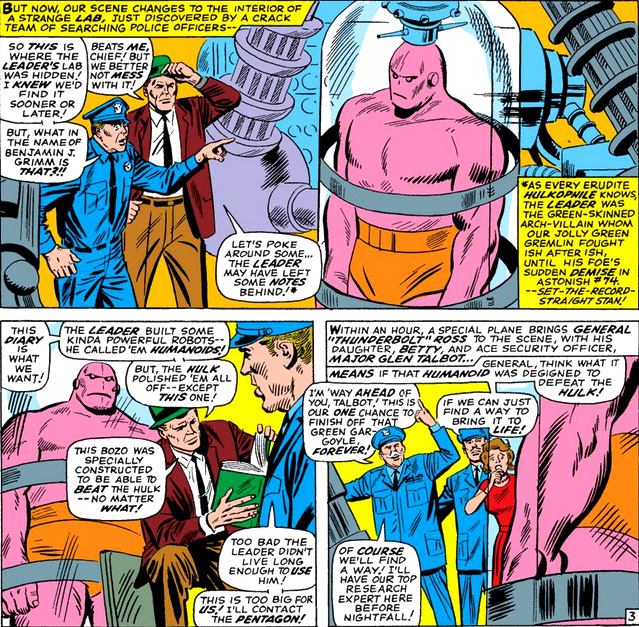
Posthumously, however, we discover sometime later that the Leader has been officially named via narrative as the Hulk's arch-villain when the police contact the Pentagon upon discovering his Humanoid creation in storage, which Ross rashly resolves to send against the Hulk--something the Humanoid, for its part, is totally on board with, except for the part about being under Ross's control.


Thus would begin a long association between Ross's command and the Leader, for better or worse (usually worse).
But... wouldn't we need a living Leader for that?

Say no more.


Friday, March 13, 2020

Symbolic Splash Pages: The Early Years


As an encore to our series on symbolic splash pages, the PPC wraps up this nostalgic look at the opening pages to a number of classic issues from the early 1960s to the mid-1970s by rounding up some of the earliest stories of Iron Man, Captain America, Dr. Strange, and the Hulk, at the time when they were building their reading audiences within the pages of Tales Of Suspense, Strange Tales, and Tales To Astonish--appearances which only numbered around twelve pages per issue, but served as stepping stones to hopefully something more. All of these characters went on to star in their own solo series--the Hulk having already been given his shot in 1962 only to disappear after just six issues, while Captain America was attempting to segue into the budding world of Marvel super-heroes after having helmed a successful series of his own during the 1940s.

Here you'll find on display the talents of Steve Ditko, Don Heck, and Jack Kirby, along with early appearances of the Black Widow, the Melter, the Red Skull...

...and, in November of 1964, Captain America, a hero Jack Kirby unleashes accordingly.


Wednesday, January 29, 2020

Symbolic Splash Pages: Spider-Man


We're in the middle of a week-long look at Marvel's symbolic splash pages which were in limited use during the early 1960s to shortly after the mid-'70s--the cleverly put-together Page One which was styled to let the reader know at a glance what obstacles or dangers were threatening our hero(es) but a representation not directly woven into the story. After starting off with the pages from Fantastic Four, we now move on to a title which was somewhat more prolific in its usage of symbolic splash pages--even beginning with the character's first appearance.


As we know, artist Steve Ditko's work here in Amazing Fantasy marks an appearance which helped to launch Spider-Man into his own series in short order. It's clear from the start (and certainly from writer Stan Lee's narrative) that Spider-Man's ordeals with public rejection and personal ridicule are intended to be the "hook" that sets him apart for those who might be expecting a costumed hero to be cheered and admired in the public arena--a point driven home in the splash page of his new series' first issue.


(Our hero is looking a little spindly here, Mr. Ditko.)


With the bizarre foes that Spider-Man would face from this point on--in addition to the woes of Peter Parker, a character whose popularity with readers appeared to be linked hand-in-hand with that of Spider-Man himself--Ditko seemed to excel in the presentation aspect of a symbolic splash page, a format that served to lay all the cards on the table for the kind of story one could expect to find inside. Grouped together, they form an excellent album of Ditko's unique style, in combination with what could be considered his signature character* for Marvel.


*Though a certain Master of the Mystic Arts might beg to differ!

Ditko's symbolic splash pages would begin to taper off around mid-1965, with his departure from the series taking place a year later. Even so, his creativity in this area continued to tantalize.


And there were of course his pages that opened the 1964-65 annuals.


With Ditko's exit, artists John Romita and Gil Kane unfortunately provided only sparse offerings as the book pivoted to a more dramatic format, a few of which mixed some of the elements of the traditional symbolic splash page though seamlessly leading directly into the story:


And how about this early Spidey effort by Ross Andru which owes its existence to circumstance--leading off a replacement story for a deadline snag involving Romita, but instead shelved and used in an issue of Marvel Super-Heroes from May of 1968 (though some of you may recall its appearance in the first Marvel Treasury Edition from 1974):


(Looks like voodoo from where I'm sitting, Mr. Lee.)


Finally, these nicely-handled efforts from Romita which masqueraded as symbolic splash pages but indulged in some amusing sleight of hand with the reader.


Ver-ry funny, gentlemen. Well played. :)

NEXT: