Showing posts with label Luke Cage. Show all posts

Monday, November 7, 2022

Planet Of The Apes!


Given the admittedly shameless aspect to this post's bait-and-switch title, it's understandable if those of you dropping in on the PPC today were expecting to see something like the following--a concept which is still kicking up steam long after its first film debuted in 1968 and carved a successful franchise that continued to 1973 and beyond which, as of this date, has collectively grossed $2,127.776,430 worldwide. That's a lot of bananas.


However.

Like Lucy van Pelt, who graciously balanced a football on the ground so that Charlie Brown could have the opportunity to run up and kick it--only to snatch it away the moment before his foot made contact, and consequently causing him to spectacularly crash to the ground, flat on his back--we regret to inform you that this post's title refers instead to a similar yet separate subject altogether. Namely:

Have you noticed the number of characters in comics which are based on or actually are, if only in part, simians--e.g., APES?


Yes, it's those characters who beckon us today, not some actors in furry suits who, along with their film crews, raked in over $2 billion at the box office. Who needs 'em? Today, we explore the apes who populate Marvel's Planet Earth. We bring you, instead, Marvel's own...


(With maybe a Beast or two thrown in!)

Monday, January 10, 2022

Don't Touch That Phone!


OR: "Hi-yo, Silllver...!"

 
After spending I don't know how much time configuring my new phone recently (remember when we only had to buy a phone off the shelf, take it home, and plug in the phone line?), I later began to think back to how often in the comics world phones had frustrated our favorite characters or otherwise been the bearer of bad news. It's the type of bits-and-pieces post that can wrack your brain in trying to recall from memory the scenes that would fall into such a category--but the diversion made for good fun, and part of the enjoyment of a scavenger hunt is the hunting, after all.

Here, then, are a few scenes where "Ma Bell" reigned supreme, and whoever was on the other end of the line wasn't very happy about it. In short, compared to spending a little time adjusting our phone settings, you and I are getting off easy.  (Unlike our friend, the Wizard.)


Wednesday, April 29, 2020

In Pursuit of... Doom!


Sweet Christmas! What the heck set these two off?


Eight issues into its run, Luke Cage, Hero For Hire is already turning to guest appearances to beef up its sales, and by coincidence this tale just happens to revolve around money--or, more to the point, the title character being short-changed by the lord of Latveria himself, Dr. Doom.

What could have led up to such a situation? It seems that some of Doom's robots have turned on their master and fled to the United States with state secrets, disguised as humans. And so Cage is hired by proxy to find and capture these "men," with his client obviously wishing to remain anonymous and withhold any information as to who is paying Cage's bill or the true nature of the "individuals" he's being paid to find (and at $200/day, which was probably a decent fee in 1973 for someone in Cage's line of work.)

But in the process, he discovers exactly what these "thieves" are when they put up more of a fight than Cage was expecting and their facade of human flesh is ripped away--and so he pays a little trip to his client's abode, the Latverian embassy, where Cage has his first meeting with that country's king.


Wednesday, October 23, 2019

"In The Jaws Of The Serpent!"


In what would be their third foray into inciting racial violence in the United States, the Sons of the Serpent, as we've already seen in the first two parts of a four-part story, have reorganized and begun launching attacks in New York City designed to stoke fear in their foreign-born and non-white victims and hopefully gain the attention of those like-minded white Americans supportive of their cause. Yet they've also drawn the attention of the dynamic Defenders (and their guest, the Avenger known as Yellowjacket), thanks to both the Valkyrie and Nighthawk having become involved with two individuals who have had exposure to the Sons' activities: Elena, a young woman forced to vacate a building in Manhattan's lower east side due to deplorable conditions ignored by her landlord, Harold Holliman... and Holliman himself, a real estate tycoon of little to no conscience who wishes to build a high-rise on the site and has courted fellow tycoon Kyle Richmond (Nighthawk) as a potential investor. Richmond never warmed up to Holliman or his proposal, his instincts toward the man having apparently been justified when Holliman is blamed (albeit cleared) in the firebombing which later destroyed Elena's building and resulted in loss of life, but whose name is later floated as the possible power behind the Sons of the Serpent.

As for the Defenders, they have been identified by the Sons as traitors to their race and captured, to soon face public execution. And now, apparently helpless, they're forced to listen as the Sons proudly explain their role in the purging of their country of those they consider impure--an explanation that includes their justification for mass murder.


It's a scenario that carries apocalyptic overtones, if only domestically--a plan that would require widespread outreach and public support for the Sons' goals to reach fruition, which bespeaks a level of sophistication and resources that would indicate the Sons have already marshaled considerable support and swelled their ranks from all corners of the country. Can the Defenders hope to stop such an organized and committed group, even if they somehow succeed in shutting them down locally? For that matter, can they escape their fate at present?

Well, we did say that they were apparently helpless...


Friday, August 2, 2019

Fallen Son--Crestfallen Friends


In mid-2007, Captain America was dead. Killed by what many believed to be a hidden assassin.

The X-Man and New Avenger known as Wolverine wasn't buying it. Relying on Dr. Strange to both transport him to the S.H.I.E.L.D. helicarrier and keep him from being detected (which Strange emphasized could be no more than ten minutes), Logan's mission is two-fold, albeit not completely to either Strange or Daredevil, who accompanies him: interrogate Crossbones, the alleged killer held in confinement, and use his senses to ascertain whether the body of Captain America is indeed a corpse. In regard to Crossbones, Logan learns that he fired on Cap that day but wasn't the person who made the kill shot. But as for Cap, the evidence is what can best be described as inconclusive, as presented by writer Jeph Loeb in the pages of Fallen Son: The Death of Captain America, a five-issue limited series that must keep mum on the subject presumably for the sake of capitalizing on continued sales pursuing the story. For his part, however, Logan appears to be convinced (repeat: appears to be).


The confrontation, then, opens the door to a series which acts as an elegy to Cap's death:


...and, consequently, can only hang like a dark cloud over


Monday, April 23, 2018

Rampage of the Wrecking Crew!


Yike! From a glance at this power-packed cover, it looks like the Defenders have decided to start this issue without us!


So let's get right to it, shall we?

  • The Wrecking Crew has been extorting New York City to the tune of millions of dollars, levelling one building after another with each refusal of the city to comply.
  • Richmond Enterprises' C.F.O., Mr. Pennysworth, has alerted his boss, Kyle Richmond (a/k/a Nighthawk), that all of the destroyed buildings were owned by his company. (You'd think Pennysworth would have done that before the first one bit the dust! Jeez!)
  • The Crew's latest demand raises both the price tag and the penalty for refusal: $25 million, or see the destruction of the entire city! (Adjusting for inflation, that works out to roughly $127 million today.)
  • Nighthawk and his fellow Defender, Dr. Strange, stand vigil at Richmond's remaining building (still under construction), one that Pennysworth has already taken steps to protect.
  • Strange and Nighthawk unfortunately come face-to-face with that protection: Luke Cage, Power Man, who jumps to the wrong conclusion and thinks the two costumed strangers are there to destroy the building. Not on his watch, sugar.
  • You can guess what happens next.
  • Eventually, our heroes convince Cage they're not part of the Crew--but as they begin to talk and compare notes, the real Wrecking Crew strike! Scratch one multi-million-dollar building.

Unfortunately, the Wrecking Crew is just getting warmed up!


Yes, believe it or not--there was indeed a time when Dr. Strange was prepared to
THROW DOWN WITH THE WRECKING CREW.
(You can almost picture the Ancient One planting head to palm, can't you?)

Tuesday, September 5, 2017

Power vs. Power!


Following issue #16 of Luke Cage, Hero for Hire, the title character was crumpling his copy of "The Daily Bugle" and venting his frustrations while wondering how he could latch onto his share of the press that all of the other comic book titles heroes in New York City were benefiting from. Welllll, just a thought, Mr. Cage, but could your fellow heroes be enjoying public acclaim because they don't list their services in the Yellow Pages? Incredibly, that thought doesn't even cross your mind, as you go down the list of ways you could change your image.


Finally, it's during a battle with a foe who had manipulated you into battling Iron Man when inspiration strikes:


Ordinarily, the name that Cage has stumbled on might do the trick. "Power Man" is certainly news-ready, and is bound to elicit more favorable attention than someone who fights the good fight as a hero for hire. Unfortunately, there's already someone who was given the name (by a goddess, no less) that Cage wants to claim for his own--someone whose criminal career has hit the skids and isn't about to let his name be usurped by a johnny-come-lately who wants to use it to build his rep.

In other words, get ready to rumble, Cage!


(By the way, have fun explaining to the press why you chose a villain's name as your new handle!)

Wednesday, July 12, 2017

Thrall Of The Purple Man!


With Brian Bendis enjoying a gig as Consulting Producer on the Netflix series Jessica Jones, it's easy to see parallels between the season-long arc featuring Kilgrave and the last few issues of the Bendis-written 2001-04 comic, Alias, which focus on Jessica's dealings with the Purple Man, who spells his name "Killgrave" and whose villainy hails back to his introduction in Daredevil in 1964. In both cases, Jessica has gone through hell with this man who kept her captive for months, an experience that haunted her even after she escaped his control; and in each case, we learn of Jessica's ordeal gradually, piecemeal, which more effectively conveys her struggle to put this period of her life behind her. Jessica as a victim is difficult enough to digest; Jessica as a helpless victim is a thought that boggles the mind.

For those of you whose interest in the character's clash with the Purple Man/Kilgrave is piqued and who have sampled (respectively) neither the television series nor the story in Alias, there is no one medium to choose first as far as which version offers more drama and a more powerful impact on the reader/viewer, as each of them has their merits and their own way of presenting the material. There is of course the perk of actor David Tennant in the role of Kilgrave in the series, who does a fine job of bringing the character to life in a real-world setting--yet you'll find the character in print no less compelling, so it comes down to the old debate about whether the book or the movie offers more entertainment for you. Having consumed both stories, I can at least attest that you won't be disappointed with either, no matter which one you prefer to dive into first.

Also, while the Netflix version no doubt brings with it the expectation of pulling no punches as far as portraying the gritty realism and frank reactions inherent in such a situation, the book is able to match the series in those respects, since Alias was the first series published under Marvel's new "Max" designation, with the company finally giving the Comics Code Authority the heave-ho and substituting its own ratings system while coming out with a line of R-rated comics titles. Both versions of Jessica are unarguably damaged, though with the television version being considerably more hard-edged and intimidating than her more vulnerable comics counterpart; but each medium does the character justice in how she copes with this painful reminder of her past.

In Alias, the Purple Man is incarcerated in the prison facility known as the Raft when Jessica is placed in the uncomfortable position of having to deal with him once more, after a group of "survivors" of his assaults on loved ones approaches her in order to obtain some closure for themselves--assuming, that is, that Killgrave decides to cooperate.


And since we're treading into the pages of a comic bearing the Max logo, it's probably a good idea to give you a heads up as to what to expect before we continue:


Tuesday, June 6, 2017

Exclusive To The Bugle: The Fall of Norman Osborn!


It often came as a surprise to come across stories in Marvel's line of comics when the "Daily Bugle," the mainstay newspaper created and given life by Stan Lee in the early 1960s, was given more exposure than simply a few panels of comic relief in Amazing Spider-Man or other titles. In those early days, ASM helped to make the Bugle, along with its crack staff of reporters and its cantankerous publisher, J. Jonah Jameson, a vital part of the mag, and not simply because of Jameson's designated role as a thorn in Spider-Man's side. (Heck, in practically everyone's side.) But as Marvel branched out, the Bugle followed--its ability to take New York City's pulse, as well as its extensive coverage of the city's crime scene, often put to good use in Daredevil, ASM, and other titles whose characters confined their activities to the streets.

In some of those stories, we saw another side of Jameson on occasion--the hard-nosed newspaper man who ran the Bugle like a taut ship and whose better judgment at times needed perspective from his editor and friend, Joe Robertson, the perfect foil for Jameson's fly-off-the-handle outbursts and his bent toward persecution. "Robbie" was a needed balance for the character, someone who could keep Jameson from becoming two-dimensional and whose presence at the Bugle gave the paper integrity to Jameson's grit. With these two anchors, the Bugle evolved to become an institution in Marvel's comics over the decades. There were stories to be told by this paper, and the potential was always there to evoke a different kind of drama that didn't necessarily have to depend on costumes and powers for its backbone.

In that respect, the 2004 series The Pulse offered something different for someone like me whose collecting bug was winding down and who was sampling other titles to see if anything grabbed me. At the time, Fantastic Four was numbering in the 500s, while the 1998 Avengers run was about to come to a "disassembled" end; and suddenly, here were Jameson and Robertson, breaking ground with virtually their own comic. For this to work, the writer and artists would have to really map out the kind of bustling newspaper office and staff they wanted to present, in a format that would put us in the city room instead of Peter Parker, Betty Brant, or any of the usual suspects who were mainly passing through or taking up space. It was the Bugle that would be the center of attention, the Bugle that would have to carry the story, the reporters who would essentially drive the stories and set the pace. It was a concept that was finally going to get its day.

As to the format, well, with its cover, you've already seen part of its foundation--"The Pulse," a new supplement of the paper that cleverly pulls double duty as the comic's masthead. A few readers will probably get a sense of bits and pieces of prior Daily Bugle concepts being salvaged and folded into the Pulse; for instance, the Pulse is aimed at appeasing newspaper readers who want to see the Bugle's content feature more informative news on super-heroes, something which was attempted with "Now" Magazine:


There's also the presence of Jessica Jones at the Pulse, a super-being who no longer suits up but is hired by Jameson to offer her unique input on stories that will see print in the supplement, which borrows elements from Carol Danvers' stint as the editor of Jameson's "Woman" Magazine:


For the Pulse, writer Brian Bendis produces a more detailed, 21st century version of the Bugle, where circulation is down because the paper's editorial slant against super-heroes has grown tiresome with readers, and whose publisher must be realistic about the paper's future and bite the bullet in terms of giving readers what they want.


Needless to say, what Jessica needs from Jameson, like Carol Danvers, is a salary and benefits, which this time Jameson readily agrees to.

Bendis, together with artists Mark Bagley and Scott Hanna, appear to be the right men for the right job here, immersing the reader into this world of news and investigative reporting and, most importantly, the Daily Bugle we were seldom privileged to get a look at behind the scenes for any length of time. As this series is starting, all three are still in the middle of their well-received run on Ultimate Spider-Man, while Bendis also chronicled Daredevil as well as introduced Jessica as a P.I. in the Alias series. No doubt some of you have reservations about cracking open any project written by Bendis, whose writing style can often be frustrating to follow. Yet if you can overlook the staggered conversations between characters, the constant interruptions they engage in, the maddening loops of subject ==> irrelevant tangents ==> back to subject, all of which try like hell to typify contemporary "casual-speak"... if you can overlook such distractions, there's some good work here and some excellent character development. Jameson, while still Jameson, is less outrageous and exaggerated--more centered and seasoned. Luke Cage, as characterized by Bendis, is one of the most solid versions of Cage I've ever read (and who fit like a glove in New Avengers). Ben Urich is a roll-up-his-sleeves reporter who's been frustrated by the number the job has done on him, but who pushes on because he's a damn good reporter. And if Jameson is the Bugle's soul, then Robbie is its heart, who keeps his eye on things and doesn't hesitate to step in when needed. It's clear there's no lack of commitment in any of the creative talent involved in these first few issues, with everyone bringing their A-game.

For its debut story, the Pulse tackles no less than Norman Osborn in his role as the Green Goblin--someone the Bugle, and Urich in particular, had attempted once before to expose but were swept up in a legal firestorm for their trouble. The series' first issue only touches on what's to come, when a body is discovered in Central Park's lake, a development that its second issue would pick up on; but this first issue is devoted to establishing the Pulse itself and those who make up its core staff. We've already taken a look at Jessica and the next steps she's decided to take in her life with Cage, yet her story unfolds from the beginning of the issue--pregnant by Cage and deciding to segue to a job with more stability. Of course, with Cage's dealings with Jameson having been on a more rocky road, he has reservations about his girlfriend considering a job offer with the man.


As we've seen, Jameson's commitment to the Pulse is real, so much so that he's made quite an offer to Jessica to bring her on board in what amounts to a position as a consultant. It speaks well of his instincts; and as for Jessica, her transition from P.I. to Bugle staffer no doubt strikes those who only know her character from her Netflix series as a bit odd.

As for Urich, the cagey Jameson has a conversation with him similar to the one he had with Jessica, only this time convincing Urich that it's Jessica who will need Urich to hand-hold and motivate her so that she'll do her best work for the Pulse, whereas Jessica is under the impression that it's Urich who needs the Pulse to jump-start his work as a reporter. But Urich is equally motivated by the fact that Jameson is changing his editorial stance and giving the Bugle a different direction.


With the look and feel of the book established, the story turns to what will truly ignite it--an investigation into the death of the young woman found in Central Park, a person who just the day before was a new Bugle reporter who was desperate to find a story that would appease Jameson's expectations of her. And so Terri Kidder takes a lunch with her friend Sheryl, who works at the Oscorp company--and a casual leading question from Terri has her very nervous and shaken-up friend spilling details that could land Terri her first big scoop for her new boss.


Since Terri was already working on a "100 most powerful people in NYC" story, it made sense to use that angle in order to go straight to the source and hope that Osborn would have a statement and/or reaction when she smoothly changed the subject to these reports of missing persons within his company. Unfortunately for Terri, she receives both.


Thursday, March 2, 2017

The Better Part Of Valor


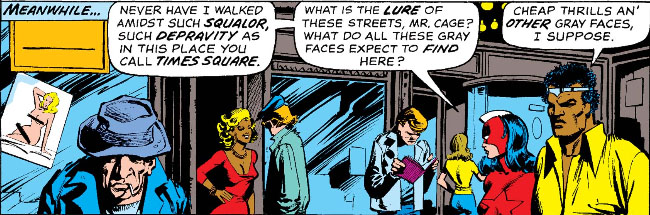
Super-heroes like Spider-Man, Luke Cage, Daredevil, and others who tend to come into contact and interact more with the man on the street are no strangers to the bluntness of their fellow New Yorkers, who will offer a piece of their mind if it's warranted and don't cut costumed heroes much slack when it comes to their day-to-day routine being disrupted or even encroached on. There have been dozens, likely even hundreds of such scenes on display in Marvel's line of books throughout the years, all doing their part to add a human element to the many conflicts that have raged on the city's streets between super-beings--and there are some scenes that you will surely want to cheer, as far as the support and level of excitement that bystanders and eyewitnesses contribute to the efforts of "the good guys" who struggle on their behalf.

And then there are the examples of selfishness, annoyance, and even outrage that we see from less appreciative citizens who step over the line and make it clear that not everyone cares for heroes butting into the lives of ordinary people and turning heads. In one such example, we find Cage canvassing the streets with Dr. Tania Belinsky, a neurosurgeon called in from the Soviet Union by Dr. Strange as a specialist for a case--though for our purposes, we'll instead see her in her guise as the Red Guardian. (Don't ask me why a surgeon, of all people, would suit up in costume and engage in physical fights with criminals, risking damage to her hands--I'm still trying to figure that one out.) Cage and the Guardian are searching for the missing Valkyrie, and their troubles begin when Cage believes he might have spotted her.


Heh. You've probably guessed that our obnoxious friend isn't going to leave it at that.


This scene might well have ended with this man's bruised and barely conscious body adorning one of the many signs in Times Square--but Cage is a cut above the rest, and instead he leaves this man's disposition to the Guardian, who settles the matter without incident.


Needless to say, when word of this gets around, the name that this guy snarled so loudly to "protect" is now as shattered as that blade of his.

Friday, August 1, 2014

One Wingman Short


In a prior post, it became clear how valuable the presence of the Hulk was in promoting sales of The Defenders, even if the Hulk wasn't actually in the issue(s) in question. I suppose when you think about it, there wasn't any other character on the team who could carry the ball in that respect--not even Dr. Strange, who mostly kept a low profile in comparison to other Marvel characters and whose book likely wasn't a strong seller in the first place. So a cover like this one, while infuriating in terms of being a blatant misrepresentation of the events in the actual story, fully met the spirit of "shameless marketing ploy":


Just to make things crystal clear: the Hulk was never present (conflicted or otherwise) during the confrontation between Luke Cage, Strange, and Nighthawk--therefore, neither Strange nor Nighthawk addressed him or questioned his loyalties. The Hulk never even knew such a meeting took place--because, in the first few pages of the issue, the Hulk angrily left the Defenders without a backward glance. Strange decided to accompany Nighthawk in investigating the mysterious destruction of buildings owned by Kyle Richmond (Nighthawk's true identity), which led to their unfortunate meeting with the private security which Richmond's C.F.O. hired to protect the premises.


Yes, a slight over-reaction on Cage's part. He compounds the blunder by decking Strange--but that opens the door to this nice little dust-up with Nighthawk:


I don't really see Nighthawk as being Cage's match--after all, even though Nighthawk has twice the strength, skill and stamina of a normal man at night, Cage's strength and stamina go beyond that. And since Nighthawk really isn't looking for a fight while Cage is, the man interested in putting the other down is likely the one who'll prevail here.


So it's a good thing that Nighthawk has Strange as a wingman tonight, because once the stars stop circling Strange's head, this fight's going to be over. Oh, wait--isn't his "mystic might drained"? I GUESS NOT.


For what it's worth, the Hulk returns in the next issue to help battle the Wrecking Crew.  At least that's what it looks like on that issue's cover.

Wednesday, January 29, 2014

The Mountain That Walks Like A Man!


When the cover to Marvel Two-In-One #13 appeared on the rack, you'd almost think you were looking at a reprint of one of Marvel's old monster comics from the early 1960s:


Those monster names just rolled off the tongue then. "Vandoom!" "Rommbu!" "Droom!" "Monstrollo!" "Goom!" And here we have a colossus that has a name like a comic book sound effect: Braggadoom! But as terrifying as he comes across, there's a little more to Braggadoom than meets the eye. We sure hope there is. Because if he's just rampaging for the sake of rampaging, we're all in trouble.

Braggadoom's story begins with a far more meek individual--Arnold Krank, a researcher whose oversight combined with his clumsiness (just what you'd want in a lab scientist) led to a fateful accident:


Yet it wasn't until a hastily called press conference that the real horror would begin:


And reach someone Krank did--Ben Grimm, the only member of the Fantastic Four in residence when Krank went to ask for their help. And the fierce conflict between the Thing and Krank's accidental creation would lead to the inadvertent naming of the creature:


Seeing that the Thing would need help, Krank then went to Luke Cage and convinced him to join in the attempt to subdue Braggadoom. Unfortunately, Braggadoom would soon enough have both of them in hand:


During the battle with Braggadoom, it becomes clear that it's an uneasy alliance between Cage and Grimm--mostly due to the Thing's underlying impression that Cage charging for his services makes him something less than a professional, as well as less of a bona fide hero:


At least for the short term, though, they agree to focus on the crisis at hand. A crisis which has literally become bigger:


The Thing manages to topple Braggadoom and gain some breathing room--but as he prepares for a final attack, Krank tells Cage that he believes it would prove fatal. And when Cage attempts to intervene, Grimm again loses his patience with him, while at last giving voice to the reason for his annoyance with Cage:


Fortunately, Krank confirms to Grimm his fears regarding a physical attack on Braggadoom. Yet, at that moment, a startling development occurs:


And so the crisis has passed, though the Thing notes that two men are still dead. As for Krank, he seeks to atone for the tragedy of Braggadoom's creation and rampage by taking on a new role with the creature, in an ending that would fit like a glove in one of those old monster comics:


I don't recall Braggadoom making any more appearances in comics, so perhaps his story ended here. As for Grimm and Cage, they went on to butt heads again when Cage temporarily took Grimm's place in the FF, another situation where Cage showed considerably more maturity in their disagreement than the hot-tempered Grimm.

Marvel Two-In-One #13

Script: Roger Slifer and Len Wein
Pencils: Ron Wilson
Inks: Vince Colletta
Letterer: Joe Rosen