Monday, July 13, 2020
(Almost) All You Ever Wanted To Know About Phoenix...
If you were one of those Marvel readers who went as far as you could in trying to make some sort of sense of all the subsequent appearances of Phoenix after the "death" of Jean Grey, let me just say that I'm awed by your tenacity--you've actually tried to bring order to chaos, and unfortunately may have come up empty like the rest of us. If Dark Phoenix were here right now, she would likely be amused at our effrontery and chide us for our hopelessness; nevertheless, we've likely at one time or another been part of a loose-knit circle of ardent and dogged "Phoenix-chasers" who occasionally attempt to connect the dots in the hope of justifying the many, many appearances of Phoenix though the decades that tried to build on what came before.
As your humble host at the PPC, I believe I threw in the towel on the subject at some point, though it's still enjoyable to come across a Phoenix story from the past and pull on its thread a bit to see how well it adds to--or how much it detracts from--the character's mystique (though referring to the Phoenix force as a "character" feels a little like reaching the point of no return). One such story involves Rachel Summers, herself one of those threads which was woven into the story of Phoenix simply by virtue of the fact that she is the daughter of Scott Summers and Jean Grey from another timeline. Rachel has the dubious distinction of being the character who started the ball rolling again on Phoenix following the end of the original storyline; and after she made a number of appearances in X-Men adventures, she was plugged in as a charter member of Excalibur, a new super-group based in Great Britain, as a sort of "Phoenix-lite" whose own connection to the Phoenix force unfolded as the book progressed.
In terms of becoming a full-blown Phoenix in her own right, however, we'll discover that Rachel finally gets to have her cake and eat it too following the events of a battle which leaves her fate uncertain--until the Phoenix itself intervenes with its own solution.
The scene where Phoenix returns to the stars (with Rachel "in tow," as it were) takes place in a story written by Alan Davis bearing a title which Phoenix-chasers no doubt applauded for its audacity, if not its accuracy: "All You Ever Wanted To Know About Phoenix... But Were Afraid To Ask," a truly laudable attempt to tie together the many appearances of Phoenix to date (in this case, July of 1992), though the story narrows its focus to those instances leading up to and involving the power's manifestation in Rachel (i.e., "All You Ever Wanted To Know About Excalibur's Phoenix..."). Davis would have probably needed an Omnibus, along with a few gallons of espresso, to tackle and bring coherence to the entire saga of Phoenix--even Mark Gruenwald would likely have balked at the task, and that's saying something.
At any rate, it's the Phoenix itself that now takes center stage in its ongoing story, sharing Rachel's body but suppressing her consciousness as Rachel continues to heal. The question is: What does it plan to do, while still tied to the mortal plane?
Friday, June 19, 2020
X-Men: Revisited
In late June of 2018, artist/writer John Byrne could be found penciling and then posting in his forum a few off-the-cuff pages of the X-Men in all-new action (yet as they still were in both garb and lineup during the fall of 1980), when a thought occurred--which subsequently materialized as a separate post he would make in said forum:
"Just had one of my wilder ideas. Remember when Chris was doing X-MEN FOREVER, picking up from when he left the book? Immediately some people started speculating about me doing the same, X-MEN EVERMORE, picking up from my own exit point.
"But just now I thought of something that would be even more fun. For the sake of reference, let's call it X-MEN ELSEWHEN, picking up with the coda of X-MEN 136, but proceeding as if Shooter hadn't thrown his king-sized monkey wrench into the works! So Jean doesn't die, Scott doesn't leave, and, well, a whole bunch of other stuff does and doesn't happen.
"(And, no, not scripted by Chris!!)
"Never gonna happen, but fun to think about."
Forum readers were receptive. Further pages were sporadically posted, again with no narrative or dialog--simply various scenes with the team in action in what appeared to be the Savage Land. But as Byrne continued to nurture this inclination, and the back-and-forth in the forum continued, a pattern gradually began to emerge, and the pages began to appear sequentially; and as they progressed to a bona fide story, talk eventually surfaced about the possibility of approaching Marvel (or, as it happened, vice versa) about turning this idea into a commercial project.
To make a long story short, that prospect was explored but ultimately abandoned. But eventually it became clear that Byrne was interested in continuing with this story's premise--and one year later, he decided to begin releasing it on his forum, a page at a time, scripting the story as he went along, complete with dialog, narrative, titles, and would you believe even sound effects. There would be no inking, coloring, formal lettering, or covers, but he did design a masthead for the "book":
To date, there have been ten full "issues" of X-Men: Elsewhen posted, with issue #11 in progress. All issues are free, and viewable by the general public--as are all forum comments related to each issue (though to submit a comment you're required to register with the forum). And while what's being produced is naturally not as polished as a copy you'd pick up at the store, the work is of course first-rate considering the source, while giving the reader an intriguing look at the creative process fresh from the drawing board.
Following is a limited number of sample pages which should give you an idea of what to expect if you decide to have a look at the issues in their entirety. As Byrne notes, the story begins at the point where the Shi'ar are returning the X-Men to Earth following their defeat by the Shi'ar Imperial Guard on the moon, a battle that never progressed to the point of the rebirth of Dark Phoenix or Jean's subsequent decision to end her life. As to the whys and wherefores in regard to what exactly happened... true to Byrne's piecemeal style in plotting a story, those answers will unfold in their own good time in order to accommodate an ongoing sense of drama in the overall tale. (Assuming they do unfold in full--the story is at the writer's discretion, after all. ;) )
In addition, nestled in with these preview pages are a selection of Mr. Byrne's comments at various points of the process which give a sense of the project being ironed out from the ground up, while also offering fascinating nuggets of behind-the-scenes info. (The segments may or may not align with the pages you're viewing here--if by some miracle they do, I assure you it's mostly accidental on my part.) If you've read Byrne's turn-of-the-century series X-Men: The Hidden Years, you already have an idea of how he would handle the X-Men (and Xavier) if holding the reins--though whether or not you agreed with his take on the team, you may still appreciate a different look at both the timeline and the characters, as well as a number of nods which Byrne gives to continuity taking place in both Uncanny X-Men and other titles.
And adding my own 2 cents, I think on the whole you'll find it to be compelling reading. :D
Monday, October 22, 2018
You Always Battle The One You Love
(with a nostalgic nod to Allan Roberts and Doris Fisher)
As a companion piece to an earlier post which took a look at pairings of Marvel characters that didn't quite work out romantically, it seems appropriate to flip the coin and look in on couples whose romantic ties were more stable (or in flux) but who, from time to time, were perfectly willing to take off the gloves and resort to duking it out to resolve their differences, just like any other couple. Except that when we're talking about super-powered characters, there's every chance that a fight will turn into a full-fledged battle, possibly to the death! Ain't love grand?
Wednesday, September 19, 2018
The Rise Of The Dark Phoenix!
In mid-1980, the already-successful Uncanny X-Men title reached what was arguably the pinnacle of its popularity when its co-plotters, writer Chris Claremont and artist John Byrne, introduced the character of Dark Phoenix--capping the already well-received makeover of Jean Grey, one of the original members of the X-Men, whose identity as the telekinetic/telepath Marvel Girl had literally been given new life as "Phoenix," the ultimate expression of her potential as a psi.It's not unusual these days to encounter an eye-roll or two when raising the subject of Phoenix, with Marvel having taken that "life incarnate" part a bit too far and recycling/remarketing the character and concept ad nauseam in the nearly forty years since her inception. Yet in the beginning, when Phoenix was still being presented as tied to Jean Grey, her steady evolution to something beyond her control was riveting, providing a different take on a classic character who up until that point had been eclipsed by even the Wasp.
As for her transformation to "Dark" Phoenix, it seemed to be well-timed to the fact that her friends and teammates had grown worried about her ability to contain her vastly increased power; while an additional factor complicated the situation when an old enemy of the X-Men, Mastermind, began to seduce and corrupt her thoughts, until she became susceptible to casting aside her self-restraint and letting slip away her morals and conscience, a steady shift in behavior that Mastermind encouraged in her.
The result: a twisted version of her former self, wielding limitless power and abandoning her moral compass as easily as you or I might discard a piece of lint. And now, as an entity intent on embracing and following a darker path to the stars, Phoenix severs ties to those who she once considered friends--and viciously, at that.
We would later learn the behind-the-scenes story of Phoenix, detailing Claremont and Byrne's original plans for Jean and why they shifted course at the eleventh hour--and we'd also witness Jean's contrived return and the status quo restored. But in this early tale which begins to explore the dark turn of the character, we're all still under the impression that these shocking developments are the natural progression of Jean's evolution as plotted by Claremont and Byrne--taking her in a direction that raises her profile considerably, at least for as long as the ride lasts.
We'll have to trust Cyclops' later assertion that Jean has made an effort here, conscious or otherwise, to avoid slaying the X-Men outright; otherwise, even though the jury would be out on Wolverine, Colossus would now be dead after a multi-ton solid gold tree was toppled onto him while he was in human form--a death which would have occurred if only a single ton of weight had fallen on him, even if it turned out he was only pinned. Whatever Jean's intentions, come on--Peter is pulp, like any of us would be in his place. When is the funeral?
From here, the story takes a fascinating turn, with Jean--or, rather, the malefic entity she's become--departing Earth forever with no reservations, while other characters react to the emergence of Dark Phoenix in various ways, depending on the circumstances. As for the X-Men at the scene, they're deprived of hearing Jean's "goodbye" sentiments, such as they are.
For those left in Jean's wake, they can only speculate as to what's happening (though the Silver Surfer comes close):
While those in her path are unfortunately reduced to a state of dread that would precede their deaths--a sudden, incredible turn of events that in an instant makes Jean Grey a mass murderer, on a horrifying scale.
It's a sobering scene that carries a wealth of complications for the character, and for the X-Men--though the reader is perhaps wondering for the first time if Jean has reached the point of no return here... if there is any coming back from this. Later, we'd see that Wolverine is convinced that Jean and Phoenix are two separate entities, ergo, Jean can't be held responsible for the actions of Phoenix. Nightcrawler wonders if he can forgive Jean for what he views as an atrocity many levels above those of the Holocaust. And Jean herself all but admits that her feelings and those of Phoenix may likely be one and the same. You can't help but wonder how Claremont will sweep it all under the rug, as he must if Jean Grey survives the repercussions of her actions.
I remember at the time being so impressed with the amount of material Claremont and Byrne were able to pack into this story's 17 (!) pages. The battle with the X-Men... the aftermath of the team's dealings with the Hellfire Club... the scenes with Xavier and Moira MacTaggert, conferring about Jean's fate... and then, an amazing panorama of scenes by Byrne and inker Terry Austin (the latter departing Marvel for DC following his X-Men and Dr. Strange work--Marvel's loss, to be sure) of Dark Phoenix, a thoroughly corrupted young woman who has already begun effecting massive change and turmoil in another galaxy. When this saga concluded, it would mark a turning point for the X-Men, for Cyclops in particular, and for the book itself as the team dynamic shifted; but this issue was such a page-turner that it was all a reader could do to keep up with the events unfolding here in front of their eyes without even thinking of looking down the road that far.
Since we know in hindsight the Shi'ar would step in shortly to bring Jean to heel and to neutralize Phoenix, this issue also presents the catalyst for their involvement: a Shi'ar battle cruiser, investigating the extinction of the D'Bari star system and finding a single entity responsible. The cruiser's Captain immediately retaliates, and pays the price; yet before the end, he manages to reach the Shi'ar homeworld with evidence of the being responsible.
Lilandra and her Chamberlain, having encountered the Phoenix previously during a Shi'ar crisis involving Lilandra's mad brother, D'ken, are able to grasp the full extent of Phoenix's threat, and move to act accordingly.
As for the X-Men, they're also grimly assessing their own situation--one that seems hopeless, even before a startling new development that closes the issue.
As cliffhangers go, it's an odd one, given Dark Phoenix's parting words to the team. It's been shown previously in this story that Phoenix is now exactly where she wishes to be; and while the X-Men, unconscious at the time, have no reason to suspect Phoenix is gone for good, Claremont's dialog for her made her intentions to depart forever crystal clear to the reader. So why the about-face? And why the gasping shock-statement from Scott that she's ravenous? The following issue shows her returning to Earth not hungry, but "homesick" for want of a better word. It's a strange turn of events that only serves to set up a final confrontation with the X-Men, and, from there, with the Shi'ar.
As the issue which begins the trilogy featuring the fate of Phoenix, this story earns its status as a true X-Men classic--and at something of a bargain, too. With the book scheduled for a price increase to 50¢ a copy after another three issues, this seventeen-page story was only costing you a little over 2¢ a page. However you define "getting your money's worth," 1980 was the year X-Men delivered.
![]() | Uncanny X-Men #135 Script: Chris Claremont Pencils: John Byrne Inks: Terry Austin Letterer: Tom Orzechowski |
Monday, August 14, 2017
The Told And The Untold
Slowly but surely I've been making my way through Sean Howe's 437-page book from 2012, Marvel Comics The Untold Story, which I unwind with just before bedtime. I enjoy reading very much, but if I don't set aside time for a book, I never have the time to sit down with one; the fact that I picked up Howe's book years ago and am only now plowing through it should tell you something. Also, I'm one of those people who becomes so relaxed by rare moments of "down time" that, unfortunately, I can only read a few pages of a good book before I feel myself losing focus and inevitably nod off. (You can imagine how long it took me to get through a stack of comics for the week. Answer: a week.) With all due respect to Mr. Howe, his book is a page-turner, but not one which I could apply the phrase, "you can't put it down" (though that doesn't diminish his work in the slightest). But for what it's worth, it does occupy a place on my nightstand, an honored place for any tome as nightstands everywhere can attest.
Lately, the book has been helpful in bringing to light and exploring fascinating information from behind the scenes of Marvel's production process, such as Sal Buscema taking off the gloves on an issue of Incredible Hulk, for example--though I've found myself raising an eyebrow at times during the reading process. Howe has been diligent in documenting his sources from quoted material--yet there is an almost necessary tendency for any author of biographical or other nonfictional material to fill in the blanks in an effort to provide the complete picture, and that can often take the form of speculation or conjecture, even taking into account "the personal recollections of more than 150 individuals, and relatives of individuals, who worked at or with Marvel Comics," as Howe states in his acknowledgments. (I haven't conducted a fraction of the interviews that Howe has, and look how often I've indulged in conjecture.) There's a point, for example, in litigation where counsel will at times object to testimony and note that "the witness is drawing a conclusion," which cautions that the witness's opinion is essentially that of a lay witness, not a person qualified as an expert; in other words, they can testify to facts, but not offer opinions, inferences or conclusions. In Howe's case, I have to take what supposition he offers with a grain of salt. His interjections make for interesting reading, but what I'm reading may not necessarily be factual. Even quoted material can be suspect; for instance, a passage in the book that reads, " 'I saved Marvel's ass,' Kirby told an interviewer...", which Howe documents in his notes as originating from an "Unpublished Leonard Pitts interview with Jack Kirby." Putting aside for the moment that the key word there is "unpublished," the reference could also be interpreted as the comment possibly having been declared "off the record" at the time of the interview, which calls into question not only its authenticity but the decision to deem it repeatable in a book being prepared for publication.
The behind-the-scenes nugget that's the subject of today's post is a good example of how connecting the dots can take a zig-zag route and have one wondering if the facts are adding up correctly; yet the foundation of the actual chain of events, at least, is stable enough to recount. The situation dates back to when the decision was made to bring the character of Jean Grey back following her demise in 1980 after artists Bob Layton and Jackson Guice successfully pitched to Editor In Chief Jim Shooter the idea of reuniting the original team of X-Men for the new X-Factor title, a concept that carried the potential of a marketing juggernaut. Even Chris Claremont, who initially resisted the idea, came on board with it--and after taking the crossover frenzy of the reading list leading up to X-Men #200 off his plate, he was curious to see how FF writer/artist John Byrne was handling Jean's reintroduction in Fantastic Four. And that's where the fun begins.
"Claremont took a look at how Byrne was handling the backstory of Jean Grey in Fantastic Four and petitioned Shooter for a chance to rewrite Byrne's two-page flashback sequence, which X-Factor penciller Jackson Guice then drew in his best faux John Byrne style. This was Shooter's chance to appease his star writer, still stinging from the way Jean Grey's return had been commanded, and even John Byrne didn't have enough clout to stop it."
Wednesday, November 16, 2016
The Return of... Marvel Girl!?
It only took a little over five years after the fact for Marvel to raise from the dead one of its classic characters--Jean Grey, a/k/a Marvel Girl, whose life had been brought to an end both heroically and memorably. In comics terms, five years isn't a great deal of time to allow the dust to settle before planning the details of the character's resurrection--and in Jean's case, there was also the matter of coming up with a reason for bringing her back (or, perhaps better put, a reason for not leaving her dead) beyond folding her into a reboot of the original X-Men. With her more dynamic identity as Phoenix at an end, what could Jean Grey bring to the table as far as reader interest that she couldn't manage to ignite in the many years since her 1963 debut?
One could ask the same of the first X-Men team, who couldn't make a success of their first title and quickly fell by the wayside when their 1975 replacements made the scene--but who were now counting on a bump from the popularity of their successors for their relaunch. Jean, in a way, seemed to be relying on her own popularity and momentum as Phoenix to bring her old readers along for her rebirth--an appropriate word for her reappearance, under the circumstances. Few characters could embody so well the commonly used phrase "like a phoenix from the ashes...", describing the mythological bird that perishes in flames of its own making only to be reborn from its ashes.Given the interest that Jean's return would likely generate, it seems strange that the story behind it wouldn't take place exclusively in the new title in order to benefit its launch, perhaps even taking two or three issues to solve the "mystery" of it. Perhaps the decision was made to instead have the X-Men regarded as a whole, rather than banking on one of their characters to sell their concept, a more meritorious approach that lets all five characters present themselves to new readers and conveys a vote of confidence in the book.
That's not to say that Jean's reappearance wasn't milked for all it was worth and used to build interest in her new title. First, indirectly, in an issue of The Avengers that featured the return of the Enclave and inadvertently led to the discovery of an energy-emitting pod beneath Jamaica Bay--and then followed up on in the pages of Fantastic Four, giving artist/writer John Byrne (along with inker Terry Austin--how awesome is that?) a crack at the sequence of events which began with the death of Marvel Girl during a fateful space shuttle flight and leading to the as-yet undisclosed details of the introduction of the Phoenix force. The issue of X-Men which heralds the aftermath paints an ominous picture of the shuttle's final moments before it crashes into the bay:
Thursday, September 22, 2016
Beating Of The Minds!
Issue #131 of Uncanny X-Men has so much going for it that it's hard to know where to begin. The team has finally found its legs by this point--not only creatively, with writer Chris Claremont and artists John Byrne and Terry Austin turning out a steady stream of quality product--but also as a result of the team itself now being stabilized, with their field leader, Cyclops, having adapted to the styles of the new people he's come to know on a personal and professional level as they've worked out their rough edges in various conflicts. This team is now the X-Men in name and deed, with even their mentor, Charles Xavier, loosening up on the reins and giving them more of a free hand in the field, if grudgingly. (He's not quite ready to relinquish those reins, as the following issue would make apparent.) They've also made contact with their first "new mutant," Kitty Pryde; Jean Grey, now known as Phoenix, has integrated with the team, with herself and Cyclops making for a nice team blend of old and new; and the X-Men have had their first encounter with the Hellfire Club, a group that would become one of its major nemeses and would certainly qualify for an entry in their rogues' gallery.It's during their meeting with Kitty and her parents that three of the X-Men--Wolverine, Colossus, and Storm--have come under attack by armed men in the employ of the Hellfire Club, with the Club's "White Queen"--a powerful telepath named Emma Frost--taking them all down with one strike and ordering them captured. (Along with Xavier, who's ambushed off-panel.) Kitty, who was with them at the time, manages to escape and track them to Frost's complex, using her newly-discovered "phasing" power to reach Storm and the others before escaping once more with instructions to contact the other X-Men. Meanwhile, Cyclops (a/k/a Scott Summers) and Jean have recently made contact with another mutant who calls herself Dazzler, and have come under a similar attack by the Club's armed men--and with Dazzler's help, and joined by Nightcrawler, this time it was the X-Men who downed and captured their opposition.
Off-panel, Kitty has made telephone contact with the other X-Men, but now tries to evade the men of the Club who have her fearfully running for her life. What these men don't know is that the X-Men have found them, and the tables have turned.
Wednesday, August 17, 2016
My Betrothed--My Killer!
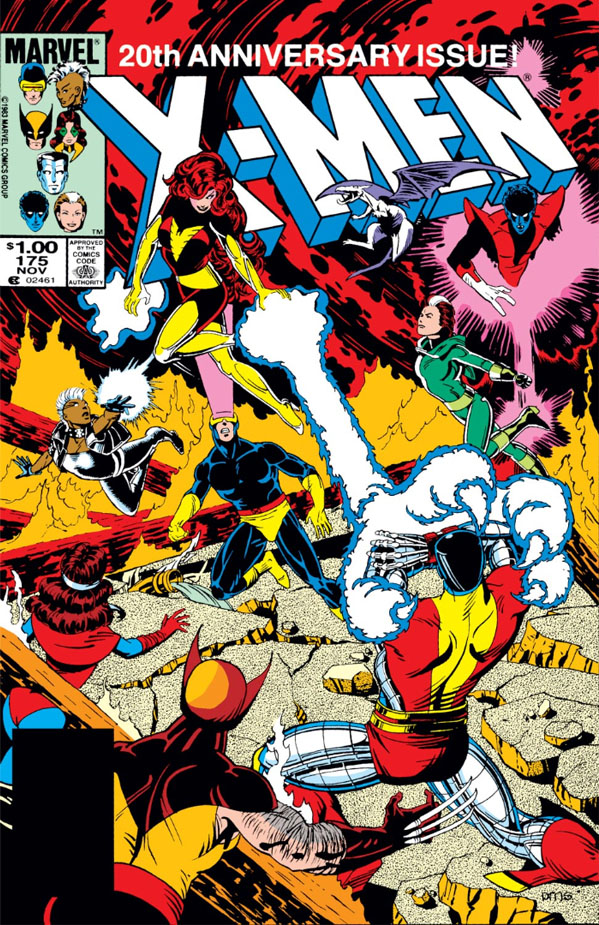
It took just a little over three years after her death for Uncanny X-Men to start the ball rolling with bringing the character of Phoenix back in one form or another--that is, if you don't count earlier issues that teased readers with the possibility. Unfortunately, the book's twentieth anniversary issue takes that sort of bait-and-switch treatment and this time applies it to its story's main plot.
Here, the team firmly believes that Jean Grey has returned, and obviously as Dark Phoenix, the character's ruthless, take-no-prisoners manifestation--reincarnated through the form of Madelyne Pryor, Scott Summers' fiancée, a woman whose own resemblance to Jean is uncanny and whose life offers disturbing parallels and coincidences in regard to the woman whose likeness she bears. Not only was Madelyne the sole survivor of a plane crash that occurred at the instant of Jean's death on the moon--but Scott has also found no evidence of her existence prior to the crash, while Madelyne avoids the subject in conversation. Conveniently, Madelyne also seems to be one of those rare humans whose thoughts are closed to Prof. Xavier. All more than enough to raise the suspicions of the X-Men (and certainly Scott) to an alarming agree; but in a Chris Claremont story, people tend to talk a lot about things which should be looked into, and then look the other way until it's too late and the crisis is upon them.
That point comes when Scott can no longer bear the thought of not knowing the truth about Madelyne, and bluntly broaches the subject during an intimate celebration of their engagement in Anchorage.
Tuesday, February 23, 2016
The Revised Marvel Universe
Along with Stan Lee's Origins of Marvel Comics series that went on to spawn a look at villains as well as throwing a spotlight on the distaff characters of the company's books, there were two one-shot comics published in 2010 that featured their own origin profiles of various characters. And they obviously didn't see a need to reinvent the wheel when it came to their respective titles.
What sets them apart from other origins efforts is their attempt to break with the past. Since many of the characters profiled had been around for decades, the contributing writers make an effort in the revised origins not to lock the heroes into any set time frame. With some heroes, their origins were fine as is. Captain America, for example, could have been floating around in ice for any number of years and been awakened at any time; Spider-Man's uncle could have been murdered in 1990 just as well as 1962; in Stephen Strange's case, car accidents didn't only happen in the '60s; and the Avengers could have affixed their charter with whatever year their date stamp was set at.
Naturally, however, a few of them needed to have their origins revised to a "one size fits all" style that would omit inconvenient details which would have locked them into a certain time period and would stand the test of time from that point on. The Fantastic Four would be one of the stand-outs, since their conversation about beating "the commies" to the moon--and later, "the reds" to the stars--dates the group to the 1960s no matter how it's phrased. But only a slight adjustment is needed to bring them into the 21st century.
(One has to wonder just why Reed's project was being cancelled by the government, if he's considered such a brilliant scientist. There's no logic to the government building a starship all the way to launch-ready status and then cancelling the entire project; on the other hand, many such instances have occurred with expensive military aircraft, both in the U.S. and abroad.)
Nick Fury, of course, can't be fighting in World War II, and yet be in his late 40s/early 50s when he's tapped to be the director of S.H.I.E.L.D. in the 2000s. But if an experimental formula worked for Steve Rogers...
And just as with Cap, it looks like Fury is good to go for at least the next few decades.
Tony Stark was also tied to a wartime period--in his case, the Vietnam War, where shrapnel from a booby-trap-triggered explosion forced him to design his Iron Man armor while a prisoner of the enemy. But war spans the decades, unfortunately--and such conflicts don't have to have a historic name to stand in for the cause of Stark's transformation.
We could also assume that the Hulk's origin can be plugged into any year, if we omit Igor's plot; and after all, Rick Jones can drive onto a bomb test site in whatever year we want to place him. But that raises the question of why the bomb test wasn't aborted when Banner raced out to get him to safety; and regardless, Rick being a teenager locks the Hulk into that year, presenting the Hulk's origin with the problem these books are trying to bypass.
Strangely, though, some origins in these books are unnecessarily tweaked, while others are prone to errors. Doom, for instance, is still shown to be conducting his miscalculated experiment to contact the netherworld, but in the revised version the purpose of his experiment is slightly changed.
It's unclear whether the origin is keeping the same angle of the netherworld, or just boiling the situation down to Doom's ego--but the result is the same. Doom is expelled, he meets up with the monks, his armor is made, and he eventually winds up in Latveria. Why bother with such a small adjustment?
The Black Panther's origin receives similar subtle treatment--the goal apparently being to provide a reason for T'Challa to leave Wakanda and become a hero in the States.
Moving to the X-Men origins book reveals other odd revisions. The Beast's experiment in finding the chemical cause of mutation is completely sandpapered over, with his change to bestial form and continued shifts now attributed to "misfortune," which appears to point to his own misjudgment but otherwise could mean anything.
With Emma Frost, she grieves over her fallen Hellions, slain by the Sentinels--when they were actually killed by time-traveler Trevor Fitzroy.
The Sub-Mariner gets a page in the X-Men origins book because it's maintained that he's a mutant--though in the absence of a story that shows either Leonard MacKenzie or Princess Fen being exposed to chemicals and/or radioactivity, I still prefer thinking of him as a hybrid.
Jean Grey's origin certainly raises an eyebrow or two, since it appears to jettison all that we've been told about the Phoenix force replacing her as a perfect copy of herself, while she was out of commission for the duration. In this version, it was Jean herself who became Phoenix, just as we originally thought she had in the first place.
For the most part, these one-page mini-dossiers are nicely put together, and give all of these characters simple, uncomplicated, baseline origins that suffice for any reader to become familiar with (or refamiliarize themselves with) for as long as the characters remain in demand.
Tuesday, November 24, 2015
In Final Battle With Mutant X!
Having confronted the X-Men and lived to tell the tale, the mutant known as Proteus now rampages through the streets of Edinburgh, using his power over reality to throw the city into chaos. Proteus, now in possession of a new host body--the corpse of his father, Joe MacTaggert--holds Joe's wife Moira hostage in order to prevent the X-Men from interfering with him; and in taking his father as a host, Proteus possesses all of Joe's memories, including the contempt he held for Moira as well as a tendency to take what he wants. As a result, the X-Men face a more ruthless, more driven foe who is now drunk with power and a sense of superiority over the human race.
For now, the X-Men can only engage in damage control, pitching in and helping those people who are victims of the shifting landscapes that Proteus has set in motion. As for Moira, try though she may to reach through to her son, Proteus is now as Cyclops has judged him to be: one of the most evil of evil mutants that the X-Men were created to battle and protect humanity against. In a way, writer Chris Claremont has enabled that label of evil and our perception that Proteus, now a callous murderer, is beyond redemption, thanks to a very strange omission throughout this story--the fact that, unlike the rest of his family, Proteus is never referred to by his birth name. Instead, he's been known by the name displayed forebodingly on his cell door on Muir Isle: "Mutant X," a name even Moria hasn't been allowed to move beyond. You're not exactly going to have the disposition of Wally Cleaver if your own mother refers to you by a lab label--nor does Moria seem conflicted about it. As Moira herself observed, "It was too late [for him] the day he was born."
As a result, and despite Claremont's efforts to establish a painful conflict within Moira involving her feelings for her son vs. her acknowledgment of his nature, it's been difficult to truly see Moira in the role of this boy's mother, particularly given how easily she seems to be able to avoid using his name--and surely she had to have given her son a name, right? How else would she have addressed him whenever she checked in on him? "Good morning, Mutant X, beautiful day outside--how did you sleep?" Yet when she thinks of him or speaks of him (and even while desperately trying to appeal to him), she only uses noncommittal references such as "boy" or "son." It's hard to tell whether Moira MacTaggert observed Mother's Day in profound sadness, or threw darts at the date circled on her calendar.
Be that as it may, Moira now finds herself at the mercy of Proteus--but the X-Men are resolved to end his threat, and her anguish, by whatever means necessary.
Monday, November 23, 2015
Home Is Where The Hurt Is
During his confrontation of three X-Men in the Scots highlands, the murderous threat known as Mutant X had at last unleashed his reality-altering powers and rechristened himself as Proteus, closing in on the injured Storm in order to use her as his new host body so that he can continue to survive. To counter his assault, Storm has raised hurricane-force winds in an effort to keep him from her--winds that now hamper the efforts of her friends, Nightcrawler and Wolverine, to help her. Storm is on her own--in what appears to be her last stand, in this third installment to the X-Men's deadly encounter with a being for whom reality itself reforms to his every command.
Wednesday, November 18, 2015
The Deadly Escape of Mutant X!
When last we checked in on the X-Men, they were preparing to at long last return home following their battle in Japan with former arms dealer turned terrorist Moses Magnum, who was threatening the country with destruction by triggering earthquakes along its fault lines. And now, following their return to the States, life has gone on for the team, as well as for those who were once associated with the X-Men. Charles Xavier now resides on the Shi'ar homeworld with his love, Empress Lilandra; while Jean Grey, separated from the X-Men after their deadly battle with Magneto, is currently staying on Muir Isle at Moira MacTaggert's research facility, along with Havok (brother to Cyclops), Lorna Dane (Polaris), and Jamie Madrox (the "Multiple Man"). The paths of both groups have yet to cross, with the X-Men as well as Jean believing each other to have died in the fight at Magneto's Antarctic base. That is about to change.
In the meantime, unknown to Moira or her guests, something is stalking the corridors of the research complex--a deadly entity known as "Mutant X," who has killed an intruder who was planning to sabotage the facility, taking his body to use as a host form. There are many other things happening in this transition issue (that is, an issue that paves the way for major action in succeeding issues), segments which bring us up to speed on several developments which in one way or another involve the X-Men. We see Magneto, on his asteroid base, recuperating from injuries he sustained battling the X-Men in Antarctica (though it looks rather odd to see even a comic book character recuperating in costume--Magneto didn't think to pack PJs or a robe for that base?); Xavier, with some time to kill at a state function, decides to review the file on Phoenix that details how she repaired an energy matrix and prevented "the end of all that is," and, horrified, he hurriedly makes preparations to return to Earth; and the man known as Jason Wyngarde begins to infiltrate and manipulate Jean's thoughts as part of a plan to indoctrinate her into the Hellfire Club.Clearly, as this issue's cover implies, writer Chris Claremont is keeping several plates spinning simultaneously as he moves things along in the X-Men's world--though as we'll see throughout the storyline involving Mutant X, some of those plates depend on the smudging of key details in order to stay spinning atop their poles.
Thursday, October 8, 2015
When Rages the Dark Phoenix!
"Jean to Phoenix to Dark Phoenix--a progression as inevitable as death."
Following the death of "Jean Grey," with the character committing suicide on the surface of the moon in order to prevent the dark nature of her power as Phoenix from bringing further death to the inhabitants of the universe, it would be about 5½ years before we'd learn what had truly happened at the point in time when Jean appeared to transform into Phoenix. During a crisis situation when Jean had been near death, the Phoenix entity confronted her, thereafter taking her form and placing her in stasis--while assuming her life for all intents and purposes with no one the wiser, not even the Phoenix itself. The revised story had been created in order to explain the return of Jean so that she could appear as a part of the new group (and book), X-Factor, comprised of the members of the original X-Men.We've already taken a look at the events leading to the death of Phoenix as they were originally conceived by writer Chris Claremont and artist John Byrne, which at story's end allowed Jean to live while purging her of Phoenix. That story was of course reworked into what became X-Men #137, in order to have Jean fatally suffer the consequences of her actions as Phoenix. Marvel would eventually publish the original Claremont/Byrne story, 3½ years after the version which made it to X-Men #137; but almost three years earlier than the revelations of that story became known, where we learned of the original intention for Jean's fate, a story in the alternate-reality-based title What If had already managed to spill the beans in that regard.
Written by Mary Jo Duffy (one of the many letters column submission writers who would go on to writing assignments for Marvel titles) and pencilled by Jerry Bingham, "What If Phoenix Had Not Died?" takes the approach of a worst-case-scenario story, which was often the case in an issue of What If; and in so doing, sacrifices much of the characterization which you would find in Claremont's X-Men stories of the early '80s in order to leap-frog through pivotal events that see the story through from beginning to end. Duffy, to her credit, doesn't jettison that characterization altogether, instead taking a leaf from Jim Shooter's work in Secret Wars and including just enough of the style of typical X-Men interaction in order to provide a sense of familiarity. As with Shooter's effort, it doesn't make up for the difference--but for what it's worth, there is at least the apparent indication that the story takes its cue from Claremont's original concept for the fate of the Phoenix, which is either an amazing coincidence or more likely the result of a pertinent inquiry to Claremont on Duffy's part.
From that jumping-off point, Duffy's plot works reasonably well. As we learn from the Watcher, the point where this reality diverges from our own is reached during the battle on the moon between the X-Men and the Imperial Guard--and during Scott and Jean's last stand in the alternate timeline, another X-Man is left to witness the other's fall.
Here, it seems that Jean's life will again be forfeit, only this time not of her own choice. But the Shi'ar have something else in mind--indeed, it's the mind of Jean which will seal her fate.
Friday, October 2, 2015
From The Ashes Rises... Jean Grey!?
It's probably more accurate to say that this disagreement is between Cyclops and Jean Grey--though this dispute has reached its boiling point because Cyclops is convinced otherwise!