Showing posts with label Dick Ayers. Show all posts

Monday, July 3, 2023

The Coming Of... The Avengers!


I was just shy of six years old and still a few years off from buying and reading comics on a regular basis when the first issue of The Avengers hit the stands alongside that of The X-Men in the fall of 1963. Eventually I would backtrack and read both stories in reprinted form--but for The Avengers in particular, I've often been curious as to how those comics readers who were becoming more familiar by the month with Marvel's characters reacted to the premiere of this new series. After all, in terms of its burgeoning super-hero line, the company was still in its infancy, with Fantastic Four and Amazing Spider-Man as its only full-fledged title series; Thor, Iron Man, and Ant-Man and the Wasp, on the other hand, were still being handled in the company's "feature" books (respectively, Journey Into Mystery, Tales Of Suspense, and Tales To Astonish), with Thor and Iron Man still being nascent characters fresh out of the gate. With the Sub-Mariner relegated to being an FF foe, that left the Hulk (whose own series bit the dust a few months earlier) as the only remaining recognizable Marvel character of note (thanks to his high-profile appearance in Fantastic Four) available for inclusion in a new team book, which in hindsight seems an absurd choice in light of the character's questionable past and unresolved state of affairs.

A situation glossed over in a deftly worded caption appearing on the issue's splash page:


Which practically begs us to scribble out some of Earth's Greatest Super-Heroes! and replace with new wording: "...The Only Super-Heroes We Have Left To Offer At This Time!" (Which helps to explain why I've never been approached by Marvel to write copy.)

Regardless, the characters who have been selected are the characters we've got--and the result remains nevertheless an intriguing first issue crafted by writer Stan Lee with artists Jack Kirby and Dick Ayers, a story which expertly did its job of making us curious to see more of...

Thursday, May 25, 2023

Jack Kirby's Secret City Saga, 1993


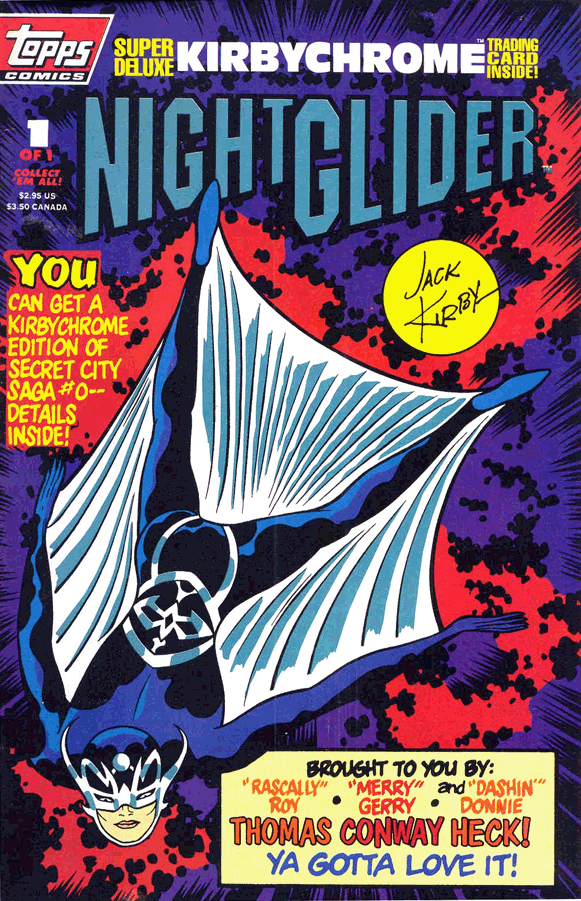
Though the subject of this post technically falls under the PPC's non-Marvel nods tag, it's hard to miss the telltale Marvel hallmarks on this comic book cover from industry newcomer Topps Comics:


Topps, a company founded in 1938, went on to become immensely profitable as a producer of sports-themed trading cards (primarily MLB) as well as other card collectibles (e.g., Star Wars, celebrities, films, etc.), in addition to chewing gum (Topps created the Bazooka comic-strip-in-the-package bubble gum introduced in 1947), candy, confectionery items, and, beginning in 1993, the Topps comic book division. It was here where the retired Jack Kirby licensed several designs and concepts he'd kept in his files which Topps came to collectively refer to as the "Kirbyverse," a series of eight titles published in April of 1993 which would culminate in Kirby's "Secret City Saga"--NightGlider being one of them.

As we can see, a sales pitch that would be right at home on a Marvel cover is in full swing for this issue, even featuring the familiar pet names of its creative team of Roy Thomas, Gerry Conway, and Don Heck. Also now at Topps is former Marvel editor Jim Salicrup, who joined their comics division after departing Marvel in 1992 to become its Editor-In-Chief. Thomas, who had left Marvel in 1980, returned to the company in 1986 but was no longer exclusive, spreading his talent with work for DC and indie publishers (which included several titles for Topps Comics), while Gerry Conway's first and only work for the company would be the NightGlider title.

As for the character, we meet the young woman named (do I have to say it?) Glida as she awakens underneath the city of Chicago, 15,000 years from when she was placed into her slumber (which would have been approximately 13,000 BC).


Monday, April 10, 2023

Symbolic Splash Pages: The Early Years, Part Two


A few stragglers to the PPC's previous segment on symbolic splash pages of Marvel's early years now come to light, again focusing on those "double/triple feature" books published from the early 1960s to the mid-1970s but this time taking a look at the work of artists Jack Kirby, Dick Ayers, Don Heck, Chic Stone, and Joe Sinnott, in pages from Journey Into Mystery, Tales To Astonish, and those issues of Strange Tales before Nick Fury and Doctor Strange elbowed out the book's previous headliner, the Human Torch.

Such splash pages in the Mighty Thor series, which picked up where Journey Into Mystery left off, were practically nonexistent, with Kirby veering away from symbolic association and instead using the title page to lead directly into the main story--which makes these pages something of a rarity where the God of Thunder is concerned. One thing that wasn't rare in either title, however, was the presence of Loki, Thor's evil half-brother, who shared Page One with the Thunder God so often that it's no wonder he practically received billing of his own.


Monday, February 13, 2023

No Rest For The Weary at Greymoor Castle


In 1941, Greymoor Castle, located in (at that point in time) the most desolate part of northern Britain, became the site of "one of Captain America and Bucky's greatest battles," as Cap himself would put it forty years later. And though this particular castle doesn't technically meet the definition of having a storied past, it may fit Cap's description given that the 1965 story of that conflict by Stan Lee, Jack Kirby and Dick Ayers offered a plot that a reader of Cap's wartime adventures would find appealing: a German officer who receives his orders directly from the Red Skull... a plot to kill British Prime Minister Winston Churchill... a scientific breakthrough from the castle's lord, himself a German collaborator... Captain America's young partner, Bucky, captured and used to lure Cap into a trap (if I had a nickel...) ... and the likely charge of treason awaiting Steve Rogers, suspected of deserting his unit when it's caught in a Nazi pincer movement on the battlefield.

Yet it's also a story which bears a second look, as Cap decides over fifteen years later (our time), courtesy of writer Bill Mantlo and artist Gene Colan, as a figure from the castle's past roams its ruined halls wary of the ghosts which haunt him--and wary as well of the costumed intruder who arrives to find more than memories awaiting him in this ancient edifice.


Monday, July 25, 2022

Atlantis Attacks!


Having begun my reading experience of Fantastic Four in 1970, there are times in thumbing through back issues that I regret missing out on the title's early days in 1963, when those toiling at the typewriters and drawing boards at Marvel Comics must have realized they had a runaway hit on their hands--so much so that the book's first annual, with its presentation reflecting a mixture of spectacle, excitement, and adventure, came across in a way as a celebration of this flagship title that established Marvel's name and new direction with its budding and receptive readership.


I wasn't really enamored with the multi-colored "Christmas tree" aspect of the masthead's lettering, a design which continued in the following year's Fantastic Four and Amazing Spider-Man annuals:


By the time of the first Avengers annual from 1967, the practice appeared to have been discontinued. Otherwise, that annual's cover might have turned out a little too colorfully:


Regardless, if the thought in '63 was to make the FF annual's cover more eye-catching while conveying a "special issue" aspect that would make it stand out on the comics rack, mission accomplished. In addition, writer Stan Lee and artist Jack Kirby were apparently counting on what they might have hoped was the growing appeal of the Sub-Mariner, now making his fifth appearance in this title (tying him with Dr. Doom) and the principal antagonist in a 37-page story. We don't yet know the details or scope of what Namor plans--but with the return at last of his vanished subjects, displaced by an atomic explosion from the surface world (or so he believes), it seems clear that it's the human race he plans to hold accountable.


Monday, April 16, 2018

Re-Enter: The Hulk!


A year and a half after the original six-issue run of Incredible Hulk ended with a whimper, the title character was brought back in the pages of Tales To Astonish in the fall of 1964 to share the book in its split format--bringing down the curtain on its long-running sci-fi/monster tales once and for all and replacing them with a man-monster that would hopefully find new life after a long hiatus.

But it doesn't look like the Hulk is too keen on sharing his new book with anybody--much less an overgrown Avenger who was probably looking forward to finally having the book all to himself.


Come on, Thor, show us your moves on those still rings! (Who knew the original Avengers just chilled together?)

It's the broadcast* of the Hulk's battle with Spider-Man that's brought the green goliath to Giant-Man's attention. But unlike his fellow Avengers, who depart once their meeting concludes, Giant-Man becomes preoccupied with the Hulk--and Henry Pym's partner, the Wasp, finds that he's suddenly made other dinner plans for them.


*How there can be news footage of a fight that took place in a hidden cave is anyone's guess.

We also see that Giant-Man's old, persistent foe, the Human Top, is out on parole and holding a grudge for his past defeat at this pair's hands. And so when Hank and Jan take off for New Mexico, where the Hulk was last reported sighted, the Top tags along in his civilian guise and waits for an opportunity to strike.

As for the Hulk, no one yet knows of his connection with physicist Bruce Banner, who continues to work at the missile base commanded by General "Thunderbolt" Ross. Banner isn't pleased at Giant-Man's arrival, having apparently ceased using his gamma ray machine to trigger his transformations and now only wishes to be left in peace and keep his pulse rate down. Bruce Banner is thus a complication that will doom Giant-Man's mission before it starts, since Banner has no wish to transform to the Hulk just to accommodate the Avengers; but as we'll see, the Hulk misinterprets Giant-Man's reason for seeking him out.


And if you think the Human Top is going to pass up an opportunity like this, brother, think again.


Tuesday, April 10, 2018

Invasions To Astonish!


Before Ant-Man returned in the fall of 1962 to monopolize the covers of Tales To Astonish, the title was ruled completely by stories both bizarre and eerily shocking, and all sharing a twist to their ending that hopefully took the reader by complete surprise--or at least left them in complete astonishment. The last issue still free of any super-hero influence played that concept to the hilt, with talent such as Jack Kirby, Dick Ayers, Steve Ditko, Don Heck, Paul Reinman, and Stan Lee all contributing to provide the reader with food for thought, and food for fright.


Following is a brief rundown of tales from this issue, a look at a genre that still had two years of life left to it but would eventually disappear and give way to costumes and super-powers, making way for different kinds of threats for a different kind of audience which traded terror for action/adventure.

Wednesday, March 21, 2018

Mission: Stop The Hulk!


During March of 1963, the first Incredible Hulk series was ending its run of just six issues--though judging by the Fantastic Four issue of the same month, where the character was making a guest appearance, you'd find it hard to believe that the Hulk's days on the comics rack were numbered.


As it turned out, not even this "hail Mary" pass for the Hulk could save his title from folding--but his inclusion here helps to make this issue of Fantastic Four a true classic. Not to mention helping it fetch a pretty penny on ebay.


So why is the FF going after the Hulk? And why is the Hulk out to destroy them? For now, we'll just have to be tempted by one of the story's chapter titles which heralds the drama to come, as we begin to flip through pages that were created 55 years ago to the month.


Monday, March 5, 2018

Play It Again, Sue


In the earliest stories of Fantastic Four which featured the Sub-Mariner, readers were strung along as a love triangle developed between Namor, Sue Storm, and Reed Richards, with Sue finding it difficult to declare which of the two men held her heart. And it all started with one scene, where a vengeful Namor reappears after a long absence and vows war against the human race, but whose rage is tempered by the sight of one girl who stands with those attempting to stop his rampage.


Later accounts of this scene tend to read more into it than there is. After all, Sue isn't being wooed here, at least in terms she would take seriously, nor has she lost her heart on the spot; instead, she's being given an impossible choice to make: Become the Sub-Mariner's bride, or Namor resumes his war with humanity. Granted, artist Jack Kirby gives her an expression that could be viewed as regret in having to refuse Namor's offer; yet her spoken response suggests consternation rather than heartbreak, given that Namor comes across as being impulsive rather than giving us any sense of heartfelt love on his part. Yet in light of what's to come for these two, the scene is still attributed as the root of their attraction toward one another--and we can at least acknowledge that, for Sue, it was enough to keep Namor in her thoughts.

There were two pivotal issues which eventually followed that took steps to put the matter to rest, both of which had Sue being taken captive by the man who professed love for her. Leo Robin, who penned the lyrics to "Prisoner Of Love," would certainly have had these two in mind if he'd written the song thirty years later:


The latter of these stories actually settles the issue; but the first again maddeningly stokes the fire by making it clear that, not only is Sue's choice between Reed and Namor still a lingering issue, but she still hasn't made up her mind. Yet there's more to recommend this earlier tale than as another piece to the Namor/Sue/Reed quandary, with quite a lot of FF goodness crammed into its 22 pages to satisfy readers who by this time have become solid FF fans.

Monday, May 15, 2017

Willie Lumpkin: X-Factor!


When it comes to recycling, it looks like comic books had a head start on environmentalists, though for comics writers it was more a matter of successful concepts that were dusted off and adapted to later stories. Take the opening pages of the Fantastic Four issue which featured the team's first clash with the mad Thinker, in a sequence that can't help but take you back to issue #1 and the introduction of this famous foursome. It's a dramatic opening that still works, over a year after it was introduced.


Here, however, we have the advantage of knowing all about the characters who are responding to the alert and converging to meet--and there's also the familiar presence of the Baxter Building anchoring the scene, the official headquarters of an established team that's now riding high in comics circles and can still generate excitement and interest in being summoned by a flare gun.

There are other elements in this story that are the result of being tweaked to one degree or another and reused--such as the team leaving their headquarters and striking out on their own, as they did when they went bankrupt. This issue would also get the ball rolling on other concepts that would be retooled and used later, such as the invasion of FF headquarters by criminals or villains, or the team having their own devices and weapons used against them.

But in this classic issue, it's the Thinker that the story has us focus on, the calculating planner who makes use of his computers to deduce his next move down to the second and take into account anything or anyone who would seek to stop him. The Thinker's ability to advance his agenda is really dependent on collating the data that his computers gather and mapping out the steps he needs to take, based on certain things taking place at a certain time (or not taking place, as the case may be). Yet the whole point of uncertainty is that you cannot eliminate it or predict it, however careful and meticulous you are in your calculations--but just try telling that to the Thinker.


It's quite a claim the Thinker makes: "Nothing has been left to chance!" That's presuming that he's isolated the uncertainties involved and based his calculations only on the events and incidents that will occur without fail. Credit where credit is due: if he can pull that off, his programming skills are far ahead of his time.

Yet, all things considered, the Thinker comes off as a third-rate villain in this tale, in spite of how far his planning takes him in going up against the FF. We know in hindsight that the Thinker will go on to become a deadly threat to be reckoned with--and while it may not seem like it, his first clash with the Fantastic Four will open many doors for him in that regard.

Speaking of our foursome, we'll see in this story their first exposure to battling organized crime, a theme that Amazing Spider-Man would be more successful at integrating into its plots but which the FF would be bound to encounter in their line of work. We'll also get our first look at the Thinker's talent with androids, which would make him quite formidable against the FF as well as other super-powered beings he would later come into conflict with. But what's his immediate goal here and now? He doesn't exactly mince words with the crime bosses he's gathered to hear his plans.


I can guess what some of you are thinking: It's amazing that the Thinker could find a crown big enough to fit that head of his.

The crime bosses are naturally concerned with interference from the Fantastic Four--but to placate his new associates, the Thinker reveals he has a two-pronged approach for dealing with the team. First he plans to see that each of the FF is offered some personal career enticement that will tempt them into pursuing time away from the team, which breaks down as follows:

  • Mr. Fantastic: A new position in a New England electronics firm as part of their R&D division.
  • Invisible Girl: Starring in a Broadway production after being approached by a producer who's been on the lookout for his next star.
  • Human Torch: Becoming a circus performer, thanks to one of his cousins who's fallen on hard times and asks him as a favor to become the star attraction in his show.
  • The Thing: A new star in the wrestling ring--his first exposure to the professional wrestling circuit, which we know would later become a fallback career he would turn to in many future stories.

It so happens that all of these decisions are mulled over just as the FF have hit a lull in their activities--and so they all treat their offerings as a vacation of sorts, and off they go.


The second part of the Thinker's plan involves a meteorite that crashes into the New York bay (those are some computers--are they linked into NASA?), causing a tremor that damages the city's power grid and wreaks havoc with repair crews. While the city is in crisis, the Thinker and his men are ready to take advantage of the situation as they penetrate their foes' headquarters.


Meanwhile, checking in on the FF, none of them are exactly thrilled with the choices they've made. (For whatever reason, Sue's choice has been revised to replace Broadway with a trip to Hollywood and have her starring in a sci-fi film.) But, returning home, they're greeted with quite a site, as well as a deadly challenge.


The Thinker is true to his boast, utilizing the FF's own building defenses as well as the many devices found in their labs to halt the FF's approach to the 35th floor--but the team makes its way through, while also dealing with the crime bosses who were armed with weaponry from Reed's armory. That leaves one piece of research which Reed was just getting started on--research notes that have now been realized in a hulking android that will also go on to make future appearances.


So far, it doesn't look like the Thinker's plans are panning out, does it? Things look especially dicey for him when the FF confront him--after all, if you boast that your calculations take into account the smallest detail and leave nothing to chance, why would you need a contingency plan? For all the good it does him. It seems Mr. Fantastic isn't such a slouch in the planning department himself--and all he needs for his calculations to come off without a hitch is a fellow professional whose motto is "Neither rain, nor sleet, nor snow, nor super-villain..."


It's off to the hoosegow for the mad Thinker--who might want to give some thought to all those crime bosses who are going to insist on joining him at his table in the prison cafeteria.

Fantastic Four #15

Script: Stan Lee
Pencils: Jack Kirby
Inks: Dick Ayers
Letterer: Art Simek

Wednesday, November 30, 2016

When Sneers Egghead!


Since we've spent a fair amount of time on Henry Pym lately, we should give due attention to the man who would become one of his most dogged foes--the man known as Egghead, who's introduced in December of 1962 just a few issues into Ant-Man's run in Tales To Astonish. Granted, Ant-Man's foes in that title were generally nothing to write home about; but when your archenemy turns out to be a man who takes pride in the name "Egghead," it's fair to say you're at the bottom rung of the hero ladder.


As far as super-villains go, we'd probably have to award the label of archenemy to the Human Top, Pym's most deadly foe in his early days, with Ultron of course rising later to menace not only Pym but all of the Avengers. Yet waiting in the wings was always Egghead, a normal human whose resourcefulness and ruthlessness, combined with his brilliance, made him a perpetual threat to Pym. (And he would have been a natural as one of the Headmen.) We've come to realize over time that Egghead is the type to hold a grudge, to be sure--but how did his anger and resentment toward Pym take root?

Like many villains, Egghead began his life of crime because of his desire for and need of money--and he didn't appear to have any scruples whatsoever as to how to go about obtaining it. In fact, when we first encounter him, he's already in hot water--a scientist working for the government, who had decided that there aren't nearly enough zeros in his paycheck and concludes that slipping government secrets to foreign powers will put him on Easy Street.


"To a genius like me your insipid patriotic ramblings are laughable! I sneer at you all!" Scripter Larry Lieber may have been an unsung talent at Marvel, but he had his moments.  It seems evident that Egghead already has his own thoughts on what status he feels he's due. It's also interesting to note a total lack of remorse in his character, a character trait we've already seen he would come to use as a ploy when necessary.

In a way, it's actually Ant-Man's effectiveness as a crime-fighter (as odd as that comes out sounding) that we have to thank for opening the door for Egghead with the criminal underworld that he would often seek out to help him further his plans. The news of Egghead being drummed out of his position with the government eventually reaches a few notables of that underworld, who have been driven underground by Ant-Man and who are desperately looking for someone to deal with a threat no larger than a thumbnail. And for Egghead, these men already have gotten wind that the best way to gain his cooperation is to flash a wad of green bills in front of him.


"Brute force ain't the answer!" Well, we're pretty sure that it is, since Ant-Man mostly chooses to remain at ant size during his early exploits and relies on his ants as back-up, limited to the more slow-acting growth abilities that his gas-based power affords him and not yet able to more extensively take advantage of his size-changing advantage. Ant-Man may have the strength of a full-grown man at ant size, but it's a fair bet he'll still go *SPLAT* when Lefty or Edward G. Robinson here brings their foot down on him. And speaking of the actor from Hollywood's Golden Age, Egghead's debut is one of several rare instances where the actor's likeness makes a delightful surprise appearance in a Marvel story.

As for Egghead, the mob's dough is money well spent, since he almost immediately produces results by deducing and duplicating one of Pym's earliest discoveries: how to communicate with the insect world. From there, it's a simple matter for him to lay a trap for his foe.


Egghead might have been better served by using his technology to direct the ants, rather than offering them a choice between himself and Pym, but we'll get to that in a moment.

When the time comes for Egghead to spring his trap, it looks like the ants are on board, with Pym walking right into it. (Or in this case, being bellowed into it.)


With Ant-Man free, it isn't long before Egghead is forced to flee and the gunmen are routed--including our poor Mr. Robinson stand-in, "see"?


Pym is being a little misleading as to the psychology of his little "friends," since they're only his willing allies as long as he wears his cybernetic helmet that allows him a measure of control over them. Egghead was on the right track when he offered to "free [the ants] from the Ant-Man's rule," since that's precisely what Ant-Man's power over them involves. Take, for instance, the incident where Whirlwind (our former Human Top) drops both Pym and the Wasp into an ant colony without the benefit of their cybernetic control technology. Fortunately, there was a stash of circuitry within the tank that Pym was able to salvage into a makeshift device, just in time to save their lives.


Had Egghead devised technology that could make the ants follow his own directives, this story might have turned out differently for him. Instead, he heads to a refuge he would come to know well in the years ahead--the Bowery in Manhattan's lower east side (also known at the time as "Skid Row"), where he would simmer and make future plans to gain his revenge on Henry Pym.


COMING UP:
Egghead bounces back! (He didn't stay holed up for long, did he?)

Just how often did Mr. Robinson moonlight in Marvel Comics?

Tales To Astonish #38

Script: Larry Lieber
Pencils: Jack Kirby
Inks: Dick Ayers
Letterer: Jon D'Agostino (as Johnny Dee)