Showing posts with label Ron Frenz. Show all posts

Thursday, May 11, 2023

Time Keeps On Slippin', Slippin', Slippin'...


Good grief, I thought in our senior years we became less busy.  Where does the time go? Wherever it's fled to, I'm running low on it this week, so I thought I'd once more raid my cache of graphics that I've stored from here and there and cobble together a little John Buscema goodness for you--mostly prior work that never saw the comics rack, with one or two homage prints thrown in.

Leading us off is someone else who appears to have run out of time--the Silver Surfer, who in an unpublished Buscema cover from his first series falls victim to none other than the heir of Frankenstein!


Thursday, December 2, 2021

Virus Of The Spirit


"But I thought freezing kills any virus." -- Will Robinson
"You thought. It's a good thing I'm the doctor and not you." -- Zachary Smith


The end of 1989 also marked the end of writer Steve Englehart's noteworthy run on the second volume of Silver Surfer, making way for new Surfer scripter Jim Starlin to come aboard (with Thanos in tow, it goes without saying). Sandwiched between the two points, however, was a stand-alone issue put together by Jim Valentino with artists Ron Frenz and Joe Sinnott that is suitably entertaining in its own right as well as possibly a breath of fresh air for readers who may have had their fill of the cast of characters Englehart had introduced which tended to steal the book's thunder. Yet while its cover gives the impression that this will be an album issue, the images are instead indicative of a dangerous threat to the Surfer which will make him a foe to all who live should he fail to perceive its true nature in time.


As an interesting twist to such stories, we're tipped off from the beginning as to what we're dealing with, if not yet who--"A disembodied intelligence attempts to convince a sentient virus... to do its bidding." From their discussion, and in light of the title of this book, it's not difficult to guess which sky-rider of the spaceways these two are targeting--but the answer as to why will take some time to become clear.


Friday, June 8, 2018

Titania Strikes Back!


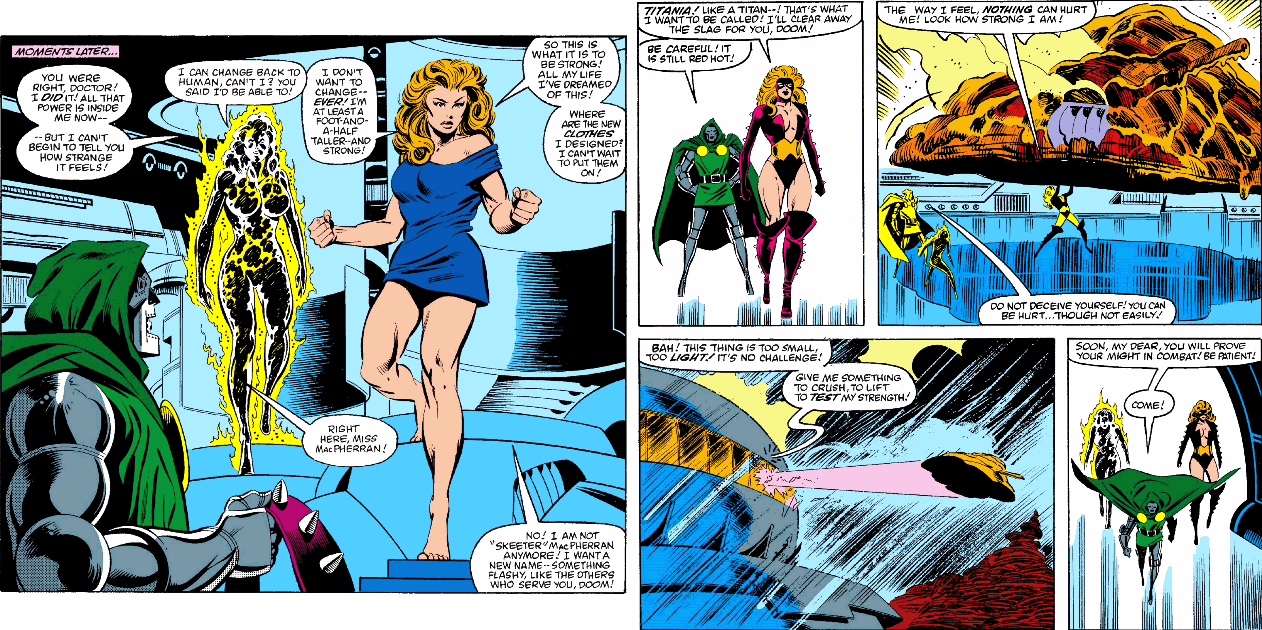
During the events of Secret Wars, the villain well known as Dr. Doom supplemented his forces by using the advanced machinery he'd discovered to endow two willing subjects with abilities and powers which made them forces to be reckoned with--a status which others before them have embraced, though none more so than Skeeter MacPherran.


And the woman called Titania does indeed get the chance to prove her might, when the heroes also trapped on the Beyonder's world attack their foes' fortress while coming to the aid of the embattled She-Hulk. Yet instead of overwhelming the equally well known hero who takes her on, Titania learns a harsh lesson in both overconfidence and underestimating her opponent that will remain with her well after her return to Earth.


But where other villains have bounced back from prior defeats (and stints in prison) to menace anew, Titania was among those who became gun shy about meeting other super-powered opponents in battle once more--particularly Spider-Man, who seemed to deal with her without effort. Considering how arrogant Titania was, out of the gate, we could rightly assess how the mighty have indeed fallen.

Yet in her rematch with the wall-crawler, one thing that may tip the odds in her favor is the fact that this time, her boyfriend's come to the party!


With Crusher Creel, the Absorbing Man, by her side, is this the day when Titania gets her moxie back?

Monday, June 4, 2018

...And One Will Fall!


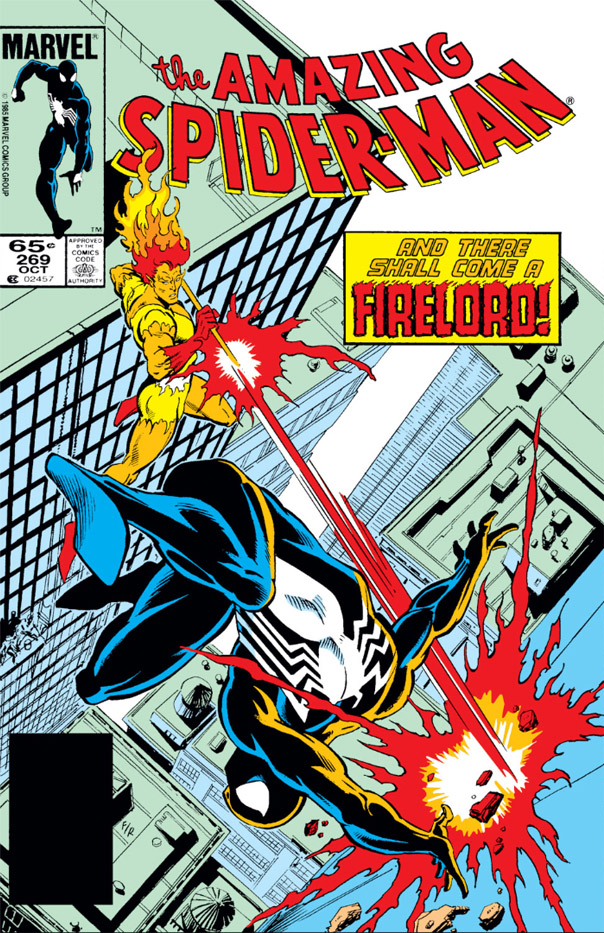
After trying to contain the fury of the alien known as Firelord and failing, while leaving Firelord so enraged that he now hunts his wall-crawling foe with the intent of ending his life, the amazing Spider-Man was on the verge of abdicating his responsibilities and slipping into his Peter Parker identity to avoid being found. Spider-Man--packing it in?? The realization brought an attack of conscience for our harried hero, who knew that Firelord, in the state he was in, might go berserk and lash out at innocents if he was denied his vengeance because the web-spinner eluded him.

And so Spider-Man, overmatched and on his own, prepares to fight the battle of his life!

(But somebody had better tell him it's hopeless!)


Friday, June 1, 2018

...In Battle We'll Meet!


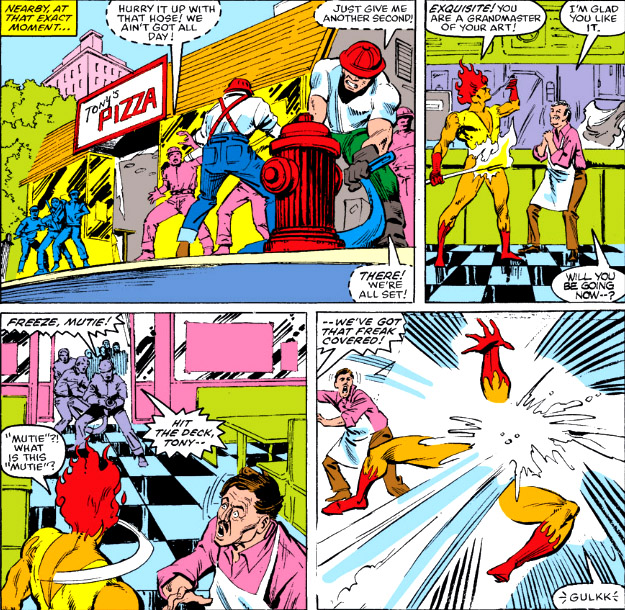
It all started when Firelord, the former herald of Galactus, arrived on our world to use it as a "rest stop" while deciding on his next destination, but who then developed a craving for a certain type of Earth food he'd sampled before--"a culinary achievement which has been mastered nowhere else in the universe!"

(And he may be right about that!)


Did I mention Firelord's temper which, combined with his enormous sense of entitlement, basically placed Earthlings at his beck and call, as far as he was concerned? Perhaps someone should have clued in Tony.


Regrettably, Firelord has arrived during the anti-mutant sentiment that had taken hold in the country and had begun to saturate the airwaves. And with Tony of Tony's Pizza being forced to serve this fire-haired intruder, Tony's human clientele aren't making the distinction between "alien" and "mutant":


Firelord scatters his attackers like tenpins, but persists in his attack when his human foe armed with the firehose targets him once more. Fortunately, someone's spider-sense is going off like *ahem* a four-alarm fire, and our rash "mutie" attacker lives to see another day.


Which puts the amazing Spider-Man in *a-hem* the line of fire,
against a being who was once the herald of Galactus!


And that means...

(Last one, I promise!)

...the fat's spider's in the fire now!

Tuesday, November 28, 2017

The Fall of Hogun The Grim!


In order to retrieve the mighty Thor from Earth so that his power could be used to augment the forces of Asgard in battling the invasion of Seth, the Egyptian god of death, Hogun the Grim has volunteered to be sent across the dimensions to Midgard in an effort to locate the Thunder God and inform him of the crisis. But with the destruction of Bifrost, the rainbow bridge, the journey to Earth was perilous and fraught with risk--and so it is that Hogun is injured on arrival and beset by hallucinations, seeing enemies all around him. And wielding the power of Asgard, Hogun is a clear and present danger to the mortals who cross his path.


Unknown to Hogun, Thor is currently indisposed battling the villain known as Quicksand--and so, in a spotlight that's rarely turned on him for any extended length, Hogun all but receives second billing as he shares two issues with his fellow Asgardian, with both of them battling mortals. In Hogun's case, his opponent turns out to be none other than:


Sure DD is outmatched--beyond outmatched. But that's where the "Without Fear" part comes in!

Friday, March 24, 2017

God Of Thunder No More!


Having already witnessed the shocking scene where the mighty Thor committed the unpardonable sin of slaying his evil half-brother, Loki--an act which caused Thor to be summarily banished for all time--it's time to follow up on that story and not only discover the fate of Thor but also the many hidden truths which writer Tom DeFalco would reveal, one by one, which allowed the mortal Eric Masterson to assume the identity (and comic book) of the Thunder God for the next 25 issues. As we can see, artist Ron Frenz has given a sense of symmetry to the cycle, commemorating the points at which the "new" Thor made the scene and when the original Thor would reclaim the book.


It was a generous two-year period which allowed a brand-new and more mortal point of view of the God of Thunder to play out, though there were likely more than a few readers who may have been drumming their fingers on a hard surface while waiting for this storyline to run its course. And run on it did, stringing along fans of the original Thor with one red herring after another that might reveal Thor's true fate and thus would give the impression of the book circling back to restore the character. In the meantime, DeFalco was pursuing an intriguing (if at times interminable) story where an ordinary human suddenly found himself to be, for all intents and purposes, Thor--someone whom the average reader could hopefully identify with and get behind. The flip side of that coin was that the character no longer carried the sense of grandeur and nobility of the original--no longer set apart from the likes of Spider-Man or the Avengers or Daredevil or other human super-heroes on the comics shelves, regardless of how many Asgardians DeFalco would pack his stories with to compensate.

If you'd prefer to take each of these issues in turn and follow DeFalco's intentions for portraying Masterson as well as the many diversions that teased the possible return of the true Thunder God, that's certainly a valid and perhaps even rewarding option available to you; and of course now you wouldn't have to spend nearly as much time doing so or waiting a month between issues. But for those of you who want the answer without reading through twenty-five issues of preamble, or for those who have already read the entire story when it was published but just want to refresh your memories, the PPC promised earlier to cut to the chase and put it all together for you, and we aim to please.


Speak for yourself, Odin! Some of us non-immortals aged two years to finally get this info!

Wednesday, February 22, 2017

At Death Do We Part!


If you were a regular reader of the first run of the Mighty Thor book, you may have eventually reached a point where you didn't give much thought to news of another Thor vs. Loki issue, since their long quarrel had driven them to blows more often than any of us would care to count. But for the sake of argument, the PPC has made a rough count on your behalf, and rounded off their clashes to 24 by the time the title's 432nd issue was published, an issue which billed yet another head to head conflict between the two. That two-dozen count is admittedly a bit on the conservative side, since the tally doesn't take into account any meetings in The Avengers or other titles beyond their match-ups in Thor and Journey Into Mystery.

But since issue #432 marks an anniversary of sorts--the 350th appearance of Thor since his debut in JIM #83--the most recent battle between Thor and Loki has been given prominent cover exposure as well as an oversized issue in which to play out, which implies that we may not be seeing the usual fare this time around when it comes to "Thor vs. Loki," that this time will be different. And that would certainly make for a welcome change. In the past, their meetings have amounted to variations on a theme: (a) Loki's plans are defeated, (b) Loki is fought and captured, (c) Loki is called on the carpet by Odin, and (d) Loki is banished, exiled, imprisoned, or otherwise dealt with for the time being.

In this issue, their legendary conflict has come to a head following Loki's recent machinations that would allow him to reclaim the surplus power long ago stolen from him by the villain known as the Wrecker--power which was in turn dispensed to three fellow convicts that, together with the Wrecker, formed the Wrecking Crew. Having now rendered those four powerless and drawn that power to himself, Loki is now able to meet Thor in deadly armed conflict, but still having an edge in his additional powers of sorcery. That covers the specifics of how Loki will withstand and perhaps even surpass the strength and power of his brother; yet the issue's story will also put on display the differences between these two which span an immortal lifetime of slights, jealousy, bitterness, and poor choices that have helped to make Loki the "god of mischief" in the minds of the Asgardians and even his own step-family. And if he has also gone on to be known as the god of evil, it's unfortunately an appellation well deserved.

At this point in time, Thor is merged with the mortal Eric Masterson, an architect and single father with a young son. The story's splash page brings us up to speed on where things stand--but it's obvious that Loki has planned well to have Thor at his mercy, given the helpless young hostage whose fate he taunts his half-brother with.


We've got thirty pages to go, so we can likely assume that Thor manages to think his way out of this immediate predicament.  But make no mistake: by the time the story reaches its end, one of these three people will die.

Monday, February 20, 2017

"This Is A Double-Zero Priority--Code: Blue!"


The concept of Code: Blue is one that could easily have sprung from the mind of Jack Kirby: A collection of crusty men and women thrust into extraordinary circumstances by their line of work and relying on their grit, determination, and overall cockiness to see them through--a diverse group of unsung heroes who came in and did the job, no questions asked, having no powers or advantages in battle other than their quick thinking and fighting heart. Code: Blue was conceived and created by Tom DeFalco and Ron Frenz, but you could almost swear it was Kirby's words coming from the characters' mouths, so closely do the wisecracks and general back-and-forth of the dialog mirror his style of writing. DeFalco, in perhaps a tip of the hat to Kirby, even at times places emphasis on the wrong words in their speech, presumably in an attempt to inject a sense of personality into the character(s)--a scripting quirk which drove me absolutely nuts when reading one of Kirby's stories and which DeFalco brings to Code: Blue to a certain degree.

Code: Blue is led by Lt. Marc Stone, who had already made his mark in carrying out his duty for the N.Y.P.D. and, from his experiences in the field, has seen the need for a special SWAT unit to be established for dealing with super-villains. To what end isn't really clear--even Stone was unsure at the time that such a unit would be able to cope with the level of threat that a super-powered villain posed. Code: Blue seems to function best by taking the heat off of the super-hero(es) already on the scene; but also working in their favor is that whatever villain they're facing is usually in the habit of underestimating them, which gives the unit a small window to play on that disbelief and accomplish their mission. If nothing else, you have to give Stone and his team props for suiting up and bringing both confidence and skills to whatever situation they're ordered to deal with, whatever the odds against them.

And what Code: Blue brings to the table isn't insubstantial by any means, just as is the case with any SWAT team; it's just difficult at times to see what sets them apart. From their early encounters, they would appear to have no special training outside of that received by their peers; they have no Stark-designed weaponry; they've studied no dossiers of known, at-large villains; nor are they specially prepared to encounter super-powers. Rather, they seem to simply go in and adjust their tactics on the fly, depending on the details they get when the zero-zero call (alleged super-criminal activity) comes in. So what makes standard SWAT teams fall below the par of Code: Blue? Whatever distinguishes Stone's unit will have to be seen on the job.

And so as they're presented to us, Code: Blue might remind you of a line from the 1965 film In Harm's Way, when Adm. Tory asks Col. Gregory if his para-marines are in shape for a parachute drop: "Maybe they're a little bit rusty, sir, but they're eager as hell!" It's an impression that Stone will have to take to heart, since their baptism of fire is at hand.


Come on, this team just reeks of Kirby!

Wednesday, January 11, 2017

The Mystery That Wouldn't Die!


OR: "Because You Never Really Demanded It!"

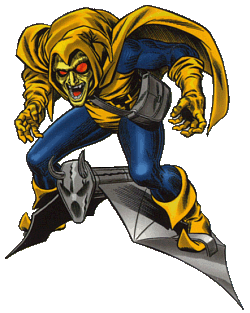
After the conclusion of the winding, four-year saga that teased the mysterious identity of the Hobgoblin in the pages of Amazing Spider-Man, we learned at last that the Hobgoblin was in fact "Daily Bugle" reporter Ned Leeds--a shocking revelation which put an end to years of speculation by the book's readers, as well as years of internal strife in the Marvel Bullpen that resulted in a virtual revolving door of writers and editors on the book. When the dust settled, it seemed we'd seen the last of the Hobgoblin--that is, until almost ten years later, when the character's original writer, Roger Stern, decided to revisit the story and turn the saga's finale on its ear.

The result is the 1997 three-issue series, Spider-Man: Hobgoblin Lives, where Stern makes an honest effort to bring about the revelation he'd intended for the character, though in the process he must dismantle or otherwise take into account all the pieces put in place by the different writers and editors who assumed responsibility for the mystery in his wake. Since this new story hit the racks twenty years ago, I don't happen to recall if there was any outcry by readers for the Hobgoblin's return or if anyone wanted to revisit the tangled mess of his identity; the Hobgoblin, after all, didn't have the complexity of Norman Osborn, nor Osborn's connection to Peter Parker's own secret identity--and that would hold true for the identity established for the character in either 1987 or in Stern's revised tale. Aside from his modus operandi and bag of tricks being similar to the Green Goblin's, the Hobgoblin was more of a substitute character for his predecessor who seemed to conduct his affairs from the hip, a reflection of having a number of writers handle him and his true identity remaining unknown for so long.  There's also the nagging observation that when his identity is revealed, in either version of his story, it really makes no difference one way or the other as far as moving this character to the A-list.

But Stern's reputation as a writer carries a lot of weight with me, and perhaps for those readers in '97 who remembered his work at Marvel and were seldom disappointed by his efforts. For what it's worth, that holds true here, as well--though whether the Hobgoblin is a character you want to see Stern spending his time on is perhaps debatable.

In blog form, we have the luxury of picking up this story on the heels of its ending ten years prior--and if the theme of this new story holds any initial interest, it mostly lies in the how all the pieces of the prior saga will be sorted out, reshuffled, and pieced back together in a way that's both intriguing and satisfying, while hopefully elevating the Hobgoblin as a character in the process. The Hobgoblin would get a new lease on life a year and a half later, in the "Goblins At The Gate" storyline in Spectacular Spider-Man--where Stern and co-plotter Glenn Greenberg reintroduce Osborn and tie in the Hobgoblin, thereby providing the latter with excellent exposure that could raise his profile with readers and establish him as a force in his own right. For that to work, Stern in this story will need to establish a formidable identity for the Hobgoblin, one who can not only go up against the likes of Norman Osborn but also establish an impression on readers that, in their eyes, makes this character one worth bringing back.

And so we seem to be back to square one:


Or, put another way: Arrgh!

Monday, January 9, 2017

The Prolonged, Tortuous Saga of... The Hobgoblin!


"The Hobgoblin storyline is one of the bigger messes in Marvel's history. It's not as bad, perhaps, as the Clone Saga. But it shows the worst of what can happen when a mystery is passed from one creative team to another with each deciding to change things to suit there own whims. You can't do that with a mystery that's been running for four years. The clues and ideas that each team left end up having no relevance and so your revelations turn out to be out of the blue. And four years is just too long to sustain interest." - Excerpt from SuperMegaMonkey.net's entry on Amazing Spider-Man #289

Whatever your feelings about how the mystery of the Hobgoblin's true identity was handled, the consensus appears to be that the mystery simply went on too long, mostly for the reasons that SMM mentions. The character's creator, Roger Stern, has stated that he wanted to handle the Hobgoblin's identity in much the same way as the mystery of the Green Goblin's identity unfolded. To say that the situation veered wildly off that course is an understatement.

When all was said and done, the story of the Hobgoblin's identity would play out over a fourteen-year period and involve no less than six ASM editors (Tom DeFalco, Danny Fingeroth, Jim Owsley, Jim Salicrup, Glenn Greenberg, and Tom Brevoort), two Editors-in-Chief (Jim Shooter and Bob Harras), and five writers (Stern, Tom DeFalco, Jim Owsley, Peter David, and Jo Duffy), and take place in the midst of considerable upheaval behind the scenes and more than a few bruised feelings in the Marvel offices that coincided with all the shuffling of talent.

Reading the storyline when these issues were originally published, I was probably as curious as anyone about the answer to the mystery--though if we're to believe the letters pages that presented feedback from what appeared to be countless readers who were eager to offer their own guesses as to who the Hobgoblin really was, my interest was only a fraction of those who were seemingly waiting with bated breath for the big reveal.

Yet the departure of Stern from the title, after writing only three stories featuring the character, would derail that train for all of us, as well as shatter whatever consistency and intentions he might have had for how the plot would be resolved. Personally, I found the Hobgoblin an interesting character in his own right, with his anonymity perhaps playing a part in that appeal; but the issue of his identity became the character's major focus, and eventually it all spiraled out of control and resulted in a denouement that felt both rushed and anti-climactic.

Rather than go into lengthy detail on the subject, consider this post to be the CliffsNotes version of this zig-zag subplot, as the PPC takes a stab at covering this period of Amazing Spider-Man that hopefully breaks it down for you in a way that makes it both fun and informative. The information will be confined to events occurring in ASM rather than including any Hobgoblin appearances in either Spectacular Spider-Man or Web of Spider-Man, otherwise we'd be here all day; but we'll cover all the bases, though at the end we'll find that we've got a double header on our hands.

Monday, October 31, 2016

The Soul Of The Darkchild!


As a four-issue story that had as its featured headliners Storm, the leader of the X-Men, and the little sister of Colossus, Illyana Rasputin, the 1983 series Magik perhaps lasted two issues longer than its material could support. Building as it does on the conclusion of Uncanny X-Men #160, where the team was drawn into Limbo and faced the demon-lord sorcerer, Belasco, we were left to wonder at the end of that tale why Illyana, who was spirited away to Belasco's lair and later rescued, was returned to the X-Men seven years older than when she had been taken. The story's final pages were coy as to what happened to Illyana, nor was Illyana herself saying much of anything; instead, we saw her keeping a mysterious medallion close to her, filled with three "bloodstones" and with room for two more.

Just over a year later (our time), writer Chris Claremont takes readers behind the scenes of that adventure and explores Illyana's experience in Limbo--a domain where another group of X-Men never escaped from, and where Belasco continues his plans to appease those he serves, the "Dark Ones," by grooming the newly arrived Illyana to become first his apprentice, and then the eldritch gate through which the Dark Ones will enter Earth's dimension and seize it for their own.


If you're finding it difficult to perk up at the prospect of reading about a story that catapaults Illyana Rasputin into a starring role, readers over thirty years ago might have been shrugging their shoulders right along with you, particularly at seeing Illyana--a blip of a character who was only known through her relation to her brother, Peter, and who was still months away from making inroads in New Mutants--receive prominent billing on the cover of virtually her own series. "Magik," its title, was likely in part chosen because of its theme of sorcery, but it would also become Illyana's code name once the dust settled. At this point in time, though, can Illyana carry her own series, even with Storm added to the marquee? It's no small gamble on Claremont's part, though he depends a lot on the prior X-Men story's mysterious ending to jump-start interest in it.


Wednesday, March 16, 2016

Failure... Death... Rebirth!


Yikes! In Parts 1 and 2 of Thor's struggle against the overwhelming power of the Celestials, the Thunder God was last seen piercing the armor of the massive form of Exitar*, the Exterminator, in an effort to reach its incredible mind and destroy it. Now, as we pick things up in the third and final installment to this story, Thor resolves to fight to the bitter end--bereft of his enchanted hammer and facing insurmountable odds, as the planet he fights for faces the imminent judgment of beings that have decreed its death!


(*If writer Tom DeFalco is going to go the alliteration route with this Celestial's name, I might have substituted "Extar," instead. Perhaps a little too obvious, in conjunction with his name's modifier; but the new name would no longer sound like this being's primary purpose is to take his leave.)

On the planet Pangoria, Thor has again encountered the aliens who once sought to pass judgment on Earth, convinced to depart only through intervention which offered them living examples of humanity's potential. There is no such saving grace on Pangoria, now that the Celestials have already begun the process of carrying out their decree--starting with encircling the planet with an energy barrier which prevents its inhabitants from fleeing their fate. An act which Pegas, the ruthless pirate who has usurped control of Pangoria and denied ship passage to those unfortunates who cannot meet his boarding price, seeks to bypass in order to save his own selfish life.


And what of Thor? The last we saw of him, he was under attack by a swarm of humanoids following the destruction of his hammer, Mjolnir--preventing him from approaching his target and completing his desperate task. Things indeed look hopeless--but try telling that to the raging god who refuses to fall, no matter how many foes are set against him. The battle is on!


Tuesday, March 15, 2016

Alone Against The Celestials!


The mighty Thor's encounter with the Celestials in his 300th issue was an epic conclusion to a long build-up of stories involving Odin's involvement with the so-called "space gods," with the Earth being saved from their deadly judgment only through third-party intervention. The stakes then were literally life and death; yet when Thor again encounters these imposing, invincible beings, we learn more of how and why the Celestials carry out their judgment, as he girds himself to protect yet another world from their awesome but potentially fatal presence.


Thor has crash-landed on the planet Pangoria, a world whose populace is desperate to evacuate to the stars as it, too, now faces the nearing judgment of the Celestials. Their desperation has turned to panic, however, because their planet's spaceport has been taken over by an armed group of pirates, who had long ago conquered Pangoria's inhabitants and have been using this world as a haven for themselves and other such thieves. Now these ruthless men, led by the cruel Pegas, allow passage only to those who are able to meet his exorbitant price.

Pegas tracks the form of Thor as it impacts with the planet, and reacts in disbelief that he still lives, having also survived the impact of a deadly missile launched by Pegas (under the mistaken belief that Thor's hurtling form was a weapon of the Celestials). Pegas, a true opportunist, proceeds to treat Thor's injuries and restore him to health, presuming that Thor's ability to survive such trauma might indicate a level of power that's capable of stopping the Celestial judgment and thus prove to be Pegas's Pangoria's salvation. Thor doesn't yet realize the kind of man he's dealing with; he only concludes that he owes Pegas a debt for saving his life, which of course comes as music to Pegas's ears. Unfortunately, Thor also doesn't realize the scope which his debt to Pegas will encompass--but Thor's character, as opposed to that of Pegas, has been defined by honor and righteousness, and once he discovers the nature of this threat, he will step up to meet it boldly, even knowing his chances of success are slim to none.


Monday, February 29, 2016

Where Waits Death!


In a way it feels strange to follow up on Fantastic Four Annual #6 with a tale that never actually happened (though the Watcher would no doubt claim otherwise). In the annual, we were provided with a happy ending at being witness to the successful birth of Sue Richards' son, with Reed, the proud father, greeting both mother and child with a mixture of joy and gratitude (and probably a little relief mixed in). But since the story avoided the death of Sue by the slimmest of margins, there was perhaps another story waiting to be told which would reveal a more tragic ending to this tale--where the male members of the FF, in a race against time, were too late in returning from a crucial mission with a control element which would have increased Sue's chances of survival. And fifteen years later, in Marvel's popular What If title, we see that story come to fruition.


Thanks to the dire nature of this tale, we see some ground covered (sorry, an unfortunate pun) that the original story, in its breakneck pace to obtain the necessary element to save Sue's life, wasn't able (or willing) to spend time on. You might even say that the What If version serves as the "director's cut" of the original story by Stan Lee and Jack Kirby. As is the case with such cuts that offer added material, some of the additional scenes in the newer story don't necessarily fit well, with a few of them dependent on context--while others add considerably to the drama and fill in the conspicuous gaps in the original story, scenes that were never addressed but perhaps should have been. For the most part, though, the story is an opportunity to see the members of the FF brought to their lowest point by the loss of one of their own, and through no one's fault in particular--though as we'll see, that's an assessment that Reed Richards will flatly reject.

Friday, December 11, 2015

Juggernaut vs. Thor--Round Two!


The first match-up between the mighty Thor and the unstoppable Juggernaut was a little indecisive, don't you think? Especially since Thor was afflicted by bouts of dizziness and weakness thanks to his evil step-brother, Loki. It took a little teamwork with the New Warriors to send Juggernaut packing--to an asteroid in outer space, that is, which ended his threat for the time being.

For any other villain this side of Dr. Doom, you'd think that finding yourself on an asteroid in the depths of space would end your threat forever; after all, what would any of us do if we found ourselves on an asteroid? Well, likely suffocate moments after our arrival, but you get my drift. But Juggernaut catches a break--and catches a ride with some aliens who transport him to their world, where he seizes power and enjoys a comfortable role as ruler. That is, until Thor shows up with Excalibur, the latter looking to account for Juggernaut after Loki freed him from his British prison. But while Excalibur deals with the forces of the former despicable ruler who's looking to regain his throne, Thor goes looking for Juggernaut in order to bring him to justice, by force if need be--while Juggernaut, as usual, isn't impressed!


Wednesday, October 14, 2015

Cover to Cover to Cover


We've already seen a sampling of the many wrap-around and fold-out covers offered by Marvel and its talented artists--yet there's a wealth of such material that's occasionally been tucked away on the sales rack, gems waiting to be discovered by readers who weren't expecting such a dividend in their comic book purchase. The real treat on these oversize covers, just as with many of their single-page counterparts, lies in the creative way that the artist chooses to convey the representation of characters--symbolic portrayals/collages of the content within, and perhaps one of the last few places to be found where word balloons are, thankfully, verboten.

Today, buyers of music lament the absence of the vinyl jacket with its oversized cover photography and/or artwork; and with the comic book, we've come to realize that when it comes to cover artwork which goes well beyond the cover, in no medium but print can you realize the instant gratification of extending a comics cover in your hands to find much more than first met your eye.

So in that spirit, let's take a look at a few more of these dazzling covers--digitally presented, but still a feast for the eyes.


Art by Kerry Gammill and Bob Layton

Friday, March 13, 2015

Great Power... Great Responsibility


With all the craziness happening in Marvel titles during Assistant Editors' Month, I wasn't expecting to find an issue of Amazing Spider-Man that stood out from the pack and delivered some excellent, quality reading--thanks to writer Roger Stern, who delivers both an action-packed battle as well as a touching, heartfelt tale where Spidey meets his biggest fan. (Other than Flash Thompson, that is.) As Assistant Editor Bob DeNatale put it:

"I've prevailed upon Roger Stern to deliver not one, but two stories... with two different sets of artists and two decidedly different dramatic tones. I asked Rog and the rest of my creative crews to come up with a pair of special stories that would contrast each other and bring out two distinct yet important facets of the web-slinger's legend."

We'll have a look at each of these stories--but their respective splash pages should give you an idea of the different approaches DeNatale had in mind:


Wednesday, March 4, 2015

Editor's Picks: Classic Hulk Battles!


Everyone has their own opinion about which of the incredible Hulk's battles stand out among the rest--but in the Hulk's 30th anniversary issue from mid-1992, several artists teamed up to accommodate Marvel's own ideas on the subject. The list was whittled down to nine classic, memorable fights that presumably eclipse all other Hulk fights. "Hey, we'll be the judge of that!" I hear you shout--so let's have a look!

First, I think we can all agree on the Hulk vs. Wolverine, a fight which also introduced this feisty Canadian who would go on to become one of Marvel's most popular characters:


Art by Herb Trimpe


Next up: the Hulk vs. Thor. I think almost any of their clashes would qualify, with the fight from The Defenders #10 being one of my favorites--but this scene is taken from Journey Into Mystery #112, where Thor arranges to be deprived of some of his power for the duration. Boo! Hiss! Who wants that? Give him all you've got, Thor!


Art by Ron Frenz and Al Milgrom


Of course, one of the Hulk's most persistent enemies is the notorious Leader, who's pictured here going after the Hulk in the "Murder Module":


Art by Sal Buscema


Naturally, the Hulk vs. the Abomination should be included in this collection--a foe whose exposure to gamma rays allowed him to surpass the Hulk in strength and overcome him in battle, at least in the short term.


Art by Gil Kane


The Hulk's violent encounters with the Silver Surfer have always been unusual in nature, but certainly no less earth-shaking. The first time they met, the Hulk demanded that the Surfer transport him from Earth (whereas when Reed Richards and Tony Stark actually did so, he sought revenge--go figure); the second time, the Surfer sought Banner's assistance in freeing him from his imprisonment on Earth.


Art by Marie Severin


At one time, Banner was successfully separated from the Hulk, which left the brute a rampaging mass of anger without Banner's influence to mitigate his destructive nature. And so the Avengers attacked him en masse and succeeded in taking him down.


Art by Al Milgrom


The Rampaging Hulk magazine from 1977 contributes another battle to this list--that of the Hulk's struggle against the Krylorians. Sorry, I wasn't on board with this choice:


Art by Walt Simonson


Nor would I have included the Hulk's battle with the Pantheon. I remember the collection of issues that Peter David devoted to the Hulk's association with the Pantheon group--but if a "classic battle" developed between them, I suppose it didn't make much of an impression on me.


Art by Dale Keown


Finally, of course, the Hulk's battle with the Thing, though it begs the question: Which one? You already know my personal preference--but I think the one pictured was taken from their joint appearance in Marvel Feature:


Art by Jim Starlin


So how did these choices stack up with everyone? I probably would have booted the Krylorians and the Pantheon, and replaced them with Doc Samson and the Sub-Mariner without even thinking hard about it.  The other selections round things out pretty well for me.