Showing posts with label Tom Sutton. Show all posts

Monday, September 21, 2020

Dr. Strange--Disciple Of Evil!


Other than on rare occasion, you wouldn't be likely to encounter circumstances where Stephen Strange would find cause to clash with the Ancient One, the wise sorcerer who turned his life around and took him on as his disciple in the practicing of the mystic arts. Once Strange decided to abandon his arrogance and selfishness as a high-priced surgeon and open his mind to the teachings of his new mentor, he'd found a calling that offered direction and purpose, as well as a new regard for his fellow man whom he had once held in such disdain--and his devotion to the Ancient One, based in both gratitude and respect, was beyond reproach.

Yet if one were to select a point when Strange might have chosen the more expedient path to achieving all he wanted, it might have been at the time when this man was the most vulnerable--seeking out the Ancient One in the snowy mountains of Tibet, driven by the slim hope that the mystic would be able to restore his injured hands so that he could return to his medical career in America and the lifestyle to which he'd become accustomed. In our reality, the Ancient One was able to wait out his visitor's impatience and skepticism until Strange's more noble instincts finally surfaced; but a late 1979 story by Peter Gillis explores the possibility of Strange's baser instincts being exploited, instead, with the Ancient One paying the price.


And under the circumstances, the fellow pictured in the background has good reason to gloat.

Friday, August 16, 2019

When Strikes Everything... And Nothing!


If there's a Marvel character whose raison d'être has been and remains a head-scratcher, I'd probably be in agreement with you in putting the In-Betweener at or near the top of the short list. Springing unsurprisingly from the mind of Jim Starlin and sharing the fashion sense of the Zodiac member, Gemini, the In-Betweener is an abstract entity who was created by and often takes his marching orders from the entities known as Chaos and Order, but is just as liable to act on his own initiative when becoming aware of a situation which requires his intervention to restore "balance."

But how to describe him? Starlin would script him thus: "I am truly the In-Betweener, he who walks betwixt all concepts such as life and death... reality and illusion... good and evil... logic and emotion... god and man... all these things do I know and can effect, yet never do they touch me!" "He is the barrier between dichotomies. He is the separator of actualities." Steve Englehart, in Silver Surfer, pretty much stuck to Starlin's definition but added: "I am everything, for I am nothing! I am a concept... of concepts!" Good heavens. Boiled down, we can presume that the In-Betweener is a being that can essentially act with impunity, affecting but not being affected by--which would put him in the company of other abstracts like Love, Chaos, Hate, Death, Eternity, Infinity, Order, et al., but with the distinction of acting as a virtual operative and being immune to the effects of, say, an assault from the Infinity Gems. He's quite unique. (Of course he would respond with "...but yet common and unremarkable!")

We first learn of the In-Betweener when he acts on behalf of Chaos and Order (as well as the Magus) to seek out and transport Warlock to his realm* where Chaos and Order will prep him to become the Magus:


*Even the In-Betweener's domain is difficult to define: "...that space between fact and fantasy...the land between reality and illusion, time and space!" His writers must have a ball scripting him.

Once the affair with the Magus is concluded, the In-Betweener turns out to be a natural foe for Dr. Strange, a sorcerer whose studies and experiences have touched on many of the concepts the In-Betweener walks between. Strange's foe has decided to take part in the plans of a trio of sorcerers called the Creators, who devised a cosmic "wheel of change" to alter the cosmos to their will. But in battling the Creators, Strange damaged the wheel, thereby setting the stage for his confrontation with the power behind the Creators.


Friday, March 8, 2019

The Vengeance of the Devil Incarnate!


It's been almost six years since our PPC profile on Cyrus Black, the so-called "Devil Incarnate" who had so desperately sought to prove his mettle as a sorcerer by defeating Stephen Strange. Black's vendetta against Strange was originally set in motion by a contest which was held by the mystic known as Watoomb, who was retiring and wished to pass on his wand (i.e., the Wand of Watoomb) to a deserving adept. Both Strange and Black were contenders for the object, with each taking one-half of the wand and using it in battle against the other; yet while Strange prevailed that day, Black's half of the wand was later stolen by the sorcerer Xandu, leaving Strange with only his own half of it.

Demoralized but furious, Black sought to avenge his loss against Strange--a plan facilitated by Nightmare, who granted Black the power to make his dreams a reality. But when Black launched his attack, Strange's friends, the Defenders, were there to aid him, and Black once more met defeat when he realized his invincibility was only imagined.

So what's Black been up to since then? Simmering, for sure--still hungering for revenge, almost certainly. Retreating to Nightmare's dimension of dreams, Black was mentored by his host and, under his tutelage, increased his sorcerous knowledge and power until he progressed to the point when, finally, he was ready to carry out Strange's demise. Which brings us to April of 1979, and a story dedicated to Cyrus Black's long-awaited triumph (or so he expects).

To take Strange by surprise and arrange for his transport to Nightmare's dimension, Black once more made use of his rodent familiar, Nebuchadnezzar, to slip past Strange's defenses and abduct the magician. Obviously, Strange could stand to review the spells protecting his sanctum, if demon-rodents can just scurry in and out at will--but perhaps equally alarming from a typical home-dweller standpoint is that, for such a large structure in New York City, Strange's pest control appears to be nonexistent.


Or, put another way in light of Strange's predicament--"Rats!"

Monday, September 19, 2016

The Mental Madness of... Mastermind!


Though we would come to know the suave and seductive Jason Wyngarde as the man who brought Jean Grey under his control and unknowingly unleashed Dark Phoenix as a result, it was in his identity as the malevolent villain known as Mastermind that this man began his criminal career--first as a charter member of Magneto's Brotherhood of Evil Mutants, and later striking out on his own, more or less. Mastermind has a villain name that, like his power, is somewhat deceptive, since he has no direct control of another's mind, as Mesmero and Sauron do--he merely deceives the person with illusions that he's cast. The closest he's come to mind "control" is to use a device that allows him to mesmerize his victim by casting his illusions directly into their own thoughts:


Wyngarde's appearance, as well, isn't the result of a makeover, but another illusion--a deceit he may have practiced often, since he's often had an eye for the ladies but seldom gets to first base because of his arrogance. His eye certainly fell on the Scarlet Witch often enough, during the time when she and her brother were reluctant members of Magneto's group, though it was definitely a one-sided attraction. That unfortunately didn't stop Mastermind from trying to gain her affection:


...and, not being the type to take no for an answer, trying again.


Being called "repugnant" often enough likely had Mastermind using the illusory appearance of Wyngarde (or others) as a substitute for simple courtesy and sincerity in seeking out women, if a poor one.

Mastermind would get another crack at the X-Men on his own when he later sought revenge against them for the treatment he suffered from the vengeance of Phoenix; but before we ever laid eyes on Wyngarde or even the Hellfire Club, it was Mastermind who took center stage in a 1972 story that took place while a new manifestation of the Beast was being introduced, a character who would be tailor-made for what Mastermind has in... mind.


Wednesday, July 13, 2016

Beware Of... The Beast!


Given the amount of exposure the Beast went on to receive in the Avengers and the revived X-Men title, to say nothing of his appearances in the X-Men motion picture franchise, you may have a certain impression of the character, depending on what years you were reading of his exploits or whether or not you limited yourself to his film appearances. Whatever the case may be, you'll definitely want to include his "rebirth" tale from 1972 in the various presentations of the character you've seen over time--the ambitious story that took one of the founding members of the X-Men and radically altered him in both character and, it goes without saying, in appearance. It was quite a change in direction for Hank McCoy, making his code name of "the Beast" apply in almost every sense of the word--and it was riveting.

The icing on this cake is the array of creative talent assembled to put this story together, with all of the choices seeming to be a near-perfect fit for this new Hank McCoy, this new Beast. Artist Tom Sutton, arguably the perfect choice for this type of story (and inked nicely by Syd Shores), brings his flair for depicting the horror genre, blending the shocking and tragic aspects of the Beast's appearance with the level of intrigue that the plot demands--while scripter Gerry Conway gives us a sense of what McCoy has lost thrown away, for reasons even McCoy doesn't fully understand. Nor does letterer Sam Rosen disappoint--his sense of a story's shifting moods and heightened drama is as fine-tuned as ever, meshing perfectly with Sutton's imagery and Conway's text to give us a full sense of the change in direction McCoy experiences and the mix of frustration and anger of the creature now truly known as the Beast.

To get a sense of all of that talent coming together in one place, you have only to look at the opening page of the story, presenting a scene taken from developments occurring further into the issue. Obviously we don't yet know the identity of the Beast, if he even has one--the only thing that's made clear to us so far is that this creature is stalking a figure, under the cover of darkness. His victim (?) is unsuspecting, but uneasy, the shadows from his flashlight and the smoke wafting from his cigarette heightening the mood. And finally, his hunter is revealed--his name doubling as the story's title to not only serve as his dramatic introduction, but to enhance both the anticipation and dread of what's to come.


Monday, May 23, 2016

Confound It--The Attack Of The Demi-Gods!


As hard an act to follow as the epic Kree-Skrull War admittedly was in The Avengers, there was still the book's 100th issue waiting in the wings, which perhaps felt like an anti-climax to what had come before. A three-part "mini-epic" that brought the assemblers into conflict with Ares, the Grecian god of war, in a scheme to invade Asgard, the story is likely better known for eventually gathering together the entire roster of the Avengers (including the Hulk)--something that hadn't been attempted to any degree since the 1967 Avengers Annual.

As to what else this story offers overall--well, you have to do some digging, as well as overlook a few things that writer Roy Thomas includes in order to have the story progress from Point A to Point B to Point C, some of which were covered in the PPC review of the aforementioned issue #100. The penultimate issue, which we take a look at today, will serve to bring us up to speed on the events of the story's beginning, as well as set the stage for the Avengers' invasion of Olympus which follows--and we pick things up after the Avengers have recovered one of their own, and turn their attention to the mysterious arrival of another team member, who recites a prophecy of doom that pronounces not only the fall of Asgard, but Earth, as well.


Thursday, June 26, 2014

The Eerie Artistry of Tom Sutton!


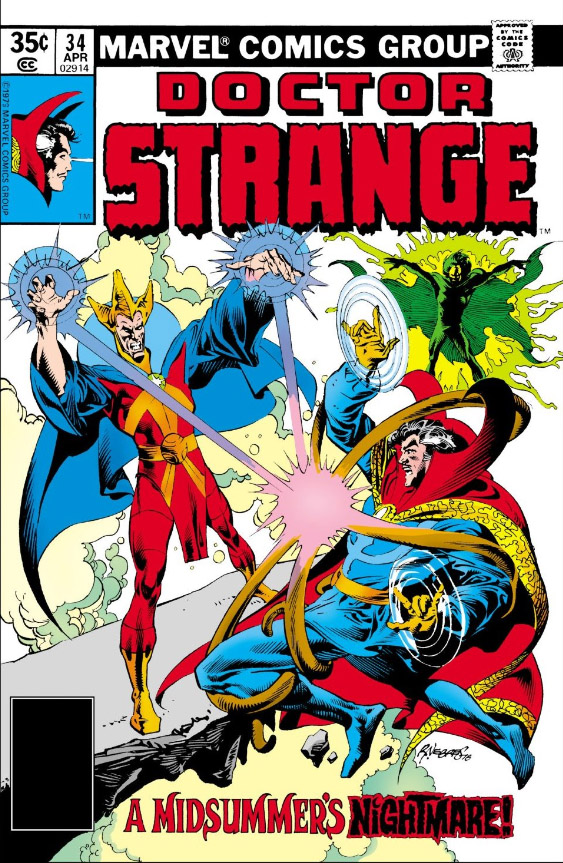
When alert reader Colin J. recently made a comment about being curious to see more of artist Tom Sutton's Marvel work, one title that springs to mind would have to be his brief run on Doctor Strange during 1978-79. Have a look at this sampling of the man's impressive artistry from that assignment:


(Check out the nice touch of the stars sprinkling out from Stygyro's cone-hat!)


Regrettably, Sutton's tenure on Doctor Strange lasted for only eight issues, even with an accommodating bi-monthly publication schedule. To say that the book was in writer/artist flux during this time is an understatement, with Sutton at times inking his own work (and, even in one instance, another penciller)--so perhaps Sutton merely stepped aboard to lend an able hand. (A letters page response in one issue showed Marvel being unusually coy about whether Sutton was the new "regular" artist for the book, when normally they'd be welcoming that artist aboard with all due fanfare.) At any rate, the man unquestionably made his mark on this comic.

Tuesday, June 24, 2014

The King Is Dead! Long Live The King!


The fortunes of Victor Von Doom had certainly changed, once his scheme to install his "son" on the throne of Latveria had backfired in Fantastic Four #199. Soon after, in the FF's landmark 200th issue, his bid to take control of the delegates of the United Nations would also meet with failure--and his nemesis from the Fantastic Four, Reed Richards (a/k/a Mister Fantastic), would triumph over him in pitched battle, rendering Doom catatonic in the process. Effectively deposed, Doom was eventually succeeded on the throne by Zorba, the heir to former King Rudolfo--and Latveria took her place at last as a free nation.

It's hard to imagine Doom ever suffering a more devastating defeat. How would he possibly recover from this--even if his mind were still functional?

Yet Doom would rise to power again--and the first seed to that end had already taken root with the election of Zorba, former leader of Latveria's underground but a man with no real experience as an administrator, let alone as a ruler. And so the economics of ruling a nation would prove daunting to Zorba, whose democratic and perhaps idealistic style of governing was far different from the methods of his ruthless and iron-fisted predecessor:


As for the second seed, that took the form of Doom himself. For Zorba had made the unbelievable blunder of appointing Hauptmann, Doom's former cowering head scientist, to oversee Doom's care. And when Zorba's affairs of state began to foment rebellion, the day came when his paranoia would reveal another potential threat to his rule:


Ironically, Zorba had been a victim of Latveria's new underground movement--this one committed to reinstalling Doom as ruler. And so Hauptmann, working with Doom's faithful retainer, Boris, brought Doom's near-mindless body to a remote laboratory--eventually fitting it with his armor, stolen during a raid on the castle. Zorba, understandably frantic at this point, had a spy locate the hidden lab--but it was too late:


(You'd be hard pressed to find a more fitting artist to portray a secret laboratory procedure that uses bolts of electricity to bring an armored fiend back to life than Tom Sutton.)

It's then that Zorba's troops arrive--but they find that their opposition needs no army to brutally deal with them. Doom lives--and there was little doubt from anyone, perhaps even Zorba, that the day would come when he would rule Latveria again.


So it would seem Zorba's days in power are numbered. Which brings us to our current story, where, in another ironic twist, Doom would use the Fantastic Four--those whose involvement made Zorba's movement to oust Doom possible--to turn the tables on Doom's usurper and bring his rule to an end. And it would begin with a bold, unmistakable declaration: