Showing posts with label Gerry Conway. Show all posts

Thursday, May 25, 2023

Jack Kirby's Secret City Saga, 1993


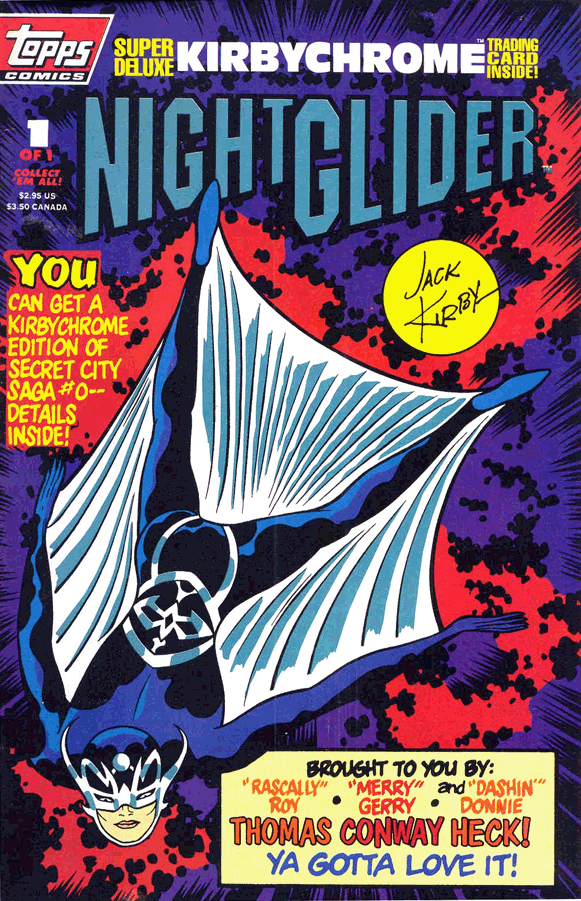
Though the subject of this post technically falls under the PPC's non-Marvel nods tag, it's hard to miss the telltale Marvel hallmarks on this comic book cover from industry newcomer Topps Comics:


Topps, a company founded in 1938, went on to become immensely profitable as a producer of sports-themed trading cards (primarily MLB) as well as other card collectibles (e.g., Star Wars, celebrities, films, etc.), in addition to chewing gum (Topps created the Bazooka comic-strip-in-the-package bubble gum introduced in 1947), candy, confectionery items, and, beginning in 1993, the Topps comic book division. It was here where the retired Jack Kirby licensed several designs and concepts he'd kept in his files which Topps came to collectively refer to as the "Kirbyverse," a series of eight titles published in April of 1993 which would culminate in Kirby's "Secret City Saga"--NightGlider being one of them.

As we can see, a sales pitch that would be right at home on a Marvel cover is in full swing for this issue, even featuring the familiar pet names of its creative team of Roy Thomas, Gerry Conway, and Don Heck. Also now at Topps is former Marvel editor Jim Salicrup, who joined their comics division after departing Marvel in 1992 to become its Editor-In-Chief. Thomas, who had left Marvel in 1980, returned to the company in 1986 but was no longer exclusive, spreading his talent with work for DC and indie publishers (which included several titles for Topps Comics), while Gerry Conway's first and only work for the company would be the NightGlider title.

As for the character, we meet the young woman named (do I have to say it?) Glida as she awakens underneath the city of Chicago, 15,000 years from when she was placed into her slumber (which would have been approximately 13,000 BC).


Thursday, March 30, 2023

The Price Is... Death!


A little over a year following his debut in Amazing Spider-Man, the Punisher makes his way over to a high-profile appearance in the fourth issue of Giant-Size Spider-Man, fighting beside the wall-crawler in a 36-page story (which, excluding ads, works out to 27 pages--still a nice 9 extra pages for your extra 25¢ than what the monthly Spidey series offered). Coming along for the ride is the regular book's creative team of Gerry Conway and Ross Andru (with Mike Esposito stepping in on inks) in a story of greed vs. human lives, an equation which rarely works out in favor of the latter.

We're introduced to at least one of those lives when Spider-Man foils an attempted kidnapping of a young woman, and receives some unexpected assistance from a nearby sniper.


(I don't know about you, but there have been enough instances of Spider-Man's spider-sense being "set aside" when the story calls for someone to take him unawares that I've conditioned myself to sigh and let it slide. That said, two such instances in one scene may tax my resolve.)

As for Spider-Man's resolve to be more understanding of first responders, that lasts for all of sixty seconds, tops (in a very odd scene on Conway's part).


Let's hear from our judges on this about-face, folks:

Police: 9.8. Suddenly can't-be-bothered jerk in the costume: 1.5.
(Five-tenths added only because he saved the girl.)


So what's this plot that Spider-Man has stumbled into all about? Why was this girl targeted for kidnapping? What's the extent of the Punisher's involvement (aside from having some interest in the kidnappers that may extend beyond simply picking them off)? Thanks to his journal entry, we can make a fair guess by now that the Punisher is conducting some sort of investigation--but judging by the issue's shocking (if symbolic) cover, the "enemy" that the Punisher speaks of is going to mete out some punishing of his own.


Monday, March 27, 2023

Woe To The Unpunished!


Of all the scenes the Punisher has to his credit over the years, one that often comes to mind for me comes courtesy of the character's creators, Gerry Conway and Ross Andru, during his second appearance in the early '70s:


The context of the panel consists of his reaction to his foe, the Tarantula, making a fool of him and giving him the slip (and, perhaps most frustrating of all, escaping punishment). The Punisher, after all, is conducting a one-man war against criminals--and while his motivation at this point in time is unclear, what does seem evident is that his obsession with that mission is driven by a mixture of rage and vengeance. Simply put, he cannot tolerate this low-life remaining free--or alive.

But there are more curious circumstances occurring in the Punisher's first appearance, taking place in Amazing Spider-Man in 1974, where we find him in an alliance with the bizarre interloper known as the Jackal, who has his own obsessive agenda in regard to the wall-crawler--a twisted mindset that the Punisher is apparently unaware of, or the Jackal might also find himself in his partner's crosshairs. Here, the Jackal takes advantage of his knowledge of Spider-Man's role in the death of Norman Osborn in combination with our hero's history of evasion of law enforcement, to make sure the Punisher's sights are now turned on a target that both men are convinced is deserving of death.


And so Frank Castle breaks into the comics world as...


Monday, October 17, 2022

The Terror And The "Team"


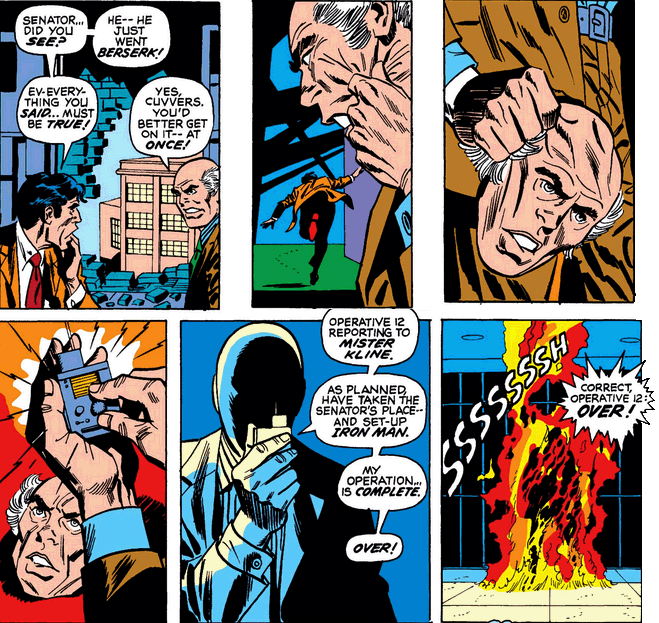
Previously, we've witnessed the machinations of Mister Kline, the figure in shadows who sought to manipulate the lives of Tony Stark, Matt Murdock, and even Franklin "Foggy" Nelson during the years 1971-72, and who made use of a number of operatives to deal with interference from Daredevil, the Black Widow, and Iron Man. Kline, having finally been revealed as an android named the Assassin, met his end at the hands of future beings who appeared following a final battle with Daredevil, which at last brought the saga of Mister Kline to a close.

As for his operatives, their fate was a mixture of defeat, death, and betrayal by Kline himself. Two such men, the super-criminals known as the Scorpion and Mister Hyde, each appeared to die under mysterious circumstances; yet if that was so, then how is it that, five months later (our time), we discover those very men in an abandoned cavern, alive and seemingly escaping captivity?


We readers learn that both men had been captured by Kline in order for android duplicates of them to carry out his instructions--but Captain America, who as Steve Rogers was recently attacked by the pair, is confronted with the question of how both men have turned up alive and at large, and for reasons unknown were demanding information from him regarding S.H.I.E.L.D. As for our two ruffians, having no clue that it was Kline who was responsible for their abduction, they've come to the conclusion that only one organization could have been responsible for incarcerating them.


And that leads them to track down one hero in particular--but thanks to a new partnership, they'll find it's no longer two against one!  Or will they?


Monday, October 3, 2022

The Final Hour of the Assassin!


We've been looking at the roughly six-month period of stories from 1971-72 which introduced the figure-in-shadows known as Mister Kline, whose agenda was to disrupt the lives of both Tony Stark and Matt Murdock for reasons unknown. To that end, he involved a number of criminal operatives to do his bidding, until finally turning to more dependable androids of his own construction--at which point Kline himself pulled back the curtain to reveal that he was also an android, in the service of another figure who was just as mysterious in regard to their ultimate goal.

And now, we come to see the situation somewhat resolved in the pages of Daredevil (the key word here being "somewhat"), where writer Gerry Conway brings an anticlimactic conclusion to this storyline that mostly fast-tracks closure for the character and story of "Mister Kline" (now designated "the Assassin" by his superior, Baal) by way of a bare minimum of explanation which may nevertheless satisfy those readers who are ready to move on. Oddly enough, it's made clear by story's end that those sentiments are also shared by Daredevil and the Black Widow.


Thursday, September 29, 2022

The Many Operatives of Mister Kline!


From late 1971 to early 1972, writer Gerry Conway introduced the nefarious Mister Kline, a character who for reasons unknown sought to upend the lives of Matt Murdock, Tony Stark, and Franklin Nelson, and whose hidden agenda would by extension draw in Daredevil and Iron Man. It's hard to say whether Kline's primary focus on Murdock and Stark had anything to do with Marvel's soon-to-be-launched large format books that would offer an increase in story length for selected titles at a cost of 25¢, given that both Invincible Iron Man and Daredevil were reportedly to be merged into a single book; otherwise, Murdock and Stark would seem to be worlds apart as far as gaining the interest of a figure in shadows who would go to any lengths to cause them trouble, to say nothing of the time and effort taken to conscript others to do that figure's dirty work.

And speaking of which, since Kline himself is due for a PPC post of his own, let's spend our time here running down the list of those whom he enlisted to further his plans--some willingly, some not so much, but all in one way or another complicating the lives of our heroes.

Which calls for a not too complicated


Marvel Trivia Question


Which characters were compelled to serve the enigma named... Mister Kline?

Thursday, March 31, 2022

Tempests In Time!


In 1974, Marvel's House of Ideas was brimming with them. The company's fan magazine, FOOM, remained a hit, reaching 25,000 members; the first issue of Spidey Super-Stories went on sale; Stan Lee would announce the publication of The Origin of Marvel Comics (a working title which would be tightened up to Origins of Marvel Comics), as well as the release of the first Marvel Superhero Calendar (another working title, becoming The Mighty Marvel Calendar); and perhaps most notably, its ambitious Giant-Size line of books launched, which supplemented a number of regular monthly titles on the stands but with a higher page count and, it goes without saying, a higher price tag.

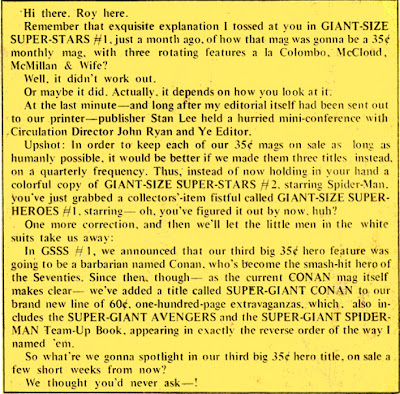
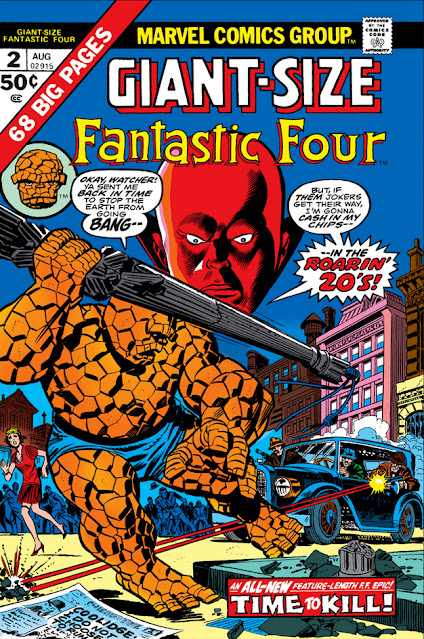
The Giant-Size books have already received their due in a separate PPC post; but in thumbing through my copy of Giant-Size Fantastic Four #2 recently, I was reminded of how the company's handling of these books see-sawed throughout their production, with ideas being tossed into the air like confetti but lacking in execution, as typified by a full-page notice/advertisement by Editor Roy Thomas:


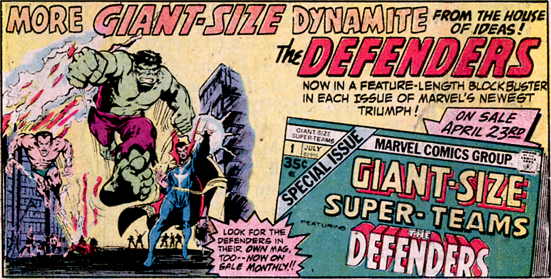
Unless they saw a very limited release that never hit my town, the SUPER-GIANT 100-page books never saw print (that I know of). Neither did the title which Thomas previewed following his announcement:


Personally I thought a book named Giant-Size Super-Teams had "winner" written all over it, since it would have at least four teams to rotate in addition to having the option to preview a new team idea should anyone come up with one. (Though the ad appears to imply that the new book would exclusively feature the Defenders, instead.)  But all of these fruits died on the vine, as did, eventually, the entire line, engulfed by reprinted material when fresh new stories could no longer be supplied.

The second issue of Giant-Size Fantastic Four was already signalling the title's future fate--its "68 Big Pages" amounting to less than half that amount with original material, while ads and a reprint FF story were used to fill the page count. Still, there is the Fantastic Four (with Medusa instead of the Invisible Girl); and there's writer Gerry Conway with artists John Buscema and Chic Stone; and there's the Watcher; and there's time travel; and there's Willie Lumpkin; and there's a brand new foe to contend with.

Though we're not talking about just gangsters giving the FF a hard time.


Monday, December 14, 2020

"The Birth of... The Gibbon!"


The July 1972 issue of Amazing Spider-Man would be the curtain call* for longtime writer Stan Lee on the series, having scripted Spidey's book since 1963 in addition to the character's introduction in Amazing Fantasy the previous year. Although a two-part story, the August issue would serve to usher in the book's new regular writer, Gerry Conway, beginning a distinguished run himself of over three years. There was little notice of Lee's departure from ASM, aside from words mentioned via a letters page response in Part Two (though frankly I was more delighted while looking back at these issues to spot a letter in Part One from future Marvel writer David Michelinie, all of 24 years old at the time)--as well as a more generalized Stan's Soapbox column in a subsequent issue where Lee would formally pass the torch to new editor Roy Thomas and the company's other writers.

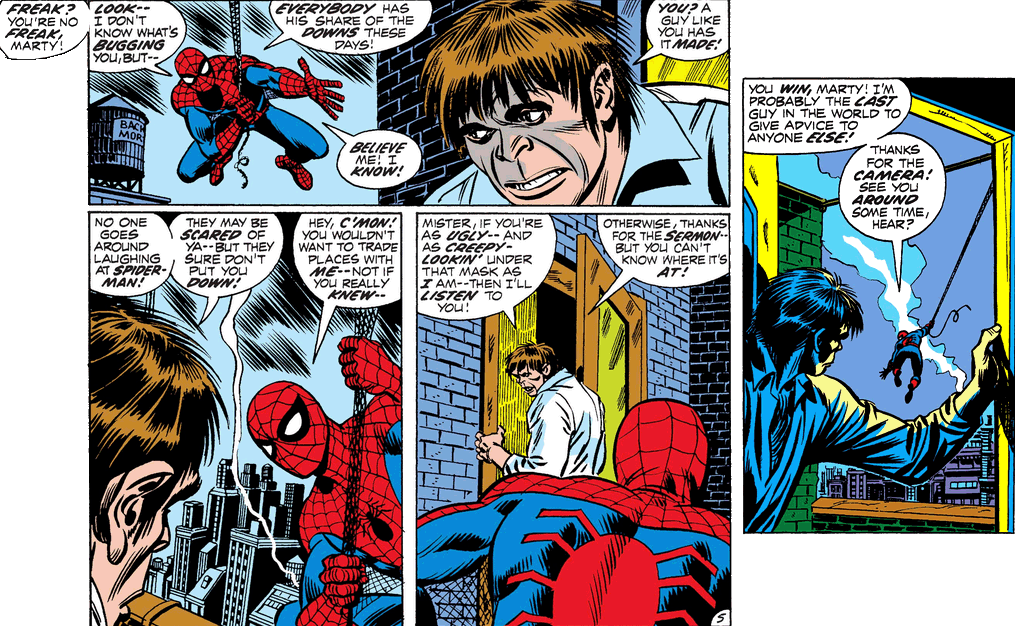
It seemed that Lee had opted for more of a smooth transition for Marvel readers than any thoughts of fanfare. And that being the case, how appropriate it seemed that in his final issue he would introduce a rather unremarkable character--a young man hoping for a chance at better things for himself as well as a life without despondency and, worst of all, ridicule. It seemed equally appropriate that, of all the people in New York City, Martin Blank would cross paths with Peter Parker, whose own life during this time had its share of turmoil and whose run of bad luck causes him to hurl his customized camera away in a flash of anger.


*Lee would again be spotlighted in an informal encore the following year, when his story from the 1968 issue of the Spectacular Spider-Man magazine was recycled into a three-part tale for which Conway provided additional dialog.

Martin's acrobatic skill is our tip-off to the character on the issue's cover--but why would this orphaned young man adopt a costumed identity as an ape-man? We would find the answer as he sought employment--and acceptance--in an environment which would unfortunately echo the deriding laughter that followed him all through his childhood.


Martin apparently has chosen to view his chance meeting with Spider-Man as a door opening for himself at last. Yet he's chosen not to hear the words of someone who knows first-hand that being a costumed hero is no guarantee of a life free of rejection or personal burden--and what happens next will not only bring Martin to arguably the lowest point in his life, but also leave him vulnerable to the influence of someone who won't hesitate to take advantage of his circumstances in order to put an end to a despised enemy.


On a better day, Spider-Man might have been more sympathetic to Martin--but his aunt's recent disappearance has added to a sea of troubles he's been experiencing lately, sapping him of his patience and having him regarding Martin as a distraction that he doesn't have time for. With his departure from the scene, however, the time is ripe for this story's principal antagonist to salvage what's left of Martin's fragile self-respect, and direct him to do what he himself cannot, at present.


Monday, November 23, 2020

When Come The Slavers of Golden Star!


OR: "Our Next God Up For Bid..."

In mid-1973, we found the Mighty Thor comic about to wrap up an eight-month stretch of issues that saw the Thunder God and his fellow Asgardians--the Warriors Three, the lady Sif, Hildegarde, and Balder the Brave--exiled on Earth by Odin, and joined by Tana Nile and Silas Grant, two individuals from their conflict with Ego-Prime and now marooned on Earth. To complicate matters for the Earth-bound Asgardians, Sif, in exchange for saving Thor's life in a battle against Loki, would be compelled to serve Karnilla, the Norn Queen, in her quest to locate the now-missing Balder*; and as for Balder himself, he later turns up in a shocking state, apparently having been to Asgard despite Odin's edict and returned with his mind shattered by whatever he endured there.


*Presumably Sif was conscripted by Karnilla because of her power to travel by bypassing space and time--otherwise, Sif's ability to locate missing persons would be on par with any other Asgardian's, and certainly wouldn't begin to approach Karnilla's own mystic resources.

And so we've come to where writer Gerry Conway would pivot sharply to a new and wholly different story arc, beginning a nine-issue series of Asgardian adventures in outer space that kicks off with all of Asgard's warriors being captured by aliens and sold on the auction block!


Monday, August 24, 2020

Childhood, Interrupted


For a while during the 1970s and into the '80s, it seemed the odds were going to be stacked against Franklin Richards, the son of Sue and Reed Richards of the Fantastic Four, no matter how many readers might have been pulling for him even going back to the difficult circumstances of his birth. As if his life weren't going to be harrowing enough being the vulnerable child of a couple who had difficulty protecting him from the frequent dangers they faced with their team, there were his mutant abilities to contend with--powers that were both unpredictable as to their emergence and potentially dangerous to the entire world should they be fully unleashed. Such a crisis arrived in late 1973, when his father was forced to "shut down" his son's mind by use of a defective anti-matter weapon before disaster occurred (which, if you were to ask anyone who witnessed the scene, surely qualified as a disaster in itself), an incident that led to all the members of the FF separating for a time until reconciliation between Reed and Sue eventually took place.

If we backtrack a bit to the point when Franklin was still a toddler, we see that whatever ambivalence either Stan Lee or Roy Thomas felt in terms of what direction to take Franklin in ceased when writer Gerry Conway began his run on Fantastic Four and began laying that decision's groundwork in mid-1973, shortly after Reed and Sue separated following the FF's battle with the new Frightful Four. Sue, with Franklin, retreats to a farm owned by friends in Pennsylvania--and we glimpse a portent of things to come.


It's later that year when Annihilus's tampering with Franklin's power leads to Reed's desperate action, after which Franklin fell into a coma--a condition that lasts for just over a year until another crisis, in the form of the return of Ultron, serves as the catalyst that returns Franklin to consciousness, and normalcy.


It's an ending to the situation virtually wrapped up with a bow, given that Conway leaves the FF title shortly thereafter. Roy Thomas, taking the reins of the book from that point, seems content to leave well enough alone vis-Ă -vis Franklin, when he touches base on the subject in 1976:


(As we know in hindsight, Sue's traumatic encounter with Psycho-Man nine years later would have her dispensing with her objections here to updating her FF name.)

Thomas's sentiments are not at all shared by Marv Wolfman in the 1980 FF Annual, however, as we see Franklin's abilities re-emerge during a conflict with Nicholas Scratch and Salem's Seven.


From that point, Reed and Sue appear resolved to the fact that Franklin's powers are still present and warrant keeping an eye on, though they essentially leave it at that while making sure they're there for him as loving parents while keeping a watch-and-wait attitude. (Under the circumstances, I might have sought out consultation from Charles Xavier, but what do I know.)

During Doug Moench's time on the book in 1980, passing reference is made to Franklin's still-dormant power, though mostly as a lead-in to another conflict with Scratch:


Nearly two years later, artist/writer John Byrne sees an opportunity to open the door a little further and again bring to the fore concerns about Franklin's mysterious power. And while not having the scope of Conway's treatment on the subject, Byrne's self-contained crisis here serves as an example of how to craft a dramatic story involving the power of Franklin Richards without necessitating that a future writer take it into account. Turning the page, we find such a story suitably beginning with Franklin's parents, still keeping a watchful eye on their son but preferring not to wait until a sudden development that might prove harmful but instead taking precautionary measures. And while Reed is no Charles Xavier, his own methods prove to be uniquely suited to both his inventiveness and the care of his son.


Though Reed may have been hasty to label this unit as a babysitter, considering that finding a traditional babysitter is still a concern when everyone heads out for the evening. Fortunately, no human sitter is present for what occurs next.


We can only wonder what Wally and the Beav would do in this situation.

Monday, August 17, 2020

A Tale Of Two Ragnaroks


If you're a longtime Mighty Thor reader, you've been witness on more than one occasion to the Asgardians having to deal with the coming of Ragnarok--the prophesied twilight of the gods when their world will end in savage conflict and conflagration. In every instance, the Asgardians have managed to survive their foretold doom (even the genuine Ragnarok); but there was nevertheless a time when the threat of world's end hung heavy over their realm and their very existence, a day of destruction which Odin himself thought it best to draw back the curtain on and bring perspective to in order to strip away the pall of doom associated with it, which up until that point had the Asgardians collectively on edge and often feeling as if they were walking on egg shells.

To accomplish what he had in mind, Odin would make use of his seer, Volla, bequeathed by the All-Father with the gift of prophecy, to reveal to all of Asgard's warriors visions of the future which would leave no doubt as to the coming of Ragnarok, yet also have them come away with more than just the inevitability of the cataclysm that would result in their deaths. Curiously, that story by writer Stan Lee would be chronicled in Mighty Thor not just once but twice--first, in 1966, with artists Jack Kirby and Vince Colletta, and again six years later with John Buscema and John Verpoorten. Both stories are essentially the same--though both Kirby and Buscema would naturally offer different interpretations of Asgard's fate, which is something of a treat for readers.

Unfortunately, Odin being Odin, there is deception on his part at work in the Lee/Kirby story--first, to open the door to the looming threat:


...followed by Thor and Loki, along with a hand-picked group of warriors, being sent on an expedition to find "the forces of evil" which are responsible for the alarming damage to the Odinsword of Asgard, which, if left unchecked, could bring about the end of everything.


Yet the expedition is nothing more than a wild goose chase conceived by Odin*, a "quest" to assuage warriors who had fallen into fighting among themselves out of boredom (only in Asgard, folks), as Thor finally recognizes: "We had been too long without battle--too long without purpose! Our tempers were frayed--our sword edges blunted!" And so when Odin feels that goal had been accomplished, the men are recalled, to join those assembled in order to hear the dreaded and dire words of Volla--words and, for us, images which will reveal a day when even immortals will perish!