Though it may have been the only thing to be done in order for Marvel Comics to continue in the 21st century to make their
20th century characters the foundation of their publishing business, it's regrettable to some degree that the company was forced to free itself from the constraints of continuity and simply insert their characters in stories that exercised only a modicum of familiarity with past behavior and history. In a way, it could be said that they were jettisoning one set of constraints only to be bound by others--for while many character origins
had been revised to avoid being hamstrung by untenable connections to previous points in history, there are a number of scenes which can no longer be drawn on to help define the makeup of those classic characters who are still having adventures five decades after their introduction.
All things considered, I'd imagine such concerns are trivial matters to the Marvel of today, given the juggernaut success of their films and streaming content that help to sustain and are in part sustained by their print material--and certainly, there's enough present-day domestic and global conflict to keep Marvel's writers busy with character-building moments. Yet there are certain scenes and connections which are no longer feasible--particularly for characters like Captain America, who, regardless of what time period he was reawakened in, is locked into World War II as the time in which he originally fought and became a legend. And with it now being over 75 years later, there are few to no instances left for him to be provided with story material that allows him to interact with those friends and comrades who were also alive during that brutal time in history--meetings that resonate with the heroism of those who, unlike Cap, had to resign themselves to death.
For example, one such battle awaited Lord Montgomery Falsworth, who fought in the war as Union Jack and who must do what little he can to stop the killing spree of his brother, the man known as Baron Blood. In spite of Cap's urging to leave this fight to those better suited to it, Falsworth is adamant that he be allowed to do his part.
But a younger man instead insists on stepping into the Union Jack uniform, making it possible for Cap to do what he must to bring an end to Baron Blood's killing. Nevertheless, Falsworth breathed his last that day--a touching ending to the story, and a farewell to a part of Steve Rogers' life that helped to mold the Captain America we know today.
Similar scenes have played out at one time or another, depending on the passage of time and the circumstances in which a character felt his own time had come. Instances such as when Cap was notified that Jeff Mace, the Patriot, was on his deathbed from cancer--or when Bucky Barnes, as the new Captain America, wanted to pay a last visit to one of the Young Allies, Pat O'Toole ("Knuckles"), at a veterans hospital.
But unless a writer of today happens upon a character who was ten or fifteen years old at the end of the war, Cap isn't likely to have further encounters with wartime survivors like Anna Kappelbaum.
And there are others of Marvel's flagship characters who have immutable roots in the past, people who don't (or didn't) have the luxury of having ingested a serum which slowed their aging process--most notably, the Fantastic Four, whose origin story has been revised to that of a government-cancelled starship project which Reed Richards and his friends decided to launch anyway, this time stripping the moment of any motivation having to do with a foreign power. But the four individuals remained young and vital through the decades since (while bringing up two growing children), even having experienced character-building moments that would otherwise anchor them in 20th century history--conversations which we must assume have almost certainly been wiped from their present-day thoughts.
(To those of you who have kept up with their current stories, I can't help but be curious: Just how far back do the memories of the FF go now?)
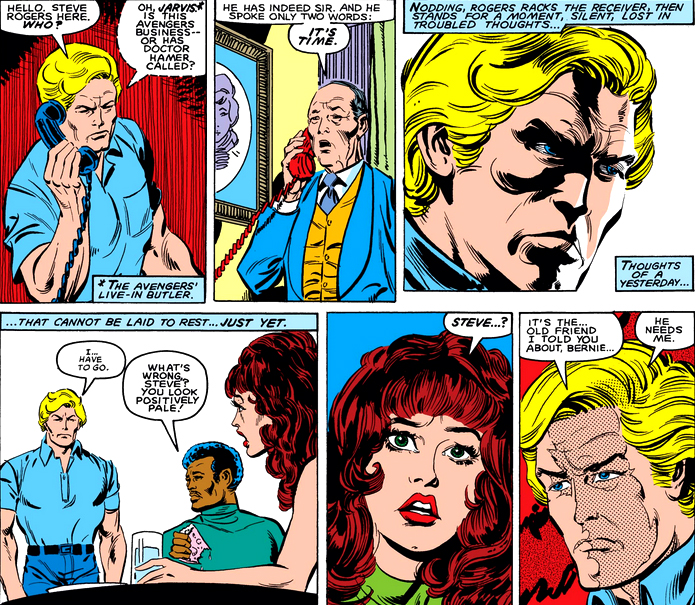
Nick Fury's origin was also tweaked to accommodate his adventures in the 21st century, being treated with an "infinity formula" which slowed his aging process. Nevertheless, age was very much on his mind in 1972 when he suspected an agent he was romantically involved with of being interested in the younger Captain America, leading to a volatile scene with Fury's "rival."

Yet we're forced to take into account the fact that Fury was given his age-slowing formula just before the end of World War II, which paints this scene in a different light than that of an "old warhorse" being consumed with jealously and rage over a celebrated and younger man who fought in the same war but hadn't paid his dues in the years of conflict which followed. For one thing, it means that Fury's anger at Cap is likely based at least in part on the fact that his formula is less effective than whatever age-slowing elements exist in Cap's super-soldier serum. Though jumping ahead to the present, we also have to contend with whatever year Marvel has now established for Cap being found and revived by the Avengers (I'm guessing it's around the year 2000?), which means Fury's clash with Cap couldn't have taken place as written since it firmly places Cap's revival in 1964.
All of this comprises a train of thought that might not amount to much--particularly if Marvel has somehow sifted through all of this and created an approach they're satisfied is working for their readers. For the last ten years or so, they've proven that they can prune or even cut down a few trees, with no apparent harm to the forest--i.e., their characters seem to need no substantive ties to the past (other than the sparse details of their origins) in order for meaningful and even compelling stories to be produced, an assertion which contemporary readers and movie-goers appear to agree with. And while characterization stemming from connections to the past remains important, there are arguably ways to achieve it other than by looking back to the past, or to past characters, to provide its framework. I don't happen to be fully on board with either of those statements, given how past events in comics have so often been the impetus for the drama to come, something that writers Stan Lee, Roy Thomas, et al. were so adept at making use of; yet I would concede that in the here and now, Marvel's comics are still doing their job of entertaining their readers while having shifted to a different formula of storytelling than what was to be found in their earlier body of work. Whether there's any merit to that statement, of course, remains in the province of the reader.