Showing posts with label Gene Colan. Show all posts

Thursday, August 24, 2023

It's Not Nice To Bind Mother Nature


For nearly all of its 1974-1987 run, Doctor Strange was obliged to follow a bimonthly publication schedule, having briefly flirted with monthly issues from April-October of '76 during the height of Steve Englehart's time as scripter on the book. It was Englehart who had announced that, despite the strenuous toll such a schedule would take on both himself (who had other projects he'd hoped to pursue) and artist Gene Colan (who was also doing Tomb Of Dracula at the time), the effort would be made, since all involved (which now included inker Tom Palmer) were "determined to keep at it, and to keep the quality high," in Englehart's words.

Flip the calendar ahead to October, with both Englehart and Colan having departed and writer Marv Wolfman announcing that the book would return to a bimonthly schedule--the reason being that its sales, though good, didn't warrant being published monthly. Early on, however, there were similar bumps in the road for readers of the new monthly series to weather, such as a reprint issue being released so shortly after the book's launch, with bimonthly status kicking in two issues later; then, the departure of celebrated artist Frank Brunner, who made no secret of the fact that he preferred a bimonthly schedule but also had other projects he was interested in pursuing, at which point Colan, who had worked on the first Dr. Strange series in the '60s, came aboard. Englehart would later provide a bit of perspective in that regard:

"When Dr. Strange had his own book in the late '60s, it failed. The insider's official explanation has always laid it off on Gene's panel layout ("you couldn't follow the story"). But it's been my conviction for some time that the real reason is far more basic: in the late '60s, despite all the hue and cry over mind expansion, there just weren't enough spacy people reading comics to support a mystic--while today, there are. In fact, as I say, there are so many spacers around that this book is not just supported. This book is a certified hit. That means there are a lot of people out there who dig Dr. Strange as he now is, and they deserve consideration."


And that leads us to a four-issue story from 1975 which I like to think smoothed the road ahead for our new Sorcerer Supreme and his creative team, and certainly for his readers who despite a two-month wait between issues were demonstrating that they were in it for the long haul. Monsieur Brunner has left us a stunning cover for that story's first installment, featuring Strange facing the unrelenting Umar, the sister to none other than the Dread Dormammu--and while Colan had yet to contribute cover work, we get a sense that Strange, as well as his lover and now-disciple, Clea, are literally about to undertake their baptism of fire!


Monday, July 10, 2023

"The Curse Of Dracula!"


OR: "London Victims Are Falling Down"


Though there was a surprising lack of special annual issues for the Tomb Of Dracula series, even with over sixty issues to its credit, readers were able to turn to no less than five such efforts in the Giant-Size books which were hitting the stands in droves during the mid-1970s--beginning with Giant-Size Chillers, which, as was the case with the Fantastic Four and Spider-Man, would adjust its masthead to headline its principal character with succeeding issues.


Padded with reprinted material (which was often the case even with genuine annuals), the mid-1974 issue still featured a new 24-page story (officially numbering 32 when factoring in ad pages, a little sleight-of-hand which I never appreciated in the sales game) as well as an intriguing new character--Lilith, Dracula's estranged daughter, who has received generous exposure in the PPC (along with her hated father, it goes without saying). Produced by Marv Wolfman and Gene Colan, the same writer/artist team who headed the main book (currently at its 21st issue at this point in time), it would instead be inker Frank Chiaramonte's work we'll be seeing here rather than that of Tom Palmer, turning in splendid pages and meshing quite well with Colan's style.

There are essentially two separate stories in play throughout the issue--but the stunning splash page we're greeted with (seen here to include its original published copy) leaves little doubt that the character who will take center stage is Dracula, who while having had dealings in London since his revival now moves to insert himself in the lives of those in government who are positioned to better help him safeguard his continued existence.


Monday, March 6, 2023

In The Night Comes... Nighthawk!


The story of Nighthawk--erstwhile member of the Squadron Sinister and, later, would join the dynamic Defenders--really begins at the point when he's conscripted to take part in a deadly game of life and death engaged between the alien Grandmaster and Kang the Conqueror which would decide the fate of the Earth. It was the Grandmaster who formed the Squadron to serve as his own "players" who would individually face Kang's chosen team of Avengers in battle--and while the latter team fought for the survival of their world, Nighthawk and his partners had more self-serving ends in mind.


As we'll learn, the Grandmaster had a direct hand in bringing Kyle Richmond's identity as Nighthawk to life--and while it may seem odd that the Grandmaster would bother with providing Nighthawk's mode of transportation, it appears to be the key to Nighthawk proving victorious against his opponent, despite what we may have assumed in regard to victory being achieved by the defeat of the player.


We'd have to look at the fine print of this game's terms to be certain, but here it seems that Nighthawk would win his match against Cap if his plan to destroy the Statue of Liberty had succeeded, rather than defeating Cap personally; otherwise, the Grandmaster would have declared Nighthawk the winner when Cap was caught by the villain's rope and slammed into unconsciousness against the statue's stone base. Regardless, since Cap came out on top by defeating both plan and opponent, the point is rendered moot.

In the end, the Grandmaster would ultimately be the losing party in the game and depart, leaving the members of the Squadron Sinister free to chart their own course. Hyperion's fate at the hands of Thor would be more problematic in that regard; and while we were left to assume that the Whizzer and Dr. Spectrum would have been turned over to the authorities, that doesn't seem to have been the case for Nighthawk*, who turns up roughly four months later to use his criminal talents to con his way into Daredevil's territory.


Monday, February 13, 2023

No Rest For The Weary at Greymoor Castle


In 1941, Greymoor Castle, located in (at that point in time) the most desolate part of northern Britain, became the site of "one of Captain America and Bucky's greatest battles," as Cap himself would put it forty years later. And though this particular castle doesn't technically meet the definition of having a storied past, it may fit Cap's description given that the 1965 story of that conflict by Stan Lee, Jack Kirby and Dick Ayers offered a plot that a reader of Cap's wartime adventures would find appealing: a German officer who receives his orders directly from the Red Skull... a plot to kill British Prime Minister Winston Churchill... a scientific breakthrough from the castle's lord, himself a German collaborator... Captain America's young partner, Bucky, captured and used to lure Cap into a trap (if I had a nickel...) ... and the likely charge of treason awaiting Steve Rogers, suspected of deserting his unit when it's caught in a Nazi pincer movement on the battlefield.

Yet it's also a story which bears a second look, as Cap decides over fifteen years later (our time), courtesy of writer Bill Mantlo and artist Gene Colan, as a figure from the castle's past roams its ruined halls wary of the ghosts which haunt him--and wary as well of the costumed intruder who arrives to find more than memories awaiting him in this ancient edifice.


Monday, July 11, 2022

The Sorcerer, The Ally, and the Avengers!


Even as early as its Silver Age books, Marvel was discovering the value of story crossovers in regard to not only profit but also as a means to entice readers to pick up a title that they'd passed on or didn't know about. In addition, the practice may have also helped to light the match of the budding collectors of the day, well before the marketing insanity of multiple crossover "events" would make even collectors balk. The early days of crossovers also offered the likelihood that the same writer would be handling scripting for each of the issues, while art buffs benefited from the opportunity of either seeing the same artist pull double duty or a different artist's take on the other book's character(s). Some examples that may come to mind in that respect were the Daredevil/Fantastic Four crossover featuring Dr. Doom (with artists Gene Colan and Jack Kirby), the X-Men/Avengers story involving Magneto (both penciled by John Buscema), and the Avengers/Incredible Hulk tale (featuring the work of both Sal Buscema and Herb Trimpe) which introduced an intriguing new villain, Psyklop.

In 1968-69, Avengers scribe Roy Thomas was also handling the first solo series of Doctor/Dr. Strange (the good doctor's masthead title abbreviated at about the halfway point) and would feature two crossovers during its 15-issue run. Regrettably, the second crossover, depicting the threat of the Undying Ones, would occur posthumously following the book's cancellation, in issues of Sub-Mariner and Incredible Hulk--but the prior crossover would have its conclusion take place in a more high-profile title, as well as bring in a guest-star along with a threat drawn from no less than the realm of the gods.


Thursday, September 23, 2021

This Way Toward... Doom!


Perhaps eyeing the success of the DC horror/fantasy anthology titles House Of Secrets and House Of Mystery, Marvel launched two similarly themed books in late 1969: Tower Of Shadows and, one month later, Chamber Of Darkness. Like their DC counterparts which were published on a bimonthly basis (off and on), both Tower and Chamber hit the stands every other month--but it seems the similarity ends there in terms of sales, as Marvel's offerings sold poorly and were discontinued after ten and eight issues, respectively. Tower, premiering first, seemed somewhat better received by readers, judging by letters page response, though the ratio of raves to more critical assessments appeared to be about 30/70. There was also the question of sustainability, as both series began pulling in reprinted material from their earlier anthology titles from the '50s-'60s (Strange Tales and Tales Of Suspense) with their sixth issue.

Suffice to say that DC's House titles were in no danger of readers jumping ship for Marvel's offerings--though it wasn't for lack of trying on Marvel's part, at least initially, as some of the company's most notable talent were tapped to contribute stories. Roy Thomas, Jack Kirby, Stan Lee, John Buscema, Gene Colan, Len Wein, Marv Wolfman, Jim Steranko, et al. (including John Romita Sr., who mostly did cover work) were seemingly able to accommodate seven-page assignments (or less) within a two-month window (though I believe Steranko withdrew after only one story, reportedly due to a disagreement with Lee)--with some artists even pulling double duty and contributing scripts as well as art, in addition to inkers providing readers with examples of their own pencils.

After their all-too-brief runs, each title shifted to formats made up of almost entirely reprinted material, in addition to adopting new mastheads. Tower became Creatures On The Loose, which mixed its reprints with sword and sorcery tales as well as a regular feature on Man-Wolf, while Chamber morphed to Monsters On The Prowl--each book having a run of 30 to 37 bimonthly issues (the creatures pulling ahead of the monsters--make of that what you will). But since there's a little more ground to cover with both Tower and Chamber, and having already examined Jack Kirby's stories in the latter, let's turn to a few samples from some of the other names we've mentioned who made their mark in the macabre during the brief time when these two titles were being published.


Thursday, March 25, 2021

This Power Denied!


At the close of 1969, Captain America's life was changed dramatically, about as dramatically as anyone could change it given the opportunity and the means. In this case, that person turned out to be the Red Skull, who recovered the Cosmic Cube after losing it during a pitched battle with his foe and used its power to switch their bodies--and to "cap" his revenge, the Skull moves in on Steve Rogers' love interest, Sharon Carter, as the real Cap realizes that his situation has become practically hopeless.


His plan in motion, the Skull amuses himself by milking his newfound status as Captain America while using the Cube to monitor the movements of the real Cap, who makes his way to Avengers Mansion in an attempt to convince his teammates of his bona fides and secure their help; but, distrusted and doubted from the beginning, the attempt fails, and the pseudo Skull is rendered unconscious as the Avengers leave to respond to a S.H.I.E.L.D. alert.

It's then that the Skull decides to add another level of peril to Cap's struggle, by transporting him to the island of the Exiles--former allies of the Skull who now wish vengeance on him, and will attack him on sight. But after Cap's initial clash with the group upon arrival, he later discards the Skull's mask so that he'll hopefully be unrecognizable to them, while further disguising his features as a precaution. In addition, this would turn out to be the moment when Cap meets Sam Wilson*, a former hireling of the Exiles, whom Cap begins to train in hand-to-hand fighting in order to become a symbol to the natives that Sam has begun to organize and band together to rebel against the Exiles.

*Both Sam and the reader have yet to learn of his identity as "Snap Wilson"--that his past as he remembers it is a sham, and that he's been manipulated by the Skull into being a sleeper agent for use at some future point against Cap.

Clearly the Skull, who holds the power to obliterate Cap with a thought, wishes to savor his revenge, with the goal of crushing Cap's indomitable spirit; but his patience becomes exhausted when both Cap and the Falcon are successful in motivating the natives to rise up against the Exiles, a development which infuriates the Skull and forces him to finally take a personal hand against his enemy. To that end, he abruptly changes the venue for himself and his foes--and the endgame of this drama finally begins.

(Of course the issue's cover might render the moment anticlimactic! Maybe the Skull just tripped?)
 

Friday, May 1, 2020

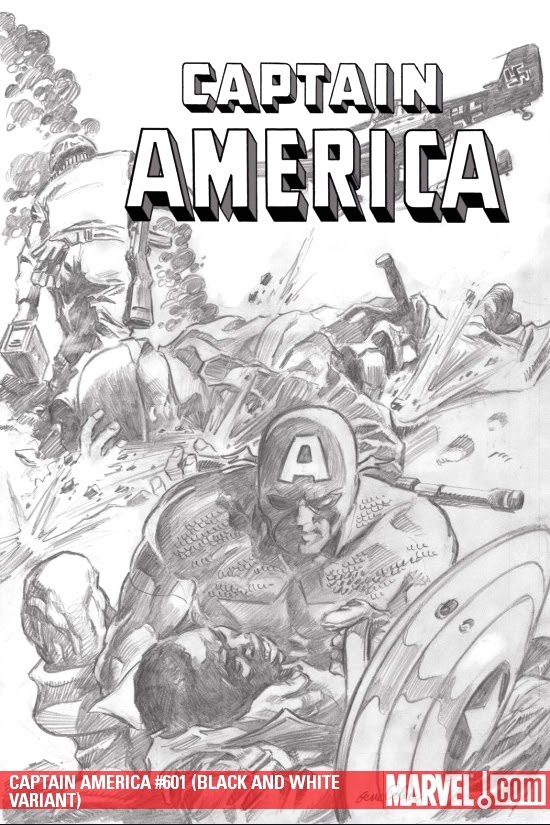
Gene Colan's Final Story for Marvel


Artist Gene Colan, who passed away in June of 2011, turned in his final full-length comics work just over two years earlier, capping a career spanning over six decades (which included commissions work, to the delight of his fans) and bidding farewell to a red, white and blue character he worked on with Stan Lee from mid-1969 until the early '70s.


With no inker assigned to the story, the issue is a splendid showcase of Colan's talent in its purest form, even well past his prime--with colorist Dean White helping to bring the pages to vivid life. As for the story itself, however, it might leave you with the impression that the issue is something of a one-shot, with Colan's large, canvas-style scenes curtailing any scripting nuances which writer Ed Brubaker provides, while Brubaker himself appears to be giving Colan a wide berth and providing narrative and dialog only as needed. As such, the story regrettably suffers, both in conception and in execution--a tale of vampires attacking a Belgium village, along with the remnants of two U.S. army platoons within which Cap and Bucky are stationed. Not the usual fare we would expect in a wartime flashback tale, though the type of story which The Invaders had opened the door to often enough.


The story's events stem from a present-day conversation between Nick Fury and Bucky, involving the conflicts of the Civil War crossover which had heroes on both sides of the conflict turning on one another--which then serves to segue us to the past, where our soldiers are being turned into vampires and preying on their fellow soldiers, with Cap's priority being clear: find the vampire who is to blame for the initial attack and destroy him. But Brubaker, taking his cues from Colan's art, is obliged to offer one red herring after another in the search for the principal vampire before finally revealing the true culprit to Cap and Bucky--only to abruptly end the story seconds after the climax has begun to unfold, while offering only token resolution in the form of Bucky providing a piece of trivia to Fury (which we'll get to in a moment).

During the post-Stan Lee part of his career, it's fair to wonder if Colan was ever in the habit of conferring more closely with the writer of the book he was working on in order for both writer and artist to be on the same page, as it were, in regard to having a more detailed understanding of the plot beyond the basic characters involved, given that this doesn't appear to be the case here.* That said, Colan arguably lays sufficient groundwork for the writer to pen at least a more coherent story, which might have benefited from less of an impulse to let the art stand on its own.


*It would certainly be helpful to have the thoughts of this book's editor at the time, Tom Brevoort, on the subject.


But with our focus primarily on Colan, his work here makes for a splendid final act to make his exit on. Reportedly suffering from glaucoma and progressively reduced vision since the '90s, the quality of Colan's work nevertheless spoke for itself, and one would have been hard-pressed to detect any hint of his condition in these pages. To have seen this story followed up with a Dr. Strange tale... well, a guy can dream.

The clues that Cap and Bucky gather eventually lead back to a village child who's been seen carrying food and water, and who was last seen in the company of one of the latest victims. Yet it turns out this child hasn't been among the living for four years.


As we've seen, the story ends abruptly as Bucky brings ourselves and Fury back to the present, where he offers one last tidbit of information: Bucky and Cap didn't return with the platoons to join up with Gen. Patton in the south, but were instead sent back to England to guard an experimental plane--an assignment which led to Zemo's island in the English channel, and a pivotal moment in time for Captain America.

Your mileage may certainly vary as to what degree this story worked for you, though I'm hoping your one takeaway is the caliber of work which its distinguished artist has produced at the twilight of his career. Do take the opportunity to sample Mr. Colan's talent in any number of other comics forums where he surely has a presence--though you can be assured that you'll see his renowned and unique artistry continue to be featured in the PPC.

Wednesday, March 11, 2020

My Son... The Sub-Mariner!


Following the death of the Lady Dorma and the abdication of Namor The First and his subsequent departure from Atlantis, the grief-stricken Sub-Mariner turned to the surface world in an attempt to establish a life for himself there and explore his human heritage; yet, in failing, he discovers evidence that Capt. Leonard McKenzie, the human who long ago had wed Princess Fen, his mother, may still be alive. It would be the last course that longtime Sub-Mariner writer Roy Thomas would chart for the character before departing the book, a loose end which Gerry Conway would resolve in early 1972. In so doing, Conway would also demonstrate that he had in mind a different approach for Namor by severing Thomas's subplot of a Washington senator's campaign to secure amnesty for Namor by representing him as a champion of the environment.

The other loose end to be dealt with, of course, was the villainess Llyra, who had murdered Dorma yet escaped Namor's vengeance. And as Namor roams the streets of Boston for clues of his father's whereabouts, we find that Llyra has formed an alliance with one of Namor's oldest foes--Todd Arliss, Tiger Shark, who has his own plans for Namor.


Meanwhile, as marine biologist Walter Newell does some legwork of his own in investigating the whereabouts of McKenzie, we discover the 74-year-old captain spending the remaining years of his life in isolation in a Boston boarding house where he is looked after by a woman named Sara (presumably his landlady) and beset by memories of the loss he suffered fifty years ago. To understand the depth of that loss, we turn to a flashback narrated by Namor himself (via Thomas), in an exquisite origin sequence rendered by artist Ross Andru.


Events which Conway picks up on as we return to MacKenzie* again in late 1971, when we find his memories of that time are in the tortured form of bits and pieces which make clear that Fen's loss is something he has never healed from.


*Conway has changed the spelling of the last name, a trifling adjustment that could have been intentional or simply an oversight.

And so we finally rejoin Namor, who has crossed paths with MacKenzie without realizing it and now is lost in his own thoughts while walking the streets of Boston (seen here in scenes penciled by noted Sub-Mariner artist Marie Severin, with Jim Mooney).


What serves as the catalyst for finally drawing together the principal characters in this plot is the capture by Llyra and Tiger Shark of reporter Diane Arliss (Todd's sister), a woman hopelessly smitten with Namor and whose unwilling cooperation provides them with a powerful means by which they can bring Namor to them, and place him under their power.


A scene which at last opens the door to this saga's climax--for better or for worse.


Monday, March 9, 2020

When A Star Dies!


Or: "When Worlds... er, Stories Collide!"


Two similar plots, playing out just nine months apart in the pages of Strange Tales and Tales Of Suspense, would have a single and similar catalyst: Our sun, the star which nurtures and sustains the planet Earth, was suddenly and inexplicably dying, leaving the planet's population to quickly devise a solution for the survival of all mankind. And it's the former title which produces a cover to give us a dramatic sense of this sort of premise.


While inside, each story offers a symbolic splash page which gives a hint of how their plots will play out:


While both stories will focus on the human race attempting to escape its fate, these opening pages already provide contrast as to what approach each story will take toward that end. "The Last Rocket!", from Tales Of Suspense, clearly indicates that Earth's population is leaving Earth, presumably to hopefully locate a suitable world orbiting a healthy star--while the page from the earlier "When A Planet Dies!" story in Strange Tales tells us that the human race either could not or would not leave, instead resigned to seemingly face certain death. (The cover caption goes further in conveying the impression that most of the population had left the Earth and abandoned the rest, though we would learn otherwise).

Monday, March 2, 2020

Traitor Of S.H.I.E.L.D.!


For an issue of Captain America so fraught with drama and danger, #127 received rather lackluster treatment in the advertising department:


We can tell by the graphics that a lot of action is happening for both Cap and Iron Man--but when your promotional captions are far more distinctive and eye-catching than the material they're pushing, a thirteen-year-old (like myself, who was just getting his feet wet in reading comic books) doesn't have much to go on here aside from two blurry (if colorful) covers.

Which is one reason why I decided to finally flip through this issue decades after the fact, if only out of curiosity, to find out if this story was worth the... well, obviously not a lot of hype, judging by so tiny a house ad tucked away in the back of Fantastic Four #100, but enough hype to at least catch my eye back in mid-1970.

To bring you up to speed on the state of the book at the time, Stan Lee was still writing the character, who had already met the Falcon but not yet formalized his partnership with him; instead, Cap was still tight with S.H.I.E.L.D. and Nick Fury, though keeping his lady love, SHIELD agent Sharon Carter, at arm's length. As for Lee, it had been evident that he was working to try to find some direction for Cap in his solo series, other than having the Avengers become the character's only recourse in that respect. But at this point in time, Fury and SHIELD still have a noticeable presence in the book; in fact, for the purposes of this story, you might wonder why Fury isn't getting second billing on the masthead.

Monday, February 17, 2020

Howl Of The Werewolf! Rage Of The Vampire!


During 1944-45, Universal Pictures sated demand for the Wolfman, Dracula, and the Frankenstein monster by giving us The House of Frankenstein and, just a week short of one year later, House of Dracula, the only two films up to that point where all three horror figures appear together--though, astonishingly, never on screen in the same scene at the same time. That honor was reserved for the 1948 film Abbott and Costello Meet Frankenstein--and while it was only a momentary glimpse, one of my favorite still shots at least gives us an idea of how things might look had our three horror figures actually joined forces (if only against two hapless comedians).


Interestingly enough, if you take Bud Abbott and Lou Costello out of the mix, that film would have made for compelling viewing--well directed by Charles Barton, and excellent acting by Bela Lugosi and Lon Chaney Jr. (who both played it wonderfully straight despite the antics of Abbott and Costello).

In the comics world, these monsters of old would also meet on occasion, often with no love lost between them. We've seen such an example with a clash in 1973 between Dracula and the Frankenstein monster--and in the following year, a crossover story with double the fangs (and hopefully double the fun) would be presented featuring the very pairing of monsters which in the A&C film engaged in a battle that led to their mutual end. Neither of these fearsome characters is likely to perish here, with each having their own title--nevertheless, there will be enough bloodshed to go around.


Once again, artist Gene Colan delivers on a symbolic splash page, eh?

Friday, February 14, 2020

"Your Serve... er, Move, Daredevil!"


Having put together a special series on symbolic splash pages featured in Marvel's major team books as well as in Amazing Spider-Man, the PPC now moves briefly to highlighting some noteworthy efforts made in a random sampling of other titles from over the years which came to mind, some of which may ring a bell for you.

Leading us off are a number of pages from Daredevil, which I lingered on for some time considering their diversity in both style and artists and spanned a range of years from 1964 to 1971. (Perhaps even longer, but DD is monopolizing this subject as it is!) Bill Everett Jack Kirby is who we have to thank for paving the way for us (correction courtesy of Dave Plunkert--thanks, Dave!):


Joe Orlando, whose work began appearing in the industry in 1949, would follow up on the title with the next three issues (though you'll find much of his work for Marvel appearing in titles published in the mid- to late-'50s, in categories ranging from westerns, romance, war stories, sci-fi and mystery). His final work was published in 1997, a year before his death at 71.


Wally Wood, whose work Stan Lee made efforts to spotlight, makes his own SSP contribution (working off artist Bob Powell's layout) in a story from 1965 which he also scripted:


Ross Andru and Herb Trimpe unintentionally provide dueling SSPs featuring Ant-Man, with Andru providing more variety in terms of what awaits us within the story:


While John Romita and Gene Colan line up their versions of face-offs between DD and Spider-Man.  Writer Gerry Conway's "sports fan" caption turns out to be appropriate, since Mr. Colan seems to have Spidey trying to capture DD with a tennis court net.


(Maybe that second title should start off with "...And So Re-enters"?)


The mask and form of Daredevil lend themselves nicely to the SSP format, as Colan demonstrates in his other efforts with the character.


Over in Amazing Adventures, where the Black Widow is splitting the mag with the Inhumans, John Buscema appeals to the action lover with imagery suggesting that the Widow's new series is the one to watch--while Colan takes a more intriguing approach.


Later in that same title, Craig Russell is well-suited to the characters and concepts we'll find in stories adapted from H.G. Wells' War Of The Worlds.


While Colan, Gil Kane, and Jim Starlin show us what they bring to the table for Captain Marvel, old and new...


...as well as for Warlock (with Steve Leialoha working off of Starlin's layout).


Dr. Strange is also well-represented, both solo and as part of the Defenders. Here we see work by Andru, Colan, Barry Smith, and Sal Buscema.


Howard Purcell, whose work for Marvel was limited to backup stories featuring the Watcher and two Nick Fury stories in Strange Tales, turns in this splendid SSP for the Black Knight's appearance in Marvel Super-Heroes.


Finally, Andru takes us out with the opening page to Marvel Team-Up #1, which features the rare display of Spider-Man in battle while poised on his own spider's web.


(Frankly these two don't seem very interested in fighting the Sandman.)


COMING UP:
One more SSP for the road... to Transylvania, that is.