Showing posts with label Frank Giacoia. Show all posts

Thursday, March 2, 2023

Earth's Mightiest Floating Heads!


"I like to goof off now and then, too, you know." - (Mrs.) Young-Ja Kim

Always one to take the sentiments of the redoubtable Mrs. Kim to heart (if I know what's good for me), I've finally gotten around to a little goofing off of my own by exploring a subject we readers of silver- and bronze-age comics are all too familiar with: Those aghast, worried, concerned, taken aback, consternated, and certainly conspicuous floating heads on issue covers which appeared out of nowhere to draw attention to whatever and whoever they were casting their piercing gaze(s) on.

It seemed a rare day when we saw such bodyless faces appear in titles featuring a solo character, since both hero and villain(s) were occupied in full-size poses slugging it out on a given issue's cover--but in group books, they were all the rage, carefully placed on valuable cover space to provoke a reaction in the comics browser that what awaited within was momentous enough to merit spending their hard-earned change on. It also goes without saying that they were also useful in a marketing sense when other characters in the group didn't make it on the cover but rated a head shot in order to let the prospective reader know that whoever they might have been most interested in still showed up in the story.

Both Fantastic Four and The Avengers featured a prodigious amount of floating heads in their first volumes, but it's the latter title which offered more variety when it came to its characters given the sheer amount of different Avengers to choose from. As for the approach we'll take with this, it became more interesting for me to present these "floaters" on their own and out of context rather than blending in with whatever else was on the cover. It turns out that, in just over 400 issues, there were only a mere twenty-five instances where these heads appeared before tapering off around 1990. Nevertheless, they made their mark, and are not to be confused with groupings of other, equally familiar floating heads:


And so let's get to it--though it seems that three of the Avengers have already taken a glance at this collection and are less than pleased with the direction we're headed in. You'll have to take up your grievances with Production, gentlemen!


Artwork by Gil Kane and John Romita
(Prior framing art by John Buscema and George Klein)

Wednesday, September 11, 2019

Like Unstable Father, Like Certifiable Son


After the death of the original Green Goblin, it took some time for the powers that be at Marvel to admit that, for sheer, cackling, calculated villainy, only Norman Osborn was capable of filling his own shoes. There have been a few others who tried, including but not limited to a psychologist (who by definition should have known better), the nephew of a "Daily Bugle" reporter, and, most notably, Norman's son, Harry, who first took over the identity of the Goblin following his father's death, which had involved Spider-Man--a/k/a Harry's friend and roommate, Peter Parker.

With Harry discovering Peter's identity as Spider-Man, as well as being convinced that Spider-Man murdered his father, we only have to add Harry's poor mental state to the mix to have all the ingredients necessary for Harry to pursue a mission of vengeance against his former friend. And since Harry had also become aware of his father's double life as the Green Goblin, it seemed inevitable that Harry would be the one to whom the torch would be passed, and pick up where his father left off with Spider-Man, and with Peter.


This two-part tale from the fall of 1974, written by Gerry Conway and pencilled by Ross Andru, doesn't have the scope of a typical story which features the threat of the Green Goblin, though that threat is certainly apparent given Harry's actions and the danger to Peter's loved ones; but with Conway virtually capsulizing this story and ending it so tidily, with Harry handily dealt with and Peter et al. none the worse for wear, you may tend to discount the danger inherent in a title such as "The Green Goblin Lives Again!" Had it been Norman we were talking about here, there's little question the story would have been a tension-filled page-turner.

Yet because it is a Spider-Man tale, which often includes the book's cast of supporting characters as part and parcel of Peter's life, well-handled by Conway, it's a fine return for your 50¢; and while to this day I wince at Andru's stiff handling of Spider-Man in action, I can appreciate the fact that his run on the title was obviously backed by Conway, editor Roy Thomas, and likely a considerable number of readers, with those issues putting on display Andru's extraordinary talent as a storyteller as well as his skill at depicting characterizations--two constants that were evident throughout his tenure.* By all indications, they were elements Conway appeared to enjoy quite a bit, fitting so well with his own style of storytelling.

*Notable in Andru's work on ASM is the presence of not one but two inkers for those issues where he's credited with doing full pencils rather than breakdowns--mostly with Dave Hunt partnering with Frank Giacoia, which we're treated to in this particular story. Occasionally we'll come across a story with two or three (or even more) finishers contributing--but it's remarkable to see it occur on a regular basis.

As for the story itself, it begins innocently enough. At this point in time, Peter and Mary Jane Watson are dating (and apparently oblivious to the fact that they're both casually walking in traffic), and Peter and Harry are still roommates in their Manhattan apartment--though Peter has noticed that Harry has been intentionally putting distance between them, perhaps chalking it up to his dating Harry's former girlfriend. But both Peter's living situation and his relationship with Harry are about to take an abrupt (and nearly deadly) turn for the worse.


Friday, February 15, 2019

Gene Colan's Dr. Doom: The Living Prison!


Having looked at artist Gene Colan's work with Doctor Doom from 1971 as it appeared in Astonishing Tales, followed by a three-part Sub-Mariner story from 1972 where Doom came into conflict with M.O.D.O.K., we now circle back to 1968 to find Colan's earliest work with the Master of Menace. We haven't seen Daredevil clash with Doom since their meeting during the so-called Battle of the Baxter Building--but here, writer Stan Lee has something completely different in mind (a pun which will become clear in a moment), as Doom devises his latest plot to gain revenge on the Fantastic Four.

By this time, Colan has drawn the Daredevil title for nearly a year and a half and succeeded in putting his distinctive stamp on the character, so there couldn't be a better time to witness his treatment of the fighting styles of both DD and Doom in a second meeting. But without spoiling things too much, you shouldn't expect a knock-down drag-out between them, since we wouldn't exactly be witnessing a battle of equals; in fact, the graphic we see here by Colan of the two duking it out (well, one of them is) speaks volumes as to which of them has the greater likelihood of prevailing. Yet there's enough novelty in Lee's approach to satisfy the reader and at least keep things interesting, though the most action that "Doom" will see is in battling his own henchmen.

To bring us up to speed as to the circumstances which bring Doom and DD together, let's have a quick recap of the events that led us up to this point:

  • The Trapster launches his own scheme of revenge against the FF--but first he has to regain his confidence, by seeking out and killing a hero he considers to be far less trouble (i.e., Daredevil).
  • With the help of a few of the Wizard's anti-gravity discs, the Trapster pastes a number of them on DD, sending him soaring into the sky and to his eventual death. Yet the Trapster's trademark super-paste is usually only as super as the writer allows--and DD manages to dislodge and discard all but the single disc he needs to retain on his person in order to descend back to Earth safely. (Tsk. Time was when one disc would have done the job, Wiz.)
  • DD returns in time to foil the Trapster's plans for the FF, but the wily villain manages to give DD a run for his money before he's finally brought down in a railway station.
  • Unfortunately, in trying to prevent serious injury to the Trapster, DD wrenches his back. And though the Trapster is taken into custody by the police and carted off to jail, amazingly no one stays to assist the injured DD.

But look who does show up to take care of him.


Monday, February 11, 2019

Gene Colan's Dr. Doom: King vs. King!

Having previously taken a look at artist Gene Colan's early work with the Master of the Mystic Arts, Doctor Strange, it seems only fitting that we sample the other end of the spectrum and bring together a collection of his work featuring the Master of Menace, Doctor Doom, a character that Colan lent his distinctive touch to in stories from the late 1960s to the early '70s.

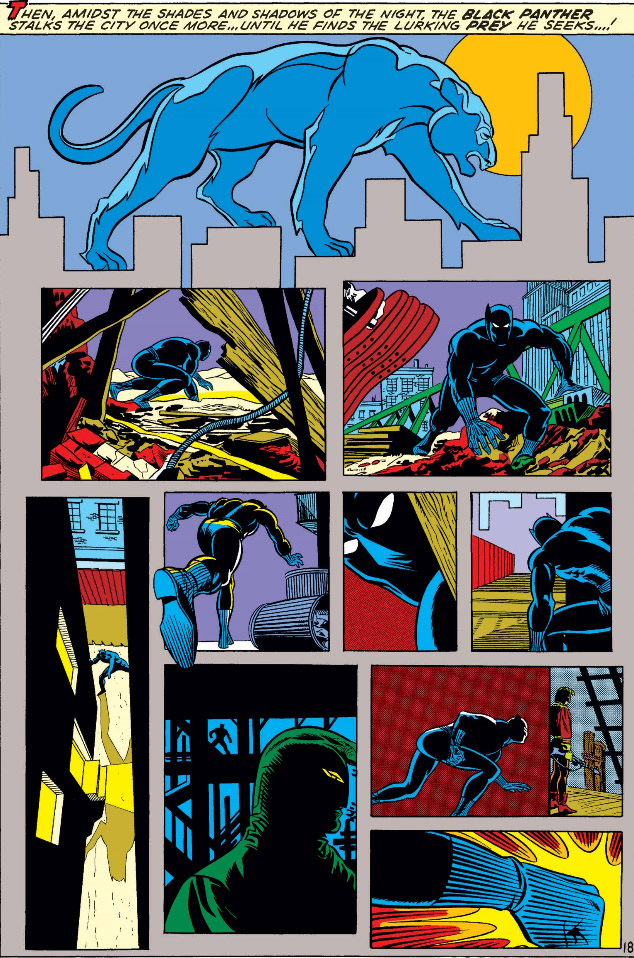
The PPC will gather together and present a select grouping of those stories this week.  To start us off, we spin the wheel of fortune and land on a tale from the "tail" end of summer, 1971, which actually is something of a landmark issue that not only sees Doom's first foray into Wakanda, but also finding him crossing paths for the first time with T'Challa, the Black Panther. It's a gem of a story tucked into the double-billed Astonishing Tales book, where Doom shared the mag with the jungle lord, Ka-zar.*


*And getting second billing, at that. Incomprehensible as it seems, there was a time when Marvel judged Ka-zar to be more of a reader draw than Dr. Doom; to add injury to insult, Doom was edged out of the book entirely after only eight issues, leaving Ka-zar to have a healthy (if bi-monthly) solo run in the title for the next twenty-two issues. (Looks like the House of Ideas may have been onto something, at that.)

Artist George Tuska handles the art for the story's first half, which provides the foundation for Doom's involvement in Wakandan affairs and his subsequent conflict with T'Challa. We can break it down briefly as follows:

  • In order to build a fleet of rockets constructed with Vibranium so that they will never go off course, Doom "interrogates" (which is putting it mildly) an African native who finally breaks and reveals where to find the ore: the nation of Wakanda, where Doom sends a sophisticated scanning device to map the deposits' exact coordinates.
  • To reach Wakanda and mine the Vibranium, Doom boards his nuclear-powered Excavator and tunnels all the way to Africa. Once in position, the ship's mining activities begin causing massive surface damage to Wakanda, enough to warrant an emergency message to Avengers Mansion where it's received by you-know-who.
  • Amidst the carnage, T'Challa vows to his people to find the one(s) responsible. To that end, he descends into a newly-erupted volcano, where he believes he can survive the molten lava thanks to having "the speed and agility of a jungle cat." (Note: Leopards, cheetahs, and yes, panthers generally stay clear of live volcanoes, probably because they have the good sense to know without even getting near them that they can't survive there.)
  • While Doom is conducting repairs on a mechanism from the Excavator, he sets aside his weapon, which is retrieved to use against him. We know the culprit isn't a jungle cat--but it is someone dressed like one.

And not only does the Panther make his entrance, but so does Mr. Colan.


Monday, November 19, 2018

"A Blind Man Shall Lead Them!"


From mid-1965 comes a classic Fantastic Four tale that has long been an all-time favorite of mine and is well overdue for a write-up at the PPC. The story finds our heroes at their lowest ebb--recently defeated by the Frightful Four, their unconscious bodies are fished out of the ocean by the crew of a U.S. Navy submarine. But their condition is far more serious than what their initial diagnosis indicates.


Returning to their lab in New York, the foursome undertake a project meant to protect them from any enemies bent on revenge, should word get out of how vulnerable they have become: a way to artificially duplicate their powers through technological means. For once, Sue Storm's usual misgivings of hopelessness and a course of action having little chance of success might indeed apply to their situation.


Meanwhile, their deadliest enemy prepares to strike anew, after a casual encounter with his court magician allows him to recover from a plan conceived by Reed Richards which led him to believe that he had been victorious in his last encounter with the Fantastic Four.*


*A misaccounting of the climactic scene to Fantastic Four Annual #2 by writer Stan Lee, altered here to indicate that Doom was placed under hypnosis by Reed--when in fact, Doom was defeated through scientific means, by ingesting the same drug he had covertly used on the FF to induce hallucination. The drug caused Doom to see the result he wanted to see following his "duel" with Reed--that he prevailed in their contest, which ended with Reed being exiled to a nameless limbo dimension. Of course, either way, it looks like our hapless magician is out of luck as far as receiving Doom's gratitude.

And so, with Doom on the way, the Fantastic Four will soon be facing the most dire battle of their lives--and a blind man shall lead them!


Wednesday, September 26, 2018

The Mental Might of... Magneto??


There was a time when Magneto, the Master of Magnetism, was content to seek out and conscript other mutants into doing his bidding and following his lead while he engaged in this scheme or that, all in the cause of bringing "homo superior" into ascendancy and ruling the world. But while his goal remained the same, his methods began to change once he became less focused on maintaining his Brotherhood of Evil Mutants and began thinking along the lines of using technology to create mutants, either from existing humanoid forms or, depending on the machinery he employed, from scratch. His rationale for doing so, as was typical of his madness in those days, was less dependent on reflective thought and more on crazed action: "Home sapiens shape their world--homo superior must needs shape themselves!"

Magneto's tilt in this direction appeared to take place following his near-escape from death after battling the X-Men and the Avengers and emerging in the Savage Land, where, as "the Creator," he began mutating the savages he found there. Later, in the aftermath of his failed plan, discovered in the wreckage by the Sub-Mariner, he detoured to pursue a power play designed to use the forces of Atlantis against humanity; but after that, too, failed and he escaped capture, he got back on track when he attempted to use Black Bolt of the Inhumans to steal a government compound that would allow him to complete a device (the "Universe Machine") which would augment the process of mutant creation. The rest of the Inhuman royal family joined with Black Bolt to foil that scheme--but in his attempt to escape, Magneto detonated the government cylinder, which resulted in severe injuries that took him months to recover from.

We've seen this plan taken to the extreme when Magneto discovered presumably alien technology that led to his creation of Alpha, a godlike mutant that almost allowed him to seize power at the general assembly of the United Nations; but just over a year earlier, he had again sought atomic secrets from government scientists as part of an insane plan which would release a torrent of radiation on the entire country, killing most of the population but leaving roughly 8% alive as mutants who would fall under his command. It all takes place in a two-part Avengers story from 1973--but this time, will the Avengers and the X-Men stop him, or join him?


Monday, September 10, 2018

The Art Of The War


Following up on a previous post that explored the launch issue of the Amazing Adventures series "War Of The Worlds" from 1973, it was evident that the acclaimed yet troubled series would be off to a shaky start, with its writer and artist moving on to other commitments soon after the book's second issue saw print--and only a semblance of direction for moving forward provided by its creator, Roy Thomas, the series now waiting for whoever would pick up its reins. After Marv Wolfman stepped in to script the third issue, the writing position, at least, was secured when Don McGregor joined the book for what would be the entirety of its run, while pulling double duty with the "Panther's Rage" storyline in Jungle Action.

But who to pencil and ink the series from this point? We know that artist Craig Russell would come aboard eventually (with the tenth issue) to add his talents to McGregor's and provide the series with the distinction it still carries to this day; in the meantime, the upside to the book's artistic direction being in flux is that readers were treated to a succession of different hands that brought their interpretations to the concept and the characters. That would be, in order of appearance, Herb Trimpe, Rich Buckler, and Gene Colan, with a number of inkers that included Frank Giacoia, Klaus Janson, and Frank Chiarmonte. Below are brief samplings of their contributions to WOTW, though you'll certainly want to enjoy their respective issues in their entirety.

Wednesday, July 18, 2018

To The Death!


Capping the year 1973 was an event closer that, while formally beginning in September of that year, can be traced all the way back to January, and this climactic scene from a battle of gods:


The following month, Dane Whitman, the Black Knight, was having his own encounter with an Asgardian--one which had its upside, yet most definitely a downside.


As for Loki, he's recovered in mid-plummet by the dread Dormammu, who proposes an alliance between them in order to recover and reassemble a device which would mean the end for the Earth as we know it.


Yet when Loki realizes that Asgard, as well, would be destroyed with that of Earth's dimension*, he does what he can to foil Dormammu's plans for the Defenders--by involving the Avengers to counter them.


*Still not too clear on that. Isn't Asgard in its own dimension? Sometimes it's hard to tell.


And so the Avengers move against the Defenders' efforts to recover the Evil Eye, though the latter group is successful for the most part. Finally, reason prevails between two war veterans from the opposing sides--and the Sub-Mariner leads Captain America and the rest of the Avengers back to the sanctum of Dr. Strange, where all parties (save two) finally compare notes.


After recovering Thor and the Hulk on the battlefield, the pieces of the Evil Eye are collected and made ready to be rejoined--but Dormammu makes his move first, sending one of his servants to swiftly swoop in and recover them before any of the stunned super-beings can prevent it. And almost immediately, Dormammu begins using the power of the now-complete Eye** to merge Earth's dimension with his own. Chaos reigns, unchecked--but not unopposed.


**Since Dormammu's alliance with Loki was predicated on his need of the Asgardian's power to help reassemble the Eye, by rights Dormammu's plan should have ended in failure, given that Loki had already earlier decided to work against him.


And now, pieces put in place throughout a year's worth of stories culminate with an assemblage of heroes who are committed to bringing the fight to Dormammu at last. Of course, given that the Avengers' book has won the coin toss as far as carrying the ball for this conflict's climax...


...some of the heroes being used to promote this issue will end up being sidelined.

Wednesday, July 4, 2018

The Pencil and Brush of "Fearless" Frank Giacoia


A fixture at Marvel Comics during its Silver Age period and into its Bronze was artist Frank Giacoia, whose inking credit (along with those of Syd Shores, Dick Ayers, and Dan Adkins) graced many a splash page across Marvel's entire line of books. I was always surprised to see his embellishment work on a story, as it seemed he "floated" between assignments; in those instances, he was generally filling in until the book's regular inker either returned or could be lined up. Much of his work could be found on issue covers, as well, but it was always his story work that I was pleased to see, as his style was always reliable and complimented the pencils rather than suppressed them to any degree. There were surely those pencillers who appreciated what a strong inker brought to their table; but I have no doubt that many were happy to have old pros like Giacoia and Shores assigned to their books, knowing that the work would be handled on time and consistently professional.

Giacoia's work in comics dates back to 1940, when he and Carmine Infantino were assigned what would become their first published work--an insert for the new Timely Comics title, U.S.A. Comics. It was Infantino who inked Giacoia's pencils on a story featuring the Golden Age character, Jack Frost (no relation of course to the Iron Man villain who would go on to become Blizzard):


In his first appearance, Jack becomes quite the crimebuster, in a virtual sea of crimebusting mags that apparently flew off the shelf during this period. Though at his story's end, it looks like he may not stay on the side of the law for long!


When Timely morphed into Marvel Comics, it was a rare day when you would see pencilling work from Giacoia. One job that comes to mind is a Sons of the Serpent arc in The Avengers, with Giacoia handling pencils on Part 1 of a two-part story. Along with inker Sam Grainger, he turns in quite a nice collection of pages.


An "unsung" but no less distinguished inker for most of his time at Marvel (a category which I'd also apply to Shores), Giacoia would receive a thoughtful dedication in the 1989 graphic novel, The Amazing Spider-Man: Parallel Lives, one year after his death at the young age of 63.


I made every effort to find a mention of Giacoia's passing in the (very abridged) Bullpen Bulletins page of Marvel's books around the time of his death, which was then using most of its limited space to promote profiles of various Marvel editors, but I came up empty. If anyone can track it down (assuming such a mention exists), I'd appreciate any info on it because I'd certainly like to include it. In its absence, hopefully our tip of the hat to the man here at the PPC will serve to give a well-deserved acknowlegement of Giacoia's contribution to the medium.


Frank Giacoia, circa 1970 (inking FF #97)
(with thanks to Alan Kupperberg via Sean Kleefeld)

Giacoia, along with Josef Rubinstein, was added to the Inkwell Award's 2016 class of the Joe Sinnott Hall of Fame.


BONUS!
Have a look at a few selected PPC posts which feature Mr. Giacoia's work.


Wednesday, February 21, 2018

"Draw!" Cries The Stranger!


One of the "strangest" battles in comics (and it has some competition), 1976's "Shoot-Out at the O.K. Space Station!" is a bit of harmless fun on the part of writer Steve Englehart and artist Al Milgrom, while still figuring into the ongoing plot of the Supreme Intelligence which involves both Captain Marvel and his human companion, Rick Jones. And as both the title and the issue's cover make clear, the general theme of the story is taken from elements of Earth's old west:


...so you'd best saddle up, pardners, 'cause there's a speck of trouble ahead.

Wednesday, November 15, 2017

The Double-Death Threat!


While it's true that you can't thumb through your stack of old Iron Man comics without coming across at least a half dozen Iron Man vs. the Mandarin issues, do you still recoil with a start when you come across the issue where the Mandarin once battled his armored nemesis TOPLESS?


Yikes! That probably triggered the evacuation alarm at Stark Industries automatically!

Wednesday, October 4, 2017

Mission: Replace Captain America!


Like a few of his fellow heroes, there have been times when even the straight-up, cool-headed Captain America has "gone wild," in the popular vernacular of the late '60s (and even extending into the '80s); in fact, you and I can probably bring to mind a half-dozen such instances when Cap has done so, without even giving much thought to it. There was the time when Cap tore into the Avengers when he thought one among them had betrayed him by aiding Immortus in capturing Rick Jones; or when the loss of his shield made him a crazed loonie; or whenever Sharon Carter's life was threatened. As popular as the word "wild" was with young people, a comics character going wild made for good cover copy, since it usually meant you were going to see them lose it in some way in the story and that the stakes would be raised.

Of course, Cap tended to go a little wild when his foe would debase our country's pride in freedom and/or liberty. But what was it about a late-1968 story, in particular, that sent Cap over the edge? Whatever it was, it was enough for the defunct Marvel fan club, Marvelmania, to single it out and make a poster from its cover.


It looks like the word "wild" was so popular, in fact, that apparently Marvelmania didn't want the words "Cap Goes" to take away from its selling power in the ad. As for the story, you'll have to judge for yourself whether or not Cap went wild, or if it was again his usual sense of patriotism rising to the fore and giving him the drive to overcome his foe. At times it's admittedly hard to tell the difference.

It's one of the last few issues of Captain America which we'd see from artist Jack Kirby, who at this point in time was closing in on the date he would depart from Marvel--and with finishing by Frank Giacoia, one of my favorite inkers for Kirby (with apologies to Mike Royer), it's quite a feast for the eyes. Writer Stan Lee also steps up and provides words to keep pace with Kirby's work, one of many stories where he plays to Cap's strengths regarding his unwavering faith in his principles and the cause he fights for.

Friday, January 20, 2017

The Plan and the Peril!


In the first meeting between Iron Man and the man known as Whiplash, Iron Man was for all intents and purposes little more than a living target--his power nearly depleted from an earlier battle and unable to make use of his strength or his weapons. Nor was his armor proving resilient enough to stand up to his foe's steel-rending whip. Iron Man only survived that meeting by rerouting power reserved for his injured heart, in one desperate strike which left him as incapacitated as Whiplash.

Since then, Whiplash has moved on from his association with the criminal organization known as the Maggia, but has meticulously been planning his revenge against Iron Man right under the nose of Tony Stark--positioning himself in Stark Industries' Cincinnati plant and waiting for the moment when the paths of both himself and Iron Man would cross. That moment arrives when Stark and his executive assistant, Pepper Potts, arrive for an inspection of a project under development by the plant's manager, Vicki Snow, as well as the plant's head of Research, Mark Scott (a/k/a Mark Scarlotti)--a man we know better as Whiplash himself.


It seems a lot of trouble and effort for Whiplash to go through in order to put in place this revenge plot of his. For one thing, he didn't do too badly against Iron Man in their last meeting, with the Avenger virtually at his mercy; and after Whiplash regained consciousness following Iron Man's desperate attack, it was the Maggia's leader, the Big M, who prevented him from finishing Iron Man then and there. It would seem that a man like Scott would have better things to do than fume about that outcome and be so consumed with thoughts of revenge. There's also one other oddity along these lines in writer Mike Friedrich's story, which we'll get to in a moment.

For now, we at least have a decent battle to look forward to between Whiplash and Iron Man, since it would be absurd to once again find Iron Man too debilitated to put up a fight. That means that Whiplash will have to have some sort of defense against Iron Man's powers other than a single weapon, since he has no strength or invulnerability to speak of. As we'll see, Friedrich will give him a hand in that respect (or in this case, two); but it appears he's also made Whiplash quite the electronics expert since his last appearance, which means he'll have a few surprises for Iron Man. Of course, his whip remains formidable, and there's no disputing the man's skill.


Friday, January 6, 2017

Presenting: Doctor Doom!


If you're not counting his origin story in the 1964 Fantastic Four Annual, the first book to feature the character of Doctor Doom in his own story would have been an issue of Marvel Super-Heroes 4½ years later--a very generous 24 pages of material that in hindsight would have made a splendid issue of Super-Villain Team-Up, though that mag was still six years away. (What's Doom doing in a book called "Marvel Super-Heroes," anyway?) The story was a dual effort by both its writing and artist team; Larry Lieber (brother of Stan Lee) reportedly scripted and pencilled roughly the first half of the story, handing off the remaining pages to Roy Thomas while Frank Giacoia finished the pencilling work. Yet you might be surprised at how seamlessly it all reads.

And it was a rather surprising story to find on the shelves, given Doom's history as a guest-star in Fantastic Four and other titles--a story that, for the first time, would test Doom's star power with readers outside of the context of his being a menace to overcome. Yet "This Man... This Demon!" doesn't really come across as a tale meant to gauge reader interest in seeing the character branch out on his own--though all the stops appear to be pulled out for his appearance here, with both Lieber and Thomas sparing no effort in crafting an interesting and entertaining story that takes into account Doom's manner and complexities. By now Doom has made enough of an impact with readers that it would be a misstep to simply "phone in" a feature story for him that only sought to coast on his popularity; fortunately, the story in MS-H meets the high standards we've come to expect with a character of Doom's caliber. And with a tale that's actually starring a villain, there's arguably no better character that deserves a shot at a cover of his own.

As something of a bonus, the story also features Diablo, a villain whose history as a deadly menace dates back to well before Doom's own. Their conflict arises when Diablo attempts to forge an alliance between the two--and when Doom declines, Diablo provides incentive that has roots in Doom's very beginnings. What leverage could Diablo possibly possess that would force a man such as Doom to capitulate?