Showing posts with label Tom Palmer. Show all posts

Thursday, August 24, 2023

It's Not Nice To Bind Mother Nature


For nearly all of its 1974-1987 run, Doctor Strange was obliged to follow a bimonthly publication schedule, having briefly flirted with monthly issues from April-October of '76 during the height of Steve Englehart's time as scripter on the book. It was Englehart who had announced that, despite the strenuous toll such a schedule would take on both himself (who had other projects he'd hoped to pursue) and artist Gene Colan (who was also doing Tomb Of Dracula at the time), the effort would be made, since all involved (which now included inker Tom Palmer) were "determined to keep at it, and to keep the quality high," in Englehart's words.

Flip the calendar ahead to October, with both Englehart and Colan having departed and writer Marv Wolfman announcing that the book would return to a bimonthly schedule--the reason being that its sales, though good, didn't warrant being published monthly. Early on, however, there were similar bumps in the road for readers of the new monthly series to weather, such as a reprint issue being released so shortly after the book's launch, with bimonthly status kicking in two issues later; then, the departure of celebrated artist Frank Brunner, who made no secret of the fact that he preferred a bimonthly schedule but also had other projects he was interested in pursuing, at which point Colan, who had worked on the first Dr. Strange series in the '60s, came aboard. Englehart would later provide a bit of perspective in that regard:

"When Dr. Strange had his own book in the late '60s, it failed. The insider's official explanation has always laid it off on Gene's panel layout ("you couldn't follow the story"). But it's been my conviction for some time that the real reason is far more basic: in the late '60s, despite all the hue and cry over mind expansion, there just weren't enough spacy people reading comics to support a mystic--while today, there are. In fact, as I say, there are so many spacers around that this book is not just supported. This book is a certified hit. That means there are a lot of people out there who dig Dr. Strange as he now is, and they deserve consideration."


And that leads us to a four-issue story from 1975 which I like to think smoothed the road ahead for our new Sorcerer Supreme and his creative team, and certainly for his readers who despite a two-month wait between issues were demonstrating that they were in it for the long haul. Monsieur Brunner has left us a stunning cover for that story's first installment, featuring Strange facing the unrelenting Umar, the sister to none other than the Dread Dormammu--and while Colan had yet to contribute cover work, we get a sense that Strange, as well as his lover and now-disciple, Clea, are literally about to undertake their baptism of fire!


Thursday, May 18, 2023

Spider-Man and Dr. Strange v. Dr. Doom Dormammu The Dread Dilby


It wouldn't surprise me if those of you who picked up the 1980 Amazing Spider-Man Annual found it to be something of a mixed bag--enjoyable, but falling short. There's the teaming of Spider-Man and Dr. Strange, an unexpected chemistry between the characters which has worked out well in past stories but here is practically nonexistent. There's the prospect of the teaming of the two against the surprising pairing of Dr. Doom and the Dread Dormammu (the prospect, mind you). There's the artwork of Frank Miller, who is more than adept at laying out a story and who encloses this one in a clever and stylish theme comprised of passages from the Book of the Vishanti. And there's writer Denny O'Neil, who gets high marks from those within the industry and whose approach to a story I almost always find to be compelling, but whose scripting on Invincible Iron Man during the early 1980s I still recall as a trudging, enduring disappointment. In this issue, however, he turns in engaging work for nearly all of the featured characters. (O'Neil and Miller would also work on the succeeding year's ASM Annual.)

Combined, the issue's cover and its splash page give every indication of a page-turner story to look forward to:


But, caveat emptor. The cover caption, in particular.


In actuality, our two villains make little more than cameo appearances.
(You'd think the Vishanti would have divulged that up front.)

Thursday, March 2, 2023

Earth's Mightiest Floating Heads!


"I like to goof off now and then, too, you know." - (Mrs.) Young-Ja Kim

Always one to take the sentiments of the redoubtable Mrs. Kim to heart (if I know what's good for me), I've finally gotten around to a little goofing off of my own by exploring a subject we readers of silver- and bronze-age comics are all too familiar with: Those aghast, worried, concerned, taken aback, consternated, and certainly conspicuous floating heads on issue covers which appeared out of nowhere to draw attention to whatever and whoever they were casting their piercing gaze(s) on.

It seemed a rare day when we saw such bodyless faces appear in titles featuring a solo character, since both hero and villain(s) were occupied in full-size poses slugging it out on a given issue's cover--but in group books, they were all the rage, carefully placed on valuable cover space to provoke a reaction in the comics browser that what awaited within was momentous enough to merit spending their hard-earned change on. It also goes without saying that they were also useful in a marketing sense when other characters in the group didn't make it on the cover but rated a head shot in order to let the prospective reader know that whoever they might have been most interested in still showed up in the story.

Both Fantastic Four and The Avengers featured a prodigious amount of floating heads in their first volumes, but it's the latter title which offered more variety when it came to its characters given the sheer amount of different Avengers to choose from. As for the approach we'll take with this, it became more interesting for me to present these "floaters" on their own and out of context rather than blending in with whatever else was on the cover. It turns out that, in just over 400 issues, there were only a mere twenty-five instances where these heads appeared before tapering off around 1990. Nevertheless, they made their mark, and are not to be confused with groupings of other, equally familiar floating heads:


And so let's get to it--though it seems that three of the Avengers have already taken a glance at this collection and are less than pleased with the direction we're headed in. You'll have to take up your grievances with Production, gentlemen!


Artwork by Gil Kane and John Romita
(Prior framing art by John Buscema and George Klein)

Monday, December 13, 2021

One Foe To Create Them All


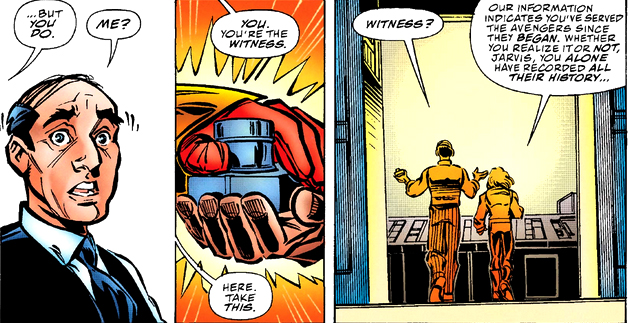
Getting in under the wire before reaching the end of Avengers Vol. 1 was the release of the book's 400th issue, a last hurrah of Earth's Mightiest Heroes before the team becomes engulfed in the coming of Onslaught. (Perhaps the less said about Onslaught, the better.) Written by Mark Waid with art by Mike Wieringo and Tom Palmer, this mid-1996 tale's wraparound cover by Mike Deodato might give you the impression that you're in for another villains! villains! villains! anniversary issue--yet the story provides a clever twist which, as the Avengers series reaches its end, would fittingly bring the book and the team full circle.


On the streets of New York, the Avengers are facing the first foray of this new danger in the form of the original Masters of Evil; but to begin to understand the nature of it, we must return to Avengers Mansion where the residence/headquarters' butler, Jarvis, encounters a traveler who brings dire warnings from the future of not only the coming deaths of the Avengers, but also the end of the world.


Thursday, September 23, 2021

This Way Toward... Doom!


Perhaps eyeing the success of the DC horror/fantasy anthology titles House Of Secrets and House Of Mystery, Marvel launched two similarly themed books in late 1969: Tower Of Shadows and, one month later, Chamber Of Darkness. Like their DC counterparts which were published on a bimonthly basis (off and on), both Tower and Chamber hit the stands every other month--but it seems the similarity ends there in terms of sales, as Marvel's offerings sold poorly and were discontinued after ten and eight issues, respectively. Tower, premiering first, seemed somewhat better received by readers, judging by letters page response, though the ratio of raves to more critical assessments appeared to be about 30/70. There was also the question of sustainability, as both series began pulling in reprinted material from their earlier anthology titles from the '50s-'60s (Strange Tales and Tales Of Suspense) with their sixth issue.

Suffice to say that DC's House titles were in no danger of readers jumping ship for Marvel's offerings--though it wasn't for lack of trying on Marvel's part, at least initially, as some of the company's most notable talent were tapped to contribute stories. Roy Thomas, Jack Kirby, Stan Lee, John Buscema, Gene Colan, Len Wein, Marv Wolfman, Jim Steranko, et al. (including John Romita Sr., who mostly did cover work) were seemingly able to accommodate seven-page assignments (or less) within a two-month window (though I believe Steranko withdrew after only one story, reportedly due to a disagreement with Lee)--with some artists even pulling double duty and contributing scripts as well as art, in addition to inkers providing readers with examples of their own pencils.

After their all-too-brief runs, each title shifted to formats made up of almost entirely reprinted material, in addition to adopting new mastheads. Tower became Creatures On The Loose, which mixed its reprints with sword and sorcery tales as well as a regular feature on Man-Wolf, while Chamber morphed to Monsters On The Prowl--each book having a run of 30 to 37 bimonthly issues (the creatures pulling ahead of the monsters--make of that what you will). But since there's a little more ground to cover with both Tower and Chamber, and having already examined Jack Kirby's stories in the latter, let's turn to a few samples from some of the other names we've mentioned who made their mark in the macabre during the brief time when these two titles were being published.


Monday, March 16, 2020

War, Interrupted


Gosh, has anyone heard of this little story?


I jest, of course. Even after nearly fifty years, the early 1972 story of the Kree-Skrull War by Roy Thomas, Neal Adams, John Buscema, and Tom Palmer continues to resonate on some level in the minds of comics readers, having reached beyond its initial publication to manifest in a number of subsequent plots in print as well as on the big screen. Often described with words like "saga" and "epic," its popularity is astonishing for a "war" which was confined to two issues and didn't play out in the conventional sense (at least not for the reader--more on that in a moment); yet all things considered, this two-part tale leaves a trail which reaches back to stories which took place over nearly a five-year period.

Briefly, the events break down as follows*:

  • July, 1967 - On a remote Pacific island, a Kree Sentry is discovered by two unfortunate explorers and later battles the Fantastic Four, which leads to its (presumed) destruction.
  • August, 1967 - The Kree official known as Ronan the Accuser confronts the FF for their presumption and sentences them to "the extreme penalty" (which in late '67 is probably a dramatic way of indicating a death sentence, but who knows with the Kree), yet fails.
  • December, 1967 - On ancient Earth, the Sentry discovers and takes a meeting with the Inhumans, where the Kree's role in their creation is revealed to them. (The details of which can be found at the conclusion of the Sentry post.)
  • July, 1971 - Ronan returns to Earth to launch "Plan Atavus," designed to devolve all life on Earth to the state it existed 1 million years ago, thus effectively eliminating the potential threat of the human race to the Kree empire. As the plan begins to crumble, the Kree-Skrull War formally breaks out.


    We're not privy to whatever other engagements take place between the Skrulls and the Kree from this point, prior to the Avengers' later involvement.
  • September, 1971 - The Super-Skrull arrives to coordinate with other Skrulls already on the planet to capture Captain Marvel as well as eliminate the Inhumans to prevent their Kree creators from recruiting them for war efforts. Meanwhile, the Kree Supreme Intelligence, forcefully deposed by Ronan, begins to influence minds on Earth (including the Skrulls) to draw the Avengers into the conflict, events which initially lead to the team's disbandment.
  • November, 1971 - The original Avengers convene to investigate what the hell is going on, leading to a conflict at an upstate farm where the Super-Skrull captures Captain Marvel, along with the Scarlet Witch and Quicksilver.
  • January, 1972 - While attempting to learn more of the Skrulls' activities on Earth, the Avengers are urged by Triton and Black Bolt to accompany them to the Great Refuge, where Maximus is collaborating with the Kree to conscript Inhumans as soldiers in the war. At the battle's conclusion, a Kree soldier (under the influence of the Intelligence) captures Rick Jones.

*Various other storylines from issues of both Fantastic Four and Captain Marvel have been omitted from this rundown.

At that point, the Avengers are poised to intervene in this conflict--for the sake of their captured comrades, and for the Earth.


Monday, September 9, 2019

"This Beachhead Earth!"


For a fleeting moment in time in late 1971, Marvel readers looked forward to their favorite comics being published with a larger page count each month, coinciding with a price increase of 10¢--which meant that all Marvel stories from that point on would no longer be limited to 20 pages, but would extend to 34-36 pages, with all books being bound on the spine rather than stapled. That change in course, as we know, vanished faster than you can say "after further consideration"... but for those few weeks, we were treated to a collection of titles which made anticipation of the following months' books practically register on the Richter scale for some of us, a spike in interest that the first Silver Surfer series would surely have coveted.

Having already covered the pertinent issues for Fantastic Four, Mighty Thor, and Invincible Iron Man, we turn now to the expanded Avengers story for that month, which moves the team closer to direct involvement in the Kree-Skrull War when they come into conflict with Skrull agents (including the Super-Skrull) who have plans not only for two Avengers (Quicksilver and the Scarlet Witch) but also for Captain Marvel. The Skrulls have already taken measures to gain their objectives by setting a trap for Mar-vell as well as disbanding the current active roster of the Avengers; but unknown even to the Skrulls, their actions have drawn the attention of four of the original Avengers, who have gathered at their headquarters to investigate.

And so, with the return of the Vision, the door is opened (with a THOOOM, at that) to a power-packed issue by Roy Thomas, Neal Adams, and Tom Palmer which will make inroads toward drawing the Earth into an interstellar conflict that will see two star-spanning empires at each others' throats, while also eventually forcing Rick Jones to play a pivotal role in their fate.


(Say, Mr. Adams--did you not get that memo on Iron Man's boot jets?)

Wednesday, July 17, 2019

The Tomb of Dr. Strange


Welcome to Part 2 of a gripping story where Dr. Strange, the Master of the Mystic Arts, sought out none other than Dracula, the Lord of Vampires, for retribution in bringing the curse of the undead to Strange's faithful manservant, Wong.

Clearly, the battle didn't go as the Sorcerer Supreme had hoped.


With Strange now dead--yet more than dead, his corpse waiting to return to "life" as a vampire--it would seem to be game, set and match for the character, unless Marvel plans to continue with him as a vampire/sorcerer (with obvious vulnerabilities that his foes can exploit). But the situation is even worse for him, since Dracula plans to enslave Strange when he rises in three days' time.

But there is a part of the human Dr. Strange which still survives--though that fact will do the survivor precious little good, under the circumstances.


This isn't exactly the time to pile on and add to Strange's problems... but with his body dead and drained of blood, and his heart and other organs no longer functioning, what was he planning to accomplish in merging his astral form with it? (Then again, Strange started out as "the master of Black Magic," so I wouldn't put it past him to be able to reanimate a corpse. Though that's bound to throw a damper on his love life.)

With this new setback, Strange's options are practically exhausted--but he presses on, nonetheless.


Can Strange pull a rabbit out of his amulet? Or will the time come when he must resign himself to his fate?

Monday, July 15, 2019

The Hunt And The Horror!


In May of 1976, there was no shortage of decent Marvel comics in the spinner rack to choose from:

  • Luke Cage, controlled by the Puppet Master, was battling it out with Ben Grimm, who had just started "suiting up" as the Thing;
  • Jane Foster fought to free Thor from a Gypsy spell that had also enthralled Firelord;
  • Spider-Man faced the strange threat of Mirage;
  • The Hulk was fighting off both Doc Samson and SHIELD;
  • Over in The Defenders, Chondu of the Headmen, horrified to see the new body which his associates had transferred his mind into, took his anger out on the Valkyrie;
  • The new X-Men were having their first meeting with the Sentinels and closing in on their 100th issue;
  • Iron Man was taking on Blizzard;
  • Captain America was fighting his way through the Elite's "kill-derby";
  • And the Avengers were trapped on a parallel Earth and fighting the Squadron Supreme over the Serpent Crown.


But hopefully some of you also set aside four bits for a compelling crossover story taking place in two separate titles distributed for sale in the same month, featuring the first meeting between Dr. Strange, Master of the Mystic Arts, and Dracula, Lord of Vampires--both tales drawn and embellished by artists Gene Colan and Tom Palmer, a welcome touch not only because both were highly acclaimed veterans of these characters but also because in a way you were reading a single 34-page comic (er, split into two, but you catch my drift). The fateful story begins in the Tomb Of Dracula title, where readers not yet realizing this was a crossover story couldn't have been happy to turn the final page to find a nail-biting ending that would be resolved in a book they'd failed to notice earlier.

For Dracula, this marks his first encounter with a mainstream Marvel character*, with the circumstances of their meeting proving to be shocking enough on their own--specifically, the death of Strange's manservant, Wong, attacked and drained of blood by Dracula. With Dracula located in Boston at this point in time, it's anyone's guess why Wong was such a distance from New York, roughly 200 miles away from Strange's sanctum. Yet it's admittedly a trivial matter with any number of available explanations, and certainly of no consequence in comparison to Wong meeting his death at the hands of a vampire; and while it seems certain that the only way we're going to be seeing Wong again is in an undead state, his master yet holds out hope for an alternative as he delves into the mystery of his disappearance.


*Unless you're counting his encounter with Werewolf By Night Jack Russell--or his non-meeting with Spider-Man, where the two only crossed paths but never dealt with each other directly.

And so the foundation is laid for Strange's hunt for his friend's murderer--but is it retribution he seeks, or something much more?

Friday, June 21, 2019

In Final Battle!


Even with the best security money can buy, a townhouse that's been revamped as a three-story mansion--located on Fifth Avenue and 71st Street in Manhattan and only a walkway's distance from street access--is going to be vulnerable to attack by a determined super-villain or group of villains. And that's the scenario the mighty Avengers now face, as they struggle to overcome the siege of their mansion by the Masters of Evil, who have struck while it was virtually deserted and, later, injured two Avengers while also leaving Hercules at death's door and their butler, Jarvis, in critical condition.

But though the Masters indeed seized the day--and the mansion--the Avengers have rallied and fought a hard-pitched battle against those who still occupy their headquarters, as they strive to secure for Jarvis the urgent medical care that he needs. Above, Captain Marvel has just dealt with Moonstone; but the immediate danger comes from the Masters' leader, Baron Zemo, who has ambushed Dr. Druid on the roof and regained control of his operative, Blackout, whose "darkforce" holds the key to tilting the odds in this battle back in the Masters' favor.

But though paralyzed by Zemo's weapon, Druid is still able to reach out to Blackout and influence him as to Zemo's true motives--and so the fight for Blackout becomes a battle between Druid's honesty and Zemo's duplicity, with Blackout struggling to assert his own identity.


Yet there are other struggles being waged below, in the sub-levels of the ravaged Avengers Mansion. Judging by this issue's cover, however, the deciding battle will take place in the light of day--though there may be precious little mansion, or Avengers, left to bear witness to it.


Wednesday, June 19, 2019

The All-Out Attack of The Masters of Evil!


In 1987, the Masters of Evil seemed well on their way to becoming the evil equivalent of what the mighty Avengers eventually grew to be. In other words:


"If you're a villain, you may as well be one of the Masters of Evil."


At this point in time, the Masters have reformed under the leadership of Helmut Zemo, the son of the original hooded Nazi war criminal--though he first began his path to vengeance against Captain America as the Phoenix. At present, their roster numbers fifteen villains (not pictured is Whirlwind, sent to attack Cap separately); but unlike the Avengers, whose ranks swelled to surpass those of the X-Men (and that's saying something), Zemo wants his team on the large side for a specific and tactically sound reason.


But the other noteworthy thing about these Masters of Evil is that they're in for the long haul, and they're not stopping with wiping out the Avengers:


And so with an incremental, detailed plan, Zemo and the villains who have signed on to his agenda have made considerable strides toward achieving victory against a team that literally didn't see them coming. The list of fallen Avengers includes:

  • The Black Knight, ambushed in Avengers Mansion following its siege by the Masters;
  • Captain Marvel, also ignorant of the mansion's fall, trapped and exiled to another universe by the "darkforce" of the mentally damaged and often catatonic Blackout;
  • Hercules, inebriated and drugged by a woman in the employ of Zemo who treated him to a midnight cruise, attacked and beaten near to death by the Masters' most powerful bruisers;
  • Captain America, defeated by the Fixer's enhancements of the mansion's defenses; and last but by no means least,
  • Jarvis, mauled by Mr. Hyde in front of Cap and the Knight in order to break the former's spirit.

A separate attack by Titania and the Absorbing Man on the Wasp fails, as she picks up an ally in Scott Lang, the Ant-Man; but in the meantime, Blackout erects a darkforce barrier around the mansion which prevents any entry by the authorities, including the military.

Yet the Wasp rallies--and the battle against the Masters of Evil, and for the lives of those they've dealt with, begins in earnest, heralded by a bold cover which hints that this may well be the Avengers' finest hour... or their darkest.


Gee, they rarely include the Wasp in these "sales" shots, even as the team's leader. Why is that?

Monday, June 17, 2019

My Son... My Murderer!


When we last left Dracula, the Lord of the Undead... well, most people would finish that sentence with "...we were running for our lives!" But since we're merely readers reflecting on fiction, we can harmlessly cast our thoughts back to when we found Dracula in a grieving rage following the death of his infant son, Janus. That night, Dracula purged himself of a great deal of anguish and regret--and now, he heads back to the satanic church which was to become his power base in America, in order to rejoin his wife, Domini, and consider their future.

But Domini has her own plans for this evening--and she has returned to a cemetery in Cambridge, where she prepares a ritual that will wipe away her grief and sense of loss if it succeeds. Though there is one who will do his utmost to prevent it.


Friday, June 14, 2019

The Purging And The Plan!


While it's true that Dracula, the Lord of Vampires, can fly into a rage for any number of reasons, we tend to learn more about this sadistic and evil yet complicated man when that rage is the result of either personal betrayal or personal loss. One example of the latter can be found in his distant past, when his second wife, Maria, a woman he truly loved, was killed by an enemy Turk named Turac when they were both held captive, just shortly after Dracula became a vampire; and while perceived betrayal is nothing new to him, one instance that resonated deeply with him was when Shiela Whittier, a young woman he took pity on and unexpectedly found himself growing closer to, left him for another when she could no longer stomach his true nature.

Yet such instances pale beside the moment when Dracula's infant son, Janus, was slain before his eyes by Anton Lupeski, a priest in his satanic church whose intent was to kill Dracula but whose rifle shot instead hit the baby. You can correctly assume that Lupeski didn't survive the night; yet rather than to the side of his wife, Domini, the night is where Dracula retreats to vent his rage, his despair... and his deadly wrath.


Wednesday, October 24, 2018

Escape From Hades!


Aside from the fact that one of their members is an Olympian demigod, the mighty Avengers' dealings with the denizens of Olympus have been few and far between. But when Hercules had the misfortune of being critically injured by the Masters of Evil, the Avengers were forced to confront the mystery of his abduction from his hospital bed--and as Thor soon discovered, all signs pointed to the Olympians. Of course, there's little reason for Thor to become alarmed, if that was the case; the assumption could easily be made that the Olympians became aware of Hercules' state and retrieved him in order to better treat his injuries. However, writer Roger Stern instead puts the notion into Thor to investigate, at which point the Thunder God subsequently leaves his teammates behind to transport himself to Olympus in search of Hermes, the Olympian he has spotted fleeing the scene. And while we readers are probably wanting to ask Thor, "Where's the fire?", Stern uses the incident as a jumping-off point to a major story that would bring down on the Avengers the retribution of Zeus for their perceived wrongdoings against his son.

Following Thor's disappearance, the remaining Avengers are attacked on the streets of New York by a strike team of other Olympians who have been dispatched by Zeus to collar those Avengers whom he believes bear responsibility for the fate of Hercules--a directive which also includes inactive members the Wasp and the Sub-Mariner, who will be targeted immediately after the active members are retrieved. The team proves no match for the resilience of their foes--and soon enough, the Avengers awaken and find themselves the subjects of a deafening judgment.


Hercules had suffered significant brain trauma as a result of the Masters' attack, so we can assume that Zeus's fury likely stems from the incoherent mumbling of recent events uttered in his son's delirium. The Avengers try to get a word in edgewise and provide the facts--but Zeus is fit to be tied, and judging by his demeanor he's already made his decision as to their guilt, and their fate.


As to where the Avengers have been banished, we find the answer when we join Namor, who has successfully been captured as well but has managed to escape--with the mysterious help of another Olympian, Prometheus, who points the way to where the Avengers are incarcerated. Though one could make the argument that Hades itself is prison enough.


(Granted, "Fortress Tartarus" looks a bit dilapidated and ready to crumble under its own weight--possibly because artist John Buscema has only provided breakdowns on all installments of this story (leaving the finished art to Tom Palmer), and panels fall a little short on detail.)

Following his infiltration of the edifice, Namor soon comes across the sorry state of his comrades, imprisoned in ways that neutralize their abilities and verbally abused by their captors. Namor wastes no time in freeing them--and through clever means, taking full advantage of the elements of surprise and confusion.


And so the Avengers learn of the fate for them decided by Zeus: consignment to Hades, the deadly netherworld under the rule of its lord and master, Pluto. And though the team has dealt with the contingent of armed soldiers guarding them, upon exiting Tartarus they encounter the first wave of the savage hordes that Pluto commands.


The Avengers thus begin the fight for their lives, and their freedom--
while, above, the battle for their very survival awaits.

Friday, September 21, 2018

Father Be Damned--The Vengeance Of Dracula's Daughter!


To say that the relationship between Dracula, Lord of the Undead, and his equally undead daughter, Lilith, is a contentious one may be a (heh) grave understatement. "Contentious" describes the behavior of individuals you'd find squaring off at protests (or at practically any Thanksgiving table). What these two share is more along the lines of a blood feud, going back five generations to virtually the moment of Lilith's birth--which makes it fair to say that Dracula himself instigated their mutual enmity, through no fault of Lilith's. Dracula, however, has a different persepective on the circumstances of their relationship, which he doesn't hesitate to recount to her during one of their rare meetings, taking place this time at a sports arena in London.


In essence, Dracula's intention at the time was to wash his hands of both wife and daughter, the latter entirely due to the fact that Lilith served to be a perpetual reminder of the woman he so hated.

But at this meeting where Lilith seeks to re-establish ties, she appears to be seeking not to bury the hatchet but to set it aside. Yet while the history between herself and her father has been sparse, it's never been even close to amiable, or even cooperative--nor is there any possibility that it ever will be. And of the two of them, only Dracula is prepared to bluntly admit it.


Consequently, there's been little to no contact to speak of between the pair in the Tomb Of Dracula title--which is probably just as well, since Dracula's brief reminiscences of Lilith are reflective of an unchanging status quo between them that Dracula has never demonstrated any signs of wishing to alter. And frankly, given Lilith's bitterness toward her father, it's clear why Dracula doesn't even entertain any thoughts of meeting her halfway.


But in late 1978, with the TOD title counting down to its final issues, writer Marv Wolfman gives Lilith her final shot at satisfying her hatred toward her father when, in a twist to their respective positions toward each other, Dracula finds himself in need of Lilith's help. The question is: Will she give it?


At first glance, it doesn't look like it.