Showing posts with label Gil Kane. Show all posts

Thursday, March 2, 2023

Earth's Mightiest Floating Heads!


"I like to goof off now and then, too, you know." - (Mrs.) Young-Ja Kim

Always one to take the sentiments of the redoubtable Mrs. Kim to heart (if I know what's good for me), I've finally gotten around to a little goofing off of my own by exploring a subject we readers of silver- and bronze-age comics are all too familiar with: Those aghast, worried, concerned, taken aback, consternated, and certainly conspicuous floating heads on issue covers which appeared out of nowhere to draw attention to whatever and whoever they were casting their piercing gaze(s) on.

It seemed a rare day when we saw such bodyless faces appear in titles featuring a solo character, since both hero and villain(s) were occupied in full-size poses slugging it out on a given issue's cover--but in group books, they were all the rage, carefully placed on valuable cover space to provoke a reaction in the comics browser that what awaited within was momentous enough to merit spending their hard-earned change on. It also goes without saying that they were also useful in a marketing sense when other characters in the group didn't make it on the cover but rated a head shot in order to let the prospective reader know that whoever they might have been most interested in still showed up in the story.

Both Fantastic Four and The Avengers featured a prodigious amount of floating heads in their first volumes, but it's the latter title which offered more variety when it came to its characters given the sheer amount of different Avengers to choose from. As for the approach we'll take with this, it became more interesting for me to present these "floaters" on their own and out of context rather than blending in with whatever else was on the cover. It turns out that, in just over 400 issues, there were only a mere twenty-five instances where these heads appeared before tapering off around 1990. Nevertheless, they made their mark, and are not to be confused with groupings of other, equally familiar floating heads:


And so let's get to it--though it seems that three of the Avengers have already taken a glance at this collection and are less than pleased with the direction we're headed in. You'll have to take up your grievances with Production, gentlemen!


Artwork by Gil Kane and John Romita
(Prior framing art by John Buscema and George Klein)

Thursday, February 23, 2023

"A Monster Called... Morbius!"


On the heels of the 100th issue of Amazing Spider-Man came the introduction of Morbius, the "Living Vampire" who became one of the living dead through scientific means, rather than through sorcery or as a victim of a vampire's attack. (Though if you think about it, "living vampire" and "living dead" are synonymous with each other, no?) It could also be said that Morbius, technically a vampire but not exactly the real thing, came on the heels of revisions to the Comics Code Authority being made during 1971 that eventually eased the restrictions regarding vampires, though such restrictions would have likely proven inapplicable to Morbius given the circumstances of his origin.


As for why we aren't seeing Dracula or some other traditional vampire appear on the issue's cover rather than Morbius, we have Stan Lee to thank for mentioning his preference to writer Roy Thomas* for this new Spider-Man villain to be costumed, with Thomas getting around a scientist having such garish attire by having the costume be worn "as secondary insulation against the shock" of the experiment meant to electrically create replacement blood cells in order to save his life. (Baloney. Why outfit such a suit with a red cape, or any cape?)

*This would be the first ASM issue that Lee had not scripted, though Thomas is only "standing in" for the time being, as the credits indicate. Lee would return with issue #105, before handing the reins to the book's new regular writer Gerry Conway with issue #111.

Still, it's an impressive new character that faces an equally-startling new version of Spider-Man. As for those extra arms that Spider-Man is sporting, what gives? It just so happens that Peter Parker has been doing a little experimenting of his own.


Presumably this would make Spider-Man a mutant--or does that strictly apply to characters whose mutations resulted from radiation or atomic-based exposure? Wait... that would make the Hulk a mutant, wouldn't it?? Let's leave this tangled subject to others to wrestle with, while you and I take a look at "A Monster Called... Morbius!"

Monday, May 9, 2022

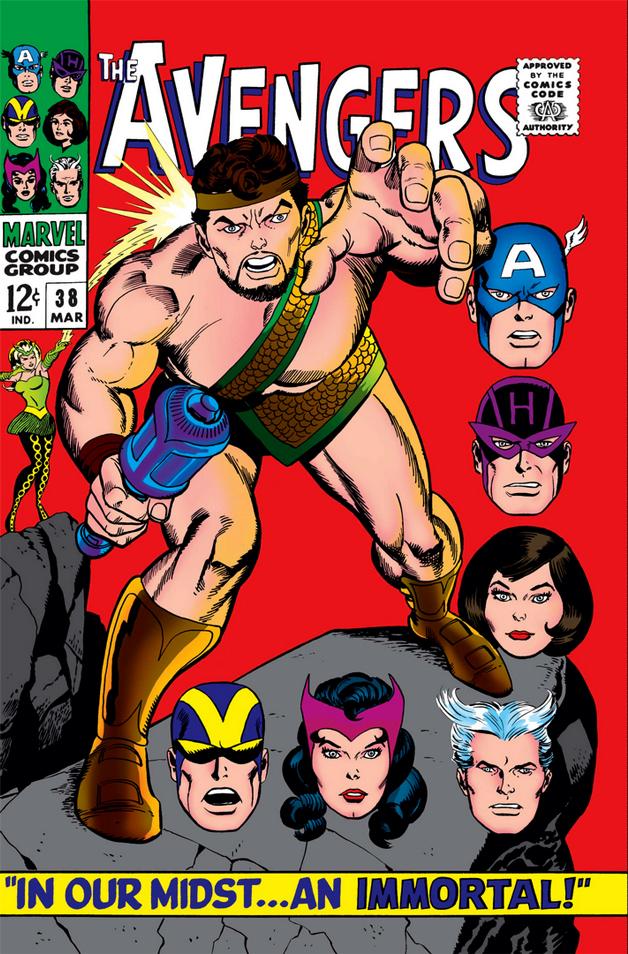
In Our Midst... Two Immortals!


After squaring off on Earth with two of Marvel's heaviest hitters--the mighty Thor in March of 1966 and, two months later, the Incredible Hulk--Hercules, the Prince of Power, apparently decided to ditch his self-appointed publicity agent and the world of mortals altogether and return to the spires of Olympus, where we find him sparring with Ares--not realizing that the Olympian war god has made an arrangement with the exiled Asgardian known as the Enchantress to seal not only the fate of Hercules but also that of the mighty Avengers.


It will become clear soon enough that the Enchantress has only enlisted the might of Hercules as a tool of revenge against the Avengers, a team of mortal heroes that she persists in maintaining a vendetta against. Though if she were privy to their current state of affairs, she might be delighted to see that their internal strife over a proposed new member could be doing some of her work for her.

(Gee, Cap--you really can't tell the difference between the voices of Pietro and Wanda?)


It's not particularly clear why writer Roy Thomas has Henry Pym, in his guise as Goliath, virtually (and verbally) beating his chest here, ready to take on any and all who might go up against him--while it's equally curious that it's the Black Widow's proposed membership that has set him off, considering he doesn't even have good reason to raise an objection. Concerning the latter point, mostly it seems Thomas's way of continuing to take advantage of the seed he planted in the previous issue, where the Widow was prepared to act against their foe, Ixar, in a way that no Avenger would consider:


We might also assume that Hawkeye's blowup at the membership meeting has something to do with the fact that, as the only Avenger to witness the scene, he realizes that disclosing the Widow's behavior would likely sink her chances of being granted membership.

Also interesting to note (though not a deal-breaker) is that, with their current six-member lineup here, the Avengers are at what both Captain America and the N.S.C. have generally considered to be the team's ideal number--something brought to light perhaps for the first time here in so many words, though not surprisingly it's a point that Hawkeye is quick to brush aside.


At any rate, the point is a moot one, since, unknown to the Avengers, S.H.I.E.L.D. has swooped in and recruited the Widow for a mission in the far east--a task which she can't discuss with the Avengers or even Hawkeye but gives the impression that she is returning to her roots as an enemy agent, which serves to remove her from consideration. And with Cap being called away to battle a threat from Power Man and the Swordsman (not to mention the Red Skull), and Hawkeye and the Wasp deciding to ditch the meeting in protest of Goliath (who's acting like "a stuffed shirt" on this issue as far as the Wasp is concerned) casually moving on with Avengers business as if nothing had happened, there arguably couldn't be a better time for the Enchantress to arrive with an ally who now resurfaces in the book's 38th issue from 1967--including prominent exposure on that issue's cover by Gil Kane, though a rare instance of the work of this artist perhaps falling short of expectations.


Monday, March 7, 2022

The Rise and Fall of Sam Bullit


An issue where a major, long-standing character unexpectedly meets their end, either tragically or through an act of malice, has more often than not made for high drama in a comics story--particularly for someone like Peter Parker, who depending on the circumstances would likely feel a mixture of guilt and rage over the loss of the person. In the pages of Amazing Spider-Man, it was the Stacy family who were victims of both tragedy and malevolence, as, first, Capt. George Stacy unhesitatingly sacrificed his life to save another, followed later by his daughter, Gwendolyn, meeting her end as the victim of the deranged Norman Osborn, the Green Goblin. Both deaths occurred just 2½ years apart, at least on our calendar; in "comics" time, we can probably assume that the loss of Gwen's father, a death occurring on Spider-Man's watch, resonated in his mind when Gwen was lost to him.

Each story, written respectively by Stan Lee and Gerry Conway, would share similarities in the issues which followed up, stories packed with their own high levels of drama yet tasked with moving on from the character's death. For example, thanks to his involvement, Spider-Man ends up being reviled--a man on whom, as far as certain parties are concerned, at least part of the blame falls if not all. Also, not surprisingly, each incident sees J. Jonah Jameson resolving to redouble his efforts to turn public opinion against Spider-Man (though it would take Osborn's death, taking place soon after Gwen's, to push him over the edge). In addition, Spider-Man becomes a wanted man, as a new figure would enter the picture to bring him to justice. In Conway's story, that would be Luke Cage (at Jameson's behest)--while in the earlier tale, Lee would turn to Sam Bullit, an opportunistic, morally bankrupt ex-cop who has his eye on the office of District Attorney and runs on a "law and order" ticket as a smokescreen to incite public support.

And, notably, each would be preceded by a crushing funeral scene--which, in Gwen's case, would unfortunately lead to Peter (if indirectly) being put in the position of becoming the most despised person in her life.


Thursday, June 24, 2021

Panic In The Prisons!


While writer Stan Lee certainly kept the amazing Spider-Man busy in sending super-criminals to prison, he also found reason to send the web-spinner himself to the big house on two separate occasions during his nine years of chronicling his adventures--once in 1968, and again in 1971, both instances involving Spider-Man attempting to rein in convicts who seized an opportunity to become unruly and threaten innocents. But given the three-year difference in time between the two, each story will differ in the circumstances of how Spider-Man finds himself in the midst of such potentially volatile situations.


In the earlier story, the circumstances are more dramatic for Spider-Man on a personal level, as he lies injured and unconscious on the street following a life-or-death battle with the Vulture. And with the crowd clamoring for the authorities to seize the chance to remove his mask, he appears helpless to prevent whatever action is taken with him from this point.


(Lee may make a great show of the perceived danger to Spider-Man, not only with the cover caption "Escape Impossible!" but the story's title, "The Impossible Escape!"--but you may as well know going in that both end up applying more to our convicts than our hero, whose departure from the barred facility in the end was never hindered in the slightest.)


Friday, February 14, 2020

"Your Serve... er, Move, Daredevil!"


Having put together a special series on symbolic splash pages featured in Marvel's major team books as well as in Amazing Spider-Man, the PPC now moves briefly to highlighting some noteworthy efforts made in a random sampling of other titles from over the years which came to mind, some of which may ring a bell for you.

Leading us off are a number of pages from Daredevil, which I lingered on for some time considering their diversity in both style and artists and spanned a range of years from 1964 to 1971. (Perhaps even longer, but DD is monopolizing this subject as it is!) Bill Everett Jack Kirby is who we have to thank for paving the way for us (correction courtesy of Dave Plunkert--thanks, Dave!):


Joe Orlando, whose work began appearing in the industry in 1949, would follow up on the title with the next three issues (though you'll find much of his work for Marvel appearing in titles published in the mid- to late-'50s, in categories ranging from westerns, romance, war stories, sci-fi and mystery). His final work was published in 1997, a year before his death at 71.


Wally Wood, whose work Stan Lee made efforts to spotlight, makes his own SSP contribution (working off artist Bob Powell's layout) in a story from 1965 which he also scripted:


Ross Andru and Herb Trimpe unintentionally provide dueling SSPs featuring Ant-Man, with Andru providing more variety in terms of what awaits us within the story:


While John Romita and Gene Colan line up their versions of face-offs between DD and Spider-Man.  Writer Gerry Conway's "sports fan" caption turns out to be appropriate, since Mr. Colan seems to have Spidey trying to capture DD with a tennis court net.


(Maybe that second title should start off with "...And So Re-enters"?)


The mask and form of Daredevil lend themselves nicely to the SSP format, as Colan demonstrates in his other efforts with the character.


Over in Amazing Adventures, where the Black Widow is splitting the mag with the Inhumans, John Buscema appeals to the action lover with imagery suggesting that the Widow's new series is the one to watch--while Colan takes a more intriguing approach.


Later in that same title, Craig Russell is well-suited to the characters and concepts we'll find in stories adapted from H.G. Wells' War Of The Worlds.


While Colan, Gil Kane, and Jim Starlin show us what they bring to the table for Captain Marvel, old and new...


...as well as for Warlock (with Steve Leialoha working off of Starlin's layout).


Dr. Strange is also well-represented, both solo and as part of the Defenders. Here we see work by Andru, Colan, Barry Smith, and Sal Buscema.


Howard Purcell, whose work for Marvel was limited to backup stories featuring the Watcher and two Nick Fury stories in Strange Tales, turns in this splendid SSP for the Black Knight's appearance in Marvel Super-Heroes.


Finally, Andru takes us out with the opening page to Marvel Team-Up #1, which features the rare display of Spider-Man in battle while poised on his own spider's web.


(Frankly these two don't seem very interested in fighting the Sandman.)


COMING UP:
One more SSP for the road... to Transylvania, that is.

Wednesday, January 29, 2020

Symbolic Splash Pages: Spider-Man


We're in the middle of a week-long look at Marvel's symbolic splash pages which were in limited use during the early 1960s to shortly after the mid-'70s--the cleverly put-together Page One which was styled to let the reader know at a glance what obstacles or dangers were threatening our hero(es) but a representation not directly woven into the story. After starting off with the pages from Fantastic Four, we now move on to a title which was somewhat more prolific in its usage of symbolic splash pages--even beginning with the character's first appearance.


As we know, artist Steve Ditko's work here in Amazing Fantasy marks an appearance which helped to launch Spider-Man into his own series in short order. It's clear from the start (and certainly from writer Stan Lee's narrative) that Spider-Man's ordeals with public rejection and personal ridicule are intended to be the "hook" that sets him apart for those who might be expecting a costumed hero to be cheered and admired in the public arena--a point driven home in the splash page of his new series' first issue.


(Our hero is looking a little spindly here, Mr. Ditko.)


With the bizarre foes that Spider-Man would face from this point on--in addition to the woes of Peter Parker, a character whose popularity with readers appeared to be linked hand-in-hand with that of Spider-Man himself--Ditko seemed to excel in the presentation aspect of a symbolic splash page, a format that served to lay all the cards on the table for the kind of story one could expect to find inside. Grouped together, they form an excellent album of Ditko's unique style, in combination with what could be considered his signature character* for Marvel.


*Though a certain Master of the Mystic Arts might beg to differ!

Ditko's symbolic splash pages would begin to taper off around mid-1965, with his departure from the series taking place a year later. Even so, his creativity in this area continued to tantalize.


And there were of course his pages that opened the 1964-65 annuals.


With Ditko's exit, artists John Romita and Gil Kane unfortunately provided only sparse offerings as the book pivoted to a more dramatic format, a few of which mixed some of the elements of the traditional symbolic splash page though seamlessly leading directly into the story:


And how about this early Spidey effort by Ross Andru which owes its existence to circumstance--leading off a replacement story for a deadline snag involving Romita, but instead shelved and used in an issue of Marvel Super-Heroes from May of 1968 (though some of you may recall its appearance in the first Marvel Treasury Edition from 1974):


(Looks like voodoo from where I'm sitting, Mr. Lee.)


Finally, these nicely-handled efforts from Romita which masqueraded as symbolic splash pages but indulged in some amusing sleight of hand with the reader.


Ver-ry funny, gentlemen. Well played. :)

NEXT: