Showing posts with label Bill Everett. Show all posts

Thursday, September 23, 2021

This Way Toward... Doom!


Perhaps eyeing the success of the DC horror/fantasy anthology titles House Of Secrets and House Of Mystery, Marvel launched two similarly themed books in late 1969: Tower Of Shadows and, one month later, Chamber Of Darkness. Like their DC counterparts which were published on a bimonthly basis (off and on), both Tower and Chamber hit the stands every other month--but it seems the similarity ends there in terms of sales, as Marvel's offerings sold poorly and were discontinued after ten and eight issues, respectively. Tower, premiering first, seemed somewhat better received by readers, judging by letters page response, though the ratio of raves to more critical assessments appeared to be about 30/70. There was also the question of sustainability, as both series began pulling in reprinted material from their earlier anthology titles from the '50s-'60s (Strange Tales and Tales Of Suspense) with their sixth issue.

Suffice to say that DC's House titles were in no danger of readers jumping ship for Marvel's offerings--though it wasn't for lack of trying on Marvel's part, at least initially, as some of the company's most notable talent were tapped to contribute stories. Roy Thomas, Jack Kirby, Stan Lee, John Buscema, Gene Colan, Len Wein, Marv Wolfman, Jim Steranko, et al. (including John Romita Sr., who mostly did cover work) were seemingly able to accommodate seven-page assignments (or less) within a two-month window (though I believe Steranko withdrew after only one story, reportedly due to a disagreement with Lee)--with some artists even pulling double duty and contributing scripts as well as art, in addition to inkers providing readers with examples of their own pencils.

After their all-too-brief runs, each title shifted to formats made up of almost entirely reprinted material, in addition to adopting new mastheads. Tower became Creatures On The Loose, which mixed its reprints with sword and sorcery tales as well as a regular feature on Man-Wolf, while Chamber morphed to Monsters On The Prowl--each book having a run of 30 to 37 bimonthly issues (the creatures pulling ahead of the monsters--make of that what you will). But since there's a little more ground to cover with both Tower and Chamber, and having already examined Jack Kirby's stories in the latter, let's turn to a few samples from some of the other names we've mentioned who made their mark in the macabre during the brief time when these two titles were being published.


Friday, February 14, 2020

"Your Serve... er, Move, Daredevil!"


Having put together a special series on symbolic splash pages featured in Marvel's major team books as well as in Amazing Spider-Man, the PPC now moves briefly to highlighting some noteworthy efforts made in a random sampling of other titles from over the years which came to mind, some of which may ring a bell for you.

Leading us off are a number of pages from Daredevil, which I lingered on for some time considering their diversity in both style and artists and spanned a range of years from 1964 to 1971. (Perhaps even longer, but DD is monopolizing this subject as it is!) Bill Everett Jack Kirby is who we have to thank for paving the way for us (correction courtesy of Dave Plunkert--thanks, Dave!):


Joe Orlando, whose work began appearing in the industry in 1949, would follow up on the title with the next three issues (though you'll find much of his work for Marvel appearing in titles published in the mid- to late-'50s, in categories ranging from westerns, romance, war stories, sci-fi and mystery). His final work was published in 1997, a year before his death at 71.


Wally Wood, whose work Stan Lee made efforts to spotlight, makes his own SSP contribution (working off artist Bob Powell's layout) in a story from 1965 which he also scripted:


Ross Andru and Herb Trimpe unintentionally provide dueling SSPs featuring Ant-Man, with Andru providing more variety in terms of what awaits us within the story:


While John Romita and Gene Colan line up their versions of face-offs between DD and Spider-Man.  Writer Gerry Conway's "sports fan" caption turns out to be appropriate, since Mr. Colan seems to have Spidey trying to capture DD with a tennis court net.


(Maybe that second title should start off with "...And So Re-enters"?)


The mask and form of Daredevil lend themselves nicely to the SSP format, as Colan demonstrates in his other efforts with the character.


Over in Amazing Adventures, where the Black Widow is splitting the mag with the Inhumans, John Buscema appeals to the action lover with imagery suggesting that the Widow's new series is the one to watch--while Colan takes a more intriguing approach.


Later in that same title, Craig Russell is well-suited to the characters and concepts we'll find in stories adapted from H.G. Wells' War Of The Worlds.


While Colan, Gil Kane, and Jim Starlin show us what they bring to the table for Captain Marvel, old and new...


...as well as for Warlock (with Steve Leialoha working off of Starlin's layout).


Dr. Strange is also well-represented, both solo and as part of the Defenders. Here we see work by Andru, Colan, Barry Smith, and Sal Buscema.


Howard Purcell, whose work for Marvel was limited to backup stories featuring the Watcher and two Nick Fury stories in Strange Tales, turns in this splendid SSP for the Black Knight's appearance in Marvel Super-Heroes.


Finally, Andru takes us out with the opening page to Marvel Team-Up #1, which features the rare display of Spider-Man in battle while poised on his own spider's web.


(Frankly these two don't seem very interested in fighting the Sandman.)


COMING UP:
One more SSP for the road... to Transylvania, that is.

Friday, October 26, 2018

Arrrr... I Be The True Sub-Mariner!


When it comes to formal occasions or matters of court, we can probably picture the Sub-Mariner not only wearing his crown but also decked out in royal raiment, while also including perhaps a pendant or two along with his trident; otherwise, he can almost always be seen au naturel amongst his subjects or even when traveling to the surface world. But in early 1973, his fellow Defenders didn't even bat an eye at a new accessory he began sporting on his left earlobe:


Aye, matey, a single earring, which materialized out of the blue in the middle of an adventure without explanation--or, rather, an explanation that the other Defenders would be privy to.

And so our ear is turned to another piercing


Marvel Trivia Question


What was behind Namor's decision to don an earring--and what became of it?

Monday, July 23, 2018

You Say "Lincoln," I Say "Atomic Pile"


In terms of human evolution, the term "missing link" applies to a fossil (either not yet found or newly discovered) that can be added to an evolutionary chain of the human species, though reportedly the term is no longer in use by biologists. But back in mid-1968, it was still going strong when writers Bill Everett and Roy Thomas adapted it for a brand new character who would go up against none other than the incredible Hulk. Only this creature didn't stay related to its human ancestors for long, at least outwardly.


You'd think the words "accursed allies" used in conjunction would be something of an oxymoron, but I doubt our sinister Russian friend reciting this narrative is in the mood to be corrected.

Nor did it seem that either Everett or Thomas were particularly interested in formalizing this creature's name as "the Missing Link," since two or three other names for it are floated throughout the story. My personal favorite was "the Nightmare Monster," uttered on the spur of the moment by Betty Ross--but the name that seemed to prevail overall was "the Beast-Man," which didn't exactly give the impression of requiring much thought. I think I preferred "the Missing Link" as a runner-up to the Nightmare Monster, though honestly I liked it much more than "the Beast-Man."


But what can you do? Anyone who sees this bruiser is going to be too shocked to actually name it the Missing Link. The creature would have no reason to give itself the name, unless it overheard it being used (either that, or he turned out to be a subscriber to Scientific American)--while the Hulk, against all odds, came up with the same name that was voiced half a world away.


At any rate, we have the Russians, seen here at a meeting with their "accursed eastern allies," to thank for the creature showing up on our shores--and whatever he ends up being called, battling him is going to be uphill for the Hulk, a product himself of radiation exposure and apparently vulnerable to that being radiated by others.


When the Link's two-part story continues, additional writer Archie Goodwin seems to be leaning in the direction of dumping "the Beast-Man," but even Betty's harrowing collision isn't enough to ram the name out of these pages--thanks to Rick Jones, who always seems to be around causing trouble, doesn't he.


Tuesday, March 13, 2018

Pilgrims Everywhere Are Curious


Those of you who read Marvel Feature #1 (and/or the scintillating PPC post reviewing it) which presented the debut of the dynamic Defenders  may have been wondering about the very strange inking work of artist Bill Everett on that story. Letter-writer Charles Meyerson bottom-lines it for us:

"The interior artwork was nice, but I wish that Bill Everett would revert to his crisp, clear style of inking. That scritchy-scratchy style is not at all suited to Ross Andru's pencils."

Whatever description of the work I was going for couldn't hold a candle to "scritchy-scratchy," so we'll go with that. As for the response, Marvel's designated response typist for "Defenders Dialogue" that month addressed every other point that Mr. Meyerson raised, but deftly sidestepped the scritchy-scratchy issue (it just rolls off the tongue, doesn't it?) thusly:

"Finally, Roy and Ross have moved on to a new Marvel surprise, so how does Steve and Sal's work grab you? We'll be interested to hear, pilgrim."

Which we can probably take to mean, "That's on a need-to-know basis, pilgrim."

To add a little clarity to the situation, Vol. 1 of the Defenders Masterworks contains this quote from Thomas on the subject:


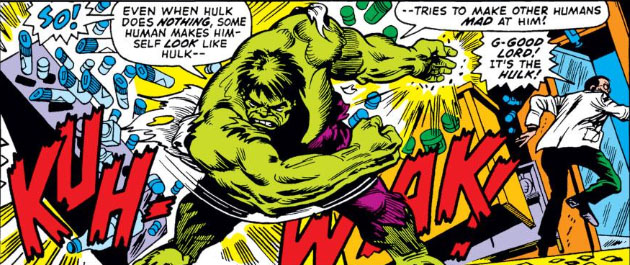
As noted, Everett skipped MF #2, but was present and accounted for in issue #3--and that went double for his inking, which returned to the quality that long-time Bill Everett fans remember well. So enjoy a quick peek at select scenes from that story, amply demonstrating that both Everett and Andru earned their pay for the week on this one.


What do you want to bet that druggist helped himself to a few samples from his prescription-only inventory following that encounter?

Friday, March 9, 2018

The Day Of The Defenders!


It's unclear whether or not Dr. Strange had the good sense to take further steps in securing the Omegatron--the doomsday device created by the scientist/sorcerer known as Yandroth to explode the world's nuclear stockpiles at the moment the device speaks its creator's name--following its previous attempt to power itself to a sufficient level to carry out its task. Since the Omegatron is a creation of both science and magic, Strange doesn't seem to believe his power can affect it at all--"Too potent is the mixture of science and sorcery that birthed [it]." Only the Valkyrie, armed with the Black Knight's ebony blade, was able to damage it to a point where it was incapacitated--but like a Timex watch, the darned thing appears to be able to take a licking but keep on ticking. Only in the Omegatron's case, its countdown has run its course, and it only awaits the power it needs to activate its deadly conflagration.

Yet we have the Omegatron to thank for bringing together a new group of heroes--only don't make the mistake of calling them a "team,"  at least within earshot.


This premiere issue of Marvel Feature was published during the last month of 1971, with an eye-catching cover by Neal Adams that practically guaranteed a double-take from the comics rack browser. (Did these three cause the destruction and panic going on in the background--or have they just dealt with whoever did? Haven't you wondered?) Since Strange had previous and separate dealings with both the Sub-Mariner and the Hulk when they fought together in common cause, it was likely no complication for writer Roy Thomas (who scripted those earlier instances) to craft another story involving them, which was workable as a one-shot (or even a two-shot)--yet, what was the plan here? The Bullpen Bulletins page plugging the Marvel Feature title described it as a quarterly book that "will present try-out stories for new series, new ideas"--so it appeared that Thomas was floating the concept of the Defenders as a new series to be picked up later, depending on initial sales. But did he look that far down the road with this concept? Men like Namor and the Hulk could be coaxed to join Strange on those rare occasions when the need was desperate enough--but was Thomas expecting that to do the trick on a regular basis?

At any rate, the "Defenders" were an intriguing concept that deserved a look, and Thomas crafted a compelling enough story to launch it--with Strange's old enemy, Yandroth, at death's door, yet who warns of dire consequences from beyond the grave.


Monday, October 23, 2017

The Searing Gaze of the Thermal Man!


Along with Replicus and the Crypto-Man, the Thermal Man filled out a trio of deadly man-made constructs that gave the mighty Thor more trouble than they probably should have (as opposed to the Growing Man, whose incredible growth reflected the impact of whatever force was used against him and thus had him well matched against a powerhouse like Thor). But like the Crypto-Man, who went on to face the Hulk and was indirectly responsible for the death of Jarella, and Replicus, who showed up over 30 years later for a rematch with the Thunder God, the Thermal Man got enough of a boost from battling a high-profile character like Thor to be taken out of mothballs and used in other stories. In battling Thor, the Thermal Man, like his brothers in armor, definitely started at the top; but, receiving a two-issue build-up before cutting loose in the third, it may be fair to say that he overstays his welcome in his first appearance.

Aside from his bulk, which begins mainly at his upper body and has been mimicked by other characters, there's little in terms of design that the Thermal Man brings to the table--and granted, there's little argument that Thor has battled larger and far mightier foes. The Thermal Man's primary weapon is of course his thermal blast which he emits from his eye apertures, rays which appear to carry both incredible heat and a concussive force--the latter of which he can also emit from "fingers" which look like they were lifted from the Beetle. Needless to say, he's also capable of great strength--and his outer shell can withstand not only mortar fire but Asgardian steel, as well as a direct hit from Thor's hammer. And while it makes no sense to you or I that Thor can challenge Galactus with his hammer yet fail to shatter the likes of the Thermal Man into bits and pieces, that's nevertheless the story we've been given for our 15¢, folks. For what it's worth, artist Jack Kirby doesn't pull his punches with the Thermal Man's scenes; it's just that the character itself isn't what you might call inspired.

Formidable, however, seems to be another matter. Just how tough is the Thermal Man? Does he rate as an opponent for the God of Thunder? Just ask the harried N.Y.P.D.--they'll take all the help they can get!


Monday, February 27, 2017

The Searing Vengeance of... Sunfire!


When it comes to Shiro Yoshida, the mutant known as Sunfire, it's difficult at times to be in the man's corner, since a great deal of his time in a comic is spent espousing his nationalist fervor for his island nation of Japan. One could argue, perhaps correctly, that Shiro's abrasive personality toward foreigners is not by choice, having been pulled in two different directions by his uncle and his father--one wishing to return Japan to the height of its power and influence and avenge its defeat that followed the twin atomic blasts of Hiroshima and Nagasaki, while the other constantly chides Shiro for taking such a fanatical view of current affairs and refusing to live in the present. The former, his Uncle Tomo, discovering his nephew was a mutant, sought to use his influence to fan the flames of hatred in Shiro and thus be able to direct the power of Sunfire however he wished--while Shiro's stern father, Saburo, refused to allow his son to become so obsessed with Tomo's enmity toward those that brought Japan to its defeat in the war. If Tomo and Saburo ever had these outbursts with each other, those scenes never became part of this initial story; but it was clear their tug of war with Shiro was taking its toll on him, since it was becoming evident that Shiro was becoming more aligned with his uncle's views every day.

Created by Roy Thomas and Don Heck, Sunfire--his powers to emit bursts of intense heat a result of his mother being located a number of miles from the center of the Hiroshima blast--arrived in comics in 1970 when the world's population of mutants was still sparse enough that his debut appearance in X-Men could be an impressive one. That assessment may be due in large part to his distinctive costume, which is arguably one of the finest designs in Marvel's extensive costume gallery and remains so nearly fifty years later. Accompanying his father, a U.N. delegate, to New York, Sunfire appears and destroys a new monument that Saburo dedicates to honor both peace and the youth of the world. Three of the X-Men--the Beast, the Iceman, and the Angel--are witness to the destruction and attempt to corral Sunfire, only to fail.

Yet Sunfire's true goal lies in Washington, D.C., the Yoshidas' next stop, where Saburo is scheduled to give a speech before Congress, with the dome of the Capitol building representing a symbolic target of Sunfire's (or shall we say Tomo's) ire. But as Tomo is prepping his nephew for the task that awaits, their conversation is overheard--and Saburo at last learns that it's his nephew who has been carrying out the recent attacks in the States.


Once again, the X-Men engage Sunfire--but at the battle's pinnacle, Saburo gives his son an ultimatum, with tragic results.


You would think Saburo's last words to his son, and the circumstances of his untimely death, would have had a lasting impact on Shiro--yet though he murdered Tomo in turn, Shiro would continue to embrace his uncle's fanatical dreams of Japanese supremacy for some time. And after he's presumably deported following his activities in Washington, Shiro ends up in Tokyo, where his path crosses with another who holds even more extreme views than Tomo, and who is able to subvert the vulnerable Sunfire to his cause.