Showing posts with label John Romita. Show all posts

Monday, August 28, 2023

What Were YOU Reading in 1983?


Forty years ago in August of 1983, we had these items of trivia occupying our minds and media:
  • 12-year-old Samantha Druce becomes the youngest female to swim the English Channel (21 miles), at 15 hours, 27 minutes (and locks it in for good--the minimum age for solo attempts to swim the Channel is now 16 years)
  • John Sain of South Bend, IN builds a 3.91-meter house of cards (hopefully avoiding drafts)
  • San Diego Comic-Con International opens at Hotel San Diego
  • La Cage aux Folles opens at the Palace Theater, NYC and runs for 1761 performances, winning 6 Tony Awards
  • Revival of the Jerry Herman musical Mame starring Angela Lansbury closes in NYC after 41 performances
  • Albums released: Billy Joel, "An Innocent Man"; Elvis Costello, "Punch The Clock"; Jackson Browne, "Lawyers In Love"; Heart, "Passionworks"; Cheap Trick, "Next Position Please"; Bette Midler, "No Frills"; Rick James, "Cold Blooded"
  • Rock singer David Crosby is concurrently sentenced to 5 years in Texas state prison for possession of cocaine and 3 years for illegal possession of a loaded handgun (i.e., the 5-year sentence controls) (I believe he ended up serving nine months--there are conflicting accounts as to when he was released)
  • Nuclear tests are carried out by the U.S. (Aug. 3 and Aug. 27), France (Aug. 4) and the USSR (Aug. 18)
  • Marriages: Paul Simon (41) and Carrie Fisher (26) (divorced the next year); Film director Philippe de Broca (50) weds actress Margot Kidder (34)
  • Birthdays: Chris Hemsworth (39); Andrew Garfield (39); Mila Kunis (you guessed it, 39)
  • Top Five Songs in the U.S.: (1) "Every Breath You Take" (The Police); (2) "Sweet Dreams (Are Made Of This)" (Eurythmics); (3) "She Works Hard For The Money" (Donna Summer); (4) "Maniac" (Michael Sembello) (no relation to this guy); (5) "Is There Something I Should Know" (Duran Duran)
  • Deaths: lyracist Ira Gershwin (86); actress Carolyn Jones (53); actor Simon Oakland (61)
  • Cost of Living: Avg rent, $335/mo.; Gallon of gas $.96; Ford Mustang $6,572; Avg. income/year, $21,070; Price of a comic book: $.60

And speaking of your hard-earned 60¢...

The Marvel checklist of books published during August of 1983.
What were you reading around this time?

Monday, January 9, 2023

Wrath of the Proletarian!


OR: "Whole Lotta SFLANNGin' Goin' On"

Previously, we'd been taking a look at a mid-1979 issue of Uncanny X-Men which catches up with the team following their return to the states from Canada and finding their Westchester base virtually mothballed, with no sign of Professor X. Yet we also learned that Peter Rasputin, the steel-formed Colossus, was experiencing doubts about his capabilities as an X-Man--even as an assassin by the name of Arcade is hired by "Black Tom" Cassidy and the Juggernaut to destroy the mutant team.

Arcade is also known by readers of Marvel Team-Up from a prior story in early '78 where the Maggia had contracted him to kill Brian Braddock (the civilian identity of Captain Britain)--and it's that story we briefly return to first, as Spider-Man joins forces with the Captain only to fall prey to a method of capture which is as clever in its simplicity (and originality) as it is perplexing in its ability to succeed against super-powered individuals who appear helpless to either evade or stop it.


Thankfully, both Spider-Man and Captain Britain prevailed in their struggle against Arcade--but when Arcade begins to corral the X-Men for their own visit to "Murderworld," artist John Byrne, perhaps with the old adage of if it ain't broke, don't fix it in mind, recycles Arcade's previous method of capture which turns out to work just as reliably with super-powered X-Men.


(You can bet Cyclops didn't waste time adding this rig to the team's Danger Room.)


Being a careful man when it comes to a job, Arcade naturally doesn't put all of his eggs in the same basket when it comes to capturing his new targets--and so he personally surprises and snags the rest of the X-Men from their mansion, and off they go to his Murderworld complex, where his planned treatment of Colossus is soon underway.


For the sake of the story, a brainwashing treatment that would have normally taken a minimum of days to succeed is expedited--and faster than you can say "Dmri, tovarishch!", the Proletarian is unleashed on his fellow X-Men, who have become separated in the deadly chambers of Murderworld.


As for the instigator of this madness, he couldn't be happier at the X-Men's predicament. After all, for Arcade, fun is the name of the game when it comes to murder.


(I wouldn't go so far as to say the Proletarian is "power-mad," Mr. Cover Captioner.)

Thursday, January 5, 2023

Bonus Features: Spider-Annuals, 1964-1999


Aside from rogues' galleries, pin-ups, and, in all too many cases, reprinted material, a staple of Marvel "king-size" annuals has been the informative bonus features that came in the form of exploring a character's abilities, being provided with a tour of their headquarters, a rundown of their supporting cast, or a supplemental tale consisting of only three or four pages, on the occasion that the main story didn't fulfill the expected page count. You'll find many of these bonus features given their due throughout the PPC over the years--but for a little variety on the subject, we'll begin digging through and dusting off some of the more under the radar material where a little extra creative effort went into these features.

In this inaugural post on the subject, we turn our focus to one of Marvel's inaugural characters, the amazing Spider-Man--and as long as we're going that far back, it seems fitting to include a few of the bonus features from the character's first annual from 1964, itself packed with additional material to no doubt titillate Spidey's growing fan base and including a number of pages which spotlight the work of the book's artist, Steve Ditko.


Monday, December 12, 2022

In Defense of... Magneto!


No doubt "The Trial of Magneto" from late 1985 was anticipated on a number of levels by those of us who were following recent issues of Uncanny X-Men, where readers had lately been seeing the Master of Magnetism turn over a new leaf and acclimate himself to members of a team who for much of the book's history had been his most tenacious foes.  Indeed, it's his own history that remains the elephant in the room for some of the X-Men--as well as for those in government circles, foreign and domestic, who see him as nothing less than a deadly threat to humanity.

Magneto's gradual development of a conscience, as chronicled by writer Chris Claremont, has been fascinating to watch--but for the book's double-sized 200th issue, a long-awaited reckoning for Magneto finally looked to be on the horizon when Mystique, leader of the Brotherhood of Evil Mutants, decided that it was in the best interests of herself and her team members to make a deal with the Feds for amnesty in exchange for their services as super-powered operatives who report directly to the government. To that end, she approaches Valerie Cooper, Special Assistant to the President's National Security Advisor, who has taken up an aggressive posture against mutant activities and certain mutants in particular but finds Mystique's offer convincing, as well as the perfect means to remove Magneto's threat.


Against the X-Men, however, "Freedom Force," though clearly having become a tight-knit fighting unit under Mystique's leadership, proves less than equal to the task. Instead it's Magneto himself who acquiesces to his arrest in order to put the matter of his crimes to rest once and for all.


Which paves the way for a riveting anniversary issue that, when all is said and done, will have provided anything but closure on the issue of Magneto's guilt or innocence.


Thursday, November 17, 2022

These Odds and Ends Approved by Princess Zanda


Recently, I had occasion to go through a lot of graphics files that have been collecting dust over the years--looking them over after so long, clearing out the chaff, that sort of thing. Many of them consisted of content for old blog posts long since completed; some were curated as fodder for framework ideas for either home or office; and there were a few curiosities in the mix that evoked my earliest days of collecting comics memorabilia, a sort of digital "scrapbook" I hadn't even realized I was contributing to. By contrast, however, there were also a few such images that had me wondering just what I'd intended for them, but for whatever reason decided not to pursue or preferred to put on the back burner indefinitely.

Yet there were enough of these to share with Peerless Power readers and perhaps convey the same mixture of nostalgia and curiosity that I still have toward them--a sort of "grab bag" of comics tidbits that will hopefully evoke some thoughts on your part, as well.

We can start off with a montage of Alex Ross renderings that never made it to a wall hanging, but were most suitable for throwing together a desktop wallpaper montage:


(And if you're wondering why there's a Batman/Green Hornet graphic among the Marvel scenes, the only explanation I have is that it was too awesome not to have on my desktop! :) )


Monday, June 13, 2022

The Dragon Seed Saga!


In 1991, John Byrne, the writer for the Invincible Iron Man title, began a one-year story arc which focused on essentially three things: the deteriorating condition of Tony Stark, his entire nervous system compromised by an aggrieved engineer using the resources of a ruthless corporation... the ascendance of one of Iron Man's oldest and deadliest foes, the Mandarin... and establishing the origin of a Marvel character which dated back thirty years. And while all of these things cross paths either indirectly or otherwise, we begin with the latter two characters who meet due to the involvement of one other: Chen Hsu, by all appearances an aged wizard who helps the Mandarin to recover his memories and subsequently brings him to the Valley of the Sleeping Dragon in southeastern China, in order to awaken a dreaded creature the PPC has only recently profiled.


Whatever passed between the Mandarin and Fin Fang Foom from that point was presumably not for our eyes and ears, but it was apparently convincing enough to rouse the dragon from his chamber and meet in force an army of 3,000 soldiers sent in response to the Mandarin's incursion into the dragon's resting place--even as the Mandarin and Chen Hsu, calmly observing the death and devastation which followed, come to an understanding between them.


And "romp" our dragon most definitely will during this saga.


Monday, March 7, 2022

The Rise and Fall of Sam Bullit


An issue where a major, long-standing character unexpectedly meets their end, either tragically or through an act of malice, has more often than not made for high drama in a comics story--particularly for someone like Peter Parker, who depending on the circumstances would likely feel a mixture of guilt and rage over the loss of the person. In the pages of Amazing Spider-Man, it was the Stacy family who were victims of both tragedy and malevolence, as, first, Capt. George Stacy unhesitatingly sacrificed his life to save another, followed later by his daughter, Gwendolyn, meeting her end as the victim of the deranged Norman Osborn, the Green Goblin. Both deaths occurred just 2½ years apart, at least on our calendar; in "comics" time, we can probably assume that the loss of Gwen's father, a death occurring on Spider-Man's watch, resonated in his mind when Gwen was lost to him.

Each story, written respectively by Stan Lee and Gerry Conway, would share similarities in the issues which followed up, stories packed with their own high levels of drama yet tasked with moving on from the character's death. For example, thanks to his involvement, Spider-Man ends up being reviled--a man on whom, as far as certain parties are concerned, at least part of the blame falls if not all. Also, not surprisingly, each incident sees J. Jonah Jameson resolving to redouble his efforts to turn public opinion against Spider-Man (though it would take Osborn's death, taking place soon after Gwen's, to push him over the edge). In addition, Spider-Man becomes a wanted man, as a new figure would enter the picture to bring him to justice. In Conway's story, that would be Luke Cage (at Jameson's behest)--while in the earlier tale, Lee would turn to Sam Bullit, an opportunistic, morally bankrupt ex-cop who has his eye on the office of District Attorney and runs on a "law and order" ticket as a smokescreen to incite public support.

And, notably, each would be preceded by a crushing funeral scene--which, in Gwen's case, would unfortunately lead to Peter (if indirectly) being put in the position of becoming the most despised person in her life.


Monday, October 25, 2021

Marvel's Classic Corner Boxes: Fantastic Four Vol. I


Nine years ago, the PPC briefly took a look at those eye-catching corner boxes which once graced the left corner of issue covers and featured the character(s) which starred in the comic you took home to read. At the time, we explored the subject within the context of where the art for the characters might have originated from; but during this week, we'll expand our look to showcase a near-entire run of a title's first volume of corner boxes in all their mini-glory, from beginning to end. And why not begin where Marvel began, in the comic which set the standard for its new line of super-hero books?

It took a year and a half for the first corner box to appear in the Fantastic Four comic since its launch--but with variations, that box would endure for the next four years and appear in nearly fifty issues.


Thursday, September 23, 2021

This Way Toward... Doom!


Perhaps eyeing the success of the DC horror/fantasy anthology titles House Of Secrets and House Of Mystery, Marvel launched two similarly themed books in late 1969: Tower Of Shadows and, one month later, Chamber Of Darkness. Like their DC counterparts which were published on a bimonthly basis (off and on), both Tower and Chamber hit the stands every other month--but it seems the similarity ends there in terms of sales, as Marvel's offerings sold poorly and were discontinued after ten and eight issues, respectively. Tower, premiering first, seemed somewhat better received by readers, judging by letters page response, though the ratio of raves to more critical assessments appeared to be about 30/70. There was also the question of sustainability, as both series began pulling in reprinted material from their earlier anthology titles from the '50s-'60s (Strange Tales and Tales Of Suspense) with their sixth issue.

Suffice to say that DC's House titles were in no danger of readers jumping ship for Marvel's offerings--though it wasn't for lack of trying on Marvel's part, at least initially, as some of the company's most notable talent were tapped to contribute stories. Roy Thomas, Jack Kirby, Stan Lee, John Buscema, Gene Colan, Len Wein, Marv Wolfman, Jim Steranko, et al. (including John Romita Sr., who mostly did cover work) were seemingly able to accommodate seven-page assignments (or less) within a two-month window (though I believe Steranko withdrew after only one story, reportedly due to a disagreement with Lee)--with some artists even pulling double duty and contributing scripts as well as art, in addition to inkers providing readers with examples of their own pencils.

After their all-too-brief runs, each title shifted to formats made up of almost entirely reprinted material, in addition to adopting new mastheads. Tower became Creatures On The Loose, which mixed its reprints with sword and sorcery tales as well as a regular feature on Man-Wolf, while Chamber morphed to Monsters On The Prowl--each book having a run of 30 to 37 bimonthly issues (the creatures pulling ahead of the monsters--make of that what you will). But since there's a little more ground to cover with both Tower and Chamber, and having already examined Jack Kirby's stories in the latter, let's turn to a few samples from some of the other names we've mentioned who made their mark in the macabre during the brief time when these two titles were being published.


Monday, August 23, 2021

"Spider-Man No More!"


During those times when Marvel brought special attention to a title's 50th issue, one story which surely stood out in that respect was the fiftieth issue of Amazing Spider-Man--one of the company's flagship characters who, as Peter Parker, reaches a pivotal moment and decides to walk away from his life as the wall-crawler forever, a moment that comes across in the issue's stunning and still memorable cover by artist John Romita Sr.


Following his previous issue, you'd think things would be looking up for Spider-Man.  Having survived a near-death battle at the hands (er, wings) of Blackie Drago, the new Vulture, only to then go on to defeat the team-up of Drago and Kraven the Hunter in a hands-down victory, Spidey was feeling jubilant and riding high. But it seems the next-issue blurb in the story's closing panel, "Spider-Man No More!", was to be taken seriously--yet how could Peter's optimism take such a nose dive so quickly?

A future Avengers story which spelled disaster for the team would have Hawkeye remarking that the team had suffered "an extraordinarily bad day," and that, living the lives they do, "[they] had it coming." We won't go so far as to say that the pile-on which is about to befall Peter amounts to his just deserts--after all, if there's anyone who doesn't deserve the raw hand his life continues to deal him, it's Peter Parker--but not long after page one, Romita and writer Stan Lee do their level best to crush Peter's spirit and morale with a steadily depressing day which has him questioning his life's direction.

The fun starts when Spider-Man foils a bank robbery in progress, an accomplishment which normally would be cause for smiles and thank-yous--but the level of gratitude he receives afterward becomes almost a metaphor for how he's come to be regarded by the general public when he goes into action.


Thursday, June 24, 2021

Panic In The Prisons!


While writer Stan Lee certainly kept the amazing Spider-Man busy in sending super-criminals to prison, he also found reason to send the web-spinner himself to the big house on two separate occasions during his nine years of chronicling his adventures--once in 1968, and again in 1971, both instances involving Spider-Man attempting to rein in convicts who seized an opportunity to become unruly and threaten innocents. But given the three-year difference in time between the two, each story will differ in the circumstances of how Spider-Man finds himself in the midst of such potentially volatile situations.


In the earlier story, the circumstances are more dramatic for Spider-Man on a personal level, as he lies injured and unconscious on the street following a life-or-death battle with the Vulture. And with the crowd clamoring for the authorities to seize the chance to remove his mask, he appears helpless to prevent whatever action is taken with him from this point.


(Lee may make a great show of the perceived danger to Spider-Man, not only with the cover caption "Escape Impossible!" but the story's title, "The Impossible Escape!"--but you may as well know going in that both end up applying more to our convicts than our hero, whose departure from the barred facility in the end was never hindered in the slightest.)


Monday, December 14, 2020

"The Birth of... The Gibbon!"


The July 1972 issue of Amazing Spider-Man would be the curtain call* for longtime writer Stan Lee on the series, having scripted Spidey's book since 1963 in addition to the character's introduction in Amazing Fantasy the previous year. Although a two-part story, the August issue would serve to usher in the book's new regular writer, Gerry Conway, beginning a distinguished run himself of over three years. There was little notice of Lee's departure from ASM, aside from words mentioned via a letters page response in Part Two (though frankly I was more delighted while looking back at these issues to spot a letter in Part One from future Marvel writer David Michelinie, all of 24 years old at the time)--as well as a more generalized Stan's Soapbox column in a subsequent issue where Lee would formally pass the torch to new editor Roy Thomas and the company's other writers.

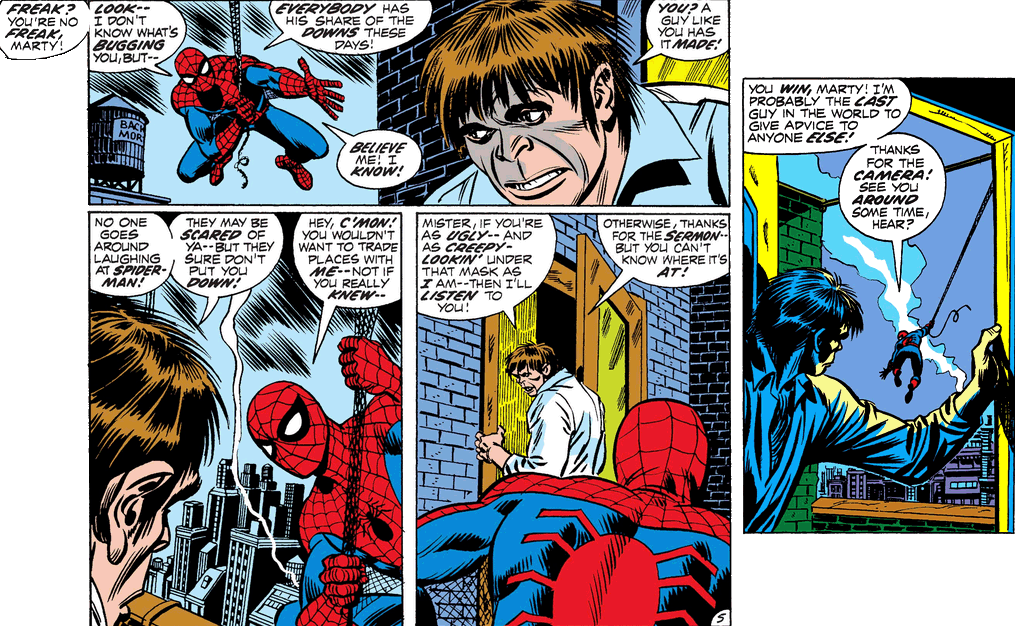
It seemed that Lee had opted for more of a smooth transition for Marvel readers than any thoughts of fanfare. And that being the case, how appropriate it seemed that in his final issue he would introduce a rather unremarkable character--a young man hoping for a chance at better things for himself as well as a life without despondency and, worst of all, ridicule. It seemed equally appropriate that, of all the people in New York City, Martin Blank would cross paths with Peter Parker, whose own life during this time had its share of turmoil and whose run of bad luck causes him to hurl his customized camera away in a flash of anger.


*Lee would again be spotlighted in an informal encore the following year, when his story from the 1968 issue of the Spectacular Spider-Man magazine was recycled into a three-part tale for which Conway provided additional dialog.

Martin's acrobatic skill is our tip-off to the character on the issue's cover--but why would this orphaned young man adopt a costumed identity as an ape-man? We would find the answer as he sought employment--and acceptance--in an environment which would unfortunately echo the deriding laughter that followed him all through his childhood.


Martin apparently has chosen to view his chance meeting with Spider-Man as a door opening for himself at last. Yet he's chosen not to hear the words of someone who knows first-hand that being a costumed hero is no guarantee of a life free of rejection or personal burden--and what happens next will not only bring Martin to arguably the lowest point in his life, but also leave him vulnerable to the influence of someone who won't hesitate to take advantage of his circumstances in order to put an end to a despised enemy.


On a better day, Spider-Man might have been more sympathetic to Martin--but his aunt's recent disappearance has added to a sea of troubles he's been experiencing lately, sapping him of his patience and having him regarding Martin as a distraction that he doesn't have time for. With his departure from the scene, however, the time is ripe for this story's principal antagonist to salvage what's left of Martin's fragile self-respect, and direct him to do what he himself cannot, at present.


Wednesday, May 20, 2020

Scintillating Selfies From Seasons Past!


While there are a number of self-portraits of comics artists, it seems a lost art when the artist would surround his image with those comics characters he or she was best known for. The first time I became aware of such portraits was when Marvelmania--Marvel's licensing arm in California which absorbed the old M.M.M.S. and sold fans a variety of memorabilia in the early '70s--grouped together a number of such portraits and advertised them for sale in books published circa 1971:


In those early days of my Marvel Comics acclimation, I was thrilled to see portfolios of those artists whose work I was just getting to know. (Jack Kirby, of course, had departed Marvel by that time, but I was starting to devour reprint titles featuring his art.) I remember being a little disappointed by John Buscema's offering, which featured only a sampling of his work from a single title, Silver Surfer:


Yet there later appeared an offering from him that showed what might have been in a more comprehensive rendering, while other outlets have adapted his pose to create their own portrait of the artist and the many characters which benefited from his style.


Buscema's brother, Sal, who also has a rich portfolio of work at Marvel, was a little more difficult to track down in this respect, but one such drawing turned up:


Though given the sheer number of characters Buscema has brought his style to, the artist himself might have been a bit lost in the crowd if they had been included.  What we see here is quite satisfactory--and Buscema's positioning of himself is an interesting choice in comparison with other such portraits.

I would have expected a similar throng of characters in a George Perez portrait, but the drawings which turned up were surprisingly reserved.


There are no Daredevil images in Wally Wood's selfie, but perhaps a takeaway panel from one of his stories explains why (though the breadth of Wood's work with other subject matter would be more extensive than the pigeon-hole he establishes for himself here).


Several of Gil Kane's offerings focused on his work at DC, though at least one of them included some of his renderings of Marvel characters:


Finally, the portraits of John Romita and Herb Trimpe round out this assortment nicely.


(If you can identify the character posed in front of the Glob in Trimpe's portrait, there's a free Trimpe-rendered Incredible Hulk comic in it for you! (Well, more like my sincere thanks, instead!)


I was surprised at the dearth of such character-based portraits for Rich Buckler, Neal Adams, Jim Starlin, Barry Smith, Bill Everett, George Tuska, Don Heck, and other notables, all of whom had a hand in building Marvel into the brand it became. If you're curious to see other self-portraits not featured here, do check out the PPC's prior posts on the subject, where you'll find those of Jack Kirby, Marie Severin, et al.

BONUS!
Renditions of the ideal Marvel Bullpen, as conceived by Marie Severin and Bob Camp.