Tuesday, July 15, 2014

The Deadly Aim of--Mr. Rasputin!


Most of the time when we come across practitioners of the mystic arts in comics, they're focused on matters beyond their day-to-day lives--contacting other-dimensional beings, amassing greater power, planning world conquest--maybe all of the above. Not many of them use their knowledge in more mortal pursuits, like extortion or blackmail--which leaves the field wide open for a man like Mr. Rasputin, who's making quite a name for himself in international circles:


By accounts, the first Rasputin, while having great influence in the Russian monarchy, worked behind the scenes and didn't harbor aspirations to rule--but Mr. Rasputin clearly considers his ancestry deprived in that respect. And so, using his skills in hypnosis and mysticism, he's well on his way to becoming the perfect terrorist.

Of course, it was only a matter of time before his activities in the occult drew the attention of the Master of the Mystic Arts:


Rasputin puts up a good fight against Strange, all things considered, but it doesn't take him long to realize what he's up against. So he resorts to a weapon which it turns out Strange is ill-prepared against:


It's surprising that we don't see more Dr. Strange foes packing heat, just to be on the safe side. A gun seems to, you'll excuse the expression, work like a charm against him. In this instance, only Strange's quick thinking keeps him from being plugged by another round:


And so, laid up in a hospital bed, Strange has little recourse but to return to Rasputin in his astral form. Unfortunately, Rasputin has taken the liberty of setting up shop in Strange's Greenwich Village sanctum, thereby increasing his threat:


We shouldn't count Strange out yet, though in his current state his options are limited. But even using his cloak of levitation and his mystic eye, Strange finds that Rasputin is a formidable foe:


You have to hand it to Strange--deprived of his physical body and on his way to imprisonment in another dimension, he still is able to keep his cloak in the fight. And its relentless grip finally swings this conflict in his favor.


I don't know what jail Rasputin is currently languishing in--but, thanks to Clea, Strange's disciple for a time, his essence gets a new lease on life when she attempts a spell to give the Valkyrie a little background on the three heavyweights who founded the Defenders. But Strange discovers her efforts too late:


And so the Hulk, the Sub-Mariner, and Strange all find themselves reliving warped versions of events from their pasts. Unfortunately, like Namor and his Nazi foes, Strange finds his fellow denizen to be armed, and all too familiar:


Rasputin's aim and determination seem as deadly as ever. But help is on the way:


The three are able to make it back safely. As for Clea, it's a safe bet she was put in front of a blackboard with a piece of chalk, where she'd begin to write "I Will Not Attempt Spells On My Own Anymore EVER" 1000 times.  We can only hope she doesn't start fooling around with handguns.

Monday, July 14, 2014

The Best Of Enemies


The career of the second Green Goblin, Harry Osborn, seemed almost as tumultuous as that of his infamous father, with both shifting back and forth between identities and, of course, their enmity toward Peter Parker. In the 200th issue of Spectacular Spider-Man, the Goblin and Spider-Man were once again primed for a "final" showdown that would bring to a head Harry's bitterness toward Peter concerning the death of his father, whose role in the death of Gwen Stacy Harry is adamant about refusing to acknowledge. There's nothing new on the table in this regard, since Harry's mental instability has been a factor ever since his problems with drug abuse coincided with his father's unexpected death. (Having Norman Osborn for a father couldn't have helped his peace of mind, either.)

And yet, this story is scripted by J.M. DeMatteis, and so we can likely expect a different approach to the Spider-Man/Green Goblin clash. For one thing, despite the fact that they're in costume as Spidey and the Goblin, it might instead seem to you that the two characters who are going head-to-head here are Peter and Harry, whose friendship is long since passed but who seem repeatedly drawn to its roots. We've rarely seen the friendship between these two given more than lip service in past stories; they shared an apartment together in their school days, yet their interaction was limited, and they were little more than ships that passed in the night. But DeMatteis, who makes his mark on a story through characterization and sentiment blended in with whatever world-threatening crisis is taking a hero through their paces, shows us the relationship and bond that must have taken place off-panel--and not just with Harry and Peter, but also folding in Gwen and Mary Jane. And as we'll see, that lost friendship will have more of an impact on this battle than any blow.

Another thing you'll notice with DeMatteis's approach to a story is that he often avoids the typical structure of a comic book story. For instance, if you see a villain like the Green Goblin begin a Spider-Man story, usually the narrative will jump right in to the impending danger and the threat he represents, with maybe some maniacal laughter thrown in. So while the Goblin is indeed swooping toward his target--and, being that the target is Mary Jane, we're allowed a sense of dèjá vu from when Gwen Stacy was abducted--thanks to DeMatteis, perhaps the Goblin's words will have a deeper meaning than simply the portent of a greater threat.


Saturday, July 12, 2014

Lies, All Lies!


A person in a comment thread once wrote, "Avengers Forever just seems to be a story consisting of really well-drawn explanations to questions 10 people had." That's as good a description as any for this twelve-issue series from 1999 which, aside from its main plot, sought to untangle and make sense of inconsistencies in Marvel continuity (as well as ill-considered character and plot decisions) which involved the Avengers, either as a group or individually.

In the midst of all the questions which a series like this must ask, there are two anchors around which everything else seems to orbit:

  • The attempted murder of Rick Jones, who's seen as a danger when his ability to manifest the "Destiny Force"--the power inherent in all humanity which he used to halt the Kree-Skrull War--reasserts itself.
  • The efforts of Immortus, the so-called Master of Time, to contain the Avengers, due to a bargain he's made with the "Time-Keepers"--a trio of beings who are convinced that the Avengers will be responsible for an aggressive move by humanity to spread its race and influence throughout the stars using the Destiny Force, heedless of the death and destruction they bring to other races. Rather than kill the Avengers, Immortus chooses to accomplish his task through a massive campaign to manipulate the team's activities throughout its history.

Rick, with the guidance of Libra, former member of the Zodiac crime cartel, summons a team of Avengers to investigate and deal with this crisis. But with Libra's studies in the area of balance, these Avengers are a mixture of members from different time periods, chosen thus for specific reasons:


Also in this struggle is Kang the Conqueror, who battles against both Immortus and the Time-Keepers in an effort to preserve his own standing in history.

With plenty of "time" to go around, and a title like "Avengers Forever" to live up to, the series spends a generous amount of that time exploring various points in Avengers history. But the real eye-opener comes when the extent of Immortus's tampering in that history is revealed. Providing key assistance to him in his machinations are the Space Phantoms--not a single alien race, as we'd been led to believe, but something quite different:


And so the Space Phantom we've seen in various stories, whose "home planet" Thor had once sacrificed his hammer's time-spanning energies to "save," was simply one of these beings who was conditioned by Immortus to take part in a ruse, such as this one:


And on the series goes, stopping at points to clear up discrepancies or wipe them away outright. For instance, in the climax of the event known as "the Crossing," we saw Henry Pym get this bombshell dropped on him:


The scene effectively nullified the entire storyline of Pym's mental instability throughout his years as an Avenger. Yet the Crossing is one of many such events which has a virtual eraser applied to it in Avengers Forever. First, as for Iron Man being under Kang's influence, we'd have to go back a bit further to follow the paper trail:


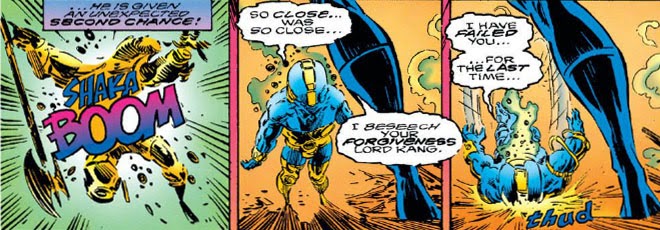
Which brings us to Pym, who, thanks to the Phantom, again finds he has no one to blame for his problems but himself:


Somewhere in this series should probably be a segment on what the heck Immortus was doing with the Scarlet Witch by making her some sort of energy repository for the Time-Keepers. In this issue of revelations, it seems they're instead exclusively concerned with her children:


Immortus takes a number of steps over various points in time which would finally allow Master Pandemonium to effectively deprive Wanda of her "children," and thereby satisfy the Time-Keepers--at least for the time being, that is. With the Vision later lost to her, the one flaw in the story's approach here is that there's always the possibility she might start a family with someone else--though I doubt Immortus would bring that to the Time-Keepers' attention, assuming he's even considered it.

Naturally for this kind of series, the opportunity is also taken to explain the discrepancy of the Vision's origin, given that the original Human Torch was later found dormant at a gravesite by the West Coast Avengers, with others popping up (including Phineas Horton, revealed here to have been a Phantom) to claim that the two could not be one and the same. The solution to the discrepancy left my head spinning:


Which all leaves the Avengers with one heck of a situation:


If that isn't enough to make your eyes glaze over, have a look at the final battle scene, where things come to a head:


What. A. MESS.


You're likely to find Avengers Forever to be a fun ride and a satisfying read, providing you don't dwell on what's truly happened here. In clearing up many of the Avengers' unexplainable contradictions, co-plotters Kurt Busiek and Roger Stern have apparently overlooked (or chosen to ignore) an important point: the fact that much of what we know of the Avengers' actions and history has now been revealed to be the result of the manipulations and/or mental coercion of Immortus. That will be an uncomfortable distraction when reading prior Avengers stories--but it also makes for a lousy footnote to a series which has made such an effort to tie up loose ends.

Avengers Forever (12-Issue Series)

Script: Kurt Busiek
Pencils: Carlos Pacheco
Inks: Jesús Merino
Letterers: Richard Starkings and Albert Deschesne

Friday, July 11, 2014

When Heralds Clash!


Since Doctor Doom regained his kingdom of Latveria from Zorba, who took over leadership when Doom was toppled from power, he didn't take long to make good on his threat to renew his goal of destroying the Fantastic Four. To that end, he empowered Tyros, the former herald of Galactus known as Terrax, with a portion of the "power cosmic" and convinced him to carry out that attack. In Part Two of the story, we saw Tyros engage both the Thing and the Human Torch, with the Invisible Girl racing to join the battle after discovering that Doom was the catalyst for it.

Unknown to Tyros, his time is limited to carry out the FF's destruction, since the rampant artificial energies that Doom has charged him with are quickly consuming him. But Tyros has been wasting neither his time nor his power, attacking the FF with a vengeance and forcing them to battle for their lives. Yet the cover to this issue implies that the cost of this battle will go beyond the Fantastic Four, and that the goal of vengeance may well circle back to consume this affair's instigator.


Thursday, July 10, 2014

What Lives Within The Cocoon?


While we're on the subject of the new Wasp, another such transformation of the character must surely be included in the what-were-they-thinking category--and it's a fair bet you know the one I'm talking about. Let's go back to that *cough* wonderful storyline at the tail end of the first volume of The Avengers called "The Crossing," where Anthony Stark had inexplicably betrayed the team and began trying to kill them. At one point in the battle, Janet Van Dyne (not yet changed to the Wasp, even in the midst of a life-or-death battle--no, I can't explain that, either) rushes to stop Stark (as Iron Man) from blasting Hercules, only to find herself in the line of fire:


Stark then escapes the Avengers' retribution by taking a powder through time, and his situation would now segue to Avengers: Timeslide and Iron Man before finally concluding as part of the Crossing. As for the Wasp, Hank Pym treats her using the same machinery that originally changed her biology to allow her to adapt to her new powers:


And the results of Pym's new adjustments to increase the Wasp's chances of survival would make any mad scientist proud:


Hank then keeps a vigil over the cocoon, monitoring the Wasp's vitals. But the danger from those making "the crossing" is not over, particularly when one of their own has escaped and sought sanctuary with the Avengers. To make sure she is slain, an enemy team arrives in a surprise attack--but only a single member, the diminutive and calculating Neut, is needed to lay waste to the entire team of Avengers, including the one they would protect:


But as Neut closes in for the kill, he gets a *ahem* little surprise of his own, as the Wasp's cocoon finally unravels to reveal... well...


In the aftermath, the now full-sized Wasp seems to take her transformation in stride, in the same good spirits as those who are pleased at her recovery:


The Wasp, in this form, would plunge with the other Avengers into battling Onslaught, and the reset button for her condition would be hit upon her return.

BONUS:
Clothes horse Janet Van Dyne takes us through a tour of her costume closet!


Wednesday, July 9, 2014

Prezzzzenting--The New Wasp!


When considering expanding on the character of Henry Pym, perhaps it's wise to follow the medical principle of "nonmaleficence," a derivative of one of the statements of the Hippocratic oath which swears the intent to do no harm. In essence, the concept means: "Given an existing problem, it may be better not to do something, or even to do nothing, than to risk causing more harm than good." Or, as Beverly Crusher might put it, "Never make the patient any worse."

In the case of Pym, I grant you that that ship has long since sailed. Yet, for all the reinventions of Henry Pym we've witnessed, both physical and mental, two of them come across as arguably the most confounding of all. One of them came into effect after the death of Janet Van Dyne in the Secret Invasion series:


I'm no fan of Tony Stark and the high horse he seems welded to--but when he steps in to usurp leadership of the Avengers from Pym, I can't say he's that far off-base in his reaction to Pym's new title:


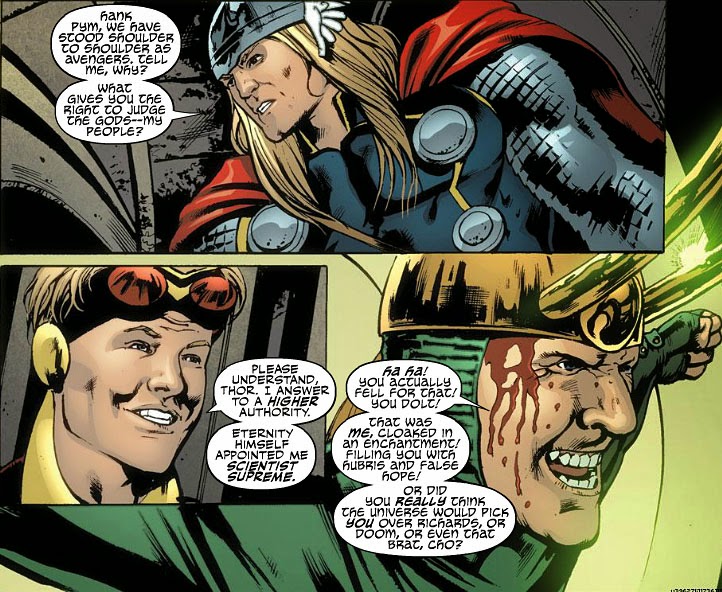
And the second change in Pym's status? Why, no less than Eternity visits him to confer on him an extraordinary distinction:


And while Loki later claimed it was a deception:


...everyone seemed to agree that it was just a bluff on Loki's part to sow dissent among the Avengers who had captured him.

It looks like Pym later abandoned his "Wasp" identity to form the Avengers Academy, though I'm not sure how you contact an entity like Eternity with the news that you don't want to be Scientist Supreme anymore. Besides, think of how something like that is going to look on your business cards.

The Monarch Or The Mayhem?


From its cover, you'd think that Fantastic Four #259 is going to be a grand battle issue involving Tyros (formerly Terrax, the Tamer), the FF, and Doctor Doom:


But as the second part of a three-part story, it only brings us partway to what will be the story's climax. In Part One, we saw most if not all of the pieces laid in place, with Doom managing to restore to Tyros a portion of the cosmic power which he'd lost in his confrontation with Galactus and then pointing him in the direction of the FF. Part Two finally folds the Invisible Girl, the Thing, and the Human Torch into the story, as Tyros begins his mission of vengeance.

And what of Mister Fantastic? Where is Reed Richards while all of this is going down? So far, the story is keeping mum on it, so his whereabouts at this point will have to be listed as "unknown," at least for those of you who haven't read ahead. As far as the FF are concerned, things haven't yet progressed to the point of warranting his involvement.

Before things kick into high gear, the lives of the FF appear pretty mundane. Reed was last seen checking in on the injured Vision's status at Avengers Mansion. Sue is returning from Connecticut, where she's taking another stab at house-hunting. Ben is returning on an overseas flight; while the Human Torch is chilling in the loft he's moved into. But Tyros doesn't exactly strike us as the type who enacts his revenge at a leisurely pace--and so the Thing finds his taxi-cab suddenly sliced open and himself subsequently faced down by the one Doom has empowered to destroy them:


No, Tyros doesn't look like he can be reasoned with.
And no, the Thing doesn't intend to try.