Thursday, August 20, 2015

For Better Or For Much Worse


While Dracula may write in his journal to muse about lessons learned or setbacks he may have endured, at times he'll write about his sadistic manipulations of and triumphs over we humans whom he holds in such contempt. Reading over such entries, you can't help but get a sense of Dracula's amusement at our predictability, and how easy we are to entrap. We could almost admire his canniness, if it didn't present such a deadly danger to us.

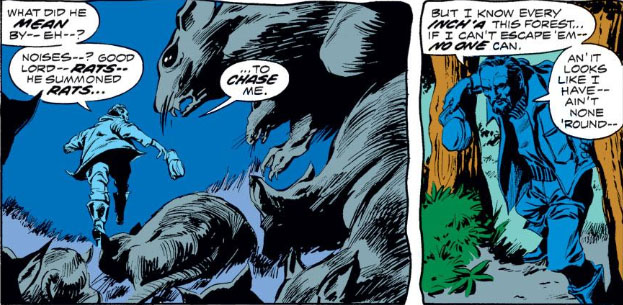
Take Vinnie, out hunting bats in the English countryside. It's not often you hear of hunters who hunt bats, particularly for trophies--how often do you see bats mounted on a hunter's wall? But the question will soon be moot in Vinnie's case, when, in choosing his latest target, he unknowingly becomes the hunted.


You can almost hear Dracula chuckling at Vinnie's ignorance of just what he's hoisted over his shoulder. But it seems Dracula's threshold for amusement with this diversion has been reached--and, rifle or no rifle, Vinnie is going to suffer this night for his presumption at his treatment of the Lord of Vampires.


Attaboy, Vinnie! Armed, you're a match for any crazed lunatic who tries to jump you at night.

Unless your target keeps advancing on you.


There's no way Vinnie could immediately comprehend Dracula's parting words, so for an instant he may be under the impression that he's home free. But like a cat with a mouse, Dracula is toying with him--and Vinnie would be wise to heed Dracula's instructions, and run like the wind.


In Dracula's encounters with humans whose petty concerns mean little to nothing to him, his journal notations at times reveal him to be a fair judge of character--having grudging admiration for some, while regarding others as a waste of space. Richard and his wife, Kitty, taking a drive in the night, appear to fall into the latter category, as Dracula reflects on the loss of sanctity in present-day marriages. Tonight, we'll see that sanctity is the last thing on Richard's mind.


But while Kitty likely feels a tightness in her chest as Richard's meaning and intent become crystal clear, Dracula, watching this scene play out, feels a sadistic opportunity taking shape.


If it's difficult for you to see how Kitty's death could gain her revenge for her, well, you're not thinking like a vampire, are you? As for Richard, well, with Kitty out of the way, he and his mistress, Cindy, have some hot and heavy celebrating to do. And given that Cindy would rather not know how Richard dealt with Kitty, these two seem like a match made in heaven; but as Dracula's plan reaches fruition, they can look forward to spending eternity in a more southern locale.


Where Dracula is concerned, it's not likely the man is ever going to have writer's block, is it.

Wednesday, August 19, 2015

The Fates Of The Phoenix!


Almost four years after the now-classic X-Men story which saw the death of Phoenix (or so we thought), a behind-the-scenes look at that story was published which not only contained an extensive interview with the Marvel personnel directly responsible for it, but also for the first time revealed the story as originally written and drawn.


Phoenix The Untold Story is precisely that: the story of X-Men #137, before its ending was altered at virtually the last minute to provide for the death of Jean Grey. The issue reveals the intent of writer Chris Claremont and artist John Byrne to allow Jean to survive, though with her life as Phoenix (and, for that matter, Marvel Girl) brought to an end. The desperate battle between the Shi'ar Imperial Guard and the X-Men would play out as before; but in the original tale, Dark Phoenix does not re-emerge, and Jean does not go on to take her own life. It would seem the best of both worlds, with both the X-Men and the Shi'ar getting what they want--with succeeding stories presumably having to deal with the repercussions to Jean as to the loss of abilities she was born with and which contributed to her growth as a person.

The gist of the decision to rewrite the story at the eleventh hour is perhaps well known by now--specifically, that the character of Jean could not be allowed to simply return to business as usual in light of the millions of lives she incinerated as Dark Phoenix. And so the story was shifted in tone to one of true heroism--particularly in Jean's case, when she sacrificed her life in order to save the universe. Yet in many other ways, the revised story surpasses the original, as the X-Men come to terms with what Jean has done as Phoenix and hard choices must be made in order to resolve the situation. In the end, the X-Men take up the responsibility to put an end to Phoenix when all others have fallen, rather than taking the course of action that might have seen publication: fighting to protect their friend, rather than giving any thought to the notion that the Shi'ar's actions may be justified.

Comparing the two stories side-by-side offers a fascinating look at the creative process, and the decision to take a story that might have passed muster and instead hammer out a story that would not only be better for the characters, but also better for the book. Over time, it seems to be the consensus that X-Men #137 remains one of the top comics stories of all time, leaving little doubt that the decisions made at the time were the correct ones. In this in-depth look at both stories, we'll see plenty of evidence in that regard; and we'll also get an idea of the advantages of running a finished story by a few more sets of eyes and going the extra mile in order to produce a more readable and satisfying finished product.

Monday, August 17, 2015

An Album Of Snapshots


It's hard not to go into a Fantastic Four album issue with high expectations--and indeed, the cover of issue #190, rendered by classic FF artist Jack Kirby, gives an indication of being something special. Yet as an album issue, which presumably would cover a considerable amount of ground in the career of the Fantastic Four, this issue may not be quite to your liking.

Part of the reason for that is that there is a lot of ground to cover with the FF, so much so that cramming the bulk of it into one standard-sized issue and putting all of its material into context would be a challenge for any writer/artist team--and this particular team (Marv Wolfman and Sal Buscema, respectively, with Tony DeZuniga) doesn't go nearly as far with that material as we might hope. In addition, the fact that its story centers on the theme of the FF breaking up limits its scope to that subject, which gives a retrospective of this sort a rather pessimistic tone and doesn't fully bring the Fantastic Four to life for the reader who might have picked up this issue wanting some idea of what makes this team so reputed in the world of comics.

What is also disappointing is that, with a cover depicted by an artist whose work can't help but serve as a reminder of a period when Fantastic Four was at its peak as one of Marvel's top comic books, the artwork that's turned in for this story is something of a letdown. With Buscema simply doing layouts and DeZuniga finishing, everything appears and reads like a rush job or a fill-in (and follows a reprint issue, if that tells you anything), while much of the story simply plugs in events almost in their entirety, panel by panel. And the general theme of the issue--the Thing recalling the circumstances of past times that the FF have disbanded--is insufficient to support these segments, or lend any sort of distinction to the lives of the FF or illustrate why this is "the world's greatest comic magazine." It's plain to see why the FF often fell apart, yes--but on the eve of yet another breakup, is it really the best time for a milestone issue whose pretense is expected to be one of affirmation?

"The Way It Was" comes ten issues before Fantastic Four #200, and precedes the real breakup issue that immediately follows with issue #191. Ben Grimm is commiserating with his girlfriend, Alicia Masters, following Reed's decision to leave the team due to the loss of his stretching powers. The segue to this encapsulation of the FF's history (at least in part) is easy enough to set up, with Ben reminiscing by way of a diary he's been keeping of "all the good times... an' all the bad" he's had with this team--though it might have been nice for Wolfman to actually have presented a mix of the two (how about, say, Franklin's birth?), since the FF is much more than just a fighting team, and certainly much more than an infighting team. But it seems that Ben is in the mood to focus squarely on the bad times.


Friday, August 14, 2015

The Strangest Show On Earth


If you're looking for an X-Men story that put a twist on the characters and essentially presented them out of character, one that comes to mind is an issue from mid-1978, which took the "new" X-Men and placed them in an entirely new light--as circus hands and performers.


And who doesn't love a circus? Probably not the X-Men at this point, since they've been conscripted into this carnival against their will--though we're not yet clear on the circumstances. When the team mysteriously drops off the face of the planet, Hank McCoy, the Beast, investigates their deserted mansion and uses their still-operating mutant-locating device, Cerebro, to track them down. Yet the state in which he finds them falls squarely into the category of "the unexpected"--to say the least.


Thursday, August 13, 2015

Fail Hydra!


With only twelve issues under his belt in his own series, an "album issue" for Captain America would seem to be premature for readers who might have begun buying the book for its contemporary take on the character rather than his wartime exploits--but writer Stan Lee and artist Jack Kirby pull out all the stops to provide him with one, whether it's warranted or not.


This would be Kirby's last issue as artist on the mag (until he'd step back aboard in 1976 as artist and writer)--so in light of the theme of this issue, and the dearth of a substantive history for Cap beyond his World War II activities, this issue is made up of one oversized panel after another of Cap in action and only minimal narrative to overlap Kirby's work. The panel size was perhaps a decision meant to accommodate Cap's limited exposure to date (in this case, mid-1969). In Captain America, the character has only thus far fought four villains (with the Exiles and the Sleeper included under the Red Skull's wing); and in his time in the pages of Tales of Suspense, he was featured in just forty issues and limited to 11-12 pages per issue, with several of his plots needing to be spread out over multiple issues as a result. With Cap still at loose ends in regard to the direction of his life, an album issue would have little to offer in terms of his personal history or evolution as a character; until now, he has been a creature of duty, a man of action. Most if not all of his stories have had one impetus: to point Cap in the direction of a deadly foe or mission. Had his life and career been uninterrupted by the destruction of Zemo's drone plane, the material for an album issue might have been much more than just the virtual newsreel we're provided with here.

All of that said, Kirby and writer Stan Lee provide in this issue exactly what's billed: a "tribute to the glory-studded career of Captain America." And if that were all there was to base this story on, it would have been better suited to an annual; but Lee gets us there by using the dramatic events of the prior issue to open the story with a startling announcement by law enforcement officers who have discovered Cap's bullet-ridden costume:


Wednesday, August 12, 2015

The House Of Recycled Ideas


If you were a reader of Tales of Suspense, the co-feature title where Iron Man shared the book with Captain America, you may have raised an eyebrow when you saw a copy of Invincible Iron Man #92 on the racks and felt a sense of déjà vu at the cover image.


At times you and I will come across artwork or story elements that give a tip of the hat to prior work, which can be fun when it strikes such a note of familiarity and makes you scratch your head and wonder where you've seen it before. Take this scene from a 1969 X-Men story, and its counterpart appearing just over a decade later:


But it's only on rare occasion when you'll see a hat being tipped to such a degree that most of a new story will ring familiar--as when writer Gerry Conway appeared to pay homage to an Iron Man story published nine years earlier in Tales of Suspense #90:


Oh, caught the near-match in issue numbers, did you?

Tuesday, August 11, 2015

Finding Namor


If and when the Sub-Mariner makes it to the big screen, the producers and casting personnel have their work cut out for them. The #1 hurdle to be cleared, of course, is Namor himself, who must be absolutely nailed in all respects in order to make such a film work; then will come the screenplay, which must somehow make the Sub-Mariner sell when that was a tall order even for his own comics series. But the prospect of a Sub-Mariner film remains intriguing.


In the meantime--well, until names of actors being considered for the part start being leaked, we'll have to be content with the many cosplayers who have taken up the challenge to portray one of Marvel's most enduring characters. (Heck, you try attaching a pair of wings to your ankles!)  Here are some of those who have risen from the depths to pave the way for Namor's red carpet moment.


5 out of 5 fish scales to you all!

Monday, August 10, 2015

Life After Death


You don't see a lot of so-called "album" issues on the comics racks, or even in collectors' boxes, perhaps because of the general format they all must adhere to. You may not even be familiar with the term "album issue," a label that popped up in the late '60s at Marvel but never really caught on as a buzzword to describe an issue that served as a recap of a character's (or group's) history to date. We're all probably more used to "origin issues," stories which also are limited to rare appearances but are different in that they aren't as comprehensive in the historic ground they cover. (A good example would be Fantastic Four #126, which retells the FF's origin in detail but limits its scope vis-Ă -vis Ben Grimm's concerns for Alicia Masters.)

An album issue, in contrast, will widely span a character's past up to and including their present, usually from the perspective of one of the book's main characters or someone else who figures into the story. The nature of this kind of story helps to explain why we only see one on a rare day, since it's basically the accumulation of all we've seen before--and sufficient time must pass before another can be prepared, assuming it's even warranted. Presumably such a story can only be done sparingly; perhaps even just once, since a second story would likely have to include much if not all of the material of the first, and would therefore result in a story too bloated or crammed with history to be of use in the context of the theme the writer is trying to circle back to. And it's really a character's reason for such reflection that makes such a story work.

We'll be profiling a few of these album issues here at the PPC, but perhaps it's best to start with the one which excels at illustrating the concept:


X-Men #138 follows the dramatic death of Jean Grey, beloved by all her friends but especially by Scott Summers, whose loss is evident on the day of her funeral. Appropriately, it's Scott who stands poised to take us back through what will be the most detailed look at the X-Men's history to the present time (in this case, October of 1980)--and if anyone is qualified to reflect on the how and why of the X-Men in light of Jean's death, it's the X-Man who was there at the beginning and the one who would grow closest to Jean. Both he and Jean were charter students of Charles Xavier's "School for Gifted Youngsters," as well as charter members of the X-Men; and besides Xavier, who certainly must be having similar brooding reflections concerning the death of one of his first class (and the second X-Man to die on his watch), Scott has cause to turn his thoughts back to how he and Jean began their time with the X-Men, and what led them to this point.


Saturday, August 8, 2015

Fantastic Four - Strike Three


OR:


I must say, the final paragraph of A.O. Scott's review of "Fantastic Four" in The New York Times will have me avoiding this film like the plague.

" 'Fantastic Four,' despite the dogged efforts of its talented young cast, has nothing. The special effects are at about the level of the early 'Harry Potter' movies--lots of glowing green clouds and ice-blue bolts and force fields. The human drama is meager. Once again, the only real pathos belongs to Mr. Bell’s Ben, who finds himself trapped in a stony new body and weaponized by a ruthless government. Mr. Teller stretches, not as an actor but as a digitally enhanced body. Mr. Jordan burns in the same way, and Ms. Mara disappears. Her character also has the power to make other things vanish. I would say she should have exercised it on this movie, but in a week or two that should take care of itself."
Good lord.

You can see a brief rundown of the film's reviews from a sampling of them here.  Though if you happen to be employed by 20th-Century Fox, be sure you're wearing your flak jacket.