Saturday, December 8, 2012

Who Punishes The Punisher?


"Gerry Conway was writing a script and he wanted a character that would turn out to be a hero later on, and he came up with the name the Assassin. And I mentioned that I didn't think we could ever have a comic book where the hero would be called the Assassin, because there's just too much of a negative connotation to that word. And I remembered that, some time ago, I had had a relatively unimportant character ... was one of Galactus' robots, and I had called him the Punisher, and it seemed to me that that was a good name for the character Gerry wanted to write--so I said, 'Why not call him the Punisher?' And, since I was the editor, Gerry said, 'Okay.' " -- Stan Lee, describing the recycling of the "Punisher" name

And with more than enough punishment to go around, these two characters continue to co-exist:


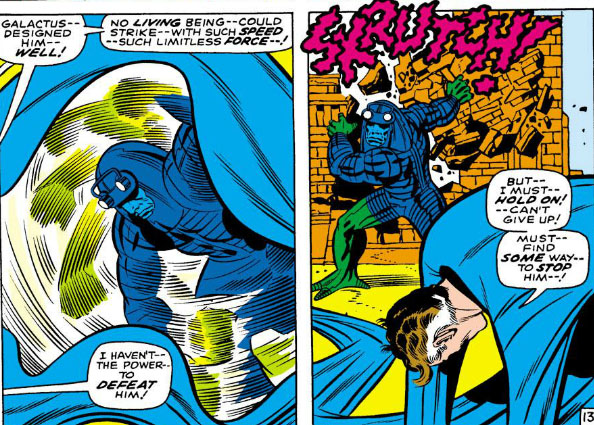
The original Punisher is still an interesting character to me, even though I've yet to hear one word from him and I'm only aware of vague details of his origin. He really amounts to being Galactus' pet Rottweiler that's sicked on planetary inhabitants who try to interfere with him while he's setting up his energy converter in order to drain the planet's life force:


Up to that point (and perhaps ever since), Lee's description of him during his introduction is all we have to go on:


I had the impression Lee was shooting from the hip as far as coming up with wording that would give the character sufficient build-up to tackle the Fantastic Four. But we can speculate on a couple of things. First, since Lee gives a point of origin for him, it's likely Galactus conscripted him rather than creating him as he did Ardina. (Nova even called him an alien at one time.) And we learn that half of him is actually alive. Indeed, when Iron Man has his own battle with the Punisher, writer Bill Mantlo reiterates Lee's description with this interesting tidbit:


The Punisher's status as a partially living being is certainly conspicuous enough--but that would seem to be where our speculation has to end. The Punisher's actions, as well as the circumstances of his appearances, have him come across as more of a deadly, unfeeling automaton to be used by others, with little to no deviation throughout the character's history. It's probably that rep as a powerhouse that keeps his origin at bay, since he's obviously more useful in a story to throw things in disarray and challenge whatever character(s) he's thrown against. That was definitely the case with the FF:


(Anyone notice the error in Reed's analysis?)

But it wasn't until his battle with Iron Man (while in thrall to the Rigellian Colonizers) that we would get to see a real knock-down drag-out with the Punisher. First, Iron Man maneuvers his foe into the path of a "super missile," where the Punisher bears the full brunt of the explosion (which accounts for the injury Iron Man analyzes above). But when the two crash-land in Detroit, the battle begins in earnest and Iron Man vows to stop the Punisher:


The Punisher seems bred for battle, meeting Iron Man's strategic decisions and countering with his own power. Iron Man is pretty much facing a bruiser here--and Mantlo's scripting keeps the reader riveted:


Finally, it's all or nothing, as Iron Man takes a gamble which seems to be the go-to tactic other writers occasionally pull out of the hat whenever Iron Man is in danger of losing a desperate battle. Yet by now we've been well-prepped to see the Punisher go down, so we're not really picky at this point how it gets done:


And for the first time, we see the Punisher laid out. You might even say "punished," heh heh. The citizens of Detroit, a city that's seen better days, didn't exactly appreciate having their city turned into a war zone.  But they had a ringside seat to one hell of a battle--and Iron Man, still standing at the end of it, had an impressive win to add to his history.

Of course we didn't see the last of the Punisher, eventually ending up again with Galactus. I was a little disappointed to see Galactus send a small army of Punishers against Thanos, which effectively quashed any curiosity the Punisher may have held to readers as an individual entity. I suppose that's really no great loss--there's been no demand from readers for those details, as far as I can tell. But being the scrapper that he is, the Punisher will probably still have a job at Marvel for the foreseeable future.


Friday, December 7, 2012

A Franchise Falls Flat


Wisconsin puts itself on the super-hero map in a new


Marvel Trivia Question


Well before "the Initiative," what super-team in middle America was this guy a member of?

Thursday, December 6, 2012

Of Course You Realize This Means--Warhawk!*


*Come on, that's a Roy Thomas story title waiting to happen!

Tom Kiefer over at Comics Bronze Age is having such fun going down X-Men memory lane that I couldn't resist taking a look at an issue myself. Unfortunately, I'll have to bring back one of the X-Men's most forgettable villains:


Warhawk is a mercenary who made some waves with Iron Fist before infiltrating the X-Men's Westchester mansion. He has the dubious honor of making his X-Men debut in a fill-in issue, taking place between artist Dave Cockrum's departure and John Byrne revving up his own run on the book beginning with the prior two issues. But since writer Chris Claremont had previously scripted the character, even this transition issue reads pretty smoothly. And it starts out with a pastime that will become an X-Men staple.


I have yet to see a baseball game played by super-beings where the players all refrain from using their powers--which I suppose would be pretty boring for the reader, anyway. So when Colossus makes a successful hit, Wolverine isn't the most sympathetic baseman to be headed toward. Nor the most sportsmanlike:


Keep in mind that this was still when Wolverine was becoming acclimated to the X-Men--and he wasn't the easiest person to warm up to, even among his fellow mutants. We know, for instance, that he and Colossus will grow to become buddies. But right now, he still has a problem with even something as simple as horseplay.


A scene which might as well have FILL-IN ISSUE stamped across it, because it's the victim of its own bad timing. You don't hold a blood-grudge against someone who sprang to your defense against Weapon Alpha only one issue ago:


As for Warhawk, he's busy taking over the mansion's computer setup and planning his next move. Though apparently, his employer thinks he needs a little nudge to remind him who's boss.


We don't learn squat about Warhawk's employer in this issue. Later we'll discover it's Sebastian Shaw of the Hellfire Club, who's probably getting a little assist here from Emma Frost to contact Warhawk via telepathy. In fact, it's likely Frost herself who's speaking to him here, considering Warhawk's state of mind when he faced Iron Fist was fragile.

So Warhawk's got the drop on the X-Men, and proceeds to drop the "brains" of the team--arguably, Moria MacTaggert, Xavier, and Jean Grey--with his tranquilizer gun:


Jeez, taking out Phoenix with nothing but a "phut." That should make Firelord feel even more humiliated about Phoenix cleaning his clock.

As for the other X-Men, who have suited up and are headed to the Danger Room (thanks to Cyclops, who has a few things to learn about team morale if he thinks that a relaxing game of ball should be followed by a grueling workout where you try to disable devices trying to kill you), Warhawk seals them inside and lets the room do his work for him.


It's only when Wolverine escapes the room that we get some interaction with Warhawk, who gives Wolverine a run for his money:


I really can't swallow why Warhawk's steel body is so formidable to Wolverine, though. Hasn't it been proven that Wolverine's claws--made of adamantium--can cut through anything? And wouldn't that include steel? I guess we'll have to find out some other time, because Wolverine has successfully disabled Warhawk's tampering with the Danger Room and the team breaks free. And that's all she wrote for Warhawk.


That "thud" you heard was Warhawk being dropped from Uncanny X-Men for the foreseeable future, as quickly as he was dropped in. Since this is a fill-in issue, and with Claremont's and Byrne's kick-ass Magneto story waiting in the wings, Warhawk's presence in the mansion and his motivations will need to remain a mystery, with Claremont limited to laying plot seeds to perhaps sprout later at some point. With the benefit of hindsight, we can take that to mean that Shaw had become aware of the X-Men and had sent Warhawk to test their capabilities and potential, perhaps even recording the deadly Danger Room scenario to study. So we get an unsatisfying epilogue, and a very strange final panel:


Yes, that's Wolverine giving the X-Men war-whoop--Wolverine, who apparently has done a 180 in one issue and is now on board the X-Men in spirit as well as in name, when just an hour ago he was ready to put his claws through Colossus' heart.  These guys should play baseball more often.

We don't hear too much from Warhawk anymore, since as a soldier in Vietnam his origins tend to date him. (Though Iron Man seems to have dodged that bullet, so to speak.)  He later got into it with Iron Fist a couple of times, as well as Luke Cage--but a prison cell always seemed to have his name on it.


Warhawk appears in X-Men #110


Wednesday, December 5, 2012

Not The Life Force He Had In Mind


Remember when I said that Fantastic Four Annual #5 was crammed with fresh material and guest-stars? One last pin-up from the annual which I'll share with you here might give you the impression they threw everything into this book but the kitchen sink:


If you didn't know better, you'd almost think these guys were forming their own team. (Which raises the question of what they'd call themselves. Maybe "The Leftovers"?)

I think a "gallery" section might have suited these characters better, where each got their own page instead of being crowded in with each other here (though it's probably a safe guess that the annual simply didn't have any pages left to allocate for them). As it is, I'd probably arrange them a little differently--putting Galactus in the background and replacing him in the foreground with some of the others who are having trouble finding face time. And Doom could take up a fully standing position next to Lockjaw, which would more balance the center behind Wyatt and Alicia (with the Panther in front).

Where the heck is Namor, by the way?

And talk about an accident just waiting to happen:  wouldn't you pay good money to see Lockjaw relieve himself on Galactus' leg?


Tuesday, December 4, 2012

A Star Is Born


You might have to dodge an elephant in this final installment of


If you're coming in late to this series, this panel should bring you up to speed on why everyone is pretty worried about Galactus:


So now, in spite of Eternity once warning that Galactus' continued existence is crucial to the survival of the universe, Earth's heroes--along with the Silver Surfer and an armada of species from across the galaxy--have gathered on the Shi'ar homeworld for a last stand against Galactus, who has made the planet his latest target. Reed's plan to defeat him involves a series of distractions, which aim to bring down Galactus' ship and then to weaken him further with a combined assault. While that's going on, the Surfer travels to Galactus' larger ship in space in order to take control of it--and, in combination with his power to create a space warp, uses the ship's ability to transmute planetary matter to energy in order to absorb and transmute Galactus himself:


And then, Galactus makes a startling transformation, which Reed describes for all:


Jeez, Reed is fond of these grand proclamations, isn't he? There was a time he said Galactus would never return from the Negative Zone, and he did. He's declared the threat of Doom ended so often I've lost count. And here he is using the word "never" again in reference to Galactus. But near the end of the story, Reed and the Surfer take a step back, and realize that this "resolution" to the threat of Galactus may be just the prelude to another threat yet to manifest:


And look who finally shows up, only to put a big fat question mark on the end of this series:


For all the good this informal epilogue does us. I don't know whatever was planned for the "evil" that was unleashed as the result of Galactus' transformation, a threat which the Surfer was supposedly going to investigate and track down. In January of 2000, there were scant details given of a proposed sequel to this series, but it never fully materialized as such. For all intents and purposes, this story ended here. Galactus, however, was recreated in the pages of Fantastic Four #49 almost two years later, completely side-stepping the events in Galactus The Devourer--instead involving a character named Abraxas, who was consumed with destroying alternate reality versions of Galactus.

The last issue of this six-part series makes a considerable effort to establish a major development in the existence of Galactus, and also attempts to put into continuity that Galactus was aware of his condition even when he first created the Surfer--as well as making the revelation that he had specific reasons for choosing Norrin Radd as his herald:


Which doesn't quite connect all the dots. For instance, it doesn't really make sense for Galactus to have tampered with the Surfer's memories and thus made him a more single-minded herald focused on his sole mission, if his intent was for the Surfer to grow in such a way as to insure his master's end. On the other hand, it would add an interesting facet to Galactus' decision to "hold" the Surfer on Earth--the only world that was able to effectively defeat his plans.

I think my hope for this series was that it would expand on the events of Fantastic Four #262, where an intergalactic court absolved Reed of any wrongdoing in his decision to save Galactus at a point when he was near death. The verdict was made following the astonishing appearance of Eternity, which put Galactus' role in the universe into brief perspective:


All very profound, but all too vague and far too based on faith. Odin, another witness in the trial, perhaps better describes Galactus as a force of nature:


Subsequently, Reed's exoneration brought a giant elephant into the room, which Eternity, Odin, and the Watcher all but urge everyone to ignore: how to stand by while Galactus continues his attacks and planetary destruction? The Watcher stated that no mortal mind can retain the "cosmic truth" that Eternity revealed--which means that no one present at the trial really understands why they agreed to sic Galactus on the universe again. In this series, that elephant that represented the role of Galactus was once again quickly skirted around:


So essentially, you have a situation where you have a deadly force decimating entire worlds and displacing whole populations (assuming they're even capable of evacuating their respective planets)--while those who would intervene in defense of those worlds (or their own) are in conflict with their subconscious knowledge that this force must nevertheless live in order to strike again elsewhere. It seems absolutely mad, virtually crying out for resolution.

And what of Galactus himself? While he does often dramatically invoke his mantra that "Galactus must survive" and "Galactus must not die," and announces his name as if he is a law and a force unto himself--which falls in line with the kind of necessary being that Eternity reveals--he also frequently makes references to the life forms inhabiting the planets he targets as being unimportant and inconsequential in light of his own survival, even comparing them to ants who should be stepped upon without hesitation. And despite maintaining that his actions are without malice or other, lesser motivations, he's certainly been known to aggressively respond to those that would hinder his plans (e.g., Ego, the Living Planet). Combined with the fact that, when Galactus approaches a planet, he has one goal--to destroy it--it's not unreasonable for species of the galaxy to see something other than a necessary force that, in Odin's words, has come to "test" their worth to the universe.

No species in their right mind, threatened with destruction, would stand idly by and allow themselves to be incinerated down to the last man, woman, and child because the being responsible for it has been revealed to be correct in its actions insofar as the "big picture" is concerned. Nor should they be adversely judged for not hesitating to do their utmost to take out that kind of threat. And any species capable of conscious thought would have every reason to question the kind of entity that would unleash such a force on the universe. That's the opportunity that I think Galactus The Devourer misses here. The word "devourer" in this case is likely indicative of the constant desperate state now driving Galactus' search for sustenance--and as such, it could have been used to explore the fallacy of Eternity vis-Ă -vis Galactus, as well as the notion that no entity is qualified to rubber-stamp murder, whatever the form it takes.

Galactus isn't some indiscriminate force of nature--he specifically targets whole planets, whether they are populated or not, for a process which will render them lifeless. He even sends out a scout to find them. This is no mindless destructive storm--this is Galen, formerly of the planet Taa, who has been transformed into a being who now requires the life energy of worlds in order to survive. He creates and uses specialized technology to that end. His actions are wholly premeditated, and he leaves billions dead or displaced in his wake. And as this series has now established, his physiology can unexpectedly evolve to make his needs spiral out of control. It's a wealth of material that Galactus The Devourer has chosen to only skim the surface of. And perhaps somewhere, Eternity breathes a sigh of relief as a result.

Sunday, December 2, 2012

Always Remember To Tip Your Guards


Fantastic Four Annual #5 was, in a word, crammed. Crammed with almost 60 pages of new material. Crammed with pin-ups (including the first double-page pin-up of the FF). Crammed with guest-stars. Crammed with ground-breaking news--the pregnancy of Sue Richards. Crammed with a new Silver Surfer story, the title of which inspired the naming of this humble blog:


Heck, even its cover was crammed:


Yes, this puppy was packed. Yet despite the wealth of content to feast on, what tends to catch your eye when you look over its cover is the blazing caption, "NOT A SINGLE REPRINT!" You didn't often see that on a Marvel annual; and as any fan can tell you, the words "reprint" and "annual" should never meet as one.

If I were to pick one part of this annual that I enjoyed above the others, though, surprisingly I wouldn't pick either the FF or the Surfer story; instead, I'd vote for the dazzling pin-ups of the Inhumans featured afterward. It's not simply because they're the first full-page renderings of the members of the royal family that I recall coming across--I suppose it's really because artists Jack Kirby and Joe Sinnott seemed to take it up a notch with these characters and really do them justice.

Let's start with the two most prominent of the family, brothers who seem destined for lifelong conflict with each other:


The character of Black Bolt, as a ruler, is both impressive and intriguing. He strikes me as more of an out-of-the-ordinary man who became a ruler, rather than one who felt he was destined to be King. We know Maximus took over rule of the Inhumans from Black Bolt after an "accident" had rendered Black Bolt mute, and that Maximus subsequently sent Black Bolt into exile (the details are unclear--Maximus probably manufactured a reason or trumped-up charge so as to remove his brother and thus prevent him from regaining the throne). When Black Bolt returns and is able to seize the crown, it's really only because Maximus' guards have abandoned him (with others prevented from coming to his aid by Karnak and Gorgon). Yet the copy on the page, with its exalted language, would have us believe that Black Bolt was, is, and will be the greatest King the Inhumans ever knew, despite the fact that he's retaking the crown by force:


However, I think that Black Bolt is more the sum of his parts, rather than someone necessarily born to rule. A mute monarch who uses gestures in a way that makes them as imposing as his spoken word might be. Above-average strength, supplementing his ability to harness electrons by means of a device on his costume. Obviously an ability to inspire loyalty (though loyal guards don't exactly stand by while your brother sends you into exile). An excellent fighter with athletic gifts. A glider membrane built into his costume that allows him flight. And of course his destructive voice, which he must always struggle to keep in check. You don't see most of these attributes in Kirby's pose of him here--but because we're aware of them, the pose comes across as more impressive even though this could be any Inhuman standing with his arms raised.

As for Maximus, frankly I was expecting Kirby to picture him as a sort of ruler-in-waiting--yet I think this pose represents his state of mind (or lack thereof) and sense of stymied ambition beautifully.

So now that we've seen the brothers, perhaps it's time to have a look at the two sisters of the family:


Oddly enough, the first thing to catch my eye in the Medusa pin-up is the replacement of her old "Madam" title with "Magnificent." I'm guessing it was thought that the former term might associate her too much with her days with the Frightful Four, which her appearances since have struggled to divorce her from. And yet, in these latter appearances, as well as for some time to come, Medusa continues to wear a mask. Masks didn't even make sense on the Inhumans when the royal family was in exile and was trying to keep a low profile because of the Seeker's pursuit--after all, their costumes alone would still make them stand out for him like a sore thumb. But once the Inhumans returned to the Great Refuge after doing reconaissance amongst the human race, what was the point of wearing masks? Ceremonial cowls are one thing, but identity-hiding masks? If you want "Madam" Medusa to be a thing of the past, "magnificent" Medusa needed to retire her mask (which Queen Medusa finally had the good sense to do).

Take Crystal, for example. If anyone suggested she should wear a mask, her first response would probably be "Why?" Interestingly, Kirby's rendering of Crystal takes a very subdued approach, even though the copy makes a point of describing her impressive abilities. I can only imagine how amazing a more dramatic pose of Crystal might have looked under Kirby and Sinnott's skilled hands. But it's a nice page nonetheless--though Kirby sometimes can make a woman's face appear older than the character actually is, as seems to be the case here.

Rounding out the pin-ups of the royal family are the Inhumans' version of the Warriors Three:


It's really Gorgon and Karnak who are usually seen fighting and bantering together the most often, though. Triton, as we've seen since day one, tends to act independently of the others, and with a more clear head.  His independence is perhaps partly due to his ability to exist underwater; but even though that segregates him in stories to an extent, he paints a very impressive picture in or out of the water in the hands of the right artist (with Kirby and Neal Adams coming to mind).

Karnak is naturally less impacting than the shockwave-producing Gorgon, who made an impressive showing against the entire FF (to say nothing of an enraged Dragon Man) at one point. But how cleverly it made sense to make his fighting form that of a karate master, since we normally associate such displays with disabling an opponent or destroying a blunt object. After all, Karnak's power--being able to sense the weakest point in his target--can't do much for him on its own. He also needs to possess the strength and skill to take advantage of it. The Empire State Building must have a weak point somewhere--that doesn't mean I can just walk up and take it down with one chop.

Kirby and Sinnott did a wonderful job with this annual, and these pin-ups in particular.  At some point I'm really going to have to get into the Inhumans in depth, since their portrayal under Stan Lee glosses over a society that's a little less dazzling when you take a closer look under those masks and cowls.


Saturday, December 1, 2012

Not Even Odin Was This All-Knowing


The Circle Closes


It's time to play a rousing game of "pass the buck" in this fifth installment of


I never did quite figure out why this installment in the Devourer series was boldly titled "Herald." It's almost unnecessary, since this story--like the entire series itself--mostly spotlights the Silver Surfer, rather than Galactus. In his search for a planet with sentient life-forms to satisfy his master's hunger, it's the Surfer who comes into contact with the Kree, who help determine his next course of action. And it's the Surfer whom the Shi'ar later focus their military might on.  All Surfer, all the time.

In the interim, we have the Avengers and the Fantastic Four sitting down to dinner, and Alicia Masters making an uncomfortable analogy about Galactus currently satisfying his own hunger in a far more deadly manner to innocent life forms--a very odd segue from the elements in the story which should be getting our attention, seemingly existing for the sole reason of Alicia's statement seeing print:


I can't say what reasons other readers might have had for picking up this series, but I'd be willing to bet my last comic book that it wasn't to have the story interrupted by meaningless--and irrelevant--scenes like this.

Yet once the fight for drumsticks is over, the heroes have resolved to head out and stop Galactus, with Reed having some new weapons (and hopefully a plan) to bring into play. In the meantime, the Surfer has encountered a Kree vessel, and hears a compelling argument for a possible way out of an impossible situation:


The Kree are hardly beings of altruism, of course. Having been conqured by the Shi'ar, their motives in this matter are more self-serving, which the Surfer realizes. Yet, grasping at straws, he reasons that the suggested course of action might be the best one to finally bring this problem to an end:


The one running theme through this series that I've found interesting has been a subtle one--the tendency to solve a deadly problem by endangering others for the perceived greater good. Those two concepts are in such conflict that they should cancel each other out, yet the "greater good" always seems to be the deciding factor in the heat of the moment. For example, the Mole Man, willing to put innocent lives in danger, in order to hijack a treatment plant that will help his people. The Surfer, choosing to save one world he favors--Earth--by offering up countless other worlds to Galactus in its place. Mantis, who points the Surfer to an alternate world to sacrifice to Galactus, by virtue of the fact that the other world's life lacks the level of "sentience" of her own. The Surfer again, who gambles on the Shi'ar homeworld's safety in order to hopefully bring Galactus' threat to an end. And Galactus himself, who continually touts his need to survive in order to rationalize murder.

Then there's Reed Richards, who virtually rubber-stamped the Surfer's decision to rejoin Galactus in order to save the Earth, with only the hope that the Surfer might be able to alter Galactus' plans. When faced with almost the exact same scenario the last time Galactus threatened Earth, Reed was of a far different persuasion:


Gee, whatever happened to that Reed Richards?

So in this story, the buck has been passed again--only the Surfer's desperate plan has almost immediately been thwarted, since the Shi'ar are throwing everything they have at the Surfer instead of making plans for Galactus. Even to the point of self-sacrifice:


It's only when the Starjammers enter the fray--a development which seems intended to stack the deck in terms of the issue's guest-stars--that the Surfer lets himself be taken out in order to reach Lilandra and divulge his intentions.  (Strangely, the Imperial Guard have been conspicuously left out of the fight--is there anyone reading this who wouldn't have preferred the Guard to the Starjammers?) By this time, though, the Surfer has devastated much of the Shi'ar's forces, making the plan to have the Shi'ar face off against Galactus almost moot when the issue reaches its crescendo, with the arrival of Galactus:


(Hey, there's the answer to a question I'd raised earlier!)


And now the circle finally closes tightly around the Surfer. He's returned to precisely the same decision he had to make when he first came to Earth and rebelled against Galactus,  And it mirrors the decision he made when this series began, to preserve one world at the cost of another:


Yet this vicious little circle also includes another: Reed, who has arrived with the FF and Avengers in tow, and who has apparently decided to intervene where before he chose to see things play out from the sidelines:


And we'll find out more about that plan when we get to our final post of this series. Let's hope Reed's packing more than a drill this time.