Showing posts sorted by relevance for query frenzy. Sort by date Show all posts

Thursday, September 9, 2021

A Fearsome Forgathering of Frivolous, Far Out Frenzy!


Aside from mental institutions and Congressional debates (which may sound redundant), you and I are generally not exposed to much if any sort of frenzy in our lives. Yet on planet Earth as seen through the eyes of comic book creators, incidences of large-scale mania, madness, insanity, or sheer frenzy can be found across the globe--any year, every year, whether due to invasions, or the plans of a super-villain brought to fruition, or world-ending disasters brought on by a malevolent power, or attack-induced panic, or any of a dozen other threats which the human race has proven ill-equipped to deal with. The word can also be applied to the unpredictable and seemingly unstoppable circumstances occurring within a particular story, as the characters involved struggle to deal with the situation.

So, fair warning:  If you're easily affected by such heightened states of hysteria, reach for that mouse or touchpad and click over to a less alarming site! (Like the news.  Ha! Kidding!) Because the PPC is about to do a frenzied roundup of those incidences, and try to figure out just why they're in such a state of:

Come on, shriek it with me...

AAAAAH! Stop it! Can't... STAND IT!


Thursday, January 8, 2015

The Alliance Of Covers


Since there are a number of comics covers which dramatically depict two super-teams charging each other, it's hard to know for sure where the cover to X-Factor #5 gets its inspiration from:


What, you don't remember the Alliance of Evil?? To tell you the truth, I don't know if they actually named themselves as such--it was probably just a name whipped up for the sake of cover copy, and meant to be more descriptive than formal. From top to bottom, the "alliance" is made up of Tower, Timeshadow, Stinger, and Frenzy. If you have four question marks springing from your head, you can reasonably assume that these characters didn't exactly set the comics world on fire.

Anyway, what other comics cover could this issue be trying to pay homage to? Its story takes place in mid-1986, so we can narrow it down to three likely candidates:


Obviously, Avengers #53 is playing a big part in the process. Even with the X-Men now appearing on the opposite side of the X-Factor cover, it's clear that Marvel Girl, Cyclops, and Iceman are mimicking their original poses--and flipping the coin, Frenzy could be standing in for the Beast from that Avengers issue. Tower's pose looks to be taken from Giant-Man's on the Avengers Annual cover; and while Timeshadow certainly doesn't look like a Thunder God, his pose closely resembles Thor's from the cover of Avengers #70.  Apparently, there's a good chance artist Ron Frenz decided to sample elements from all three for his X-Factor cover.

Angel, Beast, and Stinger are the only people who don't seem to have counterparts on the other covers. The airspace is the best use of Angel, of course; while the Beast's posture is probably to accommodate that dratted barcode symbol.

Thursday, September 2, 2021

"Frenzy On The Fortieth Floor!"


When Marvel's two new double-feature mags, Astonishing Tales and Amazing Adventures, premiered in 1970, artist Jack Kirby received assignments for each. For Astonishing Tales, he would provide art for Stan Lee's two-part Ka-Zar story featuring Kraven the Hunter; and for Amazing Adventures, Kirby would both write and pencil a two-part tale featuring the Fantastic Four and the Inhumans, followed by another two-parter which had the Inhumans going up against the Mandarin. Along with his art on the final issue of Silver Surfer, and his lead-in to the Sub-Mariner/Magneto story in Fantastic Four (and we should also include some of his work salvaged for issue 109 of that title), this would be Kirby's closing work for the company before resigning his position.

This being my first read of the Ka-Zar story, over fifty years after it was published, I was still amazed at how well Lee and Kirby could mesh their talents in a clash between opponents who were fairly well-matched in their abilities, particularly when Lee didn't skimp on his dialog and took an active interest in the characters' interaction. That might be understandably hard to pull off when it came to Ka-Zar, who in 1970 was still a character who conversed in only the most basic manner and generally reacted to hostilities by lashing out without much verbal elaboration. (Contrast that with Ka-Zar's follow-up meeting with Kraven in Ka-Zar The Savage in late 1982, where Ka-Zar's thoughts and speech were indistinguishable from practically any American man-on-the-street from the '80s.) Lee received some help from Kraven's ego in that regard, however, as both characters tended to refer to themselves in the third person.

Yet it bears mentioning that Kraven has the edge in this matchup, even without taking into account his steadfast belief in his own fighting prowess. Aside from the fact that he will first spend time researching his prey's habits and potential weaknesses, while his unsuspecting target has no such advantage, he will usually have prepared the means to incapacitate and/or capture his intended victim rather than rely solely on a hand-to-hand struggle. (When was the last time you saw a hunter who didn't pack gear against which their prey would be defenseless? Only Wolverine has a blunt but rational assessment concerning the so-called "skill" needed to kill.) That said, Kraven, unlike Ka-Zar, pairs his instincts with a knowledge of strategy, tactics, and physical vulnerabilities--and, yes, belief in a superiority over your foe probably doesn't hurt, either.

The twist in this story, however, is the fact that Ka-Zar is only a means to an end when it comes to Kraven's true target.


Monday, January 13, 2020

Havoc Is The Headmen!


OR: "I Think We're All Bozos In This Plot"
(with apologies to the Firesign Theatre)


When you form a villain group named the Headmen, there are probably a number of ways you could read into just why its members have settled on such a name for themselves. In the case of Arthur Nagan, Jerry Morgan, Ruby (Thursday), and Harvey Schlemerman (a.k.a. Chondu the Mystic), who made their first appearance in 1975* in an extended arc of The Defenders, the reason is rather apparent for each, though you'd have to dig beneath the surface to get a sense of what they've joined together to accomplish (with the exception of Chondu, who's clearly in it for the money).


*Not quite, but we'll get to that in due time.

Both Morgan and Ruby are following Nagan's lead in achieving their ends--as does Chondu, when he's brought aboard in part to facilitate a city-wide blackout, the effects of which drive many of its residents into a mad frenzy as a distraction which allows Nagan to plunder for funds. In this early stage of their formation, Nagan's focus is still limited to conducting his ghoulish experiments (which backfired on himself), though he's already thinking down the road in terms of long-term goals.


Eventually, we'll see how Chondu would become more of a "fit" for the Headmen beyond merely having a preference for wearing a stylish turban (in a development which, hoo boy, won't exactly thrill him).

Writer Steve Gerber's handling of the Headmen would take place over a span of eighteen months--inserting them here and there as, behind the scenes, they work toward world "conquest" in a way that would employ political and economic machinations rather than the use of outright force. Naturally, the Defenders will have a few other irons in the fire in the meantime; in fact, Gerber, in his own unique style that seems to thrive on the offbeat and outrageous, will have a number of plates spinning at once during this time, consisting of a jumble of different concepts that would look almost insane on paper--while artist Sal Buscema will benefit from a sundry mix of inkers assigned to the book for the duration, which will result in some of his finest work on the series.

Appropriately, the saga begins ominously when one Defender, Nighthawk, has a run-in with the startling form of Nagan during the blackout--and when the Hulk, as well, falls victim to the city-wide madness, the other Defenders sense a threat that is only now making itself known.


Tuesday, October 23, 2012

When The Going Gets Tough--Disband


My Very First Issue of:


 The Avengers
The Avengers #92


When word balloons began appearing on cover art, there was a lot of backlash from those readers who thought they were unnecessary and didn't want them cluttering up the usually fine dramatic artwork of comic book covers. Granted, some of the balloons were ridiculous, adding no real substance and being more of a sales gimmick than anything else:


Yet these word balloons helped to finally bring me to The Avengers, a group which I'd never really been interested in. Its members had always looked so "stuffy" to me--its membership so centered on its charter members, who were merely several of Marvel's charter characters gathered under one roof. Yet here was a cover which showed a crack in this book's armor and threatened to shake things up with dissension and disbandment. The word balloons, for once, were directly relevant.

So I was surprised at how low-key the majority of the issue was. Intentionally so, though I didn't know it at the time, as it was carefully laying the groundwork for what would be the Kree-Skrull War. For proof of that, you needed to look no further than this panel of Rick Jones remembering his days at the orphanage reading old comic books, an out-of-the-blue detour which had absolutely nothing to do with this particular story but which we know now would play out in a major way near the end of the war:


This was my first exposure to Rick, so you can imagine my confusion as to why this kid was able to hang with the Avengers. Or with Captain Marvel, for that matter. Or why he was getting so much development in the book. I had no idea of his history with the team up to this point. And speaking of the team, for someone who was expecting a more formal tone to the Avengers, page one gave me a far more casual picture:


Knowing the Avengers as I do today, the page still surprises me. Quicksilver kicking back and relaxing out of costume? Mod Wanda? GQ Vision? Yet at the time, it all eased me into the Avengers nicely.

The issue brings us up to speed on things as the story's crisis develops. The Avengers had just foiled a plan by one of the Kree, Ronan the Accuser, to de-evolve humanity; and they'd asked some government technicians caught in the crossfire to keep silent about it, in order to avoid panic. Nevertheless, word about this incursion gets out, and leads to the establishment of the Alien Activities Commission, led by a man named H. Warren Craddock. As you can see, Craddock's fixation on conspiracy can't help but remind you of the McCarthy hearings:


Things are complicated by the fact that the Avengers know Captain Marvel, a Kree exile--and Craddock's commission wants Marvel to testify. Mar-vell has himself suggested that he turn himself in, but the Avengers come to another decision:


While it's easy to feel our hackles go up at the implications of these commission "witch hunts," I can't help but disagree with the Vision's reasoning. First, he makes an almost panicked leap from commission hearing to a planet brought to destruction by suspicious frenzy, which seems more lecture to us than intra-team discussion. But more directly, no one said anything about confining Mar-vell; further, the Commission does indeed have reason to want him for questioning, given that he was on the scene at the time of Ronan's attack. The fact that he's also a Kree makes him an ideal witness for the Commission to question--he can provide insight and answers that not even the Avengers can give.

Yet the Avengers nevertheless vote to send him into hiding. After, of course, he (with help from the Vision) saves a damsel in distress, in this superb full-page artwork by Sal Buscema:


Again, keep in mind that this was my first exposure to the Avengers. So when Wanda shows concern for the fate of the Vision after the crash, this scene had no special meaning to me:


I just interpreted it as a scene showing characterization of the Vision--a figure who was heroic, yet aloof, even to his fellow Avengers. I had no idea it was the result of this scene which played out in the prior issue:


Another thing I was unaware of at the time was that the Fantastic Four had already encountered the Kree--not only the Kree sentry, but Ronan himself--in earlier issues of their own title. Had I known, I probably would have wondered why the FF wasn't put through the same wringer of disclosure that the Avengers--a group with government clearance, mind you--were now going through. No panicked, angry mobs camped out in front of the Baxter Building demanding answers, which I'm assuming meant that the FF briefed the government on the Kree but the government didn't inform the public--probably for the same reason the Avengers wanted to keep their own encounter with Ronan quiet. But since the FF were called as witnesses during the Avengers' hearing with the Commission, we can conclude that the Feds have known about the Kree for some time--so why the establishment of a formal Commission now, which can only make the investigation public? Why not a simple debriefing of the Avengers? It makes no sense.

Reed himself gets off pretty easy on the stand:


Beats me why the government brought him all the way down to the courthouse to repeat in public what they must have already gotten out of him privately.

As for the Avengers, their testimony at the hearing doesn't satisfy Craddock in the least. Nor, apparently, have the Avengers' actions satisfied their other teammates, who have reached an incredible knee-jerk decision:


Given that this scene plays out on the issue's last page, it gives neither the Avengers nor us time to process what's occurred. For all I know at the time, these three have always come across as arrogant overseers of the team--yet with the benefit of hindsight, I know they'd never come to such a decision without getting all the facts through further deliberation with everyone present. But aside from that, I think the circumstances would have to be far more extreme than they are here for them to see disbandment as the solution to a team problem.

So a lot of unanswered questions. But for a new reader, the abruptness of the ending certainly whetted my appetite to explore this story. And look what I got in return: the Kree-Skrull War, the Inhumans, the original Avengers, the Kree Supreme Intelligence, Captain Marvel, and art by Neal Adams, Tom Palmer, and John Buscema. And, of course, writing by Roy Thomas, who blessed me with perhaps my first introduction to one of his conspicuous, tiresome pop culture references:


On the bright side, I could at least count on the fact that neither the Kree nor the Skrulls would be having such references pop up in their dialog anytime soon.

Tuesday, December 2, 2014

False Gods


I don't know about you, but sometimes I like to open a comic book and find a good brawl waiting for me. And that's just what you get when you open Mighty Thor #217--because when you think of brawling, few do it better than the Asgardians.

On the other hand, would you expect to find them fighting to the death against:


...themselves??

Saturday, November 30, 2013

With A Little Help From The FF


I am not ashamed to tell you that, when the Beatles were taking America by storm, I had my very own Beatles wig just like everyone else. They definitely cleaned up on those Beatles wigs. I'm not aware of a single person who hung onto theirs. The wigs must all be in the Smithsonian by now, or in someone's private collection. Imagine looking out into your audience and seeing just about everyone with your hairstyle. Think of the horror of a whole audience full of Vanilla Ice hairstyles. No one would be able to see the stage.

But never let it be said that Marvel didn't have its symbolic finger on the pulse of America, because in early 1965 an issue of Strange Tales cashed in on the Beatles bandwagon:


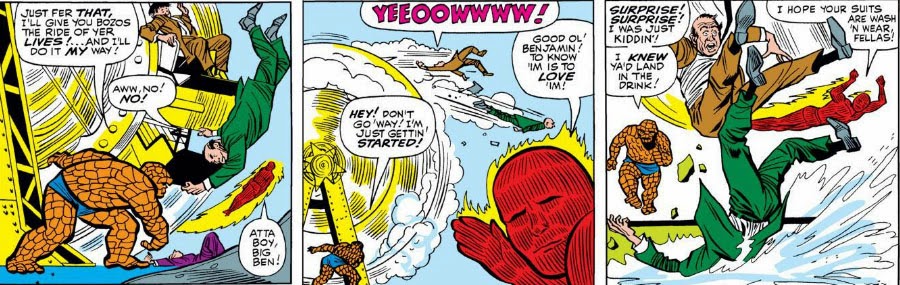
The Beatles were already well back in the UK by this time, so Marvel was a little late to the party; still, by the time of publication, the singing group had reached the height of their popularity in the states, and the Thing and the Torch on a comic book cover wearing Beatles wigs could definitely still tap into a great deal of fan frenzy from comics readers.

The story itself was all in good fun, as many Strange Tales stories featuring Ben and Johnny as a team tended to be. The pair "meet" the Beatles courtesy of their girlfriends, who manage to coerce them to see their show:


The Beatles themselves, however, are really featured only in passing, since the Torch and the Thing have to go into action shortly after arriving:


From there, we find ourselves watching this half of the FF facing off against gunmen who give them far more trouble than they should be capable of:


And just watch how the Torch breaks the fourth wall, which may be a first for a Marvel story:


At the end of the story, the pair return to the auditorium to finally see their idols perform, and the scene perfectly caps the comedic flavor of the tale:


Of course, with Ben and Reed being around the same age, we might have to face the prospect of Reed trotting out his own Beatles wig someday. Let's hope he had the good sense to dispose of it. We'd all probably be delighted to discover he mailed it anonymously to a certain Latverian monarch.

Thursday, January 6, 2022

The Old Order Changeth, Part 2--1982-1991

 
OR: "Rage Meets His Match" (and then some)


This week, the PPC has taken a look at the progression of Avengers lineup changes as seen through the eyes of not only news reporters but also the average Joe on the street, as the announcement of new Avengers steadily grew into a media event that was highly anticipated by anxious viewers and crowds (to say nothing of villains who still had the Avengers in their sights). We also learned that not every lineup change resulted in a public announcement and/or media coverage, as, in many cases, a number of shifts in membership took place behind closed doors, skipping the media frenzy entirely.

Having covered these new lineup debuts during the period of Avengers history from 1963-1981, we now pick things up nearly a year later, as the team attempts to pull itself together following some disturbing episodes that involved two of their own. First, Henry Pym, aka Yellowjacket, has badly damaged both his professional and personal standing with the Avengers by taking rash action toward an aggressor during a heated battle, prompting a court-martial during which he completely disgraced himself--compounded by the revelation that he struck his wife, Janet van Dyne, while preparing for the proceedings. With Pym subsequently expelled from the Avengers, the team turned its attention to the errant Moondragon, who used her mental powers to take over an alien world and, later, kill her own father.

Pym's troubles were certainly fair game for the media, particularly when he later went on trial over a charge of treason for committing a federal crime. Moondragon proved to be another matter, however, as Thor saw to her punishment by having her answer for her behavior to the lord of Asgard, Odin, rather than any authorities on Earth. Yet now, the team resolves to put their house in order and move on--which fortunately means sweeping the book's readers into what will hopefully be a pivot toward better days ahead.


Monday, August 14, 2017

The Told And The Untold


"By October 1979, morale at Marvel was low enough to attract the attention of The New York Times, which quoted anonymous staffers grousing about middling-quality comics and a focus on licensing toys and Sharpee cups and bath towels." -- Sean Howe


Slowly but surely I've been making my way through Sean Howe's 437-page book from 2012, Marvel Comics The Untold Story, which I unwind with just before bedtime. I enjoy reading very much, but if I don't set aside time for a book, I never have the time to sit down with one; the fact that I picked up Howe's book years ago and am only now plowing through it should tell you something. Also, I'm one of those people who becomes so relaxed by rare moments of "down time" that, unfortunately, I can only read a few pages of a good book before I feel myself losing focus and inevitably nod off. (You can imagine how long it took me to get through a stack of comics for the week. Answer: a week.) With all due respect to Mr. Howe, his book is a page-turner, but not one which I could apply the phrase, "you can't put it down" (though that doesn't diminish his work in the slightest). But for what it's worth, it does occupy a place on my nightstand, an honored place for any tome as nightstands everywhere can attest.

Lately, the book has been helpful in bringing to light and exploring fascinating information from behind the scenes of Marvel's production process, such as Sal Buscema taking off the gloves on an issue of Incredible Hulk, for example--though I've found myself raising an eyebrow at times during the reading process. Howe has been diligent in documenting his sources from quoted material--yet there is an almost necessary tendency for any author of biographical or other nonfictional material to fill in the blanks in an effort to provide the complete picture, and that can often take the form of speculation or conjecture, even taking into account "the personal recollections of more than 150 individuals, and relatives of individuals, who worked at or with Marvel Comics," as Howe states in his acknowledgments. (I haven't conducted a fraction of the interviews that Howe has, and look how often I've indulged in conjecture.) There's a point, for example, in litigation where counsel will at times object to testimony and note that "the witness is drawing a conclusion," which cautions that the witness's opinion is essentially that of a lay witness, not a person qualified as an expert; in other words, they can testify to facts, but not offer opinions, inferences or conclusions. In Howe's case, I have to take what supposition he offers with a grain of salt. His interjections make for interesting reading, but what I'm reading may not necessarily be factual. Even quoted material can be suspect; for instance, a passage in the book that reads, " 'I saved Marvel's ass,' Kirby told an interviewer...", which Howe documents in his notes as originating from an "Unpublished Leonard Pitts interview with Jack Kirby." Putting aside for the moment that the key word there is "unpublished," the reference could also be interpreted as the comment possibly having been declared "off the record" at the time of the interview, which calls into question not only its authenticity but the decision to deem it repeatable in a book being prepared for publication.

The behind-the-scenes nugget that's the subject of today's post is a good example of how connecting the dots can take a zig-zag route and have one wondering if the facts are adding up correctly; yet the foundation of the actual chain of events, at least, is stable enough to recount. The situation dates back to when the decision was made to bring the character of Jean Grey back following her demise in 1980 after artists Bob Layton and Jackson Guice successfully pitched to Editor In Chief Jim Shooter the idea of reuniting the original team of X-Men for the new X-Factor title, a concept that carried the potential of a marketing juggernaut. Even Chris Claremont, who initially resisted the idea, came on board with it--and after taking the crossover frenzy of the reading list leading up to X-Men #200 off his plate, he was curious to see how FF writer/artist John Byrne was handling Jean's reintroduction in Fantastic Four. And that's where the fun begins.

"Claremont took a look at how Byrne was handling the backstory of Jean Grey in Fantastic Four and petitioned Shooter for a chance to rewrite Byrne's two-page flashback sequence, which X-Factor penciller Jackson Guice then drew in his best faux John Byrne style. This was Shooter's chance to appease his star writer, still stinging from the way Jean Grey's return had been commanded, and even John Byrne didn't have enough clout to stop it."

Wednesday, December 18, 2019

Day Of The Avengers... Day Of Death!


The celebrations of Avengers Day have been few and far between on the printed page since its proclamation in the fall of 1967--but in 1998, writer Kurt Busiek and artist George Perez arguably make up for that in spades in the tenth issue of the rebooted Avengers series, where the team basks in the adulation of the citizens of New York in the wake of the heroes' return from their apparent sacrifice during the conflict with Onslaught. This time, we find Avengers Day culminating in a parade through the streets that might make the Macy's parade look tame by comparison.


By now, the uniqueness of the Avengers in terms of the media frenzy surrounding their public appearances and their lineup changes has been overshadowed by a running joke regarding their swelling ranks, where one often wondered if there was anyone by this point who hadn't become an Avenger. Yet the media reports* still offer a perspective that's quite different than the one we readers experience with our unlimited access behind closed doors--and at times like these, it's fascinating to observe the speculation and observations of those who only know the Avengers from the reports of their exploits and announcements.


*Props to the Stunt-Master for appearing to have finally found his calling! (If only briefly.)

By "the Avengers have counted among their number," we're left to assume that Busiek refers to not only the Avengers but all who have fallen within their orbit; otherwise, there are seventeen characters** pictured in the full-page assemblage above who had not been inducted as Avengers by this point in time, if ever--although "counted among their number" certainly implies membership. It's not important to settle the issue here and now--but later in this story a few of Busiek's inclusions will be somewhat distracting.

**At least by my own count--out of curiosity, what's your tally?

But there is an Avenger in the team's current lineup who isn't present in these festivities, someone who has been distracted in her own right by her encounter with sorceress Morgan Le Fay in the 6th century--or, more specifically, Morgan's power, which has inadvertently caused her own mutant abilities to show disturbing signs of evolution. She has also become concerned with her startling ability to summon the deceased Avenger, Wonder Man, back to the world of the living when the need arises (or even unconsciously). And so the Scarlet Witch seeks counsel with Agatha Harkness, a woman who has previously guided Wanda in the use of her power, and who now implies that Wanda has contacted her not a moment too soon.

Monday, November 21, 2016

When Falls An Avenger!


Unquestionably a landmark issue, Avengers #213 holds a historic place in the team's annals, beyond and apart from the lineup changes that in the decades prior to the 21st century defined significant moments in Avengers history--marking and celebrating the passing of the torch to new Avengers who would establish their own legend. In this story, however, there is no media frenzy, no heady sense of anticipation, no excited crowds--instead, there is a pall to the current proceedings that are held behind closed doors in their Fifth Avenue mansion. The Avengers hold their first court-martial hearing of one of their own, accused of improper conduct on a mission and subject to expulsion if found guilty. Even more eye-opening is the fact that the accused is not some rookie whose inexperience and lack of discipline led to disaster, but one of the team's founding members--Henry Pym, now known as Yellowjacket, whose long service to the team has been distinguished up until this point.

Pym has only recently returned to the Avengers following a new shake-up in membership; and while his wish to rejoin the team was met with a general "welcome back" response that lacked fanfare but acknowledged a returning member who has more than proven his worth, we would soon see that Pym seemed overly eager to make a contribution to the Avengers this time around, his laboratory work having failed to meet his expectations during his inactive status combining with feelings of inadequacy stemming from living off his wife's fortune. In Pym's mind, the Avengers offered a return to prominent status, as well as opportunities to excel in a group setting that would allow his talents to stand out and to once more be at the forefront of solving a crisis.

Nor could Pym be in better company to receive affirmation of whatever skills he would bring to the table. Except for the Hulk, whose (you'll excuse the word) signature on the Avengers charter barely had time for the ink to dry before he angrily departed, and Tigra, who joined the team at the same time Pym returned, this Avengers lineup consists of all the original members (with Captain America retroactively designated as such), men and women (er, woman) who already know and respect Pym and who won't fail to regard him as an equal. Unfortunately, Pym doesn't take this for granted, and feels he must push things along in that respect.

What happened in the prior issue to bring us to this point is something we'll let the preliminary proceedings establish. For now, suffice to say that the mood within Avengers Mansion is tense--not only setting a precedent for convening a court-martial, but throwing the book at a founding member. Only Iron Man has been the subject of formal disciplinary proceedings, a failure to answer an Avengers summons which resulted in a one-week suspension from active duty; in contrast, Yellowjacket stands accused of misconduct in the field, a far more serious matter since his actions escalated a battle that was on the verge of being halted. And so a momentous hearing is held to review the charges and Yellowjacket's response to same.


It's evident that Yellowjacket understands his personal failings in this matter; what's interesting is that he declines to explain himself, even though it's clear that his response (or lack thereof) will determine whether the Avengers convene a court-martial. Given his status as a founding member, and the fact that those facing him are his comrades and friends who no doubt want to make every effort to help him, offering an explanation of his actions would go a considerable way toward avoiding having this process proceed further--yet Pym's thoughts indicate that he's perhaps too embarrassed, even ashamed, of his behavior to lay his cards on the table. Which unfortunately leaves the Avengers no choice in the matter.


To the Avengers, it must seem as if their friend has no excuse for his behavior in the field, which, lacking an explanation, amounts to a lapse in judgment and, by extension, an avoidable mistake. When the Avengers reconvene, will Yellowjacket see it that way?

Wednesday, April 11, 2018

The God Killer!


Things didn't look hopeful for the Black Panther following his rematch with Erik Killmonger, which saw him regain consciousness in the harsh sub-frozen mountain region where he'd tracked his ruthless foe only to be set upon by a pack of wolves, an encounter which he barely escaped with his life. With his uniform ripped and leaving parts of his flesh exposed to the elements, and far from any safe haven, that life seemed in danger of not surviving the night--so it's surprising indeed to open the issue and find that the Panther not only lives, but has stalked his way back to Resurrection Altar, the cavern where another of Killmonger's subordinates, the mysterious Sombre, exposes others to rays which transform them into something more (or, in some cases, less) than human.

As "Panther's Rage" continues in Part 8, the Panther is ready for Round Two with Killmonger--but in his foe's absence, he'll have to settle for those who aided Killmonger in abandoning him to the wolves, men who will learn that even this wounded and weather-beaten king can still strike back.


Unlike Tayete and Kazibe, the fretful lackeys of Killmonger who reluctantly accompanied T'Challa to this harsh clime, these men are armed and dangerous. For himself, the Panther can only lay claim to the latter, but those he struggles with find it's enough; and as that struggle plays out, we have a few questions answered which lingered over the events of Part 7, points that address not only how the Panther managed to survive (by taking a leaf from Han Solo's book, no less), but also why Resurrection Altar hasn't proven to be more of a boon for Killmonger's plans.


Obviously the tracks which T'Challa follows weren't left by Killmonger--but he follows them impulsively nonetheless, towards a destination that will bring him face-to-face with certain myths of his people, "gods" which will unfortunately take deadly, living form.


Monday, January 3, 2022

The Old Order Changeth, Part 1--1963-1981


With all the fanfare and media frenzy that typically takes place before the announcement of a new Avengers lineup, it's a wonder that we didn't see more of that sort of story during the twenty-three years of the book's first run, particularly since such an "event" does a fair job of sweeping readers up in the anticipation. Yet there's something to be said for "less is more," a phrase which applies to so many things but can be especially true in this case since not all lineup changes merited news crews and rampant fans descending on the corner of Fifth Avenue and 71st Street. I don't recall the Fantastic Four making news with their own lineup shifts, whether temporary or long-term, though they didn't exactly lack for news coverage given the public's continuing fascination with their lives (and certainly their headline-worthy exploits); while the Champions, with a PR person on their payroll, depended heavily on news conferences to establish themselves (for all the good it did them).

As for the Avengers, in researching this subject it was interesting to compare the times when a lineup change resulted in new members being formally introduced to the public, vs. the situations where it would have been unwarranted for the writer to craft a story where the Avengers felt they should send out press announcements that a lineup change was being deliberated. If you're a longtime Avengers reader, you know precisely which story started the ball rolling where Option 1 was concerned.