Wednesday, May 8, 2019

The Inevitable, Explosive Return of Nitro!


While the man known as Nitro may have gotten off to a slow start as a presumed agent of the Lunatic Legion, he's unquestionably attained a lot of mileage out of his super-power, along with no small amount of notoriety. A villain who can detonate himself and reform at will, Nitro holds two main claims to fame (or, rather, infamy): being the catalyst for the events of Marvel's mega-event, Civil War (and, by extension, the Superhuman Registration Act), when he exploded in a populated area and caused over 600 deaths (including 60 school children)... and secondly, for precipitating the accident which resulted in the escape of deadly nerve gas that would eventually lead to the death of Captain Marvel.

Yet well before Mar-vell would become aware of his fatal diagnosis, he would meet Nitro again in battle, though not before the nascent hero named Omega the Unknown dealt him a setback:


Nitro, like the Sandman, Hydro-Man, et al. who have had their forms dispersed at one time or another, is well suited to being re-used as a threat in perpetuity without any major complications--brought into a story, apparently dealt with for good, and then inserted into another story at some future date.  (I.e., detonate, rinse, repeat.)  In Nitro's second meeting with Mar-vell, we only have to wait awhile until he can reassemble himself and return from the stratosphere--this time explosively impacting in the sheep meadow in Central Park, which is Nitro's way of surviving the fall back to Earth.


Apparently, Omega has been put on the back burner as far as Nitro's concerned.

As for Mar-vell, we catch up with him following his resolution to make a life for himself on Earth--and is he off to a good start on our planet. Look how quickly he gets the hang of taking what doesn't belong to him without recompense:


But he's not in civilian garb for long, since Nitro is intent on smoking him out. And where there's smoke--and a deafening explosion--there's in this case Nitro, who's crazed to deliver some payback to our hero.


For what it's worth to Nitro, Omega has met his death by this time, so that's one less thing on his sadistic to-do list. The question is, can Mar-vell put a halt to Nitro's current rampage and truly bring his threat to an end?

Without knowing it, Mar-vell takes a leaf from Omega's book, though with a clever twist--a way to partially contain Nitro's essence and thus nullify his ability to re-form.


Regrettably, Mar-vell has reckoned without the resourcefulness of an attorney working on behalf of Nitro's daughter, who has him freed from his subsequent incarceration at Project Pegasus. And taking a glance at the covers of the two respective stories 3½ years apart--in particular their "coincidental" issue numbers--writer Roger Stern seems to have stumbled upon an old Captain Marvel issue at just the right time for his Spidey story, eh?


BONUS!

Thirty-five years after putting this story to bed, writer Scott Edelman makes the connection between artist Dave Cockrum's last-minute substitution for the final page to this story by George Tuska and Captain Marvel's debut cover from 1967.


Monday, May 6, 2019

Days Of Future, Doomed


There seems to be no question that the two-issue "Days Of Future Past" story from 1981 was one of the high points of the Chris Claremont/John Byrne/Terry Austin run on Uncanny X-Men--taking place shortly after Storm had assumed leadership of the team following the departure of Cyclops, and the story playing a major part in helping to pivot the book toward a deeper focus on national anti-mutant sentiment. As something of a footnote, it would also mark the last days of Byrne's and Austin's work on the book, with this being their penultimate story for the title before closing out what would be regarded as a distinguished body of work.

The focal point of what comes to pass in this story is Robert Kelly, a U.S. senator (and presidential candidate) who is holding hearings in Washington on the growing number of super-powered mutants in the world. The general impression of Kelly is that he is a "decent man," with legitimate concerns, though whether that's an accurate assessment is arguable; but it becomes a moot point when the Brotherhood of Evil Mutants arrive to assassinate Kelly in order to send a strong message of intimidation to homo sapiens on behalf of homo superior.

In the events that would take shape as a result of Kelly's death at the hands of mutants, to say that the Brotherhood's act backfires is an understatement, with public opinion taking a sharp turn toward increasing fear and hatred of mutants. Four years later, voters elect into office a rabid anti-mutant President who ramrods through legislation designed to place harsh restrictions on those who identify as mutants; but when the so-called "Mutant Control Act" fails to survive a challenge at the U.S. Supreme Court level, the White House commissions a new line of Sentinels programmed to eliminate the mutant menace. That action leads to another backfire, this time one that would sweep up humans along with the intended victims of the purge. To accomplish their directive, the Sentinels decide to effectively take over the entire North American continent, while eliminating not only mutants but also any non-mutant super-powered individuals who impede their progress.

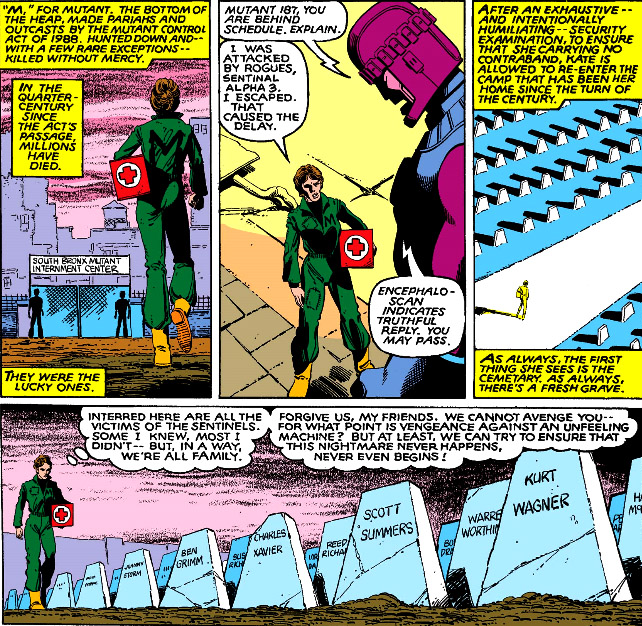
By 2013, humans on the continent are closely overseen by the Sentinels--the population in survival mode, their cities in a state of disrepair, while gangs roam the "uncontrolled" zones and resistance cells attempt to make some sort of headway against the metal overseers. We have only to look through the eyes of Kate Pryde--a mutant that X-Men readers would of course know as Kitty, aged thirty-three years--to see what human fear and paranoia have wrought.


(While the sight of rows of the dead admittedly make for a stunning visual, why would the Sentinels bother with interring their victims? To say nothing of erecting headstones? Some way of underscoring the point that resistance is futile? Wouldn't the fact that they accomplished their directive and are in complete control have sent that message already?)

Yet as bad as things are, the true crisis arises as the Sentinels prepare to move beyond North America and extend their directive to the rest of the world, prompting the other countries to threaten a full-scale nuclear reprisal in response. And so the crux of this story has Kate becoming part of a plan conceived by the few other surviving X-Men in internment to telepathically exchange her consciousness with that of her younger self in 1980 in order to warn the X-Men of the Brotherhood's plan and avert the assassination attempt, thereby preventing the sequence of events that will culminate in the world's destruction. Meanwhile, Kate's comrades in the future will attempt to cripple the Sentinel operation by targeting their continental nerve center, the Baxter Building, so that the metal titans are unable to initiate their expansion and trigger nuclear armageddon.

Both missions are longshots--and the cover of the climactic issue unfortunately offers foreboding overtones in terms of how it will all end.


Friday, May 3, 2019

By Crom, it's sword vs. shield--in 1984!?


And then there was the time when Captain America battled the leader of the Barbarians, a new street gang in New York.

You might know the fellow as Conan the Barbarian.
(Brought to you by Peter Gillis and Bob Hall.)


Wednesday, May 1, 2019

May The Best Team Win!


The scenario that greets your eyes when glancing at the cover and splash page of Fantastic Four #43 must seem shocking, indeed--the FF sprawled amidst the wreckage of an apparent battle, while, inside, Sue Storm and Reed Richards, with the Thing in tow, fleeing for their lives from the Wizard, who is issuing pursuit orders to... the Human Torch? What is going on here?


Fasten those seat belts, and we'll find out!

Monday, April 29, 2019

Victory Once More for the Frightful Four!


While I've never made a top ten list of my favorite comics stories, I feel confident in saying for the record that I can place in my top five list the 1965 three-issue story arc which features the Fantastic Four in their third and final battle with the original Frightful Four, a masterpiece of storytelling by Stan Lee, Jack Kirby, and Vince Colletta that cooks on all cylinders and would finally settle accounts between the FF and their evil counterparts who had defeated them in the past--and, in this no-holds-barred struggle, very, very nearly manage to do so again.

Over time, the Frightful Four would become less noteworthy as their ever-shifting lineup became a revolving door of villains in attempts to establish new chemistry between their members, their criminal endeavors countered by either the FF or others who were less impressed by their threat. But in '65 they were a formidable threat that became a dogged menace to the FF--a group of unsavory characters who really didn't get along under the same roof but were kept in line by the Wizard, whose ruthlessness could match their own and who provided direction and tactics that balanced their abilities and made them dangerous adversaries. Banded together, they were villains to the core, sniping at each other and jockeying for position, but who put their bickering aside when it was time to unite and take down their foes.

This story saw them at the peak of their powers and villainy--and the Fantastic Four were frankly in no shape to face them. The Thing, barely able to walk following a one-on-one battle with Doctor Doom, bitterly leaves the FF for good--which not only leaves his former partners at their most vulnerable.  And as we'll discover, that assessment might hold true for himself, as well.


For their part, the rest of the FF, understandably downcast about the circumstances of Ben's departure, turn their attention to picking up the pieces in the wake of their conflict with Doom; but following a visit from the tearful Alicia Masters, they begin a search for the Thing in order to make certain he needs no medical care. Unfortunately, just to show you how small a world it really is, another group happens upon him first--and what treatment they intend for him remains to be seen.


Wednesday, April 24, 2019

Land Of The Pharaohs!


It's always a treat to pick out a Roger Stern Doctor Strange story for a PPC review (and, honestly, that goes for just about any Roger Stern story), but this particular story brings double the pleasure since it cleverly intersects with a classic Fantastic Four tale from 1963 and breathes new life into a plot that has over twenty years of dust covering it. And considerably more dust than that, considering that Strange and the FF are showing up in the year 2940 B.C.!


We know from the original tale that the FF have used Dr. Doom's time machine to investigate ancient hieroglyphics that indicate the existence of a substance which restores sight to the blind, in the hope of using it to treat the Thing's girlfriend, Alicia Masters. But what interest does that hold for Dr. Strange?

Monday, April 22, 2019

Quod Sum Eris


We're hip deep in a story by Jeph Loeb and Simone Bianchi that has Wolverine seeking out the meaning behind surfacing memories which appear to involve not only Victor Creed, a.k.a. the bloodthirsty Sabretooth, but also a new evolutionary species known as the Lupine. Part 1 saw that mystery bringing Logan and Creed to Wakanda, where it appears the Black Panther and his consort, Storm, are pursuing similar leads on the Lupine thanks to archaeological findings in an elephant graveyard. Creed, who hasn't been exactly forthcoming with any information which might help Logan decipher the meaning of it all, has at least acknowledged a latin phrase which appears to be at the root of the mental turmoil which Logan has experienced of late--Quod sum eris, "I am what you will be," a taunting statement from Creed that "the stretch of road ahead of you ends up lookin' like this" (meaning, himself). It's a claim that Wolverine understandably rejects outright.

But what of this bizarre collage of flashbacks that have been triggered by Logan's encounters with Creed? Behind them seems to be the most elusive key of all--a man named Romulus, a hulking, formidable figure whom Logan has "remembered" from a Colosseum setting and appears to be thousands of years old. And there will be more links to the answers he seeks as this story continues.

Friday, April 19, 2019

Wolverine vs. Sabretooth: The Final Battle!


Much is usually anticipated about the fierce and decidedly bloody clashes between Wolverine and Victor Creed, the man known as Sabretooth, even though these men are arguably two sides of the same coin. Each of them has deadly claws that rend and draw blood; each has a generous amount of fear and intimidation working for them; each has a healing factor that prevents them from being mortally wounded (eventually reaching preposterous levels of effectiveness); and each has killed and will kill if the situation calls for it. Yet there are differences, as well: Logan's skeleton, as well as his claws, are made of the unbreakable metal known as adamantium; and while there have often been instances where he's been shown to be merciless, he's not nearly as sadistic as Creed, who will not hesitate to kill even when there is no reason for it. Perhaps the difference that keeps us engaged, however, is the fact that, while crusty and irascible even on the best of days, Logan isn't volatile--and rather than looking for a fight, he'll often look to avoid one (though he's certainly no slouch at provocation). Creed, put bluntly, is a monster, who will gut innocents with little thought or consideration beforehand, depending on his mood or what message he wants to send.

Yet, character differences aside, when these two are locked in battle, what can come of it, given that the most they can do is slash and maim? A chance to see how their artist will handle their match, no doubt--and a great deal of posturing and threats on both their parts, to be sure. But since there's little to no chance of one dealing fatally with the other, their clash often comes down to a battle of wills, and essence. We know we can expect little more than sadism from Creed; but from Logan, his anger and trademark fierceness (and yes, bloodletting) are channeled into stopping Creed's killing spree and ending his threat, while hopefully coming out of it without seeing more of Creed in himself than he'd like. And that's essentially the approach in their early appearances in Uncanny X-Men--where it's probably no coincidence that these particular two characters are unleashed against each other just when Marvel's books have taken a sharp turn toward bringing more graphic violence into their pages with the appearance of the Marauders and the wholesale slaughter of innocent men, women, and children.


Wednesday, April 17, 2019

"...And So It Ends!"


For the Fantastic Four, things were about as dire as they could be, following a fierce struggle with one of their own--Ben Grimm, the Thing, who had been turned against them because of the Mad Thinker's interference with a procedure meant to revert him to his human form. But the danger of their situation only increased when the arduous battle left them vulnerable to an attack by the Thinker's killer android, which enters the scene to find only one of the FF standing to meet its threat.


But how can Sue Richards prevail against one of the Thinker's deadliest, unliving creations? Let's find out, as we reach the climax of a four-part story where the Fantastic Four must pick up the pieces from the Thing's brutal assault only to find themselves virtually helpless against a new, super-powered threat--and while the fate of Ben Grimm remains uncertain, the Invisible Girl battles alone!