Wednesday, May 9, 2018

Four No More!


With the fabulous Fantastic Four having gone through their share of breakups, it can be difficult to sift through them and find one story that stands out from the others, a task usually complicated by the fact that any story featuring the FF breaking up is always hard to swallow. But a Len Wein story from early 1978 takes a little more care with the concept, and genuinely attempts to give the impression that this time the FF have every intention of parting company for good.


It's an issue that differs from others where, for instance, a team member has left in anger or frustration, or special circumstances have forced the decision. This time, the decision has been mutually accepted, if grudgingly, following the discovery that the team's leader, Mr. Fantastic, had lost his stretching power and that he couldn't continue to function in the field without being a liability to the others. And with Reed's departure, his wife, Sue, has also made the decision to leave with her husband, so that would seem to be that. Yet it all feels a bit rushed. Why take the extreme step of disbanding the FF? Sue is only leaving because Reed is--but does Reed have to leave the Baxter Building? He's not going to cease being an inventor, is he? Why leave the state-of-the-art R&D facility he's already built for himself? And while Reed is irreplaceable in the eyes of the others, no one even takes five or ten minutes to give any serious thought to a new team member.

We've already seen the Thing giving us his own account of the FF's tumultuous history, as a prelude to this issue--and now, with everyone on this former team resolved to going their separate ways, there's only the matter of packing up and saying goodbye.


So perhaps this really is

(Well, by now it's turned into the shocker we never thought we'd see so often.)

Tuesday, May 8, 2018

After The Rage


With the events of "Panther's Rage" having at last reached their conclusion, we rejoin the Black Panther two months after the fierce raid of Erik Killmonger virtually wiped out all that stood in central Wakanda, as its ruler and its people begin putting their country and their lives back in order. Writer Don McGregor appropriately titles the story "Epilogue!", though an exclamation point seems out of place considering the destruction and loss of life; perhaps it's in the spirit of transition, and moving on. Yet while there is no celebratory spirit resonating among the Wakandans, there is no cloud of sadness hanging over the country, either; rather, the mood is one of resolve and continuation, for the traditions and commitment of these proud people endure and will be reclaimed. Lives have been upended, but not abandoned.

The story spends less time than you might expect on the characters "picking up the pieces," so to speak, from the prior issue, though we can easily presume that much of the labor and administrative tasks have been well underway for the past sixty days. That leaves just a few loose ends to tie up that involve secondary characters. For instance, the former operative of Killmonger known as Venomm, who intervened in the final battle when another operative, King Cadaver, attacked the Panther's communications commander, Taku, whom Venomm had struck up a trusting relationship with during his incarceration. We don't know the extent to which Venomm may have worked against Killmonger's interests that day; perhaps he simply abstained from further action on Killmonger's behalf.  Whatever occurred, it's clear that he's being released, perhaps even on his own recognizance.


The mixed signals McGregor and artist Billy Graham are sending in regard to Venomm's current status don't leave enough room to speculate much further on the subject. Led around in chains (wouldn't handcuffs do?), Venomm appears to still be considered a threat in the eyes of Wakandan authorities--yet the Panther is supplying a craft to return him to America, in essence letting him go free (unless he's being extradited, in which case he would have remained bound). At the very least, his departure provides one last look (in the truest sense, as it turns out) at the hapless trials of Kazibe and Tayete, formerly in the service of Killmonger but in time rejecting their allegiance to him.


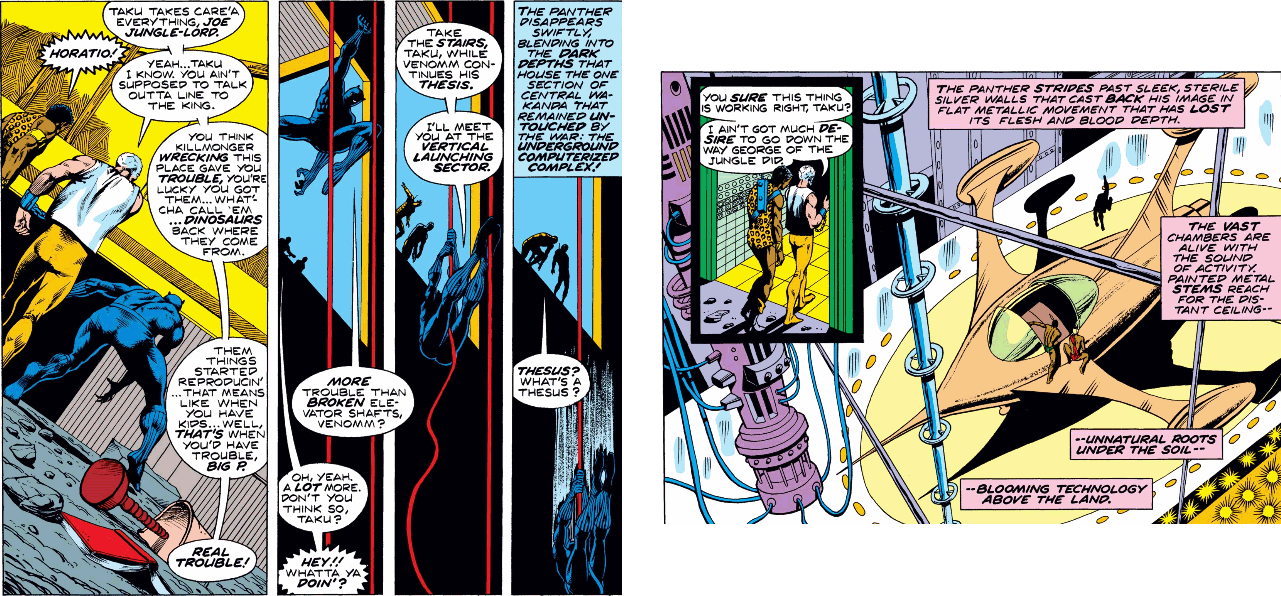
There is also T'Challa's security head, W'Kabi, to check in on, who fell victim first to Venomm and then became further injured when one of Killmonger's dinosaurs crashed into the hospital where he was recovering. Today, we find him not only having lost his family, but something that even Wakanda's technology can't fully replace.


Later, W'Kabi joins the Panther in investigating the deaths of two men, whose murders are in the style of one who was only recently dealt with. Both men, unfortunately, will fall to the merciless foe who ordered these recent deaths--or, rather, the one who acts in her name.


The story of the man called Mute and his mistress, Madam Slay, has already been recounted elsewhere in the PPC, serving to bring to a close this saga of over two years which became a well-regarded feather in the cap of McGregor, Graham, original artists Rich Buckler and Klaus Janson, and Graham's predecessor, Gil Kane.


Along the way, there were some noteworthy moments in "Panther's Rage" aside from the pages of the story itself. Additional insight into the story's plot and implications could be found in the book's letters pages, which, thanks to its bimonthly publication, were printed with as little as a two-issue gap between story installments rather than the usual four. There was unfortunately limited space for letters, for the most part; in fact, it's a fair observation that with a few less "filler" pages (as one letter-writer put it) of artistry and recaps, letters pages could have been expanded more frequently. In addition, many letters pages featured letters from the same writers repeatedly--among them Dean Mullaney, Ralph Macchio, and Peter Gillis (the latter two you may recognize as future Marvel Comics writers); it would have been nice to hear from a broader spectrum of readers, particularly since there was no lack of notices reminding readers that voicing their thoughts on stories made a real difference. (Though even one of Macchio's letters was omitted due to space limitations, it should be noted.)

And speaking of Machhio, he had the following food for thought on the deeper role that the boy and unexpected hero of the story's climax, Kantu, seemed to personify.

"When Erik Killmonger is pushed off the precipice in the climax, he is not pushed by either the Black Panther or Kantu. He is forced over the edge by the basic id portion of the Wakanda chieftan, T'Challa, for in truth, that is what Kantu really is. ... T'Challa and Kantu are inexplicably entwined, for each is but a different side of the same coin, with each emerging dominant in response to a given situation."


There were also two Editor forewords from those pages that followed the series and gave a virtual "Whew!" to the effort involved. Distilled and consolidated, they read as follows:

"It's all over.

"Two years and 209 pages later, the concept that began back in 1973 is finished. Oh, that concept changed subtly with the passage of time, as ideas reached their moment to become comic book reality: and the initial thrust expanded with each new chapter, sometimes adding more sagas to the entire "Panther's Rage" than had been originally planned: but even with the changes and expansion, it has ended.

"Don didn't realize what a controversial hornet's nest he was ramming into when he had T'Challa saved by that 'younger version of himself,' Kantu. Some were outraged by it. Some thought it negated the entire series. Others claimed that they didn't care how it ended except that was a stupid way to end it. On the other hand, there were positive responses also, and many of them, especially, were from you people who have been steady followers of the Marvel mythos."

Finally, to close out these PPC posts on "Panther's Rage" (and may I repeat:  "Whew!"), a sampling of splash pages which highlight the art of the letterer, so nicely coordinated with the work of Buckler and Graham.


Monday, May 7, 2018

Kantu's Rage!


It's time to finally polish off the series of PPC posts which have dealt with the 1973-75 story arc known as "Panther's Rage," a tale which somehow hung onto the readers of Jungle Action who at the time had to wait two months (or even longer) for a new story installment to be published. At the center of this conflict are the Black Panther, who headlines the book and who has returned to Wakanda to find it has come under attack by forces that are wiping out whole villages--and Erik Killmonger, the one who has launched a "revolution" against T'Challa's rule and is intent on taking down both the Panther and his legacy. Throughout his assault on Wakanda, Killmonger has made use of a number of operatives who are committed to his goal, some of whom have been altered or otherwise enhanced by rays emanating from a fallen stellar fragment; others are augmented by special weaponry, backed up by cadres of "death regiments" who specialize in their obvious vocation; while some, like Venomm, have certain talents that appeal to Killmonger's modus operandi in conquering Wakanda.

Over the course of this series, we've seen Killmonger move his forces around methodically, taking advantage of Wakanda's own weapons caches while also mining its Vibranium--always building toward a final power play that, with the conscription of the prehistoric beasts that roam Serpent Valley, is now at hand.


Friday, May 4, 2018

Snakes On A Plain!


We've at last come to the penultimate issue of the "Panther's Rage" storyline in Jungle Action, the calm before the storm which finds central Wakanda's security cells practically overflowing with nearly all of Killmonger's confederates (with the prickly archer known as Salamander K'Ruel being the most recent addition). Yet if you're thinking that this means that Killmonger, the instigator of this coup d'état against the Black Panther, will be more of a presence in this issue than in his sparse appearances throughout this saga--well, that would be a normal expectation to have at this stage. Instead, writer Don McGregor chooses to revisit the first Killmonger operative we encountered, Venomm, and make him the story's focus. In other words, you won't see Killmonger at all; but you will see much more of Venomm and his snakes than you did his first time at bat. If you don't exactly feel giddy at that news, put 'er there, pal.

In a way it feels as if McGregor is trying to close a circle with Venomm that doesn't really exist; yet there is closure that can reasonably be expected from the few segments he's featured in prior installments of this arc where the Panther's communications commander, Taku, has struck up conversations with the incarcerated Venomm and acted as a sounding board for the man's anger and frustration at his circumstances. Not quite a friendship, but more than words between jailer and prisoner. Venomm, however, has warned Taku that he'll eventually break out, and that he wouldn't hesitate to deal with Taku should the man get in his way. Unless there's so much action in the upcoming Part 12 to make it impractical, McGregor could likely have waited until then to pursue (and, if necessary, condense) what he has in mind for Venomm--but by the look of this issue, it seems that he's had this resolution for Venomm cooking in his head long enough for it to merit a story of its own. And perhaps it does feel that way, in McGregor's eyes. Your mileage may vary.

That story begins almost immediately--that is, after the first five pages catch us up with this book's starring character, the Black Panther, having returned at last to Wakanda following his trials in Serpent Valley and the northern region of the white gorillas. There can be little argument that he deserves some down time, even with Killmonger's threat looming--and he and his lover, Monica Lynne, make the most of it, courtesy of resident artist Billy Graham whose full-page work continues to impress.


Suffice to say that you haven't seen down time until you've seen it in Wakanda.

Wednesday, May 2, 2018

Target: Rogue!


As the catalyst for a 40-issue stretch that shifted the X-Man, Storm, to operating in the field without the use of her powers--a period that for readers lasted over three years, but only a few months in X-Men time--Uncanny X-Men #185 has a good deal more to offer for those following the progress of Rogue, the newest X-Man who joined under protest and still isn't sure that she belongs in the company of heroes. Adding to her conflicting feelings is the fact that Charles Xavier hasn't been able to help her in controlling either her powers, or the emotions and memories of Carol Danvers which now permanently exist in tandem with her own, a failure which probably astonishes anyone familiar with Xavier's abilities; after all, for such a powerful telepath, who can manipulate thoughts as adeptly as you or I might rearrange furniture, isolating Carol's thoughts while giving Rogue's dominance should be child's play. This was the man who psychically kept Dark Phoenix in check within Jean Grey, for pity's sake.

So this story serves to put Rogue in perspective, for readers and for herself, in setting her on the path to becoming an X-Man in not just name but in deed. Crucial to that shift for the character are the actions of Storm, the X-Man who had strongly opposed Rogue's addition to the team (to the point of issuing an ultimatum) but has grown to care for the welfare of this young woman who has proven herself with them. Though the excellent cover by John Romita Jr. might have us thinking that, for Rogue, the feeling isn't mutual!


Tuesday, May 1, 2018

Gather, Ye Witches!


Let's take a quick poll--c'mon, it'll be fun!

Question:  Out of all the foes the Silver Surfer has come up against, which would you want to see the most? And here's the cool part:  you only need to think of your answer!  Through the mental talents of Charles Xavier, we can tally all the thoughts of those taking part and automatically present the winning result below.  Ready? Take it away, Chuck!

"Gathering all thoughts... processing results..."

"Done."

Already? Then let's have a look at the winner, and...


...Wait, that's your choice? A witches' coven? Seriously?

My guess wasn't even going to be in that general neighborhood--
but we aim to please, so you got it!

Can I at least throw in the Abomination?

Monday, April 30, 2018

The Ultimate Reed vs. Namor Battle!


The matchup of Mr. Fantastic vs. the Sub-Mariner has always been one of the more unusual recurring clashes that Marvel has presented over the years; it's also, frankly, one that's difficult to look forward to with any feeling of anticipation, since it's almost always the result of tension between the two characters over their feelings for Sue Storm (Richards) rather than genuine enmity between two classic Marvel characters who each feel the other is a threat. Otherwise, their conflict is the result of Namor moving against the human race, with the rest of the Fantastic Four taking a hand in fighting him.

But as far as Reed and Namor being the headliners in a battle issue--chances are a reader is picking up the issue not because of the potential for a surefire, cover-to-cover blockbuster, but because they're wondering if the writer and artist are going to succeed this time in pitting a stretching man against the power of the Sub-Mariner, in a story that would hopefully go down as a classic. By 1996, you would have thought there had certainly been enough time for Marvel to figure out what worked and what didn't as far as pulling off a no-holds-barred Reed vs. Namor clash--and so, just a few issues before the events of Onslaught would effectively end the first run of Fantastic Four, the title took another crack at it, and we were presented with what was billed as "The Ultimate Reed vs. Namor Battle!"


(Though after so many misfires, such a claim may have been pushing their readers' status as "true believers" to the limit!)

Friday, April 27, 2018

Home Wrecked Home


Whether you're a new homeowner, or one who still has a ways to go in paying off the mortgage, or simply someone who's thinking about home ownership, you'll have to give some thought to things like plumbing repairs, or fixer-uppers, or location and property taxes, or at some point getting a new roof. But your worst nightmare by far will be opening your door one morning and discovering a drifter in your neighborhood, which normally wouldn't be a cause for panic--unless this drifter were a product of gamma ray exposure and could potentially level your most important structural investment with one blow of his trip hammer fists.


Since the Hulk's reputation for destructive behavior and being out of control generally precedes him, rather than those rare occasions where his interactions with humans have been benign, George's alarmed state is understandable; but while the other parents have kept their distance, George assumes the worst when the Hulk approaches his daughter and relates to her in a way that George is unfortunately unaware of out of earshot. Yet George and the Hulk share one thing: they act accordingly when responding to a perceived threat. Which one of them is justified in doing so in this instance is a matter of perspective.


Of course, by virtue of his incredible power, the Hulk has a way of settling a domestic dispute to his own satisfaction without doing much soul-searching regarding his methods.


Nevertheless, both parties suffer as a result. As a homeowner yourself, you may think it's obvious which of the parties here has suffered more--though again, perhaps that, too, is a matter of perspective.


That's not to say that homeowners don't have a case against the Hulk; on the contrary, the Hulk has uprooted enough lives in suburbia as well as whole towns and cities to merit his own dartboard in HOA meetings as well as insurer offices across the country. For those who have found their homes in the Hulk's path, the Hulk can represent not simply terror and destruction, but devastation. Imagine, for instance, feeling a little more secure in your homestead when the Hulk received a presidential pardon during the time when Bruce Banner's mind was in control of the monster--only to have that security, like your home, ripped apart when the Hulk reverted to an even more savage state and passed through your zip code.


Even when it seemed Banner had licked his problem for good, many who lost their homes and livelihood to the Hulk's rampages weren't willing to forgive and forget. Yet as he arrives at Kennedy Airport, could even Banner have ever expected the outrage still felt by some of those whose lives were shattered would lead to attempted murder??


Wednesday, April 25, 2018

Death From On High!


As we come to Part 10 of "Panther's Rage," the 1973-75 story which introduced the character of Erik Killmonger and his attempt to overthrow T'Challa's rule of Wakanda, the Panther remains in Serpent Valley where he tracked and dealt with Sombre, Killmonger's inhuman custodian of Resurrection Altar in the northern region where live the white gorillas of legend, and also learned of Killmonger's plans for harnessing the prehistoric beasts which roam the land. How much success he's having in tracking Killmonger is unclear; but a trio of Killmonger's men, led by the murderous Salamander K'Ruel (himself a product of the transformative rays of the Altar), have been left on their own to guard Killmonger's trail back to his home village of N'Jadaka.

The dangers that T'Challa will face in this particular story are two-fold, and are best represented by the issue's cover as well as its opening page: another prehistoric threat which this time descends on him from the sky, and one that approaches in stealth from the jungle in the hope of ending his life with one clean shot.


Tuesday, April 24, 2018

Ball of Doom!


When we last took a look at the scene of carnage near a demolished building under construction in New York City, the dynamic Defenders were in a pitched battle with the ones responsible for the destruction--none other than the Wrecking Crew, in their Marvel debut. The Crew's ultimate goal, however, was to locate a certain device believed to be at the site; and during a lull in the fighting, Thunderball recovers the object's empty casing, only to react in stark terror at the realization that, due to the nature of this particular device, someone else now holds the power to kill them all!


On the bright side, at least no one has to worry about characters like the Wrecking Crew having a gamma bomb at their disposal. You might as well toss one to the Masters of Evil while you're at it. But now we have to ask ourselves: Who, or what, has a weapon of mass destruction in their grasp??