Friday, April 14, 2017

The Battle For Three Worlds!


Of the many issues of Marvel comics that have had the caption "This One Has It All!" slapped on their covers, the 1981 X-Men Annual should be among them. An engaging and exciting read from cover to cover, the 39-page story features the Fantastic Four, the X-Men, the Shi'ar, Arkon--and the Brotherhood of Badoon, who have not only successfully attacked and conquered Arkon's world of Polemachus but, with the help of the captured FF, also plan to exterminate all the super-beings of Earth so that they can extend their rule to that planet--and from there, the Shi'ar homeworld, as well.

Scripted by Chris Claremont, the issue is pencilled by Brent Anderson, whose portfolio is extensive and who does an amazing job here of pacing the issue and dealing in all the parties without short-changing anyone (with the exception of Arkon, though technically we really owe the blame to the Badoon, as we'll see). Anderson's style offers a refreshing change in visuals for fans of both X-Men and Fantastic Four, and demonstrates an excellent take on the characters of both teams as well as the story's entire character roster.

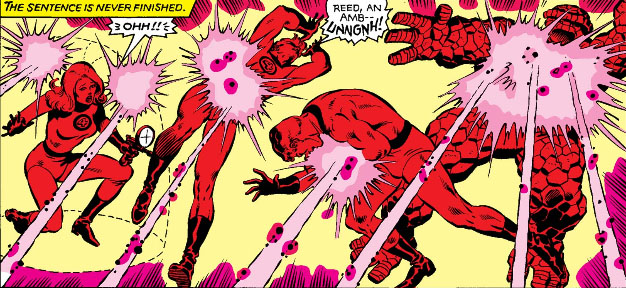
For the FF, their involvement comes as a result of a police report of a running firefight involving a woman with a type of laser weapon--yet it's a firefight of one, since the woman is firing at seemingly random targets. With the location of the woman being so near the Baxter Building, the FF decides to investigate pending the arrival of the police--but there's more to this story than what the police are aware of, and more than even the FF will be able to decipher, since this woman's pursuers are cloaked in invisibility.


Sharp-eyed readers will recognize the unseen armed aliens as the Badoon, who have infiltrated Earth before using such technology to shield themselves from detection, and who make use of it now to not only keep their target on the defensive but also to manipulate the arriving FF into taking down their prey for them--after which they slip in to finish the job.


With just a few words, Claremont has made the injured and now murdered Shi'ar agent, D'syndri, the catalyst for the events of the entire story, providing everything needed to cause the FF to further investigate her actions as well as her mysterious death. Yet this scene has not yet played itself out--as the Badoon, still undetected by the FF, swiftly move to take out the FF's threat before the heroes even have a chance to put together the pieces of this puzzle.


What is going on? One of the Shi'ar, fleeing through the streets of New York? The Badoon once again on Earth, pursuing and assassinating what will be revealed to be an escaped Shi'ar prisoner? Jumbled words of warning that mention not only the Badoon, but also the Shi'ar Majestrix, Arkon, and Charles Xavier? And now the FF gunned down in broad daylight? It appears that the Invisible Girl's force field has saved her from sharing her teammates' fate--but what happens now? Through D'syndri's gunscope, Sue sees these creatures moving toward her, no doubt preparing to finish her off--and weakened by their weapons fire, her death seems certain. Do the answers to this mystery die with her?

Wednesday, April 12, 2017

The Makings Of A Leader


It's nice to go back to a few of the earlier X-Men issues where the character known as Wolverine was just starting to be explored, where we didn't yet know so much about him or his potential and he was still limited to (brace yourselves) one title. At the time, all that seemed apparent about Wolverine was that he made a habit of not playing by the rules--and that it was difficult for him to integrate into the new X-Men team, not because he wasn't an asset to the X-Men, but mostly because he was a hard man to get to know.


Little by little, however, Wolverine and the X-Men began to accept each other, and the X-Men benefited from having him in its ranks in spite of his aggressive and at times provocative style of handling a situation. On rare occasion, however, we also were witness to situations where Wolverine was allowed to step out from behind the shadow of Cyclops and demonstrate his leadership potential and his capability to cope with a crisis by depending on his own judgment and instincts. The results were surprising, and remarkable. From a reader's perspective, it seemed like Wolverine was growing into his own, and the character's popularity began to grow as well.

When Cyclops left the team after the death of Phoenix, Storm was chosen by Charles Xavier to lead the X-Men in his place, perhaps in light of the fact that still so little was known about Wolverine and his activities prior to his affiliation with the Canadian government. That's no legitimate argument for disqualifying him, of course--with the possible exception of Banshee, one could say the same of Storm, or any of the new X-Men and their respective histories. There's also the fact that Xavier could have made inquiries regarding Wolverine, had he wished (to say nothing of making use of his mental abilities); perhaps he simply preferred for Wolverine to be more forthcoming on his own.  As it was, the question of his judgment in battle situations was still a cause for concern.

And so the instances we see of Wolverine exercising his initiative prior to Storm assuming the team's leadership are particularly interesting, since his decisions affect her along with the other X-Men and her reactions are those of a team member rather than a team leader. What you may notice most of all is how quickly, and easily, those he's with at the time adapt to Wolverine's style of leadership, as well as how well Wolverine himself adapts to this type of role.

First, let's look back at when the X-Men had detoured to the Savage Land following the destruction of Magneto's Antarctic base. Along with Ka-Zar, they're investigating the so-called city of the Sun God--a huge structure built by Garokk (said Sun God) and his high-priestess, Zaladane, which tapped into the power of the geothermal heat sink that gives the region its warmth and dense foliage but disrupts the delicate ecological balance of the Savage Land as a result. A surprise aerial assault deprives the X-Men of key personnel in their group--leaving Wolverine, Nightcrawler, and Storm to proceed on their own.


The way that Wolverine "handles" Zabu, the saber-tooth tiger that accompanies Ka-Zar, admittedly goes a bit far in giving Wolverine an apparent rapport with animals; perhaps it's more fair to say that he can reach more savage-minded beasts on a fundamental level. And while it's fair to balk at the specific instructions he's able to relay to Zabu here (something I don't recall even Ka-Zar doing, though someone will have to fact-check me on that--I'm not a big Ka-Zar reader), to see Zabu and Wolverine... oh, let's say, establish an understanding with each other, is still an interesting scene to watch.


(How Tongah, on the other hand, is going to figure out from Zabu's snarls that the X-Men have been ambushed by Garokk's warriors is anyone's guess.)

Soon enough, these X-Men make their way into the city via conduits that are understandably low priority from a security standpoint. Thanks to this segment, Storm and Nightcrawler learn significant information about their comrade--as well as confirmation that Wolverine operates by a code that is as yet foreign to the X-Men.


You may find it curious that Storm raises no tone of outrage at Wolverine's act of cold-blooded murder of Garokk's sentry, as she did when she thought he was hunting for prey in the forest; perhaps Wolverine's strike is somewhat mitigated in her eyes by the fact that the victim was an enemy. Writer Chris Claremont seems to feel that the unspoken reactions of both Storm and Nightcrawler are sufficient, while Wolverine's lack of either hesitation or regret in making his kill comes as little surprise to anyone. If Cyclops were present, perhaps he would have picked a later time to have a frank discussion with Wolverine on the matter, in order to tell him in no uncertain terms that this isn't how the X-Men operate.  And perhaps he wouldn't have. Cyclops isn't blind--he has to be aware of the kind of operative he has in Wolverine, and what kind of man he's taking on missions with him, and he's certainly intervened to stop killing strikes from Wolverine often enough.

At any rate, Wolverine and his team succeed in reaching the others and setting them free--and from that point he continues to defer to Cyclops calling the shots.

Some time later, when a teenager named Kitty Pryde is being evaluated for the school, part of the team travels to Chicago to meet with her and her family, unaware that specially-prepared hirelings of the Hellfire Club plan to intercept them. While Xavier speaks to her parents, Kitty is taken by the others to a malt shoppe, where all hell breaks loose--fortunately for the shoppe's testy manager, who unknowingly came close to learning the downside of the phrase "when push comes to shove." Regardless, Wolverine thinks on his feet when the attack occurs, and his comrades benefit from his instincts.


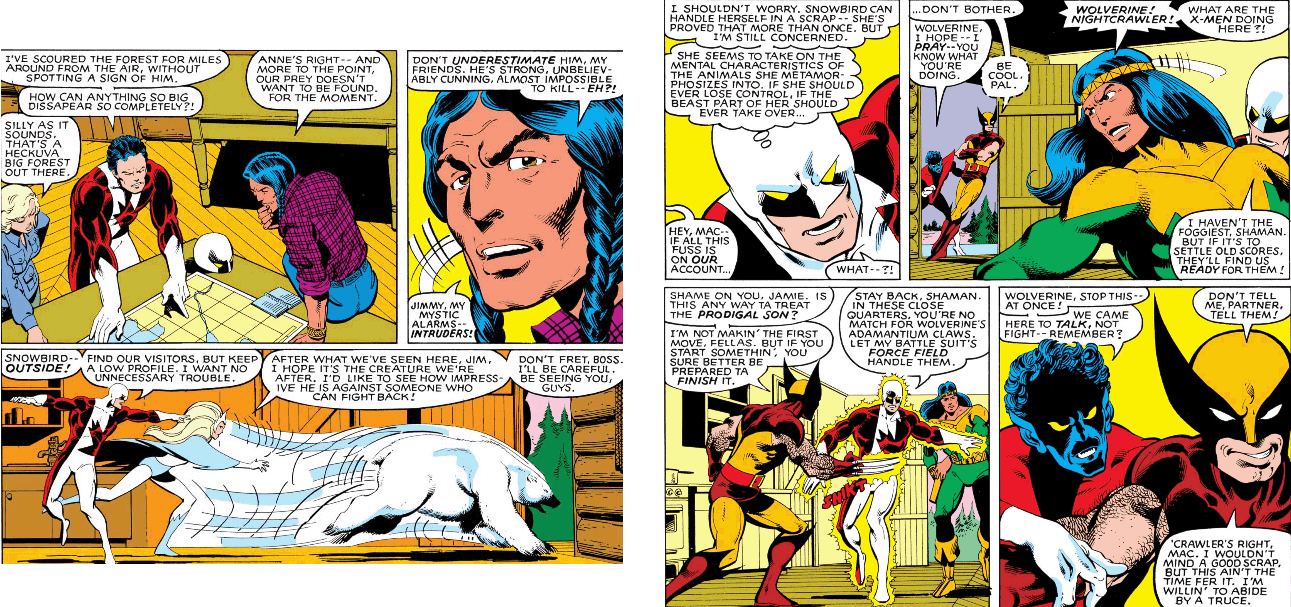
Finally, let's skip to Ottawa, where Wolverine is attempting to settle his differences with James Hudson, leader of Alpha Flight, who has twice attempted to return Wolverine by force to government custody. Xavier has sent Nightcrawler with Wolverine as a precaution--and with their first stop being the Hudson residence, Nightcrawler not only learns a bit of Wolverine's past, but also his comrade's name.


What becomes a two-part story is a strong focus on Wolverine and how he operates in group situations other than in his status as an X-Man. Where Alpha Flight is concerned, that may be problematic, considering that he'd no doubt ruffled a few feathers by escaping their custody in their last encounter; but while he makes clear that he won't back down if provoked, he makes every effort (with Nightcrawler's help) to give tempers a chance to cool.


The truce is accepted, and Wolverine learns why Hudson, Shaman, and Snowbird are in the area--investigating reports of a missing Canadian mountie and his family, with only the mountie's son recovered and the evidence at the site suggesting that the man had been devoured. In the process of offering his assistance, Wolverine asserts his personality and skills in a way that smoothly integrates into the overall mission of finding answers, leaving the others with a clear impression that they could use his help and removing any lingering objections from their minds. And when Wolverine is shown further evidence from the attack, his particular perspective on what happened will make his arrival a fortuitous one for Alpha Flight.


("We've tried just about everything else." Snowbird couldn't shift to a form that could track the wife and infant? Really?)

It's gratifying of course to see Hudson and Wolverine mend fences--but also to see another example of Wolverine's capabilities as a field operative and decision-maker, attributes that are coming to light for the character slowly but surely. And how well they serve him against another confrontation with the Wendigo is something you can see for yourself in the PPC's review of that story in a prior post.

Wolverine and Nightcrawler join forces again to face--the Brotherhood of Badoon!
(Might be a time to call in reinforcements on this one!)

Tuesday, April 11, 2017

Reunion Of Evil!


At the same time that the scientists of "Them" were creating the first Cosmic Cube, they were also resurrecting one of the most evil men in history--the Red Skull, who formed an alliance with Them only so long as it took him to learn of and secure the use of the Cube for himself. The Skull's grab for ultimate power was eventually foiled by Captain America, yet the Skull himself would continue to scheme and plot his way into many more stories thereafter.

Meanwhile, Adolf Hitler, the man who created the concept of the Red Skull and who both chose and molded the man who would don the hideous mask and become his protégé, would live on as well, in stories that presented him as the villain known as the Hate Monger as well as a creation of Arnim Zola that presumably held Hitler's transplanted brain. Later, it was revealed that Zola, originally one of Hitler's scientists before his own bizarre transformation, had successfully made it possible for Hitler's "mind-essence" to be transferred to a cloned brain at the instant that the mad führer fell victim to the Human Torch at the end of World War II--the same brain that Zola, decades later, had transplanted into the creature known as "Nazi-X." Eventually, Zola perfected the process, so that Hitler could transfer his essence at will to any specially-prepared body that Zola had waiting.

Yet in a story from 1980, the circle would finally close for Hiter, the Skull, the Hate Monger, and the Cosmic Cube, as the Red Skull reunites with the man who created him, and both men are on the verge of attaining the power they crave. The tale follows the Skull's defeat on the moon by Dr. Doom, where the Skull had been left to die but was retrieved by hirelings of the Hate Monger and brought to the former isle of the Skull's compatriots, the Exiles--now a fortified base where the Skull and the Monger assembled their own Nazi army and conspired on a secret project designed to bring them nothing less than ultimate power. At the center of it all is the Cosmic Cube--but which of these fiends would wield it?


Monday, April 10, 2017

The Prisoner And The Power!


If you've ever wondered what it would take to become Adolf Hitler's protégé (and who hasn't?), we need look no further than to the man who willingly stepped into that role with both eyes open--Johann Schmidt, better known in sinister circles as the Red Skull, whose origin story was revealed in 1941 to his helpless prisoner, Captain America, as well as to ourselves, his captive audience, in mid-1965. In the way that writer Stan Lee and artist Jack Kirby have crafted this villain's origin, it's fair to say that it follows the rags-to-riches formula for such characters, though in the Skull's case it's more accurate to paraphrase that as "rags to infamy," since it would be clear that it's infamy that the Skull truly sought for himself.

There are probably one or two other versions of the Skull's origin floating around that perhaps go into more detail, as rich as other writers would no doubt find this character's past to be in riveting material waiting to be mined. In Tales of Suspense, where Lee's tale appears, he and Kirby have only eight or nine pages to devote to their profile on the Skull while also dealing in the segments featuring Cap--yet you don't get a sense of anything meaningful being left out or sacrificed due to space limitations, nor does it seem like only the bare necessities of the Skull's beginnings are being offered. Instead, both writer and artist appear to rely on the Skull's status as a diabolical and feared Nazi, already made clear in his prior introduction to the book, to establish the Skull's foundation as both ruthless and irredeemable and render any detailed explanation of his transformation to such an immoral, merciless oppressor unnecessary. In these early action-adventure stories that feature heroes like Captain America, "just the facts" was often all that was needed for the creation of a memorable villain.

As for the good Captain, he's unfortunately in no position to pass on the Skull's whim to recount his rise to power, having been worked over by the Skull's hirelings to the point where he's passed out. But that won't do--the Skull has plans for Captain America, while Cap will find that his interrogator has chosen an unexpected way to pass their time together.


Friday, April 7, 2017

Avengers Reborn!


When you look at the line of "Heroes Reborn" books that were released during 1996-97, it's difficult to do so with an objective eye--that is, without factoring in the upheaval that seemed to be occurring in Marvel itself, set in motion by the "Onslaught" crossover event that few look back on with fondness. It was publication chaos that readers were unfortunately swept up in--a massive reshuffling of creative talent behind the scenes, as well as several of Marvel's major titles being dismantled and rebooted to accommodate new visions that would hopefully suit the company going forward. In the interim, Marvel would outsource the production of its flagship titles to separate studios (Jim Lee's WildStorm Production and Rob Liefeld's Extreme) which would produce alternate versions of these titles that offered a fresh take on both their heroes and concepts. In essence, the new work by Wildstorm and Extreme could be regarded as placeholder titles that would keep the fire stoked for Marvel's characters until such time as Marvel's revamped books were ready to launch, though that categorization isn't intended to downplay the amount of time and effort that Lee's and Liefeld's staff put into their contracted work.

The PPC has already taken a look at the first issue of Liefeld's Captain America book (scripted by Jeph Loeb) produced during this period, which was surprisingly well thought-out and executed; and so let's turn now to another title which also featured Cap but of course had several more diverse characters to take into account--a super-group that not only begins a new chapter in its long history, but does so by rewriting and rebuilding that history from the ground up.


Wednesday, April 5, 2017

The Man And The God!


"When I'm Blake, I don't care about Thor. And when I'm Thor, Don Blake is just yesterday's bad dream."
-- Donald Blake, MD/MS/NSG

A minor sub-plot in Mighty Thor from mid-1974 that I wish had been pursued further by writer Gerry Conway involved an identity crisis that Thor's mortal alter-ego, Dr. Don Blake, was experiencing. Earlier questions about Blake's origin vis-Ă -vis Thor had been answered by a two-part story explaining how Thor had been suppressed within the mortal form of Blake by Odin in order to learn humility. Essentially, Blake discovered he had always been Thor--that he and Thor didn't exist as two separate beings, with Blake finding "the real" Thor's hammer abandoned in a cave in Norway and assuming the role.

That hurdle cleared, Thor continued contentedly in his dual state of Thunder God and mortal physician, splitting his time between Earth and Asgard in extended stays in each of those worlds, with neither Thor nor Odin raising the issue that Blake had outlived his original purpose and was no longer necessary. That seems quite a curious disinterest in the matter on the part of both father and son--perhaps less for Thor than Odin, since Thor was used to his existence as Blake and had come to have much more empathy for mortals than Odin. But at the moment Thor learned the truth of the matter, wouldn't Odin have offered to remove the Blake persona then and there? Blake did, after all, represent a vulnerability in Thor that could be exploited by an enemy at any given moment, depending on how Thor fared in a battle; separated from contact with his hammer for more than sixty seconds, he would revert to Blake and likely be either captured or killed, with the hammer falling into enemy hands. In addition, it's no secret that Odin preferred that Thor spend his existence in Asgard--Blake obviously represented incentive for Thor to continue his activities on Earth.

As a reader, I was always glad that Blake remained, as I felt he added dimension to Thor's character, as far as it goes. Practically speaking, Blake's extended absences from not only his practice but in the operating room would surely raise eyebrows about the man in professional circles and compromise any reputation for dedication and commitment he hoped to establish. Why would Thor be remiss in saving lives, whether he did so as a mortal or as an immortal? And that's precisely what's so fascinating about Blake's later quandary on his double life and his responsibilities as Donald Blake.

What brings the matter to light for Blake is Thor's rescue of a young Asgardian goddess from the clutches of Pluto, with Blake's surgical skill needed to save her life. And it occurs to Blake that his professional life as a mortal is as important as his existence as Thor--a perspective he unfortunately only has when he takes Blake's form. The situation becomes only more nagging to him once he's successfully completed the operation, and a fellow doctor wonders aloud why he appears to take so little interest in a career in which he's so uniquely gifted.


Tuesday, April 4, 2017

Monster vs. Monsters!


If you've never sampled Marvel's line of monster stories that were published in the early 1960s in mags like Strange Tales, Tales To Astonish, and Tales Of Suspense, you're in for a treat--thanks to the 1976 Incredible Hulk Annual, which rounds up six of these mammoth menaces who literally walked all over the human race and brings them face-to-face with the mightiest mortal on the planet.


But, wait a minute--weren't these monsters sent packing or otherwise destroyed by clever humans who were able to pull victory from almost certain defeat? So who, or what, is resurrecting them--and why?

It looks like we've lumbered our way into yet another


Marvel Trivia Question


What diabolical figure in the shadows is responsible for these


Monday, April 3, 2017

...And The Crowd Goes Wild!


Recently I was flipping through a back issue of The Comics Journal and enjoying another look at a 1980 interview with artist John Byrne--all of 30 years old at the time and at the peak of his runs on X-Men and Captain America (though you might describe his time on the latter as more of a guest-artist stint, in light of its brevity). The Journal, known for its frank and comprehensive articles that one could find hard to put down once you'd begun reading, featured an extensive 22-page discussion with Byrne conducted by Journal staff Mitch Itkowitz and Consulting Editor Michael Catron, while also including inker Terry Austin, writer Roger Stern, comics critic/researcher Peter Sanderson, and publisher Ed Via.

In one of the outtakes of the interview, an exchange between Byrne, Itkowitz, Stern, Austin, and Via caught my eye, where Byrne was expressing a wish to dispense with any of the Captain Americas who appeared after 1945 when the original Cap disappeared. The discussion eventually turns to, as Stern puts it, the "made-up comic book stories" (heh, as opposed to regular comic book stories, but you probably get his point) that featured Captain America during this time, and one story in particular.

Byrne: So the Human Torch did not fly to Jupiter, passing clouds on the way...
Itkowitz: Yes, that was a silly story. "I'm breathing in outer space, fellows. With no air I'm keeping in flame!" Wonderful story. I don't know how they did that.
Byrne: He didn't fall from Jupiter to Earth, either.
Stern: And Cap didn't catch him when he fell from Jupiter, either.
Via: That's a good catch.
Byrne: That's a real good catch. [imitating radio commentator's voice] "An' he's caught him, an' the crowd goes wild!"

I'd only vaguely remembered coming across that story*, but the impression it had left on me was that it was a fun, harmless read, as comics stories from the 1940s were doubtless meant to be, no more, no less--an indulgence in sheer fantasy. At the time, comic books were items casually passed around and flipped through as little more than light-hearted kids' entertainment, far from the more involved storylines and conflicted characters that came our way in the '60s. Those earlier Golden Age characters were taken at face value--"Sun Girl," for instance, appears in costume and becomes attached to the original Human Torch as both sidekick and love interest, but mostly seems to be along for the ride on his adventures. I never figured out why she's called "Sun Girl," or what exactly she brings to the table besides a comely figure; apparently she carries around a ray gun that fires (what else?) sunbeams. Now how can you not laugh at something as superficial as that.

*Human Torch Comics #33, 1948

And so I dug up and dusted off an old reprint of this story, "The Ray Of Madness!", just to get an idea of the levity involved in the back-and-forth with Byrne. Was there more to this 10-page story than the running joke it's been for decades? I mean, how preposterous could it really be?


Well, a little preposterous, yes. How about "adventurous," instead? (And a lot of fun!)


The source of all the trouble for everyone turns out to be mysterious rays being fired at Earth that are causing all of the planet's animals to go mad and attack and kill the human population. Called in to assist "the nation's foremost scientists" in investigating the crisis are Captain America, the Torch--and Sun Girl, whose input has no doubt been sought out because it's bound to be insightful. Actually, no, her input essentially amounts to fretting and reacting to startling news. Given that these are American comics, it came as no surprise to readers that America leads the way in world crisis management--and so all the parties meet with Dr. Jefferson at, yes, the Jeffersonian Institute in New York to compare notes.


Yikes! That would seem to be that, doesn't it? Who the heck in 1940s America is going to stop an attack from Jupiter?

Come on, you know who!


Don't you just love the fact that the story has the Torch starting his flight to Jupiter from the airport? He could have just walked out of the Institute and taken off from there, or from a rooftop, or even the bus stop. Maybe the Torch is more media-savvy than we thought. And just for the record, Torch, nobody needs to "take care" of Sun Girl, bub, because she's--Sun Girl! 'nuff said!


So the Torch begins his journey. It turns out his mission away from Earth only lasts a few hours, round trip--and so we've obviously waded into preposterous territory, haven't we. In this case, that also means coming perilously close to a situation rife with


And in 1940s comic books, what other kind of science is there?

We don't want to get bogged down in facts here, since, clearly, facts are the last things we're likely to find in this story.  But here are the head-shaking statistics which our story freely tosses to the curb:

  • At its closest distance to Earth, Jupiter is 365 million miles away; in a worst-case scenario, with the distance being its greatest, that jumps to 601 million miles.
  • Back in 2006, our fastest spacecraft launched from Earth took an average of over five months just to reach Mars, which is about 34 million miles away at a minimum; in 1964, the spacecraft of the time would take over seven months.

Sun Girl could no doubt do the math if we substituted Jupiter and bumped the technology down to 1940s standards--but suffice to say that even the zooming Human Torch would be in one-way transit for over a year at least, assuming (a) his flame didn't fizzle as soon as he left Earth's atmosphere, and (b) his flaming power could last indefinitely, despite how staying constantly ablaze and at top speed would tax it.

However, to play devil's advocate... if for some reason the Torch could attain the speed of light, and Jupiter happened to be at its average distance of 483 million miles from Earth, it would take him about 43 minutes to get there. The Avengers' Captain Marvel could swing that; but for even an android Torch, zooming through Earth's clouds is the best he could hope for as far as setting any speed records from point to point around the globe.

On the other hand, maybe those clouds sticking with him all the way to Jupiter were meant to compensate for the void (to say nothing of the distance)? *shrug* So, before you know it:


Fortunately, the Torch has landed directly in the vicinity of the red hot "pool of peril," where the ray of madness originates. Otherwise, our poor guy would have to spend, oh, several human lifetimes searching a planet the size of Jupiter, a world so large that over 1,300 Earths could fit inside it. But he's right on target, and proceeds to not only destroy the pool, but also survive the attack of those who protected it--the savage Kleezar and his tribe of animal-like "Jupiter-men." The Torch catches a break when Kleezar's men are destroyed by a barrage of fiery meteors and Kleezar himself becomes a victim of the flood of fire-water resulting from the Torch's destruction of the pool.


Only seconds after fighting a major battle, and the Torch is ready for the return trip to Earth. What a guy. What a hero.

But it may not be smooth sailing for the Torch. Back on Earth, with a telescope that would put the Hubble to shame, Dr. Jefferson monitors the Torch's approach; but the even sharper-eyed Captain America notices from at least 33,000 feet below that the Torch's flame has gone out, and leaps into action, while Sun Girl... well, Sun Girl basically tells Cap that there's nothing to be done. For once, I'm with Sun Girl. What exactly is Cap going to do about someone plummeting from space? Salute? Well, when you've got a story that paraphrases John 15:13 when the situation is at its most desperate, you'd better believe that Captain America is going to be the best outfielder for the job and make the big play.


And yes, it was lucky the Torch happened to be falling within the perimeter of Jefferson's observatory, instead of, say, Uruguay.  But rest assured that Sun Girl would be proud of him no matter where he fell to his doom.


You can catch (ha ha, get it?) our own Human Torch from the FF in a similar predicament in a separate post, though there would be more than enough trouble on planet Earth to keep him busy.

Friday, March 31, 2017

Not On Our Watch


Recently we were witness to a hearing requested by the entity known as Eternity and officiated by the Living Tribunal, to assess the fitness of Adam Warlock to retain possession of the all-powerful Infinity gauntlet--a distinctive glove embedded with gems which give their bearer mastery over the mind, space, reality, time, power, and the soul. With the help of his allies, Warlock prevailed over the villain who wore the gauntlet, Thanos of Titan, and subsequently took possession of it for himself, declaring that he would use its power wisely. Warlock considered the proceedings little more than effrontery, but nevertheless felt compelled to see the hearing through to its end. Unfortunately, Eternity's profile on Warlock was damaging enough to cause the Tribunal to rule against him; and since resistance on his part would likely lay waste to all of reality (which seems ridiculous, since one of the gems gives Warlock control over reality--but what do I know), Warlock agreed to relinquish five of the gems and distribute them to five individuals who would serve as their guardians.

The outcome of the hearing was the best that Eternity could hope for, under the circumstances--though since Eternity's case against Warlock was based on his mental instability, one could admittedly question the wisdom of allowing Warlock to choose the gems' custodians. But the compromise is struck, and Warlock departs to see to his task.

Yet Warlock's eventual choices as to which individuals will each receive one of the Infinity gems are questionable, to say the least--a collection of misfits that might have us wondering if Eternity's concerns about Warlock's stability shouldn't have been taken more seriously.