Thursday, February 11, 2016

The Lost Boys


It was during the (West Coast) Avengers' conflict with Master Pandemonium and the deadly Mephisto when Agatha Harkness began to consider the conundrum of whether or not the twin children of the Scarlet Witch and the Vision were actually "real."


We've already seen Miss Harkness provide an answer to the Torch's question when the situation with Master Pandemonium was resolved; but while writer/artist John Byrne did a thorough job of arranging for these children to have literally never existed, it's important to note that Steve Englehart's original story of their birth provided Byrne with sufficient tools to do just that.*

*Byrne's research wasn't as exhaustive as he might have wished.  The linchpin to the fact that the children weren't "real" lies in the one piece of empirical data which Miss Harkness provides to test it:  "Whenever Wanda is not consciously thinking about them, the tiny creatures disappear!" If that's the case, then their "grandmother"--Simon Williams' mother, who stepped in to care for them when the Vision and Wanda became involved with the West Coast Avengers--has some explaining to do as to how seven issues of WCA adventuring went by for Wanda without the children disappearing even once, and thus has nothing out of the ordinary to report when the parents return from Europe to reclaim them:


As busy as Wanda must have been on missions, it's very unlikely that Mrs. Williams, who seems quite attentive to the kids, never took note of their disappearance--and equally incredible that, as preoccupied as Wanda must have been with Avengers business, not five minutes went by without her thoughts being focused on her children.


Regardless, to put the matter into perspective, it's time we had a look at key events from Englehart's twelve-issue 1985-86 Vision and the Scarlet Witch limited series, which focuses on Wanda's unexpected and improbable pregnancy and, for at least an instant in time for this couple, provides one of the happiest happy endings you may have ever seen in comics.

But the event would also unknowingly end up setting the wheels in motion for... oh, let's see:

  • Wanda going mad;
  • the end of the Vision;
  • the deaths of Ant-Man and Jack of Hearts;
  • the end of the Avengers;
  • the death of Miss Harkness;
  • M-Day; and, if we connect the dots,
  • the Marvel Universe, as we knew it, ceasing to exist.

This post already has its title, but we could also simply call it:


(Needless to say, those complications would extend beyond the delivery room!)

Wednesday, February 10, 2016

Reckless Youth


OR: "Be Careful What You Wish For..."


It's probably about time that we found out just what was up with that story arc we've seen in bits and pieces here at the PPC--one which took place in the pages of Amazing Spider-Man, involving an ancient petrified tablet which had New York's crime figures very interested in deciphering the secret of its mysterious inscription. To bring us up to speed, here's a brief rundown of the players involved and where the tablet has landed along the way:

  • The Kingpin has already tried and failed in his own attempt to uncover its secret, having brazenly retrieved it from its display at the E.S.U. college campus only to see it eventually recovered by Spider-Man.
  •  
  • From that point, the tablet makes its way to retired police Capt. George Stacy's wall safe (pending its return to ESU), where the Shocker finds and steals it (thanks to the news media blabbering its location--nice going, news hounds!). But the Shocker, merely interested in financial gain, discovers that it's now impossible to fence the object because buyers are fearful of tangling with Spider-Man. The Shocker's plan at that point is simple: deal with Spider-Man, thus making himself more feared than the wall-crawler and thus more likely to find a fence for his heist. You can guess how lousy that turned out for the Shocker.
  •  
  • The trail of the tablet then leads to Man-Mountain Marko, a hireling of the Maggia crime syndicate, who discovers the Shocker has stashed the tablet at his girlfriend's apartment for safekeeping and breaks in to steal it. Marko ends up tangling with Spider-Man for his trouble, but manages to escape with the tablet.

Which brings us to this point: What the heck does the Maggia want with this tablet? We discover that Marko is acting under the direct orders of the aged Silvermane, a powerful crime figure of the organization who suspects the tablet's secret but kidnaps scientist Curt Connors (as well as Wilson, the Kingpin's expert on the object) to decipher the inscription. To ensure Connors' cooperation, Silvermane has also captured Connors' wife and son, and stashed them at another location--in the custody of Caesar Cicero ("Big C" to his associates, despite his short height), a Maggia lawyer who has aspirations for Silvermane's position and is impatient for Silvermane to kick the bucket.

Whatever the tablet's secret, Silvermane is prepared to go to great lengths to unlock it--and more, to be the one to benefit from it. Due to his age and deteriorating condition, time is of the essence for Silvermane--an apt way to phrase the situation since, in these final two issues of this story, we'll discover that his plans for survival regard that phrase quite literally.


Tuesday, February 9, 2016

"Kill Me Once, Shame On You..."


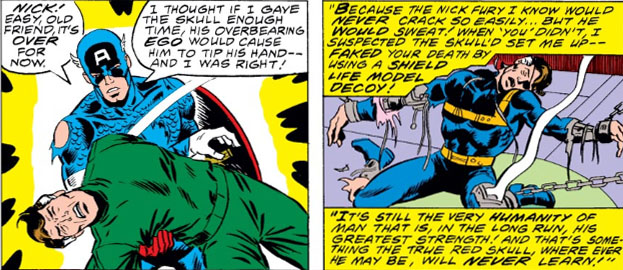
Sometimes all it takes is eleven years to recycle a good whodunit--in this case, two separate stories featuring the death of Nick Fury, before the shocked eyes of Captain America!


But the real question is: does the head of S.H.I.E.L.D. really cash his chips, or do our eyes deceive us?

The short answer is: BOTH. But let's get to the bottom of this.

In the first story from 1967, our assassin is dropped off near the barbershop which SHIELD uses as a decoy for access to their underground base. (Some decoy.) And while the approaching Captain America closes in as quickly as possible, he isn't in time to prevent the killer from carrying out his deadly task.


But while Cap has failed to prevent the death of his friend, he rises to his feet to make sure that Fury's killer pays for his crime.


Cap has a tough time with this super-strong, super-tough foe, but he has the drive and the motivation to make sure this bruiser answers for Fury's death. It's only after he finally lands the haymaker that puts the brute down when he finds out who has sent this assassin--and guess who's up and around to relay that information?


I guess you could say that Fury had... wait for it... A CLOSE SHAVE. (Though our poor Life Model Decoy wasn't so lucky.) By the way--did you catch the goof that got through editing in the fight scene above? If you're right, you get a free comic book! (Not really!)

Now let's jump ahead to 1978, where the Red Skull has taken over the SHIELD helicarrier and turned its agents into murderous Red Skull facsimiles, which is definitely going to take a bite out of agent morale. Cap is aboard and has battled his way past the agents sent to kill him, and now confronts the real McCoy--but the Skull has a final surprise for his arch-foe.


As we can see, the Skull doesn't waste time with boasting, but immediately enacts his revenge on Cap by forcing him to remain motionless while Fury is put to death. It's a gruesome spectacle, made all the more horrific by the Skull reminding Cap of similar circumstances of helplessness as he watched the death of his young partner. It's a little disturbing to find that Cap can be so distracted in such a moment of crisis, to the point where he's frozen just because a foe has brought up the subject of Bucky. No wonder Fury is so shocked at Cap's inaction. "Yo, Avenger--person dying over here!"


Cap's counterattack would seem to be too little, too late--it even looks like the Skull has one last trick up his sleeve. But what he doesn't have any longer is the master control of his orbiting satellite, which Cap confiscates and uses to put an end to the Skull's plan for the world--and the act triggers the true story behind the Skull's last deception.


Good grief! Those Life Model Decoys have it rough, don't they? Talk about cannon fodder. We don't know where the Skull really is--but with this facsimile of him reverting to Fury with the satellite's destruction, we can assume that the other agents on board are back to normal, as well. And with one heck of a craving for bratwurst and sauerkraut.

Monday, February 8, 2016

Agent Carter, Reporting For Duty!


As much as I felt Jack Kirby veered off course in his treatment of the Captain America book when he assumed creative control of the title upon his return to Marvel in 1976--as well as radically altering the characterization of its principal characters--I found myself nevertheless admiring his turnaround on Sharon Carter, Steve Rogers' girlfriend and former agent of S.H.I.E.L.D., whom Kirby at first had pigeon-holed into a civilian woman who moped on the sidelines about her super-hero boyfriend's responsibilities not allowing the two of them to lead a normal life, to the point of becoming something of a shrew on the matter.


But that all changes when Cap is later abducted and Sharon is sidelined by exposure to the tranquilizer gas used to take him. The SHIELD regional director, stalled in the Arnim Zola matter, decides to bring Sharon back into harness as an agent to crack the case--and Kirby's treatment of former Agent 13 gives Sharon Carter responsibilities of her own. And woe be to whoever she's gunning for, because...


...you don't mess with an agent who's going into action sporting a new coiffure.

Friday, February 5, 2016

Danger! Danger! Danger!


When the villain known as Warhawk infiltrated the Xavier school and attacked the X-Men through their Danger Room, our PPC review of that issue focused more on a general look at the story (and character) as a whole, but leaving out one tiny bit of excitement:


Namely:  How the HECK did the new X-Men survive the Danger Room's attack on them--at lethal force?

Thursday, February 4, 2016

The Monstrous Mind of Arnim Zola!


Unsurprisingly, there were a number of creations from Jack Kirby's work produced at Marvel during his return in the late 1970s which proved to have staying power, going on to be included in other titles and stories well after Kirby's second and final departure from the company. Which is one reason why one of them, Arnim Zola, could never be featured as a mystery villain here at the PPC, especially given his distinctive and well-recognized features.

A Swiss scientist with ties to Nazi Germany during the war, Zola, like Nathaniel Essex (a/k/a Mr. Sinister), made strides in genetic engineering well ahead of his time. As a scientist lacking a moral compass and conducting near-horrific experiments, Zola's introduction could have taken place in practically any of the titles Kirby was working on as writer/artist (with perhaps the exception of Devil Dinosaur); but Kirby had a particularly sinister plot in mind for Zola in the pages of Captain America, a book which Kirby was unfortunately having his share of problems with at the time.

Since the 1940s, of course, Zola's expertise with genetics had only grown more prolific--for instance, the creation of humanoids capable of morphing into any shape as well as possessing incredible strength and other abilities. Even his castle has been recreated as an almost living entity, still appearing as a traditional structure but its every stone and wall responding to Zola's wishes. (Today's entrepreneurs dabbling in "smart homes" obviously need to aim a little higher.)

While the character of Zola might benefit from a detailed origin which explains his fantastic appearance and the reasons behind it in greater detail, Kirby significantly curtails Zola's history and provides the character with only the basics needed--where he comes from, what he's doing, and why he changed his appearance. It's perhaps one of the most uninspired origin stories you could imagine for a character that, from his appearance, would seem to have been given a great deal of thought by his creator.


In essence, Zola fashioned this new body, painstakingly developed a method to transfer his personality, and then killed himself in order to better protect himself against being harmed by his experiments. The fact that he later developed a control module which had the same ability as his new brain's mental power must be keeping him up at night. (Though sleep is likely something he's also done away with.)

Zola first appeared when Cap was in battle with a Central American despot known as the Swine, with the conflict ended after a monstrous creature appeared and fatally dealt with the foe. Cap discovered that the creature was a creation of Zola, who took Cap (as well as the Swine's rebellious cousin, Donna Maria Puentes) into custody and returned with them to his Swiss castle. The two are effectively Zola's prisoners; but in Cap's case, Zola seems to already have Cap in mind for a procedure, one which has been sponsored by a villain with a distinctive feature of his own.


It's hard to say whether the Skull's sudden presence in the book is an attempt by Kirby to placate those readers who have been crying out for Cap to be more integrated with other characters in the Marvel universe, as opposed to Kirby's preference to isolate him in order to presumably allow him to grow as the character that he envisions. That said, and in spite of the somewhat juvenile dialog in these particular panels, the Skull is developed reasonably well for the remainder of his appearance in the book--though he's shown the exit rather suddenly, perhaps due to Kirby's time on the book drawing to a close, with just four more issues of Captain America before making his own exit.

It's at this point in Zola's story where Cap encounters "Nazi-X," another Zola creation but also the pinnacle of his plan (with the Skull's blessing), one which dates back to the last days of the war.


Wednesday, February 3, 2016

The Explosive Debut of... Blastaar!


1967 took the Fantastic Four comic through an awesome year of adventure, helmed by the Lee/Kirby/Sinnott team that was still going strong. The beginning of that year saw the team plunged into battle with the cosmic-powered Dr. Doom; in the summer, they would go on to encounter both the Kree sentry and that race's deliverer of final judgment, Ronan the Accuser; soon afterward, they would come into conflict with the group of scientists responsible for the creation of Him; and to close out the year, the Thing would once again be turned against his friends, this time as a pawn of the mad Thinker.

But while Spring in the real-world New York City of '67 was ushered in with a late snowstorm that had New Yorkers sledding down hills and shoveling snow off their walkways and cars, things were heating up for the FF around that time with a sensational two-part story that introduced a brand-new villain--Blastaar, the Living Bomb Burst--who would join forces with one of the team's deadliest enemies and engage the FF in pitched battle in the city's streets.


And things were already looking pretty bad for the FF from their prior issue, when the Sandman launched a brazen attack against them within their headquarters that had them on the ropes and left Reed Richards hopelessly stranded in the Negative Zone and minutes away from his end. Shoveling snow off the Baxter Building roof probably seemed infinitely preferable to Reed, under the circumstances.

As the next issue opens, the remaining members of the FF are caught in a state of frustration and helplessness, unable to think of any way to help their leader avoid certain death, as his course takes him closer to the exploding atmosphere surrounding the Earth that exists in negative space. Of all times for an event which would normally be a cause for celebration to occur: the return of Crystal, who, along with the rest of the Inhumans, has escaped imprisonment from behind the barrier that had surrounded their Great Refuge, and who teleports into FF headquarters to reunite with Johnny Storm. She learns the grim news involving the FF's leader almost immediately--but she also offers some slim hope for Reed's rescue.


(And a No-Prize is waiting for you if you can deduce the solution to Reed's dilemma that both Crystal and the FF have completely overlooked in this scene!)

Meanwhile, it turns out the so-called Living Bomb-Burst has been busy wreaking havoc on one of the Zone's populated worlds--but finally subdued and taken prisoner, though too dangerous and powerful to be dealt with through conventional means. The mission the crew of a transport are charged with is to dump this deadly foe in the same debris belt that Reed is hurtling toward, and letting the deadly atmospheric explosions solve their problem for them. Coincidentally, Blastaar's drop-off point turns out to be far too close for comfort for Reed, though he remains unaware of his danger. (As if he needs any more danger coming his way at this point.)


Back on the Earth of our universe, Crystal has brought the FF's dire problem to Black Bolt, who assigns Triton to pierce the Zone in order to track Reed's location and rescue him--and in the nick of time, too. But what of Blastaar?


Yikes! Reed and Triton have picked up a hitchhiker and don't even realize it! It's a happy homecoming for Reed, to be sure--but what fate awaits the Earth?


Tuesday, February 2, 2016

Dangerous Liaison!


OR: "Big Shoes To Fill"

Late 2002 saw the culmination of a fourteen-issue Avengers saga where Kang the Conqueror conducted his most successful campaign in the conquest of present-day Earth. It was the "Age of Ultron" story of its day, engulfing the entire planet in war and seeing Kang forcing the world to accede to surrender--and thereafter begin a struggle of resistance that finally resulted in a hard-fought, costly victory and Kang's defeat.

Among the dead was the Avengers' federal liaison to the National Security Council, Duane Freeman, who was killed when Washington, D.C. suffered a devastating attack which left it in near-ruin.  Freeman succeeded his predecessors, Henry Gyrich and Raymond Sikorski, and came aboard as the book was beginning its 1998 run and the team was selecting a new lineup.  Their new liaison was quite disarming, keeping a low profile and assuring the Avengers that he would do his best to accommodate their needs.

Memory escapes me whether or not the Avengers were assigned another liaison who would continue the government's (or what was left of it) oversight of the team following the war with Kang, though at the time the arrangement seemed to have run its course. Freeman was an affable enough fellow who made a genuine effort to avoid ramming federal regulations down the team's collective throat; but rather than monitor the Avengers' adherence to federal requirements from the sidelines, he grew to be more of an administrator of the Avengers' procedural affairs, to an extent that was perhaps a bit overreaching for a man assigned as a liaison. Though trust him to rationalize that involvement by the use of both logic and tact.


This was during the period when the team had some involvement with the Triune Understanding, a sort of self-empowerment movement which eventually began to draw attention to the Avengers for its lack of minorities in its lineup, as well as inflaming public opinion against the team's tolerance of mutants in its ranks. Complicating matters was the fact that Freeman was himself a member of the T.U., causing the team in general and Iron Man in particular to doubt whether Freeman had the Avengers' best interests at heart. Freeman didn't help matters when he picked up on public opinion and began pressuring the Avengers to diversify their ranks, at this point a dead horse that former liaison Gyrich had already beaten but which writer Kurt Busiek decided needed to be resurrected and taken much further than before.

In the meantime, Thor, for one, is becoming infuriated at seeing angry protesters every time he looks around after the Avengers have successfully dealt with a threat which threatened these same people who have come to hold the team in such low regard. And finally, he's pushed to his limit.


Since we know that Mjolnir usually trashes what it's hurled at, scratch one expensive news camera. But the incident prompts Freeman's briefing of the assembled Avengers, as we've seen above.

Yet to put this meeting in perspective, we have to leap ahead a bit, to when the world is picking up the pieces following the war with Kang. In a conversation with Freeman's brother, Iron Man has discovered the extent of Freeman's devotion and loyalty to the Avengers, particularly in light of the team's further dealings with the T.I. where it was discovered that the movement itself was on the level--and that it was only its leader, Jonathan Tremont, along with a few of his aides, who corrupted the organization and used it to further their own agenda. In addition, Freeman, fearing that his classified knowledge of the Avengers' priority codes might have been compromised by Tremont, had set in motion his resignation before he met his death with Kang's attack on Washington. It was a revelation which deeply affected Iron Man and the other Avengers, and which recalled one very vivid memory.


Though instead of relying on Cap's recollection, let's take a peek at how exactly that confrontation went down.


It wouldn't be the first or last time that Freeman stood his ground with the Avengers. I suppose his epitaph might be that he did his job, to the best of his ability--and when your job involves a group that's accustomed to handling their own affairs in-house but nevertheless saw merit in Freeman's proposals, he unquestionably left his mark on this assignment.

As for Thor, he was eventually ready to return to the team--though with one condition.