Wednesday, July 17, 2013

To Challenge Eternity!


There probably aren't many villains who would brag--much less look forward to--taking on, of all entities, Eternity. You might as well just say that you're going to attack the entire universe. In other words, it would take you an eternity to battle Eternity. We won't bother holding dinner for you. But if there was one such villain who seemed like he might make some headway with such arrogance, it was surely Dormammu. And he was even going to wipe the floor with Dr. Strange as an appetizer:


The closest analogy to such a battle I can think of would have been when the Destroyer sought to battle Thanos after the villain had used the Cosmic Cube to become one with the universe. Granted, the Destroyer's single-minded pursuit of his foe didn't exactly make him the most clear-headed super-powered being, so it probably would have been wasted effort to try to get the Destroyer to understand how futile it would have been to try to take on Thanos after the villain's transformation--i.e., now that your enemy has become everything, how do you begin to put a dent in your target?

Leave it to the Destroyer to give it a try:


So Dormammu essentially has the same challenge awaiting him. But these are the mystic arts, where almost anything is possible, particularly at the tip of artist Steve Ditko's pencil. And after Dormammu attempts to imprison Eternity, they both square off in front of Strange, who has a ringside seat to what will be a one-of-a-kind battle:


Eternity sounds pretty confident, doesn't he? Do you think Dormammu will back off in the face of such intimidation? Please. If you go around calling yourself the "Dread" Dormammu, you've got a reputation to live up to.  And that means even beings who embody the cosmos need to fall to your might:


Dormammu certainly has more oars in the water than the Destroyer, so I'm sure he realizes what he's going up against; but unlike the Destroyer, Dormammu is no stranger to cross-dimensional battles, and can actually encroach on Eternity's essence. That sounds ridiculous, I know. But try telling that to Strange, who may be starting to regret that center-stage seat he scored:


It's a battle we never got with the Destroyer and Thanos, given the Destroyer's limited resources and the fact that he was designed to battle a physical foe. Dormammu's conflict with Eternity is destined to be a brief one, but look at Ditko go. You have to have grudging admiration for Dormammu for even getting this far. Finally, though, the Dread One realizes the scope of just what he's set himself against, and he goes out in one hell of a big bang:


We learn that Dormammu's physical form has been destroyed (jeez, I should say so), but we're left to fill in the blanks on what happened to Eternity. I'd guess that once he set Dormammu up for that collision, he simply departed the battle scene and went on about his business. Dormammu is still floating around as a disembodied spirit, so we'd be seeing him again soon enough; in fact, in a later Defenders story, he and his sister Umar actually manage to siphon Eternity's energies to further their scheme.  If you embody the collective consciousness of all living things in the universe, you really shouldn't forget about a little thing called a grudge.

BONUS!
Have a look at how artist Gene Colan depicted this battle.

Tuesday, July 16, 2013

The Perils and the Politicians


When you think about the high drama potential that the appearance of a U.S. president would bring to a comic book story, it's a wonder that such appearances are so rare. No one really expects to see a president pop up in comics like Doctor Strange or Daredevil, of course--but in stories where the military plays a part, or in a crisis situation that has national or worldwide repercussions, at times we'll see a silhouette of the President in a few panels, alluding to events taking place where the hero is directly involved.

In the early 1970s, there were occasions when Marvel brought the President directly into focus, though in little more than cameo appearances. I think the first time I remember seeing a president was in Fantastic Four, where the Sub-Mariner was goaded to the brink of war by Magneto, and the FF were trying to defuse the situation:


Nixon, of course, was the butt of many a joke by just about everyone, and in comics he was almost always portrayed in humorous panels which drew attention to his mannerisms and overused phrases. Reed's got some clout, doesn't he? All the Avengers get is a national security liaison, while Reed is put right through to the President. In another story, even Sue gets to screen his call:


Over in Incredible Hulk, around the same time, Nixon took a personal interest in seeing some weaponry which would finally put the Hulk down for the count. But a live demonstration?? How was that given the green light?


The story even brought Vice-President Agnew along for the ride, another political figure who wasn't spared the satire:


In the same story, the Leader had his own plans for these two men--replacing them with robots when the opportunity arose:


Sure, sure, go ahead and say it: "Robots? Gee, maybe the Leader was able to pull that one off! Who could tell the difference?"

General Ross hosts another president in 1975, when Gerald Ford makes a stop at the base and, unfortunately, doesn't get a live Hulk rampaging toward him. But he doe at least get to see our tax dollars at work:


Major Talbot has a sinister motive for moving closer to the President, since Ford can't exactly get "a closer look" standing at a railing with Banner several floors beneath him. And the plan doesn't involve pushing him over, even though Ford was famously known to take a stumble or three. But Talbot is foiled, and Ford would probably be instructing his switchboard at the White House to forward all calls from Thaddeus Ross to the commissary for the near future.

Monday, July 15, 2013

Crackle! Pop!


"Stranded in Sub-Atomica!", the title of the story that's the subject of the following two covers for Fantastic Four #76, was a misnomer, since no one was really stranded there at all. The FF shrunk down to that world in order to retrieve the Silver Surfer--and Psycho-Man, who considered that environment to be his own, had launched an android to also capture the Surfer, but which instead ended up battling the FF. Once the FF find the Surfer, they're able to convince him to return to the world above in order to deal with the threat of Galactus--but they decide to remain in the Microverse in order to pursue Psycho-Man, which is probably what the story's title is referring to, if inaccurately.

There were several ways for artist Jack Kirby to design the original issue's cover, since Psycho-Man's android is only one combatant which the FF deal with--and, indeed, other things of note were happening in the issue, as well (Galactus, for instance, not exactly being chopped liver). The collage design of the next issue's cover would give a more effective representation of all the things that issue was juggling; but here, Kirby chose to focus on the android, which Psycho-Man had made indestructible.* As to how to portray the FF "stranded," it either didn't occur to Kirby or else he disregarded it as much as the rest of us did (assuming he even knew the story's title at that point).

*It must be nice to make something indestructible whenever it suits you. Why aren't cell phone manufacturers beating down Psycho-Man's door?

In the redone cover for the issue of Marvel's Greatest Comics which reprints that issue, artist Ron Wilson follows Kirby's design almost precisely, but goes him one better: instead of its back turned to us, which doesn't make much of an impression on us and gives little indication how this android can be such a threat to the FF, Wilson has the android fully engaged with the FF in a more aggressive and determined posture:


Wilson's effort results in a more visually exciting image where the action pops out at you, even highlighting the FF more by using "Kirby crackle" to make the background less stark--while Kirby's depiction only lets us know that the FF is in battle with something but does nothing to really make us curious as to who or what this powerful opponent is. Even if you removed the newer cover's over-the-top "murder machine" caption, we'd still be left with an image which gives us more of a reason to pick up this issue and see what's going on.

Sunday, July 14, 2013

Pieces Of A Dream


As a companion post to an earlier one that takes a look at some of the tucked-away gems you can find in some of those older Fantastic Four stories, it seems appropriate to highlight some of the fans from the book's letters pages who went on to greater roles at Marvel, such as Roy Thomas, Dave Cockrum, et al. Thomas and his fellow soon-to-be Marvel staffers weren't the only fans who were FF "letterhacks" (those fans who had their letters regularly published in the letters pages); in fact, it's interesting to see, out of the presumably hundreds of letters Fantastic Four received, how often the "editor" published letters from the same people who had written and been published in earlier issues. Since the pages were often as popular as the story itself, I can only assume an effort was made to strike a balance that featured both enthusiasm, suggestions, and the occasional criticism--but perhaps there was also an effort to bring some familiarity to these pages, as well.

Most of the letters we'll see here typically gush with praise for the FF story as well as Marvel in general, which fit right in with the image that Marvel seemed to want to project at the time. Yet it's also interesting to see what things the writers wanted to make a point of bringing to Marvel's attention. Don McGregor, for instance, has a repeated desire to see certain characters get married. Dave Cockrum will make an offhand comment or two about the art on a particular issue, yet also takes a great interest in all the concepts being explored in different titles. Steve Gerber is, as you might expect, all over the map, jumping from this to that, and not exactly shy about saying what does work vs. what doesn't. And Thomas, who began staffing at Marvel in the mid-1960s along with Denny O'Neil, at times jumped around on subjects as much as Gerber, though with a more tactful and suggestive approach.

So here's a brief scrapbook of those letters, sampled from the first fifty issues of Fantastic Four--little pieces of history from Marvel's Silver Age that remind us that it's possible for anyone to get in on the ground floor of their dream.


Saturday, July 13, 2013

"You'd Better Watch Out..."


Can YOU


Name This Marvel Villain??

Fantastic Four Fan Base


It's usually fun flipping through back issues if you just want to re-read one of your favorite stories, of course--but sometimes you can find some interesting trivia in some of those older Marvel issues that were published when the company was really making an effort to light the match under new readers and get everyone excited about "the Marvel Age of Comics" that the Fantastic Four comic book ushered in. The best place to really find a virtual grab-bag of such items shuffled in with a comic's story was in the pages of those early Fantastic Four issues--mainly because it was the flagship mag of Marvel's growing line, and thus the perfect venue for Marvel to reach the bulk of its customer base in terms of announcements.

For instance, have a look at the first ad for Sgt. Fury and his Howling Commandos, from FF #15:


I wasn't clear on what they meant by "in the Fantastic Four style," unless the Sarge and his commandos were exposed to cosmic rays and they fought as the first super-team in the war. (A later ad clarified that the wording simply referred to the mag having the same writer-artist team of Lee and Kirby.)

In FF #14, Marvel establishes what it calls its "trade mark" graphic,
with the FF leading the way:


And here I'd been calling it a "corner box" all this time. Marvel followed up the announcement in an ad that took the opportunity to also push its other titles and new characters:


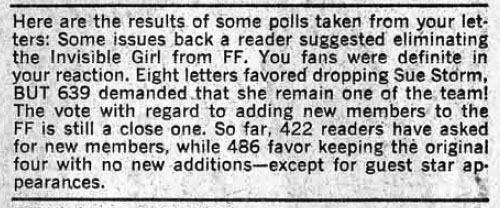
Next: was there trouble in paradise? As early as FF #10, there were rumblings in FF fandom of people wanting to actually add new characters to the team (which I'm assuming meant booting out the present ones if they wanted the title to remain unchanged):


Three issues later, though, the matter was settled:


Let's all breathe a sigh of relief.  Because you know that the Howling Commandos would have "wah-hooed" their way into FF membership at some point.

Question: What exactly does an FF fan club do? Haven't you wondered? Is it like a book club, where you read the latest issue and then meet as a group at a "clubhouse" to discuss its fine points and subtleties? However they were set up, they were really popular at the time, and Marvel knew a promotional opportunity when it saw one:


Define "nearest," because otherwise you're trying to get readers jazzed about regional FF fan clubs. Kinda sucks for members who can only be at meetings in name only because of distance. I don't think the local members were going to spring for a speaker phone and long distance charges to accommodate their members in absentia.

Remember when the first Incredible Hulk series had the plug pulled on it after six issues? It was at the time when the Hulk met the Thing for the first time, in FF #12--and if you wanted to then check out the Hulk's mag, you would have found yourself reading its final issue, due to its cancellation. A skeptic might have thought that Marvel simply promoted the Hulk in that FF issue in order to send fans scurrying back to their comics stores to check out the Hulk mag so that dealers wouldn't be stuck with all those unsold Hulk #6 issues. So thank goodness Marvel "levelled" with readers in FF #17:


Why does that explanation not really hold up? Because if you're spreading yourselves too thin with a new book, you don't announce on the same page that you've got a lot of new product coming down the pipe:


And speaking of titles that didn't exactly set the comics world on fire, there was this item in FF #22 about comics fandom figure Jerry Bails (who passed away within days of Dave Cockrum) and his opinion on one of Marvel's newest titles, X-Men:


I hope Bails took that bet. I never found such a follow-up letter (at least in Fantastic Four). The original X-Men title actually had a semi-respectable run of 63 more issues, but with its shifting directions and creative teams it's unlikely it ever attained the status of being one of Marvel's most successful sellers (though correct me if I'm wrong on that).

Finally, here are a couple of firsts for you: the original announcement of the first Marvel fan club, the "Merry Marvel Marching Society" (M.M.M.S.), as well as the first Bullpen Bulletins page, from FF #s 35 and 45, respectively:


The Bulletins items (along with the Marvel checklist) had been formerly crammed into the FF letters pages as a "Special Announcements Section," so a separate promotional page all its own was kind of a bonus page in the comic, and proved to be a big hit during the Silver Age runs of Marvel's books as well as the early part of the Bronze Age--and it made sense to devote an entire page to it, as it was also the main standard-bearer for the M.M.M.S.

To bookend this nostalgic mix of snapshots from Marvel's growth in the 1960s, we'll soon sample a few noteworthy letters from the "Fantastic Four Fan Page"--a/k/a the book's letters page, where we'll see that a number of fans who wrote in would themselves turn out to be some of Marvel's future writers and editors.

Friday, July 12, 2013

We Can't All Be The Ringmaster


I'm ashamed to say that I bought one of these when I was a kid, which led to some of the most humiliating moments of my life when people would laugh at my efforts to put them under:


Clearly I should have gone the extra mile and taken no-risk lessons from this company:


I don't think the ad ever identified this guy, but I'm sure he's a master hypnotist.
Or a stern principal.

Cross This World Off The Menu


There's a lot of Galactus imagery out there that's been adapted for desktop wallpaper, but I always thought this rendering was just awesome:


Anyone know who put this together? I'd like to give them a well-deserved nod.

Thursday, July 11, 2013

This Wasn't The Honeymoon I Had In Mind, Darling


We've spent some time recently on posts featuring Jane Foster during the period she was infused with the spirit of the goddess Sif--but there was a time when Jane came pretty close to being a goddess herself, back when Thor first petitioned Odin for her hand in marriage. Unfortunately, though Odin gave her the trappings of a goddess, Jane didn't quite make the cut. And that was fine by her:


Thor was understandably peeved--yet he knew deep down that life as an Asgardian goddess wasn't suitable for Jane. But Odin isn't called the All-Father for nothing, and so he was already working behind the scenes to ease the outcome for everyone involved. For Thor, he immediately sent him on a mission where, lo and behold, he just happens to run into the lady Sif, who's had a crush on Thor since, well, forever (which, in immortal years, may just be forever, I guess). And sparks fly faster than you can say, "Jane who?":


As for Jane, Odin sets her up in a new life on Earth, altering her memories so that she's not heartsick over losing Thor:


(Yeah, right back to being nurse to another Don Blake, it looks like. Jane obviously isn't the upwardly mobile type.)

But things turned out very differently for Jane and Thor in a What If? story from 1981, where Jane's banishment from Asgard didn't quite come off as planned: