
With Marvel Comics having filed for Chapter 11 bankruptcy in 1996, you may have noticed a trade name making its appearance on corner boxes in 1998 which was an indication of the company outsourcing production of a few of its titles to Event Comics (headed by Joe Quesada and Jimmy Palmiotti):
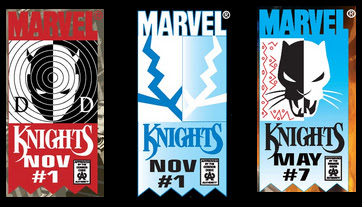
Around 2006, Marvel Knights would revert to being handled in-house by its now more solvent namesake (joining Quesada himself, who came aboard Marvel six years earlier as its new Editor-In-Chief), and of course went on to see its imprint appear on other series during that decade (and spawning other imprints such as the MAX line and the Ultimate books). But in MK's nascent days in 1998, we would see Event produce a new Inhumans twelve-issue series which, along with Black Panther, Punisher, and Daredevil*, was a pioneer of the story format which Marvel Knights brought to the table.

*Marvel Knights also became a series in its own right--the name of a super-team led by Daredevil and consisting of Shang-Chi, Moon Knight, Black Widow, Dagger, and Luke Cage.
Inhumans, written by Paul Jenkins with art by Jae Lee, was probably quite an eye-opener for readers like myself who had been soured by the quality of comics released by Marvel in the late 1990s. With Marvel Knights' emphasis on higher production values, stories with more of an edge and not necessarily beholden to continuity, and jettisoning long story arcs**, Jenkins and Lee were free to think outside the box and explore aspects to the Inhumans that have often been shuttered behind closed doors. (Roy Thomas's 1973 story highlighting the travails of their worker race, the Alpha Primitives, being one example.)
**That may have looked good on paper, but you can nevertheless expect a MK story to take awhile to play out.
Its first issue, where we find the Inhumans' city of Attilan now located somewhere off the coast of Portugal following developments which took place in the "Atlantis Rising" event, takes an approach of the members of the Royal Family pondering what their king, Black Bolt, might have to say if he were somehow given a chance to speak. For Black Bolt himself, Jenkins' opening narrative combined with Lee's imagery make for a striking first glance of a man soaring toward the refuge of his people--a "silent king" whose voice, if released, could otherwise cause devastation and destruction. "Imagine you could never make another sound. Not for the rest of your life. Not a sigh. Not a yawn. Not a single word. Ever."


