Friday, November 18, 2016

A Hero Reborn--The Forgotten One!


The character of Gilgamesh has appeared so sporadically in Marvel stories over time that it's a wonder we still hear from him. Often on the verge of earning the name he's better known by--"the Forgotten One"--he still pops up in one role or another, most recently as a companion to his friend Hercules as they became involved in a conflict with a pantheon of gods known as the Uprising Storm. A creation of Jack Kirby who found a place as one of the Eternals in the title of the same name, the Forgotten One dates back to ancient history, having roamed the Earth and being mistaken for such figures as Samson, Atlas, and even Hercules. Apparently having penetrated too far into human affairs and perhaps allowing his status as a "legend" to get the better of his ego, he was reined in by Zuras, the Eternals' leader, and restricted to a sector of their homeland of Olympia--a sort of "house arrest" that would last indefinitely. It was during this time in virtual isolation that he would become known to his fellow Eternals as "the Forgotten One," an unfortunately appropriate designation which perhaps spoke to his place in history as well as his status among the Eternals.

But during the Eternals' conflict with the Deviants, and with almost all the Eternals occupied in their ritual of the Uni-Mind, the Forgotten One was the only Eternal in a position to help when sought out by the one called Sprite, in order to deal with an explosive device the Deviants planned to deploy on the Celestials' mother ship.


And so with new raiment, the Forgotten One prepares to take his first step back into history, this time to avert catastrophe for all of humanity--for if the Deviant explosive should detonate and cause the ship's destruction, the Celestials' retaliation against the Deviants would possibly annihilate millions on Earth. With the stakes so high, and given how this man has been so shunned by his fellow Eternals, it's to his credit that he steps up and becomes again the hero of old--though this time his reward will not be laurels, but hopefully survival.


The meaning of those closing words from the Eternals story wouldn't become apparent until two years later, when writer Roy Thomas had begun to incorporate Kirby's concepts involving the Eternals and the Celestials into the pages of The Mighty Thor in an extended arc which would culminate in the title's 300th issue. Eventually, in two power-packed issues, the Forgotten One reappears as an emissary of the space gods, thereby bringing him into conflict with not only the Eternals, but with another god who has sworn to stand against the Celestials' judgment which could bring an end to all life on Earth.


Thursday, November 17, 2016

Who Killed Scorpio?


In the conclusion to the story of Scorpio which took place in the Defenders' 50th issue, Scorpio met his end in a scene that played out off-panel but which left no doubt that Scorpio's threat was ended.


But... take another look at the scene.

There are two things here that aren't adding up. Can you spot them?

Wednesday, November 16, 2016

The Return of... Marvel Girl!?


It only took a little over five years after the fact for Marvel to raise from the dead one of its classic characters--Jean Grey, a/k/a Marvel Girl, whose life had been brought to an end both heroically and memorably. In comics terms, five years isn't a great deal of time to allow the dust to settle before planning the details of the character's resurrection--and in Jean's case, there was also the matter of coming up with a reason for bringing her back (or, perhaps better put, a reason for not leaving her dead) beyond folding her into a reboot of the original X-Men. With her more dynamic identity as Phoenix at an end, what could Jean Grey bring to the table as far as reader interest that she couldn't manage to ignite in the many years since her 1963 debut?

One could ask the same of the first X-Men team, who couldn't make a success of their first title and quickly fell by the wayside when their 1975 replacements made the scene--but who were now counting on a bump from the popularity of their successors for their relaunch. Jean, in a way, seemed to be relying on her own popularity and momentum as Phoenix to bring her old readers along for her rebirth--an appropriate word for her reappearance, under the circumstances. Few characters could embody so well the commonly used phrase "like a phoenix from the ashes...", describing the mythological bird that perishes in flames of its own making only to be reborn from its ashes.

Given the interest that Jean's return would likely generate, it seems strange that the story behind it wouldn't take place exclusively in the new title in order to benefit its launch, perhaps even taking two or three issues to solve the "mystery" of it. Perhaps the decision was made to instead have the X-Men regarded as a whole, rather than banking on one of their characters to sell their concept, a more meritorious approach that lets all five characters present themselves to new readers and conveys a vote of confidence in the book.

That's not to say that Jean's reappearance wasn't milked for all it was worth and used to build interest in her new title. First, indirectly, in an issue of The Avengers that featured the return of the Enclave and inadvertently led to the discovery of an energy-emitting pod beneath Jamaica Bay--and then followed up on in the pages of Fantastic Four, giving artist/writer John Byrne (along with inker Terry Austin--how awesome is that?) a crack at the sequence of events which began with the death of Marvel Girl during a fateful space shuttle flight and leading to the as-yet undisclosed details of the introduction of the Phoenix force. The issue of X-Men which heralds the aftermath paints an ominous picture of the shuttle's final moments before it crashes into the bay:


...but what happened during its flight? And what happened to Jean Grey?

Friday, November 11, 2016

Let There Be Victory!


With the Doctor Strange film now a week into its run, it's a pleasure to take you back in time over fifty years and present one of the character's classic struggles against two of his most implacable foes. And while you won't find buildings folding in on themselves in this tale, you will find that writer Stan Lee and artist Steve Ditko spared no effort in presenting a 3-issue adventure that dazzles the eyes as well as the mind--all to be had at the staggering cost of 12¢ per copy, and all without using a single pixel of CGI.

We'll see here the culmination of an extended story that took place over several issues of Strange Tales in 1965, where Baron Mordo was menacing both Strange and the Ancient One. Mordo has become even more dangerous, having formed an alliance with a powerful sorcerer from another dimension who has been funneling mystic might to him and thus made him a more formidable enemy for Strange to face. After evading Mordo's pursuit of him in a global manhunt, Strange returns to find that Mordo has managed to capture the Ancient One, raising the stakes in this conflict considerably. For his part, Strange has been following a vague lead that will hopefully give him an advantage in the coming battle--a mysterious entity he must find, known as Eternity. In the interim, Strange has discovered the identity of Mordo's new benefactor--none other than the dread Dormammu, whose added power makes Mordo virtually unbeatable.

We've previously seen the results of Strange's meeting with Eternity, where Eternity declined to provide Strange with the extra power he needed to prevail. Now, Strange is forced to confront his two greatest enemies in order to save the life of the Ancient One and end their threat. But Strange is well aware of the very real possibility that he may be able to accomplish neither, and that his own life may be forfeit.


Thursday, November 10, 2016

One For The Road


Following the Defenders' battle with Scorpio and the new but artificially created Zodiac, there were some things for S.H.I.E.L.D. to iron out at Scorpio's factory/headquarters in New Jersey. So as promised last time, let's tie up a few loose ends from that classic story.

For one thing, Director Nick Fury--that is, the real Nick Fury, the brother of the man who had once again taken on the identity of Scorpio, Jake Fury--had the dubious privilege of meeting his counterpart, the Life Model Decoy which had been created in his image and which had become Scorpio's sympathetic ear, aide, and, for all intents and purposes, surrogate brother. Jake Fury had nothing but resentment and hatred toward his real sibling--but ironically, the Fury LMD felt exactly the opposite toward Scorpio, a man the LMD appears to be mourning if you read between the lines.


The fact that the LMD seems to feel anything at all is shocking in and of itself; but let's assume for the moment that its "feelings" of loyalty to Jake Fury were simulated and simply part of its programming. With Scorpio dead, that programming would have run its course--so it's surprising to find the LMD not only being affected by Jake's loss, but downright astounding to see it remaining mum on the true details of the circumstances of Scorpio's death. Not even the real Fury seems to suspect the truth (or so it seems). All the parties involved, including Fury, assume the Fury LMD is the one who ended Scorpio's life with a gunshot, when actually it was Scorpio who took his own life--partly because of the failure of his Zodiac project, and partly due to his feelings of despair and hopelessness regarding a life that he felt amounted to nothing.

Whatever (the real) Nick Fury's thoughts are regarding the loss of his brother, he's not saying--perhaps because, in his dealings with Scorpio as part of his brother's criminal past, he feels it's all been said already.

As for the Defenders, they're also picking up the pieces, though for the most part they've come out of this encounter unscathed--except perhaps for Hellcat, whose battle with the savage Leo has left her injured and perhaps a little shell-shocked at her foe's merciless, near-fatal assault on her. While Moon Knight--a lone agent who allied himself with the Defenders to help Jack Norriss, the man who's married to the Valkyrie's human host--prepares to bid them farewell, his experience alongside them proving to have been both rewarding and beneficial.


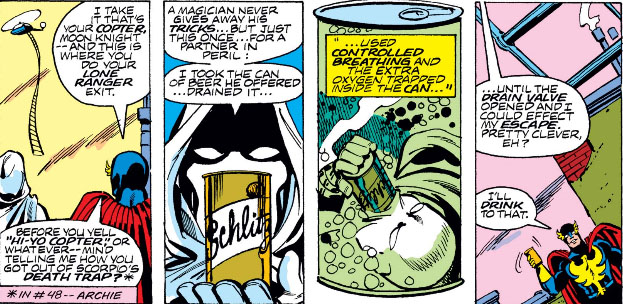
And speaking of Moon Knight, there's one loose end to this affair that hasn't been covered: How did Moon Knight escape from Scorpio's death trap--locked in a water tank and left to drown as it filled to capacity? Thanks to the last bit of product placement by writer David Kraft and artist Keith Giffen, we have our answer.


Or, to paraphrase the old Schlitz slogan: "When you're out of Schlitz, you're not out of air."

Wednesday, November 9, 2016

All Signs Point To... Death!


While the villain known as Scorpio prepares to unleash a new grouping of Zodiac to the world, the Defenders have moved to invade his New Jersey headquarters in an effort to save two of their own as well as put an end to his plans. But one angry Defender has been carefully (and, to say the least, recklessly) herded to arrive ahead of them--a behemoth who has clashed with Scorpio before, and who wishes to express very specific sentiments on how the score between them will be settled:


It's the bludgeoning, beer-popping conclusion to the classic 1977 tale featuring the Defenders vs. the new Zodiac--and just in time for the group's knockout fiftieth issue!


The Defenders face the power of the Zodiac key, plus 4 to 1 odds against them--or do they?

Monday, November 7, 2016

Who Remembers Scorpio?


There seems to be little argument that the three-part 1977 story from The Defenders, "Who Remembers Scorpio?", is a fan favorite, spotlighting as it does this arachnid member of Zodiac and the exploration of his character in depth by writer David Kraft. Scorpio--whose identity is again that of Jake Fury, the brother of the director of S.H.I.E.L.D., Nick Fury--is a mixture of introspection and cynicism, critical of the world's social ills and pressures and mired in depression over his solitude. Yet he has the Zodiac key, as well as the means to alleviate his loneliness--while his ruthlessness and resources drive him to sweep aside the societal constraints that he regards as dangerous and self-defeating and establish his own supremacy.

In this tale, Kraft writes Scorpio as if the character were delivering the lines in a one-man show, with the Defenders waiting in the wings while he moves ahead with his plans. His headquarters, a building in Belleville, New Jersey, almost comes across as a carefully lit set, with its dimness and many shadows only sparsely broken up by pieces of equipment and recessed lighting. One could easily make the case that the environment matches his contemplative mood; yet it's that mood that drives him to act to alleviate his state of frustration, and he is no less the "super-villain" because of it. There are many villains who wish to alter their circumstances through the use of force--people such as Magneto, or Doom, or Loki--but instead of using their broad brush, Scorpio seeks to strike back at the core of society, rejecting its dictates while becoming his own ideal. To do that, he'll need some sort of positive reinforcement in place that provides him with affirmation and support, which will come to him from two sources--each of which will be something of a surprise in terms of what form they take. (And as the story's events fall into place, we'll see just how literal that description should be regarded.)

In a prior issue, a prelude to Scorpio's involvement with the Defenders (as well as the introduction to this arc's title) has already taken place, when he made an incursion at the heroes' riding academy H.Q. in an apparent effort to kidnap Kyle Richmond. When his plan failed, he was forced to adopt a contingency plan and set his sights on Jack Norriss, who had been married to the Valkyrie's human host, Barbara, and who has remained in the Defenders' orbit only to be frustrated by his inability to reach Barbara on any level. Norriss has consequently become embedded with the Defenders to a certain extent, and his activities in a recent power play by the Headmen have brought him to the attention of SHIELD, interrogated but subsequently released by Fury.

But Norriss soon found that Fury was after him again, and this time he wasn't asking for Norriss' cooperation. Yet Fury's heavy-handed treatment of Norriss draws the attention of the adventurer known as Moon Night, who manages to drive off Fury and his agents and then informally becomes Norriss' protector in order to get to the bottom of the mystery.


(Selected scenes from issue #47)


It's a splendid introduction of Moon Knight to the book--and there's no denying the impact he makes on the story, since taking on Fury and his agents is nothing short of impressive, buoyed by the fact that Moon Knight operates on the strength of his convictions and his loyalties are to whomever he's trying to help. After an altercation between the Defenders and Wonder Man, one of the Avengers, it comes as something of a surprise when Fury changes his approach vis-à-vis Norriss, deciding to substitute diplomacy for the use of force.


Norriss' instinct proves to be correct, since the Defenders are convinced that Fury wouldn't circumvent the law and that no harm will come to Norriss.

Unfortunately, in the opening of Kraft's follow-up story that will bring Scorpio's plans front and center, we're not so sure anymore that the Defenders made the right call--and even less sure of Fury's good intentions.


You might want to pop open a Schlitz and relax while you can--Scorpio's melancholy won't last.

Friday, November 4, 2016

Below Us The Battle!


The prelude to the classic Avengers/Defenders war took place in the September 1973 stories of each title, kicked off in separate epilogues following their main stories. In sequence, the first to read would have to be the epilogue of Avengers #115, which segued to its follow-up in Defenders #8--both of which can be sampled in a separate post. The two segments are driven by the common denominator of the Black Knight--his mysterious disappearance and his fate, respectively--but the main Avengers tale gets short-changed a bit, since what the team discovers at the site of Garrett Castle is a separate encounter that must play out before they move on to address the mystery of the Knight, and that story as a result is given limited space to pique the reader's interest.

On the other hand, the foe the Avengers face is not a powerful one nor a particularly formidable one, considering that the lineup of the Avengers at this point in time is unquestionably both--and so the story doesn't necessarily require a great deal of space to be resolved. (In fact, all things considered, it may be using too much space to dispatch the opposition.) But with other elements in the story taking up the Avengers' time, there are only eleven pages to dedicate to the main conflict--roughly the same amount of pages that stories in Tales Of Suspense, Tales To Astonish, or Strange Tales had available for splitting their issues between two heroes in separate stories.

Yet, even wedged in as it is, "Below Us The Battle!" doesn't fall into the category of a throw-away story, and it certainly isn't filler material. Yes, the Avengers probably have more trouble with their foes than might be reasonable to expect for "Earth's mightiest heroes"--and yes, it's confusing to see the Avengers so at a loss to handle superior numbers, given how they met and vanquished a mass of armed warriors far more adept at savage combat and with far greater armament than the primitive foes they face here. But the circumstances of the encounter are intriguing enough to leave you at least satisfied, while the bookends of the Defenders plot are sufficiently distracting to supplement any perceived weaknesses in the main story.

There's also the added benefit that writer Steve Englehart is finding his legs with the Avengers, and so there's no shortage of continuing character development. In this case, the Swordsman, their newest member, finds that he's persona non grata in the U.K. when the Avengers quinjet, on its way to the Black Knight's ancestral castle, is boarded by a S.H.I.E.L.D. craft that's been dispatched to deliver a brief but blunt message for the team:


(Does this SHIELD agent think he's landing on the moon?)

Wednesday, November 2, 2016

The Year Of The Pharaohs!


Time-travelling back to ancient Egypt has been used from time to time (ha ha--get it?) in Marvel's line of comics, but in 1963 the land of the Pharaohs' tourism industry must have been working overtime. Not only did Iron Man travel back to approximately 41 B.C. during the time of Cleopatra, but the Fantastic Four also made a journey back to Egypt to fulfill their own mission. And in each instance, there was an evil Pharaoh to deal with.


(Did you manage to spot the goof on one of these splash pages?*)