Monday, June 6, 2016

Marvel THEN and Marvel NOW!


I wasn't one to snap up comics issues with variant covers when they suddenly began appearing on the store racks, since the price of a single comic book had become outrageous enough. (Though I did *ahem* mysteriously often find in my pull stack variant issues which the store dealer probably figured wouldn't move otherwise.) But as a browser, it was definitely fun to take a look at the different pieces of cover art than a single issue featured. I even remember wryly thinking, "Jeez--with all of this cover art being commissioned for a single issue, I'd better not hear any more excuses about a missed deadline for a story."

Recently, this related news item from over two years ago caught my eye:


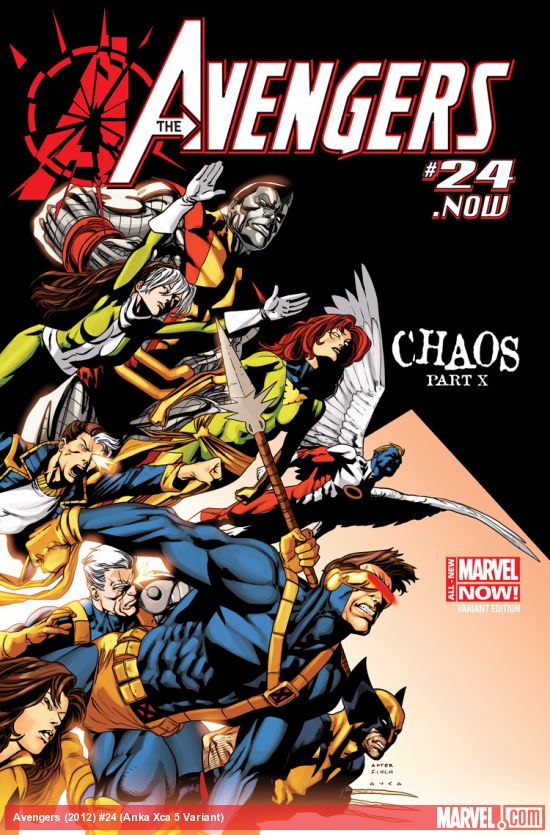
"Now isn't that clever," I thought, intrigued. Of course I'd stopped collecting comics well before that time, or I might have been tempted to snag one or two of these variants. (Probably not.) I had to actually look up "Marvel NOW!" (which also carries the caption "Join The ReEVOLUTION"), since that was another sales push that passed me by; apparently it refers to the event in 2012 that relaunched several books with new #1 issues. Glancing at what's available from Marvel on a week-to-week basis these days, it looks like Marvel NOW! probably became Marvel ALL THE TIME!, given the overflow of issue #1s featuring the same characters that are constantly rolling off the presses.

At any rate, here are the featured variants from the 2014 Avengers #24--excuse me, Avengers #24.NOW--which are worth a look if mostly in a nostalgic sense.  Each row displays the original issue's cover, followed by its variant to the right.  (The final two covers you may remember from a prior post.)


Friday, June 3, 2016

Make Way For The Demolition Man!


If you took a bulked-up, super-strong ex-wrestler and gave him a costume to make him resemble an amalgam of Wolverine and the original Daredevil (albeit without the claws and the billy club), would he have a future in comic books? We'll try to find out in today's "I see it but I don't believe it" spotlight on a character who was introduced in a 1987 issue of Captain America--though it's never a good sign when even his premiere cover doesn't bother to take him seriously!


Writer Mark Gruenwald is an acquired taste in terms of looking at his run on books such as Captain America--heavy on development, yet providing some of the most plodding stories for an action-oriented hero like Cap that you may have ever read. It's unfortunately the type of environment in which our budding hero, Dennis Dunphy--the Demolition Man (or "D-Man" for short)--debuts. On the one hand, Gruenwald's dialog is fairly realistic as he takes us through his story, and it's hard to fault him for that--but there is no "spark" to be found in how his characters come across (particularly Cap), and, by extension, in how his stories read from beginning to end. As a result, if D-Man fails to make much of an impression on you, bear in mind that he might have if he weren't so weighed down by the exposition that Gruenwald employs in the dialog and thought balloons his characters are burdened with.

Cap meets Dunphy as he's following leads in seeking out a man known as the Power Broker, who's responsible for the appearance of a number of men and women whose level of strength has been augmented to an incredible degree. Many of them have found employment as wrestlers in the Unlimited Class Wrestling Federation based in Los Angeles--where Dunphy came to know Ben Grimm during the period when Grimm had left the Fantastic Four (a period expanded on in both The Thing and West Coast Avengers). Dunphy provides Cap with background info on the Broker's ties to the augments, which gives Cap cause to investigate a disreputable scientist named Malus. What Cap doesn't expect is that he now seems to have a new (if informal) partner tagging along on the case, someone who obviously has designs on using his mega-strength in another capacity than in the wrestling ring.


And so, with absolutely no fanfare, a new hero is born. Again, there's nothing particularly wrong with the way Gruenwald has handled these scenes; perhaps his method is meant to have the average person relate more to how another person might go about suiting up as a hero. Yet it does nothing to pick up the pace of the story, and certainly nothing to distinguish D-Man in the least.

There's also another plot thread that Gruenwald follows throughout this story--the fact that a recent encounter with another augment known as the Super-Patriot (John Walker, who would go on to replace Captain America and, later, become USAgent) has undermined Cap's self-confidence in his own abilities, and has him wondering if perhaps he should consider the Power Broker's treatment for himself. It's quite a jolt of news for the reader--yet Gruenwald conveys it so casually and matter-of-factly that we get little sense that it really concerns Cap to the degree that Gruenwald would have us believe.

Inside, Steve Rogers' ruse to enter the facility as a prospective subject for the augment treatment is uncovered. Eventually captured, he's taken for augment experimentation by Malus--but help is on the way.


D-Man cleans house with the other augments, and goes on to free Cap in the nick of time. With the facility compromised, the Power Broker escapes, though Malus is captured--and after questioning him, and giving the matter serious consideration, Cap decides against having the treatment performed on himself, though it's obvious he's not comfortable with the choice he's made.

Later, using Malus, Cap and D-Man pick up the trail of the Broker to his lab facility, where a swarm of augments arrives to intercept them. The two become separated, and D-Man goes down--as he must, since he brings no fighting style to the fight and he faces many foes whose strength matches his own.


D-Man is taken to face the Power Broker, who moves him to his private facility in order to experiment on him further. Elsewhere, Cap and Malus find their way underground and face the deformed and brain-damaged augments who didn't make it through Malus's experimentation. Fortunately, they escape with their lives with the intervention of the Night Shift, a macabre group of former criminals led by the Shroud who later join Cap in raiding the Power Broker's lair.

To make a long story short, Cap discovers that the Power Broker is none other than Curtiss Jackson, formerly of the west coast branch of the criminal organization known as the Corporation, whom Cap confronts and forces to lead him to D-Man--currently undergoing joint experimentation along with another augment who would soon be known as the new Ms. Marvel. Unfortunately, Jackson's sadistic treatment of D-Man has gone beyond the limits of his endurance, which Cap learns the hard way.


Gruenwald wraps up the story of the Power Broker in the following issue; but as for D-Man, Cap manages to stabilize him, but he's forced to rely on Malus to attempt de-augmentation treatment on him in order to reduce the risk of another heart attack. The treatment proves to be successful, bringing D-Man back to the level of augmentation he'd attained prior to Jackson's additional experimentation--yet the experience nevertheless appears to have compromised his heart to a certain degree.

Still, D-Man continues to suit up, particularly when Cap goes missing after turning in his stars and stripes following a government review of his modern-day role as America's symbol.


Once Cap is settled into his new role as "the Captain," D-Man joins him in a battle with the terrorist organization known as ULTIMATUM, only to apparently meet his end while trying to save an enemy's life.


It takes another fifty issues of Captain America before D-Man reappears, located by USAgent and the Falcon at an ULTIMATUM installation--and Cap (now back in his stars and stripes) is understandably elated to see him alive, though he finds that his friend has suffered significant brain trauma.


Things become somewhat settled with D-Man after his involvement with the Night People (a legacy from Jack Kirby's run on the book), as he seeks to help these people break free of the misguided leadership of a man who keeps Dunphy's strength in check by absorbing his strength. And in a final street confrontation, D-Man finds himself again, as well as a new purpose.


D-Man's history becomes sparse at this point, the character shuffled into this story or that in an effort to make use of him. Eventually, he was captured by Hydra, brainwashed into becoming the new Scourge, and sent forth to execute criminals in witness protection--finally meeting his end from the gun of Sharon Carter, who, as we've seen, knows her business when it comes to gunning down people.

Thursday, June 2, 2016

Destination: Counter-Earth!


Do you get the feeling you've walked into the middle of something here?


If it's any consolation, the Rhino knows just how you feel! Taken control of by the mental might of the Leader, the Rhino was unknowingly battling the Hulk in the closing pages of the incredible one's prior issue, when the Leader decided to bait the Hulk into following his shuttle as he lifted off and headed for the location where Betty Ross was to be married, vowing (heh heh, get it--"vowing"?) to bring about her death--either by his own hand, or from the Hulk's rage in trying to stop him. It was a no-win situation for the Hulk, should the Leader/Rhino make it to his target; but thanks to one of his prodigious leaps, the Hulk caught up with the shuttle, and now seems intent on smashing his way to his foe.

But as we open the next issue, we see that not only has the Leader seemingly abandoned the mind of his horn-headed pawn, but abandoned his plans, as well. Now that the Leader has realized that his shuttle will never reach its destination, he's made an abrupt course change and decided to cut his losses.


Obviously the Leader's brilliance is not to be underestimated, having designed and built a "shuttle" that's piloted and powered by his own mental force, can span the distance from the Earth to the sun in just days, and can survive a battle between its two occupants while still adhering to its flight path. But something even the Leader isn't even aware of is now in that path: the world created by the High Evolutionary in orbit on the far side of the sun, a world known as "Counter-Earth."


Both combatants are unceremoniously evicted from the shuttle--the Rhino by the Hulk's massive fist, and the Hulk when the shuttle strikes a land mass. Now on an alien yet familiar world, both men end up in the midst of a civil war taking place between factions of the High Evolutionary's New Men--the Hulk falling in with those still loyal to the Evolutionary, while the Rhino ends up with those who are out to dominate the human race. Both groups are aware (thanks to an eavesdropping reporter) that the Hulk and the Rhino arrived on a space ship, now in possession of the military (commanded by--who else?--General Ross)--and the Hulk's allies agree to help the Hulk locate it in order for the Hulk to return to his own world, though they also wish to keep the ship out of the hands of their evil brothers.


Again, the story gives us the feeling that we've found ourselves in the middle of events already well underway, a situation now escalated by both groups converging at the hangar where the shuttle is being studied. Aside from the convenient coincidence that the Hulk and the Rhino have separately fallen into the hands of each faction, there's still no reason why the Hulk would have cause to suspect that he's not on the true Earth, and thus wanting to make his way back to the shuttle--nor is there reason for his new allies to broach the subject with him, since they seem unfamiliar with him. The story almost seems geared to be a plug for the new Warlock mag (at this point a brand-new series, in its third issue), with even Warlock himself making a brief cameo--and in addition to cutting a few corners and giving the Hulk a sense of purpose in heading toward the shuttle, it also throws in another surprise appearance to pique our interest in Counter-Earth.


Yes, on this world, Banner remains a scientist who only had a brush with the events that led to the creation of the Hulk; he's even highly regarded by Ross, who considers him the model son-in-law. But of course there's one newcomer who won't exactly be thrilled at the sight of Banner--and we'll find there are other surprises to come from that meeting.


With the incursion of the Rhino and the murderous New Men, it becomes apparent that the Rhino and his group intend to seize the ship--and while he and the Hulk battle in earnest, the two groups of New Men clash as the scene erupts in violence. It's intriguing how such events affect those on Counter-Earth, since their world has until now been bereft of super-beings--and the arrival of the creations of the Evolutionary (to say nothing of the Hulk and the Rhino) is a little overwhelming to them.


Yet for the purpose of this story, the Hulk is virtually a guest-star in his own mag--his stay on Counter-Earth a limited one, since he won't be extending his stay in the pages of Warlock and must out of necessity make an abrupt exit (in spite of the Leader's efforts to deprive him of the means to leave). Banner's engineering team has even repaired the shuttle's damage and restored it to operational readiness to accommodate the Hulk's departure. (Wouldn't you think the team assigned to the shuttle would study it by inspecting its components, rather than attempt to rebuild a craft they know nothing about?) And so the Hulk's departure from Counter-Earth is calm and without incident, compared to his chaotic arrival.


Curiously, another odd development occurs in this story, prompted by the startling meeting between the Hulk and his other self--the fact that the Hulk, who often angrily denies that he and Banner are one and the same, now mentions it as a given, as if he never questioned it in his life. "How can Banner be here--when Banner is part of Hulk..." To be fair, the comic has always had difficulty making up its mind on the subject, going back and forth on it; but with the appearance of "Bobby," the Hulk finds it easier to lay those cards on the table. (Though in this case that's perhaps mostly out of necessity. Until the Rhino makes the scene, the Hulk is the only character on this planet who can demonstrate the surprise necessary for the scene to work--so it's the Hulk who must voice the reason why he hates the man standing before him, when up to now his reasons simply had to do with Banner being a weakling and his "imprisoning" the Hulk in "a dark place.")

Equally strange is that in this story, Banner appears to have no difficulty recalling his time as the Hulk--and clearly, at that. By rights, his last memory should have been just before the Leader taunted him on Earth about heading toward Betty to endanger her life, which angered him sufficiently to turn into the Hulk--yet he clearly remembers the details of his time on Counter-Earth as the Hulk, when he should instead be very concerned about being aboard a shuttle in outer space with Earth apparently receding from view behind him, not to mention wondering if the Leader carried out his plan with Betty.


So we can reasonably chalk this issue up to an unabashed opportunity to plug the Warlock comic by somehow getting a mainstream character over to Counter-Earth, provide the reader with a sense of what's going on there, and then bring that character back again while bending a few rules of logic and characterization in the process to make it happen. For instance, consider:  As hard as it is for the Hulk to think, and yet he's still able to distinguish that there are two planet Earths? It's only a sampling of the nuggets that we're asked to swallow in this story--yet that said, it still shaped up to be reasonably entertaining, though the Leader and the Rhino might beg to differ.

But, what's that, you say? You're wondering how Banner makes it back to Earth, if the Leader controls the shuttle and is dead set against Banner ever returning? Let's take a peek at the following issue and see how that's explained:


Yes, that's right: the residual mental force of the Leader still present in the mind of the Rhino repelled the Leader's efforts to regain control of the craft, allowing Banner to seize manual control and enter Earth's atmosphere. It seems not even the Leader is a match for the suspension of disbelief.

Incredible Hulk #158

Script: Steve Gerber
Pencils: Herb Trimpe
Inks: Sal Trapani
Letterer: John Costanza

Wednesday, June 1, 2016

Jarvis, Ascendant!


Recently having looked in on the Avengers' butler, Jarvis, during his recovery from the brutal attack on Avengers Mansion by the Masters of Evil, we saw that he had made the decision to return to his position, one he had held since its inception. With his injuries so extensive, the decision he had to make did not come easy; but in reaffirming his commitment to the Avengers, it was clear how much esteem he held them in, and how close he felt to them all. In the end, it was a matter of living up to the standards of perseverance and the overcoming of hardship that the Avengers strove to hold themselves to--and Jarvis would be there alongside them.

Looking back on the character, we really didn't get a handle on Jarvis until he was forced to accept a payoff from an earlier grouping of the Masters in exchange for the mansion's defense plans, in order to help his ill mother--an act of betrayal for which the Avengers forgave him. Until then, it took some time for Jarvis to appear in the book, mostly working behind the scenes to maintain the mansion and see to the Avengers' needs; but occasionally, an opportunity would appear in a story for Jarvis to make his presence known, if only briefly. Two such instances were covered by writer Bob Harris previously, as Jarvis looked back through his memories of getting to know the Avengers from the ground up--with Harris expanding on those scenes, since, originally, our poor butler was never allowed to utter a sound!

Our first glimpse of Jarvis already has him in a predicament--thanks to the arrival of Hawkeye, who arrives to apply for membership in the Avengers and decides to demonstrate his qualifications with the reluctant cooperation of an understandably nervous butler.


(No doubt a difficult memory for Jarvis to relive these days, considering that his recent hospital stay was also a result of being bound and used for a demonstration.)

Harras also brings up the solitary existence Steve Rogers led when he first took charge of his own team of Avengers, choosing to remain at the mansion whenever the others would go out. Harras showed Jarvis lending an ear whenever Steve felt like talking during those times, though in the original version we'll have to assume that Jarvis stayed in the room following the discharge of his regular duties.


To my knowledge, Jarvis is first mentioned by name when Cap begins appearing in Tales of Suspense in late 1964, in a scene which mirrors the above but occurs nearly a year earlier:


But in The Avengers title, there appears to be a gap of twenty issues before Jarvis is first mentioned by name, when the Black Widow is being considered for Avengers membership and the active members decided to take a dinner break before deliberation--all of them except Cap, that is, who remains on monitor duty. Jarvis probably only owes his name being dropped to the fact that Cap practically logs his every thought for posterity.


(We can only imagine what Cap would think if he knew that one day, Iron Man would cross the same line the Widow did, with his treatment of Jocasta while the team was in pitched battle with Ultron.)

Shortly afterward, it's Jarvis who summons the team back to the mansion when Cap ducks out on a mission (to confront the dual threat of the Swordsman and Power Man). Jarvis isn't really needed in this scene, but it looks like writer Roy Thomas wants to begin making him more of a fixture in the mansion.


A few months later, Jarvis makes a cameo appearance in the first Avengers annual, and inadvertently makes something of a faux pas with Iron Man. The issue also features a cutaway of Avengers Mansion, with Jarvis apparently the only one minding the store!


Good lord, does that man have a lot of upkeep to take care of in that place. Maybe he enlists Quicksilver's help in dusting and vacuuming.

Finally, we see Jarvis answering a distress call from the very same Quicksilver--and you'd better believe he wants to make sure to give that guy prompt service.


From that point, Jarvis begins to receive more exposure in The Avengers, and the rest is history. I for one am glad to see him on the road to recovery from his ordeal--it's hard to think of the mansion, or the Avengers, being the same without the old boy.