Thursday, January 14, 2016

Here's To Surviving The Experience


I had stopped collecting Uncanny X-Men long before December of 2011 was crossed off on my calendar, so I'm afraid I don't have a point of view on what the quality of the book was at the time. Suffice to say that, like other titles whose issue numbering was reaching into the stratosphere, the axe finally came down on UXM and drew the curtain on a nearly fifty-year span of Marvel history.


As its cover implies, the last issue comes full circle, at least symbolically. The tone of the story, however, is not of celebration or nostalgia, but a sign of changing times, and how the X-Men--as a concept and as a team--will face the future.

The story basically provides us with a general sense of where things stand, enough to bring us up to date without including the details of prior issues. It would seem part of the team is abandoning their "Utopia" base off the coast of San Francisco (a remnant of Magneto's orbiting asteroid base which fell to Earth and was recovered and adapted for the team's use), with Wolverine taking a group of its inhabitants and relocating to Westchester County in New York to reboot the Xavier school and likely rename it--while Cyclops, Emma Frost, Storm, Magneto, Colossus, et al. will remain on Utopia. It's a curious step to take.  Since the whole point of the naming of Utopia was to regard it as a safe haven for the mutants who remained and were in need of sanctuary after the events of M Day, there doesn't seem to be much point to retaining that name if a large segment of its population is abandoning it--but what do I know.

As to how much has changed in those changing times that were previously referred to, the story addresses the point succinctly in a very clever side-by-side look featuring the introduction from issue #1, adapted for its counterpart here at the team's crossroads.


The frank comparison would seem to paint a grim picture of the X-Men's evolution as well as the team's state of affairs as it prepares to take its next step. On the other hand, the fact that there is a next step to take, even in the face of all that's happened to the X-Men as well as to the mutant race, offers a peculiar feeling of optimism as everyone prepares to depart. The perfect contrast between these two points of view can be seen in the interaction between the dour Cyclops and the more light-hearted Iceman, who as charter members of the X-Men go as far back as two men--two friends--can.


Filling in the gaps where needed and acting to provide perspective of a sort is Mr. Sinister, who injects a more formal reflection of the X-Men's activities which led them to this point, as well as looking down the road toward their future (though in a decidedly different manner than Cyclops). Sinister has arguably been a conspicuous presence in this book for quite awhile, at times moving key personnel of the X-Men around like chess pieces in his manipulation of their lives. In his musings, that's made quite clear, as is his almost intimate familiarity with the characters he speaks of.


As for Scott Summers, whatever events have led to this decision to split the team's ranks have left their mark. On Scott... certainly on Wolverine... as well as one other for whom this occasion should mean as much as it does to Iceman. But we'll find no quick wit in Hank McCoy this day, except in the form of innuendo.


Though leave it to Bobby Drake to attempt to lighten the mood:


Sinister's mood is also light, seemingly untouched by whatever setbacks he may have experienced in the past and taking an almost personal interest in a team of mutants which has retained his focus for so long. I would hate for this ending to write finis to the career of Mr. Sinister; fortunately, by all appearances, he has every intention of continuing on.


And Scott? As he packs away mementos of days (and years) gone by, he'll continue on, as well--but this time, in his own way, and at his own direction. It's a moment that first page of the story has prepared us for--and by the time it arrives, we're ready to acknowledge it with him. It's a poignant close to the story, since mementos, after all, need not necessarily be reminders.


BONUS:
Artist Greg Land's double-page spread of this issue's variant cover image!


This puppy is pretty crammed with X-Men memories--
but is there anything missing that you feel should have been included?
(No Shi'ar? No "fastball special"?)

Uncanny X-Men #544

Script: Kieron Gillen
Pencils: Greg Land
Inks: Jay Leisten
Letterer: Joe Caramagna

Wednesday, January 13, 2016

The Killing Game


Since we haven't had enough merciless, brutal killing of mutants for one week, let's see who else will have their head on the chopping block, as Marvel continues with its unofficial shift in direction toward bloodlust following its introduction of the Marauders, a mercenary group that invaded the Morlock tunnels and slaughtered hundreds of men, women and children. Let's jump ahead a bit to late-1991, where the company is celebrating another anniversary--fifty years of Captain America, a hero who would likely be appalled at how conflicts with super-villains now resemble the bloody battlefields of World War II that are seared into his memories. In the Marvel comics of the 1990s, you'd better be packing a piece--because the company has decided that attitude, a body count, and the BUDDA-BUDDA-BUDDA of high-tech weaponry are what readers are looking for in their comics.

We pick things up as a new team of X-Men is introduced, along with a new creative team to chart its course.


As for which characters are going to shortly be in need of tombstones:


They're even pictured as corpses here--how's that for adding insult to injury?

Tuesday, January 12, 2016

Kill Or Be Killed


It's been almost thirty years since Marvel shifted toward a more violent posture for its characters, by producing a series of stories in 1986 that tested those waters with crossovers between three main titles:


All coinciding with the company's 25th anniversary--which you might think would be a celebration of the special brand of heroism and entertainment that Marvel's comics and characters brought to the industry, but now gives us a "that was then--this is now" impression. Starting with this raw, brutal murder scene, where a young mutant girl is stalked by a pack of killers from Los Angeles to New York and discovers that her flight has made it possible for her home to become a killing ground.


Monday, January 11, 2016

Iron Man--Recharged and Rebooted!


When writer Mike Friedrich came aboard Invincible Iron Man in mid-1972 to begin his 3½-year run, his first order of business was to CLEAN HOUSE in terms of getting Tony Stark's life back on track. In comic book terms, that meant making Stark less of a doormat who carries around a bum rap for manufacturing munitions and whose heart condition has him turning to his identity as Iron Man to have a sense of animation and thrill that he appears to lack in his personal life. Of course, it was his life as Iron Man, with his lousy suit of armor frequently malfunctioning or running out of power, which tended to exacerbate Stark's heart condition and sideline him to the point of being regarded as an invalid in the first place. Heck, just ask Bridget, Stark's stalwart cook:


(Jeez, I'd say you can just forget about that Christmas bonus, Bridget!)


So after the death of his close friend, Kevin O'Brien, and following a period of reflection that had him questioning whether he wanted to continue as Iron Man, Stark blurts out three words that he's probably been wanting to say for a lonnnnng time:


(Don't you love the symbolism of the Stark Industries logo happening to also bear a resemblance to the dollar sign? Who do you think you're fooling, Tony?)

Stark's first stop is his feisty Board of Directors, who aren't feeling so feisty when Stark calls their bluff and moves to regain personal control of his company.


(Oh, don't worry, Marianne Rodgers--you don't know it yet, but you'll also find yourself on Stark's hit list soon enough!)

The Board's Chairman, the power-hungry Simon Gilbert, has aggressively maneuvered himself (and the other Board members) into the position of capitalizing on Stark's difficulties, and now feels that Stark's embarrassment over the Guardsman debacle will effectively tie his hands as far as having any sort of clout to overcome the Board's show of strength. But the simple truth of the matter is that the Board is up this creek without a paddle, and, truthfully, always has been, since Stark owns controlling interest in his company. As long as that's the case, there can be only one way that this is going to go down.


Gilbert may be grumbling now, but his planning comes to naught when he meets his death trying to sabotage the factory after his hireling, Firebrand, fails to overcome Iron Man.

Next up: Stark takes his first steps towards shifting S.I. from a manufacturer of weapons of war to focusing on R&D and the tools of progress and peace.


Then there's Marianne, whom Stark is still in love with but whose powers of ExtraSensory Perception (which was getting all sorts of press around this time, if memory serves) have now suddenly included visions of the near-future--one of which involves Iron Man meeting his death at the hands of a monstrous figure when she is present at the scene. Unfortunately, when she arrives at Avengers Mansion in response to an "ESPer" flash that tells her that Stark needs her...


...her vision manifests in front of her eyes, which she takes as a sign that her presence will spell disaster for Iron Man if she stays with him.


(No, I don't know how Marianne can go charging in and out of Avengers Mansion as if she had her own membership card. Then again, this was well before Henry Gyrich stormed in and beefed up the mansion's security, so maybe she simply picked the lock.)

Thank goodness Stark pays the mansion's power bills, because Stark is resourceful enough to find a wall electrical socket (which you or I could never have done) and save himself. But the disaster that Marianne feared will turn out to be her own, if Stark's mood is any indication.


It's quite an abrupt end that Friedrich will bring to the relationship of Stark and Marianne, considering how long it's been going on in the pages of Iron Man and how only just recently Stark proposed to her. Why would Stark just slam the door on his commitment to his fiancée without first hearing the circumstances that led to an apparent betrayal on her part? Particularly when her ESP ability has otherwise been an advantage to him on more than one occasion? But just watch the whirlwind reasoning that Friedrich supplies Iron Man with to drop Marianne like a hot iron.


And so it comes to pass:


Wow! I wouldn't be surprised at this point if Stark phoned down to Security to have her escorted from the premises.

So, that takes care of:

☑ Putting Stark back in charge of his company;
☑ Choosing and implementing a new direction for Stark Industries;
☑ Severing ties with the last character remaining from the old days.

What does that leave? Oh, yeah--the armor!


Well, elation at a successful test run aside, Iron Man should never say "never" when it comes to his heart. Friedrich is obviously under the mistaken impression that Stark's heart is a transplant--though Friedrich is the new kid on this block, so he can be cut a little slack, especially when other writers like Gerry Conway have put forth the same misconception. Regardless, future writers would have Stark grabbing his chest again in no time. At any rate, the armor looks good to go!  (As long as there's a wall socket somewhere nearby.)

Friday, January 8, 2016

Enow, Cries The God of Evil


It's been over ten years since I took a second look at the four-part Loki series from 2004, and I must say it's aged very well indeed. Written by Robert Rodi with art by Esad Ribic, the story fits comfortably within the Asgardian mythos that Marvel established in years past, and yet refreshingly makes its own powerful statement as to the characters and motivations of Thor, Odin, Sif, et al., and of course Loki himself. The Asgard of this series is far removed from the "eternal realm" of magnificent spires and spotless hallways, grandiose and defiant speech, and spacious, well-lit palace chambers that reflected the glory of the realm and those within; instead, these Asgardians give us a sense that every battle has been hard-fought, every victory coming at a cost--a race of warriors with a strong grasp on life and a keen awareness of the many factions of their world that threaten their existence and demand their vigilance.

The same history is there, but there is more to see of it, with undercurrents that still resonate among even these immortals. The infant Loki was still taken from Jotunheim after his father, Laufey, was slain by Odin, and adopted as Odin's son. Loki still evolves as a trickster, one who employs guile and deceit and endures the taunts and mockery of his new countrymen. Thor is still champion and favored son of Asgard, his brother-at-arms Balder and the lady Sif at his side. And Thor still makes sojourns to Earth, fighting alongside "his Midgard cronies," as Loki calls them. Yet in this deeper look at the Asgardians whom Loki despises, there are definite indications of their disdain toward Loki through the years, and not just from Loki's perspective. In an environment where a strong and bold presence on the battlefield translates to camaraderie and respect amongst your fellows, there is no room for the wiles of Loki Laufeyson--a son of Odin who appears to be anything but.

In order to meet these impressions head-on, Rodi finds it necessary to finally bring Asgard under Loki's heel--a state which Loki has long sought and launched many campaigns to accomplish. Now, fortunes have indeed shifted in Loki's favor--and the conquered of Asgard no longer have the luxury of ignoring Thor's half-brother or throwing snide innuendo his way with impunity as to his worth as a warrior. He is now unquestionably their master. Accordingly, the bold cover image chosen for the first issue in the series is no mere teaser--it is where this story begins, preceding a striking two-page spread by Ribic that reveals the aftermath of a fierce struggle which sees Loki triumphant.


Thursday, January 7, 2016

Big Crime Lord On Campus


For much of the year 1969, a story arc concerning an ancient petrified clay tablet virtually hijacked the Amazing Spider-Man book and kept our hero busy investigating its theft while trying to keep it out of the hands of two major crime bosses. And small wonder they wanted to possess it--supposedly, the writing on the tablet held the answers to one of the greatest secrets of all time.

The first crime lord to covet that secret would be the Kingpin, who's been keeping a low profile since his ascension to the position of the city's head crime figure was foiled by Spider-Man. But now he's set his sights on the tablet, making its way through the research departments of various universities in the hopes that one of them will be able to decipher its inscription, which dates back hundreds of years. In this story, the tablet happens to be on loan to Empire State University (ESU)--an appearance which would qualify this tale to be among the campus unrest stories which Marvel featured in some of its titles in the late 1960s and early 1970s.

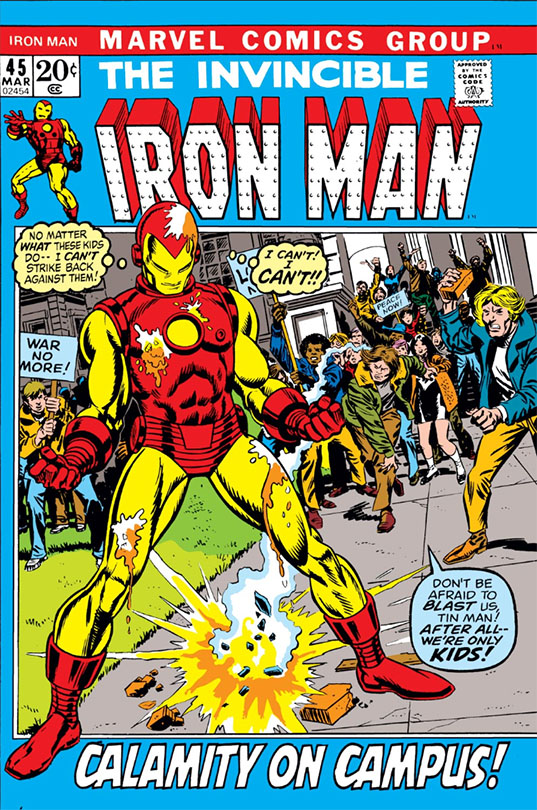
Yet unlike the story involving the Guardsman that took place in Invincible Iron Man, this one will occur on an actual college campus; and rather than its protests centering on the war, our ESU students will be after nothing but taking the exhibition hall which the tablet will be temporarily displayed in and rededicating it as a low-rent dorm for students once the exhibition of the tablet is concluded. The point of contention that the demonstrators are taking issue with is that ESU plans to instead turn the hall into housing for visiting alumni--which seems a minor enough issue that can be worked out without the use of violence, though if that were the case we wouldn't have much of a story, and certainly an altogether different cover image.

Clearly the Kingpin hasn't abandoned his goal of taking the reins of New York City's underworld mobs, regrouping from his earlier setbacks and likely targeting the tablet in order to give him the edge as he continues his power play. And you would think that putting the snatch on an ancient tablet under minimal guard would be child's play for a man of the Kingpin's resources. But the Kingpin must also continue to secure his own position and reputation in his slow and steady climb to the top. We've already seen him fend off a challenge from one of the mob bosses who made the mistake of questioning the Kingpin's leadership; there's also the matter of the Kingpin's unresolved business with Spider-Man, which continues to infuriate him. So while the tablet is at the top of his to-do list, the Kingpin must constantly make sure to keep his men in line, by continuing to employ the method which has served him well: pure intimidation.


It's not a bad way to vent your anger toward a certain web-slinger, either.

Wednesday, January 6, 2016

My Friend, My Enemy!


The conclusion to Part One of the story which saw the debut of the Guardsman probably left you a little stoked, eh? A tense standoff involving the police, Iron Man, and an angry group of demonstrators, with the police finally being provoked into taking action, with casualties likely? When we open the next issue, we're all expecting a bloodbath waiting to happen--or at least Simon Gilbert, Stark Industries' ruthless Chairman of the Board, yelling the equivalent of "Get off my lawn!" from the offices above, right?

Imagine our surprise when we discover that, somewhere between Parts One and Two, everybody has left the scene. The demonstrators have inexplicably dispersed; Gilbert gives us a two-page ranting of the events of the prior issue and wraps it up convinced things will end in his favor regarding his hostile takeover of the company; and writer Gary Friedrich adds a quick behind-the-scenes recap while driving home the point that it's somehow the fault of the Guardsman armor that the mind of Tony Stark's close friend, Kevin O'Brien, has been impaired.


Meanwhile, each of us would be perfectly justified in asking: "Wait! What... Did I blink??"

But almost immediately, Friedrich and artist George Tuska practically bring us right back to where we left off.


With the difference being that this time, the police are absent, and will be for the duration. (That is if you're not counting Mr. Todd of "Plant Security," whose job description doesn't seem to cover "all hell breaking loose" on the premises.)

Tuesday, January 5, 2016

At Your Service--The Guardsman!


Marvel has done its fair share of campus unrest stories, particularly in the late '60s and early '70s--so it's probably no surprise to find Tony Stark (and, by extension, Iron Man) coming into conflict with the violent protest movements of the time, in light of the fact that he was still primarily manufacturing munitions and hadn't yet rededicated his company's resources to research and development. Yet in a two-part story, national unrest with the Vietnam War served as the backdrop for a more personal crisis for Stark, involving his best friend--who also would be the first person to don the armored suit of the character known as the Guardsman.


(Get a good look at that campus where Iron Man is getting pelted with rotten fruit and molotov cocktails, because this story doesn't go anywhere near a campus; instead, it takes place entirely on the grounds of Stark's factory. The cover to the story's conclusion in the following issue hits much closer to the mark.)

We've become so used to seeing men in Guardsman armor "guard"ing facilities where super-villains are incarcerated that it's easy to forget that this armor has a tragic history. Designed by Stark to be used by his close friend, Kevin O'Brien, as a fail-safe measure (in conjunction with a special ship), O'Brien suits up in the armor in order to rescue an overdue Iron Man who's battling an agent of the mysterious villain known as Mister Kline.


O'Brien is successful--but there are some complications involved in "the Guardsman" (so named by O'Brien himself) becoming a character in his own right, at least for the time being. First, of course, we should keep in mind that Stark didn't create this suit with the idea of its wearer using it for anything beyond a short-term operation as needed. (Though knowing Stark, you can make a fair assumption that the Guardsman armor is still a cut above the status of a prototype.) That's all well and good, until we discover something festering within O'Brien's mind like a time bomb--the fact that he's developed feelings for Marianne Rodgers, a woman who has slowly but surely acknowledged her own feelings for Tony Stark, with Stark feeling the same. And now that O'Brien has had a taste of the armor's power, his feelings of friendship toward Stark have become conflicted, to say the least.


Unfortunately, O'Brien then overhears Stark and Marianne professing their love for each other--after which, Stark proposes marriage and Marianne accepts. (Good grief! Haven't these two ever heard of dating?) In Kevin's state of mind, it pushes him over the edge; and when the ruthless Simon Gilbert, Chairman of Stark's Board of Directors, prepares a hostile takeover of Stark Industries, Gilbert finds that he's been handed a trump card to play against Stark.


And so for better or worse, the Guardsman is finally committed as a character--though we can all probably assume that the situation will indeed become worse for him. But where does this issue's cover image fit into all of this? Iron Man, appearing to be caught in the middle of a campus war protest? The cover basically has the right idea, but the circumstances are very different. We just have to move the hostilities to a munitions factory like Stark's, a likely venue for demonstrators to target; but before Iron Man can get involved, the demonstrators are going to find themselves being confronted by another armored figure who isn't obliged to be nearly as charitable in hearing them out, thanks to Gilbert.


And if you think the Guardsman being unleashed on essentially unarmed kids is a recipe for disaster, then you're beginning to get a sense of the potentially explosive direction the story is headed in.

Monday, January 4, 2016

For Justice Comes... the Jack of Hearts!


For a battle issue that practically leaps off the pages, you can't do much better than the knock-down drag-out between the incredible Hulk and the Jack of Hearts, a character who got his start in the black-and-white magazine The Deadly Hands of Kung Fu in 1976 and went on to make his first full-color appearance in comics the next year taking on the Hulk.

With Bruce Banner having decided to make a new life for himself in New York City, the Hulk is encountering his share of local opposition that naturally results in a good deal of street-fighting and rubble-strewn city blocks. Jack is a new hero on the scene, throwing himself into crime-fighting in New York following his accidental exposure to the "zero fluid" solution that his father had developed as an energy source; and after hearing reports of the Hulk's rampage (while battling the Quintronic Man), he puts himself on the trail of a foe who will undoubtedly put his formidable power to the test.


Jack gets points for sheer audacity as far as skipping right to the top of the totem pole and starting his career by taking on the mightiest mortal on the face of the Earth.  Maybe he should have first done his homework on this gamma-spawned bruiser that's about to clean his clock?

Friday, January 1, 2016