Monday, September 21, 2015

Nobody Gets Out Alive!


The winding road which writer Tom DeFalco took in bringing the Fantastic Four closer to their 400th issue provided its share of diversions and sub-plots before finally reaching that point. Some of those seemed to just be marking time, while throwing in an assortment of characters that made the members of the FF virtual guest-stars in their own mag. (Anyone remember Lyja? Psi-Lord? Vibraxas? Huntara? Paibok the Power Skrull? Devos the Devastator? Move along, nothing to see here...) But there were one or two stories dealing the FF back in which were pretty interesting, and actually might have made excellent What If stories--particularly with the twist of the Watcher himself playing an integral part in the stories he might otherwise have simply observed while offering dispassionate narrative from afar. And at the end of one such story, a dramatic double-page spread by artist Paul Ryan illustrates the aftermath of the tragic events that preceded it, where we find the Fantastic Four as decimated and lifeless as their world.


Quite an eye-opener, and perhaps more suited to the pages of Fantastic Four, after all--for the story spawns two unforgettable and iconic cover recreations that herald the battle the FF face, but which now appears to end far differently than when they first fought it. Yes, these are indeed the same FF members who again face the coming of Galactus--for the first time, and the last.


Friday, September 18, 2015

Hercules Meets The Hulk!


There was no stopping Hercules, once he laid out the mighty Thor for the count in full view of not only astonished New Yorkers but members of the news media. Witnesses to the fight went wild, and it goes without saying that Hercules drank in the adulation--because if the "Prince of Power" has a vulnerability, it's his ego. And naturally, it didn't take long before Hollywood came calling to take advantage of it.


Before you know it, Hercules and his new agent were making tracks for the west coast--specifically, train tracks. The same tracks that the incredible Hulk is about to make use of to take care of the military that's been doggedly pursuing him.


Hercules would go on to have grave problems on arrival at his movie set, at the hands of no less than Pluto, Lord of the Netherworld.  But for now, his journey has been unforgivably interrupted by our raging green behemoth--and suddenly, we have a ringside seat at the first meeting of two of the most powerful characters in the Marvel stable.


Wednesday, September 16, 2015

This Rage Forever!


We've already seen Part 1 of a story where Tony Stark attempted to help Bruce Banner in preventing his transformations into the incredible Hulk. It seems we have only to take a look at the cover of the following issue to see how that worked out.


Yet we've jumped a little bit ahead, because there's more to the story. After being taken into Stark's custody following a rampage as the Hulk, Banner thought of the idea of an implant that would regulate his heartbeat, so that, no matter how agitated he became in times of stress, his transformation would never be triggered. Stark grasped the concept and took it from there--enlisting help from his staff to construct the implant, as well as the services of Dr. Erica Sondheim, the world's foremost laser surgeon, to operate on Banner and insert the device in Banner's chest.

Afterward, all signs pointed to the experiment being a success--until a military attempt to take Banner into custody resulted in a grenade being triggered near the fleeing scientist. And for a few seconds, everyone feared the worst--that Banner's implant had failed, and that the Hulk was once again free to wreak havoc. Yet when the dust settled, it was clear the device had functioned as designed--but that Banner's transformation took place on levels other than just physically.


But, despite the glitch in this plan facing them now, Stark and his team are about to find themselves in greater danger from "the man who would be Hulk."

Tuesday, September 15, 2015

The Worst Of Both Worlds


Even Tony Stark can become gridlocked on the Long Island Expressway. Traffic jams happen all the time, usually caused by breakdowns or some kind of accident. Unfortunately, in Tony's case, this particular accident happens to be--man-made.


If those brave law enforcement officers were smart, they'd let the Hulk enjoy his meal and move on. But since situations with the Hulk have a way of escalating, it's perhaps prudent to take precautions. And that goes for a certain businessman who finds himself at the wrong place at the wrong time.


Oh, you didn't think Stark was going to be let off the hook that easily, did you?


Milk may do a body good, but it's lousy for chopper pilots who need to see their target--leaving no one to deal with this dangerous situation now but Iron Man. But when this skirmish is over, Stark may have a chance to help rid Bruce Banner of his curse forever--that is, assuming the Hulk leaves his armored alter-ego in one piece!


Monday, September 14, 2015

In The Shadow Of The Death Star!


"We had been losing money for several years in the publishing. And y'know, actually a lot of credit [for turning things around] should go to Roy Thomas, who -- kicking and screaming -- had dragged Marvel into doing Star Wars. If we hadn't done Star Wars -- well, we would have gone out of business. Star Wars single-handedly saved Marvel... And that kept us alive." -- from an interview with Jim Shooter by Michael Thomas of Comic Book Resources, October, 2000

The publication of a six-issue adaptation of Star Wars in the last half of 1977, coming on the heels of the successful film release, appeared to be a much-needed shot in the arm for Marvel which allowed it to regroup and ride out the turbulence the 1970s brought to the company, in both the financial sense as well as presenting a more clear picture of a direction for itself. Resolving its distribution problems would help with the former; but internally, Marvel often didn't seem to be on the same page with itself, as it went through one sales experiment after another (such as its format/pricing shift, or its giant-sized line of books). You had only to look in its letters pages or "Bullpen Bulletins" promotional-information pages during this time to get an idea of the company's difficulties, with one apologia after another to readers on the subject of price change or the failure to meet a deadline. In its trial-and-error attempts at growth, it appeared that Marvel was overextending itself in regard to its talent.

To say nothing of the shufflings of staff to various overseer/editorial positions, which the pages kept us apprised of regularly. Though I don't know of many comic book readers who rifled through an issue to find out what staff position changes had taken place recently at the company.


The Star Wars adaptation proved to be a welcome diversion from trying times, and certainly an influx of capital for a company trying to stabilize itself. And a good thing, too--because at the point we left this story, it appeared our heroes could certainly use some stability themselves, since they were fighting for their lives against a deadly rain of blaster fire with nowhere to run! We've taken a look at this series' first three issues--and with Darth Vader still on the loose, and the Death Star a clear and present threat to the efforts of the rebellion, Luke, Han and the others had better find some way to salvage this situation, because it looks like the Empire's striking back!


Friday, September 11, 2015

When Duty Calls


"The story of 'Star Wars' could be written on the head of a pin and still leave room for the Bible. It is, rather, a breathless succession of escapes, pursuits, dangerous missions, unexpected encounters, with each one ending in some kind of defeat until the final one." - Vincent Canby, The New York Times

Taken out of context, this excerpt from the Times' review of "Star Wars" from May, 1977 might make it sound as if the film was found wanting in some way. But Canby practically gushed over this film, as would other reviewers, and most definitely audiences en masse. "Star Wars" was, by any measure, a hit. A mega-hit. To cliché-bomb you, this ambitious film by George Lucas exploded onto the movie scene and took audiences by storm. You'd even be hard-pressed to find a disparaging comment in the Times review, and its film critics can generally find something to belittle in even the most stellar film.

The only conspicuous thing that Canby would do in terms of not making his review a clean sweep of praise for the film was to back off from complimenting the cast individually, actors who certainly deserved praise for their interpretations of their characters but who only received general props from Canby for "treat[ing the] material with the proper combination of solemnity and good humor that avoids condescension." Yet the review makes it perfectly clear that Canby would be one of the many who would re-enter the movie theater and give "Star Wars" a few more viewings just for fun's sake.

With "Star Wars: The Force Awakens" scheduled for December release, I found myself thumbing through and looking over my back issues of the Star Wars movie adaptation that Marvel published in mid-1977, and which I had the good cents--er, $en$e--I mean, sense to pick up off the rack and bag and board for a rainy day. If that sounds unenthusiastic from a reader's perspective, perhaps so. After all, I'd already seen the film, so reading these six issues for the next six months was like reading the Star Wars adventure in slow installments and knowing what I'd find in each issue. But, while the experience couldn't hold a candle to what I'd seen playing before my eyes on the big screen, the comic series in a way was like a souvenir to take home with me.

The Star Wars comic adaptation was written by Roy Thomas and illustrated by Howard Chaykin, with Thomas already busy with a full plate of other projects such as Conan the Barbarian, Marvel Premiere, What If, Red Sonja, and editing Kull the Destroyer, while having to drop his run on Fantastic Four to make room for this six-month series. On the other hand, the plotting for this project would be a no-brainer, while the characterizations and scripting would practically take care of themselves. Thomas and Chaykin would presumably only need to plan how to *ahem* space out the story into six segments--with Thomas only adding scenes here and there which weren't present in the film, perhaps to avoid the feeling of strict repetition.

You may find that the story and the spectacle of this film lose something in their adaptation to illustrated print, which would be a fair observation perhaps due to the reasons I've already mentioned. We should also keep in mind that this is a mid-'70s comic, which presents its material far less slickly and polished than what we would find in today's production standards and artistry--nor does it have the luxury of straying too far from its set-in-stone story (and when it does, the result can come across as awkward and forced). Star Wars was really an experience best taken in by seeing it with wide eyes in live action, sweeping you up in its hallway firefights, narrow escapes, and desperate assaults on an ultimate weapon.

That said, a comic adaptation, like any memorabilia at the time that had the words "Star Wars" on it, could only fly off the shelves at speeds even an imperial fighter would be unable to match. And consumers who still had Darth Vader and Luke Skywalker running through their heads from seeing the film were now turning the cover to the first page of an encore series that would replay this story in a new light.


Thursday, September 10, 2015

To Stalk The Spider-Man!


Considering how much of a role the criminal called Stone Face played while Captain America and the Falcon were getting their new partnership off the ground, it only makes sense that he would soon return for Round Two. But even though the man is now out on bail and plotting a new scheme, it doesn't look like it's Stone Face who has the attention of Cap and the Falcon in this power-packed two-part story from mid-1971.


Given that these three heroes are on the same side of the law, it's easy to assume that this story might go by the numbers in having them square off with each other; in other words, due to some misunderstanding between them, or the wrong conclusion being reached that Spider-Man has committed a crime and must be brought in. Indeed, with Spidey not exactly trusted by the police, it wouldn't be much of a problem to have some villain set him up to take the fall for a high-profile crime that's come to the attention of Cap and Falc. But there's more to look forward to in these issues than presumably the same song and dance that we've seen before which involves heroes coming to blows--though there's also the prospect of seeing Cap and Falc's partnership put to the test in a confrontation with a powerful opponent like Spider-Man.

Boiled down, this story has three main parts to it that help to keep the reader's attention. First, there's the Falcon's growing worry that, despite knowing how capable and effective he is in the field, the shadow of Cap's reputation and experience will always prevent his own ascendance as a costumed hero in his own right. Obviously, of course, there's also their conflict with Spider-Man, which Marvel has the good sense not to hide under a bushel and instead prominently features on both covers of these issues. And third, there's whatever Stone Face has planned, a crime lord who ran the numbers racket in Harlem and who now has designs on raising his profile considerably.

Wednesday, September 9, 2015

Monster Team-Up!


When it comes to the monster of Frankenstein, all is fair in love, war--and especially fiction, where the monster made a second home for himself after Mary Shelley had loosed him upon us in her novel of nearly 200 years ago. I wouldn't have expected the monster to have made much headway in the world of comic books, where characters often scoff at or mock such figures from "real world" literature; yet characters such as Dracula, the werewolf, the mummy, et al. have managed to do pretty well when weaved into a comics story, so it's clear that having a background in real-world literature need not be an obstacle to crossing over into the world of comics.

The tricky part is: What is to be done with the monster, other than rely on him for shock value or the expected rampage? On several occasions, the Marvel stories which featured the monster worked around the situation by only dealing him in for the short term--even to the point of working around the monster himself, by providing a facsimile rather than the actual monster of literature and horror movies. The real monster of Frankenstein would need considerably more care if he were to be weaved into comics stories on even a semi-regular basis. For instance, having characters constantly react to him with phrases like "The monster of--Frankenstein? But... but, that's just a story! A fictional character! You can't be him!" would get old fast. (Even the monster would probably get to the point of rolling his eyes at it.)

If memory serves, the earliest instance of seeing the monster of Frankenstein in a Marvel comic (if you're not counting its predecessor, Atlas Comics) was in early 1968 in a copy of X-Men. Not only was the resemblance of the monster true to our expectations, but the cover left no doubt as to his identity--or so it seemed.


"The X-Men Meet Frankenstein! 'nuff Said!" Au contraire, as that caption would be screaming "false advertising" by the time this issue concluded.


From there, we'd shift to the pages of Silver Surfer over a year later, where the cover copywriter had learned a thing or two about blatantly misleading the reader and instead realized that the word "Frankenstein" is sufficient and enticing enough on its own:


In this story, the monster again was a no-show--but he's at least established in comics as a once-living character, thanks to the many assessments by Frankenstein's evil ancestor of that fateful night's work.


(You can learn more about "Experiment X" and its results in a full review of that issue.)


Four years later, The Monster of Frankenstein is launched by Marvel--a bi-monthly series for much of its run, which would be renamed as The Frankenstein Monster after five issues. The title would end after eighteen issues, but would eventually shift its time frame and establish the monster in the mainstream Marvel universe beginning with its twelfth issue, where the creature is discovered in the present-day in suspended animation.


Heh--"...it's alive." A nice touch, and famous last words in every sense.


But the waters are muddied a bit when, in an appearance which in hindsight might have been seen as a sign that the monster might not be enough of a draw for his own title and could be headed for the grave again, he shows up as one of the Legion of the Unliving, where he engages in a rather one-sided battle with Dr. Donald Blake's alter-ego.


It's not until a month before the TFM book's cancellation when the monster makes an appearance in the pages of Marvel Team-Up mag, where an evil scientist named (I am not kidding) the Monster Maker has brought the monster and Spider-Man to a mountain castle as part of an experiment to merge their abilities.


And since the monster's appearance in the 20th century may come as news to those who aren't reading TFM, the story provides a nice summary that brings readers of MTU up to speed:


Ordinarily, the monster sharing the billing with Spider-Man in the popular MTU mag would be a practically guaranteed sales bounce for his own title--but with its cancellation imminent, the influx of new readers (assuming that would be the case) would unfortunately be too little, too late.

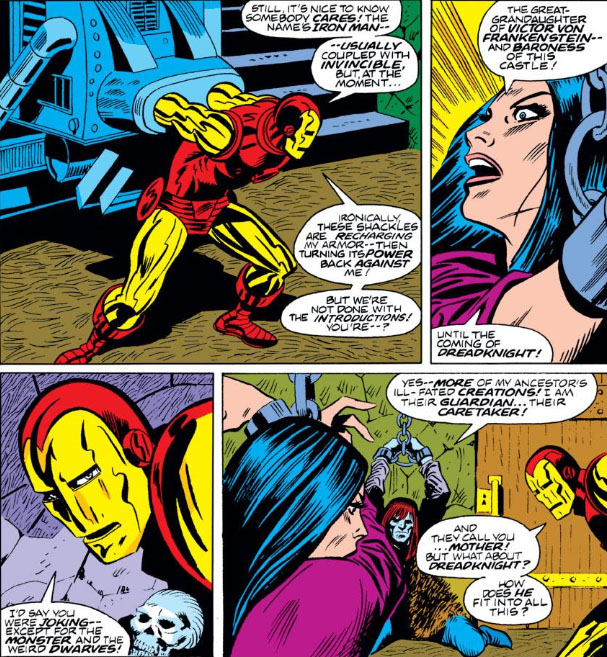
After the end of The Frankenstein Monster, it would be two years before the monster would appear again, this time in Invincible Iron Man, where writer Bill Mantlo would link the developing story he'd written for the final issue of TFM with his two-part story taking place in Iron Man, both involving the mysterious great-granddaughter of Victor Frankenstein. A woman that Mantlo writes somewhat malevolently in the closing panels of TFM:


...but whom he rewrites into a more sympathetic character in Iron Man, someone who's gathered other victims of the Baron's experiments in order to care for them.


(That's assuming her "children," as she refers to them, had also been in suspended animation for over a century, since they would otherwise have long since passed away. Mantlo really doesn't address that aspect of this story; we could assume that she was referring to the ancestors (plural) of the original Frankenstein, and not Frankenstein himself.  If that's the case, it would be just an oversight here of an apostrophe ending up in the wrong place.)

Another ancestor of the Baron showed up a year later, this time in World War II in a story from The Invaders--Basil Frankenstein, tasked with creating an army of artificial Nazi soldiers. You can probably guess what form his own creation took, complete with swastika armbands:


Aside from that, there seemed to be a dearth of stories that featured the original monster interacting with other characters in the Marvel universe. Filling that void would be an odd story that found the monster on the planet created by the Beyonder for the "secret wars," where Ben Grimm remained behind for a time. Once again, however, this monster was something other than what was expected.


As for the original monster, for all intents and purposes he seemed to be a dead issue as far as Marvel was concerned--an experiment of their own, which didn't work out as successfully as hoped. However, if the subject of the Frankenstein monster and its adaptation to Marvel comics interests you, be sure to continue on to a far more comprehensive (and quite well-written) look at the monster's evolution in this medium by writer Adrian Wymann, who offers more perspective on the subject and behind-the-scenes anecdotes.

Tuesday, September 8, 2015

In The Past, There Dies My Future!


As much exposure as Kang the Conqueror has received battling the Avengers, you'd think he'd receive as much limelight battling individual Avengers. But in taking on both Thor and the Hulk, two of the team's heavyweights, Kang has made little more than cameo appearances in each of their mags. In Thor's case, Kang only appeared to retrieve the Growing Man--and even on his way out of the story, he was disposed of by Thor handily.


And the Hulk? I would have paid good money to have seen Kang in battle with the Hulk--and I certainly would have forked over 15¢, the going rate for a Marvel comic at the time the two faced off in the Hulk's title. Even then, Kang was mostly grumbling about gaining his revenge on the Avengers, this time by targeting a character that penciller Herb Trimpe had created over two years earlier--World War I pilot the Phantom Eagle, whose mission was to destroy a deadly enemy cannon.


Kang's reference to irony would come to have greater implications than he yet realizes.  Unfortunately, a "time storm" prevents him from journeying back to 1917 to complete his plan--and so he chooses a powerful form to breach the storm and go on to kill the Eagle. The irony of his choice would become clear, once Kang plays on the Hulk's hatred of Bruce Banner to enlist his aid.


As a result, this issue's tantalizing cover by Trimpe would be a strictly symbolic one, with Kang mostly taking a back seat to the action and carefully monitoring the Hulk's progress in the past--while the story would be something of an encore for the Phantom Eagle, who didn't receive much of a bounce after his solo feature in Marvel Super-Heroes was published in 1968 but whose encounter with the mightiest mortal on the face of the Earth might just bring about the end of the Avengers.