Tuesday, July 8, 2014

Finally--The Day of Loki!


Loki, the God of "Mischief"--jeez, what a handle to have attached to yourself if you're a god. Other Asgardians snagged descriptive words like "Thunder," "Brave," "Dashing," and Loki gets saddled with "Mischief." Of course he can't go around proclaiming his alternate handle, "Evil"--you can't very well scheme in the midst of others if your descriptive name is always reminding them that you have deadly intentions for them.

Loki spends so much time lurking in the shadows that we forget sometimes how formidable he can be if he's decided to fight you. Ruthlessness and a complete lack of honor go a long way, especially when they're combined with utter contempt for your foe--and Loki has done well in those instances when he's not worried about Odin finding out about his illicit activities:


Fortunately for Balder this time around, the Death Goddess feels the urge to yawn:


Even Thor feels that Loki would whip the Avengers with no problem:


(A perspective a little at odds with The Avengers #1, where the team defeated Loki before they even had a name--and mostly by Ant-Man's doing. Maybe Thor thinks that the absence of the Hulk is a factor now. What do I know.)

Loki has gone up against Thor a number of times, and done pretty well. Of course he's done very well when he's enhanced his power in some way, such as with the Odin Ring or by tapping into Dormammu's power. But a true match-up of these two would involve levelling the playing field in some fashion. Thor would have to put his hammer aside (and no using spells, either!)--while Loki would be free to be ruthless, but no use of magic, and no norn stones or other objects to give him an edge. Just strength against strength, no holds barred.

Which is sort of what we got in this deadly confrontation:


Monday, July 7, 2014

Still Is Mine The Power Cosmic


Fantastic Four #258 is one of the high points of writer/artist John Byrne's run on the book, both in story and art. To describe its essence in a nutshell, it makes apparent Byrne's appreciation for the character of Doctor Doom, with its story a virtual profile of the Fantastic Four's deadliest enemy--an approach never before taken in the comic to this extent, aside from his origin tale. Byrne once did an FF cover which mimicked a stunt used on a cover of Strange Tales, where Doom was effectively used to help sell the book even though the character didn't appear in the story; here, the stunt is reversed, with the Fantastic Four logo naturally present on the cover but the FF are nowhere to be seen within. But if you find, as I did, that you didn't really notice the team's absence, then the credit can be laid at Byrne's doorstep.

As for Doom, this story serves as both a follow-up to his removal of Zorba from power, as well as a prelude to his latest planned assault on the Fantastic Four. Yet also, page by page, we come to understand in greater depth Doom's style as ruler of Latveria, beyond the perspective of his subjects living in fear of him; and though the man still undeniably exudes madness as well as a lust for power, he is a capable ruler who, as opposed to earlier times, now seems to regard his subjects as less of a nuisance and more as a reflection of his status and achievements. It's a change that gives Doom much greater dimension, and in turn makes him a much greater threat.

In terms of the look of the story, Byrne is at his peak here. I can't say I'm the greatest fan of Byrne's inks on his own pencils, but I must say he outdoes himself here. Consider also that for almost all of this story, he's depicting Doom from panel to panel--a monarch not only whose body language is scrutinized, but whose metal mask affords little opportunity for displaying changes in mood or temperament--and for a man whose mood and temperament can change in an unexpected instant, I would imagine that poses quite a challenge to an artist. So often, an artist will resort to inserting creases in the metal near the eyes or forehead, or expanding the mask's mouthpiece in moments of rage--and while Byrne unfortunately isn't exempt from the use of such alterations, for the most part he manages to shift Doom's expressions with a simple use of shadow and reflection, or eye movement, or posture, or even a simple tilt of the head. Annoyance at being disturbed during a meal; contentment with his young ward; contemplative surveyance of a situation. These pencils and inks have Doom's mask speaking volumes.

And so, welcome to an outstanding issue of Fantastic Four--where the title characters are only to be found in a small corner box on the cover, replaced on page one by an imposing figure who seems pleased that he's taken over their book for the month.


Sunday, July 6, 2014

Finding Your Inner Panther


Jack Kirby's run on his Black Panther title lasted twelve issues, which may not seem like a substantial contribution in comparison to his other projects during his return to Marvel in the late 1970s--but it actually works out to a two-year stretch, since the book was published on a bi-monthly schedule. His work on that book unfortunately met with the same reception that he found with readers of Captain America, another title that he took over as both writer and artist and basically made into his own vision of the character. Marvel, to its credit, acknowledged the flood of discontent in its letters columns--and while Captain America, published monthly, bore the brunt of readers' comments, the Panther book didn't slip by unscathed.

One reader sums up the situation in the book:
"This strip, even more than CAPTAIN AMERICA, shows your weakness as a writer. To take Marvel's first black character and depersonalize him so severely is criminal. So far, T'Challa has been a pawn of others, totally devoid of personality, black or otherwise.

"Perhaps the saddest thing is that the life has left your art. Three monthlies and a bi-monthly have taken their toll. We readers can say it until we're blue in the face: You can plot, but let someone else script."

Given Kirby's preoccupation of having the Panther deal with more adventure-based matters such as the fountain of youth, futuristic threats, time-travel artifacts, and a pack of armed collectors, it would take some time before this ruler of Wakanda would give us some sense of who he was by returning to Wakanda--and that wait is regrettable, because Kirby had an interesting take on Wakandans and the Panther's heritage, with its meshing of tribal tradition and technological distinction. In the original Fantastic Four stories, a great deal of emphasis was placed on the Panther's "jungle" of technology; but while Kirby gives nods to the contemporary aspects of Wakanda in these newer stories, he throttles back on the technological and focuses more on the traditional. The fascinating thing about Wakanda, aside from its Panther cult, is that there is a deep respect and adherence to traditional ways, yet co-existing with the financial and technological benefits of the Vibranium mound--and Kirby doesn't forget that.

In the issue where the Panther makes his journey back to Wakanda, we actually see little of the Panther himself, as he deals with mobster Nick Scarpa whom he's rescued from a raft adrift off the African coast. Instead, the story mainly centers on a crisis in Wakanda, where the step-brother of T'Challa, Jakarra, has made a bid for power by exposing himself to raw Vibranium, heedless of the mutating effects which have doomed prior victims. With the Panther's absence, it's an opportunity to see how Wakanda is governed, and who steps in to represent the Panther cult when that presence is needed. The premise which Kirby offers is intriguing, though his choice of the story's title could have been given more thought:


Saturday, July 5, 2014

Welcome To Our Deadly Home


Now this looks like a discriminating home buyer, doesn't it?


Yet Sue and Reed Richards have struck out twice when attempting to establish a life away from the Baxter Building and become average homeowners living unremarkable lives in suburbia. Given their success rate--or, in the Richards' case, the complete lack thereof--we can reasonably put together a few rules for Reed and Sue to bear in mind when tackling their next home-buying excursion. So here they are:


Seven Simple Rules
for Buying Your Home Away From Home


Friday, July 4, 2014

Make A Stand For Liberty!


It probably goes without saying that, in the early 1940s, patriotism in the United States was on the rise, with Americans on the alert and keeping an eye out for enemy threats not only beyond the country's borders, but also within them. When it came to comic books being published at the time, it seemed even little kids weren't exempt from the patriotic fervor that appeared to be everywhere:


Timely Comics, the predecessor to Marvel, obviously had no qualms about tapping into that fervor, as well as the eagerness and enthusiasm of its young readers who would respond to calls to "serve" and "volunteer," even if that only meant joining a patriotic club and having a badge to show for it. Timely had a trio of patriotic stars in the Human Torch, the Sub-Mariner, and Captain America, but others were waiting in the wings. One of whom took the readily-available name of:


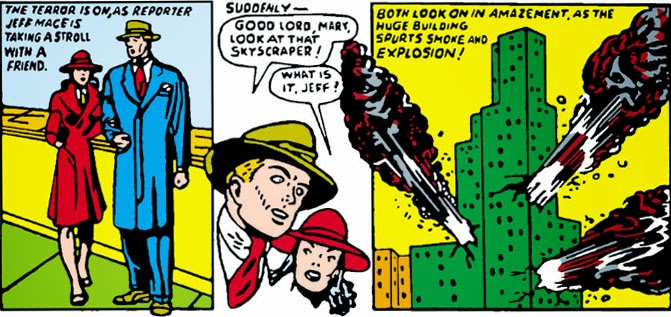
The Patriot, a/k/a Jeff Mace, reporter for Consolidated News, would later be known as the third Captain America in post-war America; but in the beginning of his career, he traded punches with any number of subversives and "fifth columnists," with tunnel vision that saw his duty to America clearly and unwaveringly. In his debut in Human Torch #4 (though mistakenly numbered on its cover), Mace hits the ground running by battling the "Yellowshirts," who move like lightning to strike at vulnerable areas of the country and paralyze Americans' will to fight:


"And they won't call us 'yellow' after we show them the color of our terror!" That's just superb writing by Ray Gill, whose story carries little subtlety or depth but cuts right to the chase in most cases. We meet Mace and his friend and future sidekick, Mary Morgan, simply taking a stroll when all hell breaks loose.


In these comics, panic is usually the order of the day when a crisis strikes. Fellow reporter Casey wastes no time stoking fear in the reader, reporting on simultaneous strikes all across the city and jumping to the conclusion that death is around the corner for all of them (or, if you read between the lines, all of us). And so the time is perfect to debut a new hero:


(Clearly, Mary cuts no slack for her friends, crisis or no crisis.)


The Patriot is a whirlwind of action, a one-man army who strong-arms the Yellowshirts wherever he finds them. But as we'll see, his main function is to act as inspiration for not only the other characters in the comic who are hard-pressed and even cowed by the opposition, but also for the story's readers.


Mace makes sure to clean out the Consolidated News offices first, but then heads to more visible areas of New York, making stands with his fellow civilians. Eventually, he's wrapping things up and settling up with the Yellowshirts' leader:


With the words "liberty," "freedom," "democracy," "country," and "defenders" virtually bursting out of that panel, it seems the Patriot is on his way to being a Timely mainstay for the duration of the war. Mary will be hanging around, too, though her mood doesn't seem to improve even when everything turns out all right:


Mary reminds me of how actress Noel Neill played Lois Lane in those old George Reeves Superman shows--the day is saved, but all Lois can do is chide Clark Kent for missing all the action. Maybe Lois took a leaf from Mary's book. If it ain't broke...

The Patriot also would have a brief cameo in the Kree-Skrull War, when Rick Jones summoned a simulacrum of him to battle a Kree death squad:


But when the Patriot took the place of the Spirit of '76--the first man to step in as Captain America, killed in the line of duty--his patriotic fervor was at odds with the changing times:


Lost to time and obscurity, Mace would encounter the original Cap one last time, on the verge of losing a battle that could claim even the most spirited of heroes:


So on this day, it seemed appropropriate to give a nod to a less celebrated version of Captain America, fighting for a country that won its battle for independence through the efforts of many such men and women who made a stand for liberty.

BONUS:
In the Patriot's own words, his very first adventure!


Thursday, July 3, 2014

The New, Original Avengers


In 2005, a new series called Earth's Mightiest Heroes caught my eye, mainly because it featured the original Avengers lineup on its cover. At the time, the current-day Avengers had just been "disassembled," seemingly for good--so what was this new series? Reprints? Some sort of condensed history of the team, riding on the coattails of the just-ended main title? But I took a chance on it--and when I got it home and read the story, it turned out to be a very interesting "reimagining" of the founding of the Avengers. Granted, one rarely hears the word "reimagined" without fearing the worst--but if you haven't read this eight-issue series, I think you'll be surprised at this new take on the team's beginnings.

You'll find almost immediately that this first issue goes into much more detail than the first two issues of the original book.  In those stories, the team had already cleared the hurdles of government red tape and public trust, as well as skipping past other minutiae that must have needed to be dealt with in order to get them up and running as an institution; and once the Avengers decided to become a formal team, their development fast-forwarded to show them sitting around a table becoming more acquainted with each other.  But in 2005, with the Avengers already "sold" as a concept to long-time readers, writer Joe Casey has the luxury of inserting detail that the 1963 book couldn't afford to have weigh down the action--showing just how difficult it must have been to secure government assistance and cooperation for this unknown alliance of super-beings, as well as getting Thor and the Hulk to operate within the confines thereof.  Mostly, we'd find that forming the Avengers wasn't just a matter of meeting at Stark's mansion and deciding on what threat to tackle.

We see from Casey's point of view that it's Iron Man, with Stark's extensive experience in organizational matters, who puts together the tight structure within which "the Avengers" must operate, a structure which Thor barely tolerates and which the Hulk eventually rejects. Once it's clear that these five people have made the commitment to band together, Iron Man and Stark do the legwork in terms of the bureaucracy involved, and perhaps going a little overboard, drafting both the charter and the by-laws without the input of the others and having everything ready for the members to agree to and sign. It's clear that this initiative means a great deal to Iron Man; by the time the team meets formally for the first time, he's pulled a lot of strings as Tony Stark (using his clout as the country's foremost munitions manufacturer) and likely called in some favors to secure clearance for the Avengers as well as a certain level of autonomy for them.

As for the public, Iron Man also makes the case that securing their trust is an important part of their operation. Everyone knows that the "Avengers" are about to meet for the first time--but no one knows just what that means yet. Casey uses a tried-and-true method that's been used successfully throughout The Avengers for taking the pulse of John Q. Public--media reporting--to give us a sense of the importance of this day to not only the newly-formed Avengers, but also to the people who now find themselves under their protection:


Inside, Iron Man has opened the meeting, and perhaps forgets that he's dealing with individuals accustomed to action, rather than attendees at a company staff meeting who are used to working swiftly and efficiently through an agenda. It's not that Iron Man's presentation is at fault; but at this first meeting, he practically inundates everyone with bureaucratic matters that need attending to, rather than encouraging interaction which might have put everyone more at ease.


Wednesday, July 2, 2014

'Cycles Wherever A Spider Can


This ad which ran in mid-1976 was mainly for Spider-Man toys, but it looks like they threw in everything but the kitchen sink:


I don't know--if I were in marketing, I'd probably recommend that the ad would be more eye-catching if it pictured the actual toy, rather than an artist's representation--but maybe doing it this was was more cost-effective for the company. And it's easy enough for a kid to find what appeals to him/her. Prices range from $2.00-$4.00, plus shipping/handling (translation: postage/labor).

I suppose the Hulk model requires assembly ( the smoke/dust rising from the ground is pretty clever!), but the web shooter looks ready to go:


You probably have to retrieve and keep using the same string--I wonder how long before a kid gets tired of doing that? Not to mention the fact that you're not really going to be able to snag anything. Phooey.

It's hard to mess up a bike horn, though I think it would be cool if Spidey's eyes lit up when the horn was sounded:


(Maybe they didn't want to give the kid any ideas about taking their bike out at night.) This later horn doesn't look nearly as distinctive, but I'm guessing you'll still get out of the way when this puppy is honked at you:


Evel Knievel probably didn't appreciate his name being misspelled in the ad, but I don't think he has to worry about Spidey stealing his thunder. I'm not sure how many kids are going to be able to picture Spider-Man riding a 'cycle, though forking over two bucks to see him take off on it and slam into other objects seems like a good deal. But why settle for just Spidey when you can get the Hulk in a sidecar?


Marvel's On The Move Again!


Here are a few more wallpaper samples I've designed for my phone, courtesy of the artistic talent of John Buscema, John Byrne, and Jack Kirby. I think my favorite is the Buscema Hulk/Thing portrayal--but try not to pass that on to Doctor Doom. I make it a point not to offend armored fiends holding a gun on me!


(You can see more Marvel mobile mayhem here and here.)

Tuesday, July 1, 2014

My Cross To Bear


In exploring the essence of the connection between Bruce Banner and the Hulk, we saw psychiatrist Leonard Samson open the door by developing a procedure that would allow him to observe and take part in the Hulk's dreams. But we wouldn't come to understand the foundation of the connection until writer Bill Mantlo, closing out his run on the book, had Banner face the traumas of his past--finally realizing that the rage of the Hulk was really his own, given form through his over-exposure to gamma radiation.

During this time, the Hulk had been absent from Earth's dimension, existing as a creature of pure rage while Banner's influence, however minimal, had been effectively suppressed. Facing the events of his past allowed Banner to re-emerge and reassert himself; and, through a turn of events, he was able to return to Earth, though once again sharing his existence with the Hulk. Eventually, Leonard Samson learned of the Hulk being sighted again and attempted to contain his threat, still believing that Banner was (for all intents and purposes) dead and that the Hulk would once more be in a savage, destructive state. But Samson learned that Banner had survived--and so his plans changed. Obtaining clearance and funds, Samson arranged to have the Hulk undergo a radical procedure that would hopefully eliminate the threat of the Hulk while giving Banner a new lease on life--as an entirely separate person, divorced from the Hulk.


As we can see, Samson is still operating under his original diagnosis--that Banner and the Hulk are separate entities co-existing in one form, however transformed. And so he applies an understandably scientific approach to the problem (an approach similar to that previously attempted by Banner's college alumnus, Raoul Stoddard), yet one that's ignorant of Banner's recent realization--that he and the Hulk are one being, one mind, with his transformation to the Hulk bringing to the fore the bottled-up rage of his past and breaching any barriers that might have held it in check. Samson may well think he's completely exorcised Bruce Banner from the Hulk:


...but as he'll discover, he's caused an instability that will, once again, send the Hulk on a mindless and devastating rampage of destruction.