Thursday, April 18, 2013

When Giants Walked The Earth


I hope that nice Alex Ross painting from an earlier post tempts you into taking a look at Marvels, the 1994 series that takes readers through a nostalgic tour of Marvel Comics' silver and bronze age stories from various titles, as seen from a man-on-the-street perspective. The series follows photographer Phil Sheldon, who decides to pass on an assignment in Europe and instead begins documenting the appearance of new super-beings, coming to terms with what their presence means for himself as well as others who are caught up in their lives and battles.

Phil, like his peers and fellow citizens, finds his opinions on the subject see-sawing as the years pass. In the beginning, he was like any other Joe who aspired to the American dream of having a wife, kids, "the little house in Queens, the white picket fence, the works!" And then the human race became virtual bystanders to the likes of the Human Torch, the Sub-Mariner, and others who seemed to settle their differences and live their lives as if the world was theirs to build, or destroy.  In those early days, Phil wasn't at all happy with his sense of helplessness:

"Look at us--just sitting here, waiting! There isn't a thing we can do--and this our city! Our world! Who gave them the right to just come in and take it away from us?!"

Of course, there would be bona fide heroes who would emerge, who humanity would rally behind and regard as their own; and there were those like the Sub-Mariner, who would battle alongside the Americans against the Nazis, and then inexplicably declare war on the human race. Sometimes it was difficult to keep a scorecard. Sometimes the only thing you could do was to look out the window or walk down the street and speculate on whatever sight greeted your eyes:


But the gems of this series are numerous--brought into focus through Phil, our eyes and ears, whose life at times feels as if it were our own. His reactions could be our reactions--his frustrations, his feelings of helplessness, his confusion, but also his eagerness and sense of anticipation in following the story playing out before him. He and the rest of the human race are there when the "Marvels," as he calls them, come on the scene:


And through Phil's eyes, the little touches of Marvel history that are sprinkled throughout the pages feel brand new to us, as if we're right there with them seeing everything for the first time:


Through Phil we see how the human race aligns itself with Marvels who are almost treated as trends. The Fantastic Four, for instance, are glamorous celebrities who always seem to be in the thick of the most dramatic threats. Of course, it doesn't hurt to be headquartered in a skyscraper in New York City:


Through their adventures and their visibility, the public take an interest in the FF--though as we've seen over the years, their mood towards the team changes depending on how direct the threat is to them and how successful the FF are at defending those they fight for:


Other super-beings in their midst who have a high degree of visibility are treated with varying degrees of familiarity, depending on the information available.  Iron Man has the advantage of being associated with Tony Stark, a playboy celebrity if ever there was one--and with both Iron Man and Thor spearheading the Avengers, the super-group whose meeting place was Stark's townhouse on Fifth Avenue had a popular following, as well. Spider-Man, by contrast, was at the mercy of the Daily Bugle's constant and detrimental coverage of him. And the X-Men had the unfortunate distinction of being "mutants," not helping themselves with their appearances being so sporadic and usually shrouded in mystery:


Finally, as Phil is ready to retire, another invasion of New York by Namor as well as the death of Gwen Stacy have a profound effect on him and bring him full circle with those he's spent his adult life documenting with his camera.  All in all, Marvels is a genuinely satisfying read, taking a break from the introspective point of view of Peter Parker or the grandiose Victor von Doom and instead putting you and I on the scene as the unexpected happens--sort of like the remake of War Of The Worlds, where we only learn about the events through hearsay or as eyewitnesses to the incredible. It's a story with a combined sense of wonderment and uncertainty, where the human race is along for the ride as their world goes through an astonishing and often overwhelming change:


As a comics reader who's already used to the idea of super-beings, I think I'd find that thrilling. But, honestly, if I were one of Phil's neighbors, trying to understand just what the hell was happening to the world I lived in? It wouldn't be a brave new world to me--it would be an uncertain one.

Fortunately, in this case we know what we're getting into--a good series that you'll find to be a real page-turner.  You can find Marvels in its entirety in either TPB or hardcover.

Wednesday, April 17, 2013

It's Right In Front Of You--Sort Of


It was nineteen years ago to the month when artist Alex Ross painted this beautiful representation of the Avengers battling in the Kree-Skrull War:


As you can probably tell, it took a bit of artistic license to get everyone into this one image aboard the Skrull ship the Avengers boarded. But aside from that--

There's one thing that isn't right.

Can you spot it?

Master Of The Mystics


I don't know if Dr. Strange is still making a big deal out of having the title "Sorcerer Supreme." It always seemed like a brainstormed title to me, given to the character to make him sound and seem a little more dramatic and powerful. When it was first trotted out, with the Ancient One's death, it was something to be bequeathed, as well as a title which meant that no other mortal magician was stronger. That's a little presumptuous, if the mystic arts are teachings and disciplines to be taught and studied. Strange may possess the Ancient One's collection of artifacts and tomes, and his library may be second to none, but he's surely not the only mystic bookworm. Yet apparently, the Ancient One's "power" and status were things that could be passed on to and absorbed by Strange after his teacher's death--which almost makes much of the time Strange spent studying as a disciple seem moot, as well as slamming the door on anyone else who feels like ascending to or surpassing Strange's level of mystic mastery.

"Master of the Mystic Arts" may not have given much fanfare to Strange--but I always liked it, because it was a classic and looked really cool below his cover masthead. But it also didn't elevate him to the point of exclusion. There could be other masters of the mystic arts, other "flavors" of sorcerers, if you will--while there can be only one "Sorcerer Supreme." For all the good that title did to its bearer. As we'd later see, being Sorcerer Supreme mostly made Strange a bigger target; but it was apparently also a way to make Strange more marketable. "Master of the Mystic Arts" was perhaps too enigmatic--while "Sorcerer Supreme" was bolder and certainly upped Strange's ante as far as the types of threats we could expect him to engage.

I just wasn't crazy about it.

Anyway, I thought you might like to see the earliest scenes of Strange as "Sorcerer Supreme"--spending nine days meditating in the Mexican desert, where Clea and Wong find him getting his bearings, so to speak. It's a brief scene, but it allows us to see Strange in the process of assimilating his new state of enlightenment and serves as a sort of transition between the man he was and the sorcerer he'll become:


Interestingly, with his new enlightenment, Strange also seems to have adopted an "eye for an eye" approach as far as dealing with his enemies:


Which almost makes you wonder if Baron Mordo would have met a similar fate.

Tuesday, April 16, 2013

Cover To Cover


In Marvel's Greatest Comics, which for much of its run reprinted the Silver Age issues of Fantastic Four, a few liberties were taken with both cover and content. At times, the covers themselves were entirely redone--sometimes by the original artist (Jack Kirby), but often by other artists like Gil Kane and John Buscema. As much as I appreciate Kirby's art, it was interesting to see how another artist would give new life to an older story by designing a new cover for it--sort of like commissioning another artist to re-do one of your favorite scenes, but going a step further by rendering a totally different impression of it.

Here's a nice example, from the FF story "This Man... This Monster!".  The original cover on the left is drawn by artists Jack Kirby and Joe Sinnott, with the one on the right by Sal Buscema:


Buscema's version obviously seeks to add much more impact to the scene, with its larger scale and greater depiction of the Negative Zone and its dangers. There's also the shift of emphasis to Reed's predicament, vs. Kirby's focus on the Thing. Both covers clearly represent danger to Reed--but in Kirby's, it's apparent that the Thing has more direct involvement in the situation than any of the others--and speaking of which, Buscema adds the Torch to the cover, even though the character had no involvement in this aspect of the story.

The most important difference I see is that Kirby's cover does much more to reflect what's actually going on in the story, apart from the cut-to-the-chase element of Reed's lifeline to the lab breaking and casting him adrift in a deadly environment. In Kirby's version, the simple depiction of the Thing turning his back on Reed while his life is in danger makes the need for word balloons underscoring the situation superfluous.

I think Buscema's work on the cover could have held up fine on its own, with the dramatic, bold caption on each cover doing the work of selling each of these issues; in fact, if you remove the word balloons, Buscema's interpretation of the Kirby cover does a fair job of representing the basic threat to Reed's life, if not the story behind it.  Word balloons can be the kiss of death for otherwise good artwork.  On Buscema's cover, Sue states the obvious--whereas on Kirby's, a simple gesture and her expression speak volumes.

Still, two very cool pieces of artwork on the same piece, by three exceptional artists.

Monday, April 15, 2013

Flight From The Status Quo


After the Hulk's encounter with the Harpy, MODOK must be one happy Mental Organism Designed Only for Killing. His scheme to remove the Hulk from any interference with his plans was carried to fruition perfectly. Taking control of a vulnerable Betty Ross, he mutated her into a creature more powerful than the Hulk and unleashed her on her brutish target, where she proceeded to brutally subdue and perhaps even kill him.

I must say that when I originally read this story, the direction that writer Steve Englehart was taking with these characters was fresh and most welcome. Englehart would have a fairly brief run on the book, but he'd already given readers some good stories featuring the Mimic, the Abomination, and the Gremlin, as well as the first appearances of John Armbruster, the Wendigo, and (unfortunately) Zzzax (hey, nobody's perfect.) This would be MODOK's third appearance since being featured in Tales of Suspense and Sub-Mariner, expanding on Gerry Conway's nice take on the character in the latter and further establishing him as a power in his own right. And now, with his departure from the book imminent, Englehart takes the staid character of Betty Ross and uses the past elements of her life to bring her to relevance in a book where she all too often blended into the background. On top of that, he makes her into a crazed super-villain. What's not to love about that?

Sunday, April 14, 2013

Hellbolts of the Harpy!


Back when the Hulk was still being pursued by the relentless General "Thunderbolt" Ross, he had two people in his corner. One of them, Rick Jones, did his best to locate the Hulk in order to hide him or assist his human alter-ego, Bruce Banner, with attempts to cure himself. While the other--Betty Ross, daughter of the general--would do her best to plead on behalf of Banner, whom she was in love with. The general, of course, had a job to do and forged ahead, despite his daughter's tears; while Glenn Talbot, who steadfastly carried out the general's orders, found himself falling in love with Betty and was constantly frustrated by her loyalty to a man he viewed as a lost cause.

So Betty spent a lot of her time in the book engaged in scenes like this one, in one form or another:


In 1973, writer Steve Englehart came aboard Incredible Hulk and decided on a turn of direction for the character.  And before the year was out, he'd end up giving Betty Ross one hell of a makeover.


And the Harpy was hatched born. Say goodbye to those tears, kids.

Saturday, April 13, 2013

The Hulk vs. The Cutting Room Floor


I can only imagine the scrambling that must have gone on in the Marvel offices during the tail end of the format about-face that happened with their books in late 1971. By the time the new larger-format issues were on the store racks, the issues scheduled for the next month were already in production--so when the decision was made (in Marvel's own words, "almost overnight") to return the page count per issue back to a manageable 20-21 pages, those upcoming issues had to be edited to fit the smaller format. Writer/artist teams must have felt a little like film directors during post-production, having to take all of that footage and edit it in such a way that it fits the original idea, even if there was more shot than needed. With comic books, it was a matter of making one story into a two-parter, with a little creative rearranging to make that first issue read as if it were always meant to build to a climax that would make the following issue a can't-miss story.

Given the time constraints, I think everyone involved did a reasonably good job in the time they had, though the efforts may not have been quite seamless. Spider-Man ended the first part of his edited issue by landing on some soft ground which turned out to be quicksand--but since the guy is surrounded by trees and he has a pair of web-shooters and spider-strength, making it appear that he's in mortal danger is a little hard to swallow. Over in the FF, the Torch is flying over what he thinks are war games, though if the story hadn't been forced to split I think instead he would have exclaimed (as he did on page one of the next issue) that unarmed people were being strafed by planes. And Iron Man is interrupted in mid-battle, with the rest of his issue filled by an Ant-Man story.

But while these stories and those in other titles may have been forced to end abruptly, you can still find yourself enjoying the "new" story that came about as a result, at least to the extent of how it was adapted to the smaller format. For example, Incredible Hulk at this point in time had the Hulk lumbering through the desert, where as you might guess there isn't a whole lot of smashing to be done--which gave writer Roy Thomas a lot of opportunities to explore the workings of the Hulk's mind and how he might interpret things and events. Sandstorms, for instance:


Not exactly enough to support a larger-format issue, true. So in this story we had a great deal of attention given to Thunderbolt Ross, his daughter, her suitor at the time (Leonard Samson), Major Talbot, and Jim Wilson, all becoming involved in a plot by the Leader to replace the President and Vice-President with androids during their scheduled visit to Hulkbuster Base. Yet this issue's cover might give you a different impression of the action you were expecting to see:


"Earth vs. The Green Behemoth!" Well, not quite. But there wasn't enough room for "The Hulk Has a Skirmish with an Israeli Battalion Which Lasts Under A Minute, Leaping Off Because He Feels a Subconscious Conflict About Harming Women." Translated from the Marvel, that means that "Earth" survived the Hulk's attack.

There's also a little fallout to be found from the format do-si-do, with a 21-page story still attempting to dramatize itself by separating itself into "Parts." You're also likely to find some left-over full-page artwork that would have helped to fill out the larger format, but is still a real treat to find in the smaller issue. Even so, Jim Wilson rating a full page by himself was definitely unexpected:


I wonder how long it would have been before Betty Ross would have gotten her own page? Constantly pining over Bruce Banner was bad enough in smaller panels.

It's only toward the end of the issue when you start to feel that things are beginning to coalesce. In this case, it happens when Jim stumbles upon the Leader's stash of android replacements:


Gives you a sort of Invasion of the Body Snatchers vibe, doesn't it? Thank goodness Thomas didn't write the screenplay for that film, or you'd have those pop culture references of his littering almost every scene. I honestly don't know who would suddenly think of Abbie Hoffman if they found a secret room of android replacements and they're scared out of their wits. But Jim's brush with fear isn't over yet:


The issue ends with Jim being tossed into a cell with Ross, Talbot, and other personnel, with the Leader learning that the Hulk (remember him?) is headed in the direction of the base. That would normally set up a dramatic "Part 3" page--but in this case we'll have to settle for a "next issue" blurb. Perhaps in a future TPB we'll get to see a "director's cut" of the story where it's restored to its original format. Things are wrapped up pretty quickly in the next issue, almost dizzyingly so--which might seem odd, since half of the issue shifts gears and adds a completely different story. But since the original story would have only been about 33 pages in length, what remained of the Leader story wasn't enough to fill a 20-page issue--and the additional story segues well enough.

Curiously, once the issues returned to the smaller number of pages, future cover art took on the more "boxed in" look that was put in place with the large-format issues:


The change went on for about a year for all titles, before finally expanding again to the length of the full page. Perhaps it was done to ease the impact of the behind-the-scenes changes and make it appear that the company was still on track as far as its direction for its books.  Still, it all made for an interesting kick-off to Marvel's bronze age.

Thursday, April 11, 2013

From Imagination to Pen


You know how it is when there's a car accident, and you know you shouldn't slow down to look but you do? I remember having a similar feeling when this series of books hit the comics racks:


There were a few of these "Stan Lee Meets..." books published during 2006-07 which were in celebration of the 65th anniversary of Stan Lee's employment at Marvel. (Though I think maybe association with Marvel would perhaps be more accurate, unless he actually drew a check for that length of time--I'm not on a first-name basis with Marvel's bookkeeper to say for sure.) Each of the books featured a different Marvel character interacting with The Man. The stories were harmless enough, since obviously they were satirical and done in good humor. Though at four bucks a pop, you obviously weren't laughing on the way to the cash register.

There were three stories in this particular issue, with the title story consisting of Galactus abducting Lee and sending him to spend some time with the Surfer in order to see first-hand how depressing his writing of the character is:


Gee, Galactus, thanks a lot. Where were you when we needed you in 1968?


But there's also a real gem of a story following, where Lee drops in on budding writer Paul Jenkins as a boy in England in 1971 and helps to influence his talent in comics. Jenkins, of course, would go on to create a character who became very popular with readers:


The entire story is a well-done depiction of Jenkins' and Lee's interaction with each other, a mixture on Jenkins' part of homage and appreciation. And when Lee sees that the spark is lit and departs, we're left with a fitting ending to a touching story:


You can pick up the entire collection of this series for a song, though I can't at present vouch for the other books in the series. Still, the whole thing might make for a nice bookend to a Marvel comics collection.

Wednesday, April 10, 2013

When Loki Met Thor


I guess you can tell how things are going to go between these two:


If you go around calling yourself the God of Mischief, I suppose it's a given that your disposition is going to be self-serving. But when we first meet Loki, half-brother to Thor, he also has thoughts of anger and revenge--which is understandable, having been imprisoned within a tree for centuries:


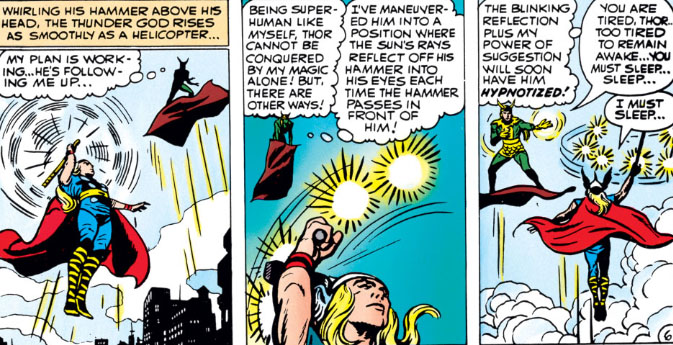
As light-hearted and uncomplicated as Thor's stories were in Journey Into Mystery, Thor's challengers were more menacing than ruthless, and the stories tended to be more entertaining than gripping. Loki, as we know him now, would probably be more suited as the god of malevolence rather than mere mischief, as his actions in contemporary stories are deadly and often merciless. Yet even with thoughts of "revenge," which Loki would normally act on in far more vicious ways, his methods against Thor in their first clash are more tame, with less of a sense of deadly urgency than you'd see in later meetings like this one:


There's no doubt about Loki's intentions in that battle. Thor is going to be carried out on a stretcher--if he's lucky. Yet in their first meeting (at least the one we're privileged to see as readers), Loki's revenge consists of mostly trickery and, well, mischief:


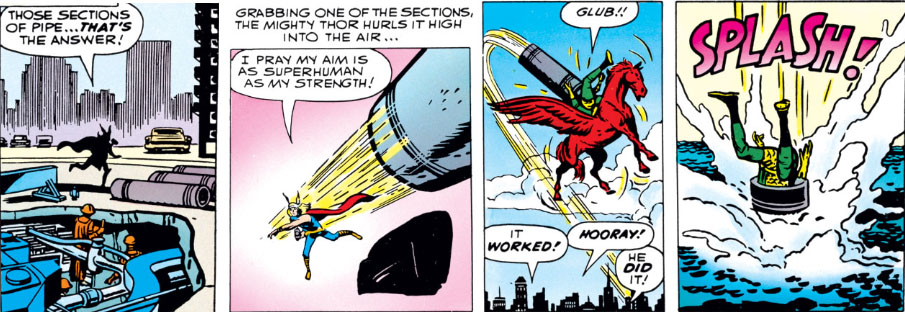
Things don't get much more exciting when Thor escapes his hypnotic spell and beings pursuing Loki, who leads him through a merry chase in Times Square, the theater district, and a subway tunnel. It's not much of a battle when your foe spends all his time fleeing you and throwing obstacles in your way. Finally, it's time for Thor to settle accounts with Loki, using something apparently better than the enchanted hammer he's already packing:


And did you know about this little factoid?


Good grief, Thor--for a guy who can summon thunderstorms, you're pretty slow on the uptake. If you're fighting Loki, two stamps of your hammer and the battle's over, every time.

The encounter ends in dramatic fashion (at least for what passes as dramatic in 1962 comics), with Thor hurling Loki away from Earth. Which also gives us our first glimpse of Asgard and Odin:


Where there's probably a tree waiting with Loki's name on it. Though all-wise Odin might think of imprisoning him in a river this time.