Friday, December 14, 2012
Built-In Teamwork
One thing all three major super-teams at Marvel--the X-Men, the Fantastic Four, and the Avengers--have in common is that they've all fought a single being who's an amalgam of their powers and abilities. And it's happened relatively early in their respective runs. The FF were only a year and a half into their career before they were challenged by the Super-Skrull--who not only possessed their powers, but had them many times magnified. And being a Skrull, the alien also retained his shape-shifting abilities.
The Super-Skrull gave the FF a pretty good battle--but with such enhanced abilities, there came a time when his own Emperor felt he should be dealt with before he became a threat to the throne. And having created him, the Skrulls also had the foresight to create a defense against him:
Then there was the Adaptoid, a creation of Advanced Idea Mechanics whose goal was to destroy and replace Captain America. Cap, of course, is still around--but that didn't stop the Adaptoid from imprinting the abilities of Cap's fellow Avengers on himself and thereby becoming the Super-Adaptoid:
And in the ensuing battle, he thought he'd done away with Cap. But, realizing his mistake, he made more attempts to destroy his target--first by facing the entire Avengers team, where he actually had them on the ropes as he now possessed the abilities of even their most powerful members. But he finally went down due to, of all things, a design flaw:
Then, taking a more subtle approach, he later decided to lie in wait for Cap at Avengers Mansion. But he got a little more than he bargained for when Iron Man showed up instead:
In the case of the X-Men, their foe turns out to be an embittered man named Cal Rankin, who also goes by the rather appropriate name of the Mimic:
Rankin is something of a precursor to Rogue--only it's his proximity to others that allows him to mimic their powers, rather than needing to come into direct contact with them. And there's one more important difference: where Rogue fears prolonged contact which risks her borrowed powers becoming permanent, Rankin concocts a ruse to join the team in order to mimic their abilities and reach a machine which he hopes will do just that. And when he makes his move, it's indeed an impressive display:
What Rankin didn't know was that the machine was rigged to remove his mimicking power, and thus his threat was ended, at least for the time being.
I suppose if the original Defenders had been together long enough, they would have faced their own amalgam. And then there are the Sentinels, who are somewhat like the Adaptoid in function but with more emphasis on creating counter-measures. I don't recall any other examples--anyone care to chime in?
Thursday, December 13, 2012
Wednesday, December 12, 2012
My Brother's Keeper
After the Grim Reaper's failed attempt to destroy the Avengers along with his deadly partners in the Lethal Legion, almost two years (in reader-time) go by before he reappears to scheme anew. Obviously this is a man who knows how to bide his time; but we'll just assume that he's been in prison until now, and went right back to planning his revenge after his release. Apparently two years making license plates doesn't quench one's thirst for vengeance, because the Reaper is as single-minded as ever:
But just who is he talking to? He's using the word "sibling," but obviously he can't be chatting with his deceased brother, Wonder Man. (Or if he is, it's a very one-sided conversation.) Yet while it's technically true that it's not his brother, the Reaper is indeed speaking with someone he feels is his brother for all intents and purposes:
Yes, the Vision, whom the Reaper learned possessed his brother's brain patterns. The Reaper has subsequently become somewhat fixated on the Avenger--even using the Vision's name and the word "brother" interchangeably during this secret meeting he's arranged with him. Yet the Reaper didn't call this meeting just to have a bizarre family reunion. He still wants to destroy the Avengers, yes--but he now implies that the Vision will help him in doing so. And it's then that the Reaper makes his startling proposal to the android:
The offer is mad--insane--and though we're 99.9% sure of what the Vision's answer is going to be, the Vision still ponders the situation if only on the barest level. Because there is another element involved, which the Reaper isn't aware of. For the Vision has grown very close to the Scarlet Witch, and she to him--and though Thor, for one, has assured him that he's as human as anyone except in appearance, the Vision sees his existence as an android as an impediment to having any sort of future with Wanda:
And so, seeing the Vision's hesitation, the Reaper sweetens the offer. With the result we expected:
And the Vision departs, with the Reaper yelling after him that he'll eventually change his mind. In a later issue, though, we see that the Reaper hasn't been entirely forthcoming with the Vision; in point of fact, he's involved himself in an alliance with the Space Phantom, who's used the resources of Hydra to capture a group of Avengers. And with the Phantom's plans coming to a head, the Reaper again meets with the Vision and implores him to accept his offer:
It's only with the Vision's second refusal that the Reaper feels compelled to reveal the full details of his plan for the Vision. And that plan involves not Wonder Man, but an Avenger whom the Phantom has painstakingly monitored and manipulated in order to fulfill his bargain with the Reaper:
It's probably time we heard from the Space Phantom himself, who revealed his plans to Captain America when he first set them in motion:
And finally, when we know everything there is to know, the Vision unexpectedly gives the Reaper the answer he's been waiting for:
Which leaves the Reaper elated:
But the Space Phantom is no slouch at planning himself--and when the Vision frees the other Avengers, and subsequently reveals that he's been working behind the scenes with Captain America to play along with the machinations of both the Reaper and the Space Phantom, the Phantom appears in force and reneges on his deal with the Reaper. And the Reaper makes his choice of who to back in this fight--not the Avengers, whom he still despises, but the man he believes more than ever is his brother personified:
I'm sure you can guess what happens next. All hell breaks loose, with the Avengers cleaning house and taking down the Phantom, his Hydra forces, and the Reaper--with an assist from, of all people, Captain Marvel. When it's all over, the Space Phantom is trapped in limbo, Hydra is in no shape to hail anyone, and the Reaper realizes that it's back to cranking out license plates for him.
A nice final touch to the issue is that, in front of everyone, the Vision for the first time makes his feelings for Wanda known to all, and Wanda reciprocates. I suppose it's debatable whether that initiative--and need--come wholly from the Vision or emanate from the part of him that's Simon Williams. I prefer to think that the Vision has come into his own, and that these recent events have made him come to accept and assert his own identity. When the Grim Reaper next appears and finally confronts the two distinct sides of his lost brother, we'll see if the Vision can make his case for his humanity.
Tuesday, December 11, 2012
Welcome To The Family
When you're reading the early stories about Eric Williams, the Grim Reaper, and his fixation on revenge for the apparent murder of his brother, Simon (a/k/a Wonder Man), it almost feels like you're peeling an onion. Because as easy as it would be to keep the Reaper ignorant of the truth, and simply continue to sic him on the Avengers without allowing for any further development on this front, he slowly builds on the minuscule amounts of fact which get under his guard--bits of the truth which will either take root, or instead be twisted into the Reaper's warped conclusions. Consequently, with each new appearance, and each new fresh set of accusations, the Reaper himself gives us an idea of how he's dealing with this situation's new developments--or not dealing, as the case may be, as he always seems to be in some level of denial.
For the Reaper, one thing is certain: the Avengers are to blame for whatever pain he is suffering at the loss of his brother. When the Reaper first makes his appearance, that loss manifests simply in the form of his brother's death; though later, with the addition of the Vision as an unexpected variable, he shifts his rage to railing against the loss of his relationship with Simon, his "true" brother taken from him. When writer Roy Thomas first created the Reaper and unleashed him against the Avengers, the Vision's first appearance was only five issues away--so it's not clear whether the Vision and his connection to Wonder Man's brain patterns (revealed in the Vision's origin) played a part in Thomas's plotting of the Reaper, and how much Thomas planned to mine from the character. Clearly, though, the Reaper's twisted rationale for continuing this vendetta against the Avengers would yield not only some notable Avengers stories, but dramatic interplay between the Reaper, Wonder Man, and the Vision before the story was exhausted.
To understand the forces in play here, we have to take into account the circumstances of Wonder Man's death, seen through two sets of eyes--our own, in the form of the original story, as well as the same scene interpreted from the Reaper's perspective. Run side-by-side respectively, it becomes clear that the Reaper is interested only in assigning blame to those who stood by in helplessness (or, as the Reaper might term it, inaction), as opposed to blaming the actual source, Baron Zemo:
In a way, it would be easy to assume the Reaper's possible frame of mind here, with "Earth's mightiest heroes" (even before they were formally known as such) unable to protect Simon in battle, and seemingly standing by in callous indifference as he dies. The Reaper obviously doesn't know (or doesn't care) that Zemo's ionic procedure on Wonder Man was fatal to begin with, and used as a mean to ensure his loyalty. Zemo, at this point, is dead, while the Avengers are none the worse for wear. And so the Reaper adopts a "scorched Earth" policy to deal with those who walked away alive.
Fortunately for the Avengers, at the time a "skeleton crew" of a fighting force, the Black Panther's timely arrival as a new member (stepping in for Captain America) brought about the Reaper's defeat, falling on his own blade while grappling with T'Challa. Yet while the Panther raced to save the Avengers, who were near death from the energies of the Reaper's scythe, the Reaper managed to escape.
When the Reaper next appeared, he had lost none of the crazed rage he felt toward the Avengers, particularly since they'd escaped his vengeance. And this time, he assembled a little strike force to help take them down:
Monday, December 10, 2012
Terrifying Trumps Frightful
Let's say you're the Frightful Four (three of them, anyway), and you've just effectively trapped the Fantastic Four in a strange house and are preparing to dispose of them once and for all. (There's something about the Frightful Four and houses--they seem to go together so well.) The last thing they probably expected to impede their revenge is the home's mistress and her hissing cat:
But the sharp-eyed among you know something the Wizard doesn't--that this is actually Agatha Harkness, and her cat's hackles are not to be taken lightly. A lesson the Wizard learned the hard way:
At the time, all that we knew of Agatha (I wouldn't call her "Aggie," if I were you)--and all that the Fantastic Four knew--is that she was a retired "child-rearing specialist" whom the Richards sought out by reputation. Most importantly, Agatha lived in a secluded area known as Whisper Hill, which was perfect for a famous family who sought to keep their child off the radar. Though for the Thing, who could only be humbled by a well-written ghost story, Whisper Hill--and Agatha--didn't make the best first impression:
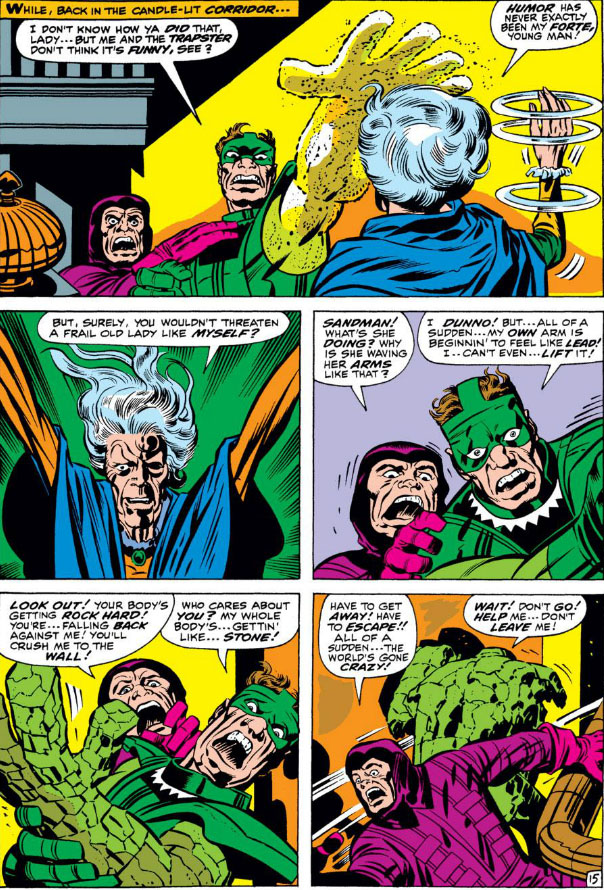
Yet apparently, the locale wasn't secluded enough, if the Wizard and his partners in crime had already scoped out the place and were ready and waiting for the FF, right under Agatha's nose. But I suppose the issue is moot, since the Sandman and the Trapster had their own surprises waiting for them:
The twist to this odd introduction to Agatha Harkness is that, even finding the Wizard and his cohorts completely and mysteriously incapacitated, the FF remain blissfully unaware of this woman's abilities. Nor is Agatha in any frame of mind to enlighten them:
There's something oddly satisfying about Agatha's secret completely slipping by not only the Fantastic Four in general, but Reed Richards in particular--a man who's been known to investigate just about anything that doesn't quite add up. Yet he, along with the rest of the FF, seem to be in no hurry to ask too many questions here, content with simply acknowledging how well Agatha is suited to watch over their child. Writer Stan Lee handles the whole situation quite adeptly, satisfying the Richards and us at the same time. (Though frankly, I'd want to know if my child's caretaker was packing a piece--or in this case, deadly skills that can deal with threats like the Frightful Four.)
We get another glimpse at this status quo arrangement when Sue drops Franklin off at Whisper Hill while racing to avert a crisis with the FF. Apparently Reed and Sue have yet to have a sit-down with Agatha in order to obtain full disclosure (I mean, come on, they're no dummies), since Agatha again portrays herself to be nothing more than an elderly caretaker:
But in a later issue where Reed becomes trapped in the Negative Zone and his moments of life seem numbered, Agatha finally shows her hand. And the FF, grasping at straws, scrambles to comply with her wishes:
The spell creates a distraction in the Negative Zone, which not even Annihilus and his army are prepared to cope with:
Reed makes it back to his lab--and though he's told that it was Agatha who was responsible, there's so much jubilation at his safe return (as well as an imminent situation with the Thing to deal with) that there's neither the time nor the inclination to pursue the matter further. Yet soon afterward, Agatha again takes her place as Franklin's caretaker, with the Richards and the rest of the FF quite content to let sleeping dogs lie. And that's really a little harsh--it seems clear that the FF have come to accept Agatha's special abilities as they have with so many others.
And it seems the perfect arrangement where Franklin is concerned. At some point in the near-future, we know that Agatha will be taken out of the picture--first, enigmatically, by writer Roy Thomas, and then later by Gerry Conway in a development which will render her further services moot. Yet now, she's a handy resource to have around in a pinch. Take, for instance, when Galactus returns, and Reed needs her help to further one of his plans:
When she leaves the pages of Fantastic Four, we'd see Agatha in other appearances in other magazines, though she would occasionally cross paths again with the FF. Yet now in the "open," so to speak, those appearances never quite recaptured the fascination we had with Agatha Harkness, living in seclusion on Whisper Hill, quietly watching over her famous charge. As understated as it was, I thought her introduction was one of Lee's and Jack Kirby's coolest stories.
Sunday, December 9, 2012
Runaway Bride
Two back-to-back issues of Amazing Spider-Man published in March and April of 1974 had readers shaking their heads in--confusion? Astonishment? Shock? It's hard to narrow it down. When you put the covers of the issues next to each other, it's easy to wonder if writer Gerry Conway had gone off his medication for a couple of months:
The introduction of the "Spider-Mobile"--and the completely out-of-the-blue marriage of Peter Parker's Aunt May to Dr. Octopus. Peter's ulcer must have tightened like a knot at these developments.
First things first: the Spider-Mobile. Wouldn't you have loved to have been a fly on the wall when that concept was pitched. To make a long story short, an advertising company approaches Spider-Man (the reps see him swinging overhead and yell to him--you'd think the police would have such luck) and proposes to draft him into an advertising campaign by having him build a car which uses a motor designed by their client. Which seems ludicrous, given how public opinion regarding Spider-Man wouldn't exactly be conducive to selling anything and that any advertising company would already know that. But Conway follows one of the rules of soap opera: if you have an absolutely preposterous concept that no one in their right mind would swallow, first acknowledge the reasons not to do it and then go full speed ahead with it.
So Spider-Man lists all the things we're thinking as to why this is a terrible idea:
But mid-issue, when Peter is up against the wall and can't make his rent, he accepts the deal and pays a visit to the one guy he knows who's a wiz at cars:
Don't ask me why these advertisers wouldn't just go to Johnny Storm, already a popular celebrity, and ask him to sign on the dotted line instead. If you're looking for a super-being to advertise a new car motor, is your first thought of a vigilante who never uses a car--or do you approach a famous public figure whose favorite hobby is not only driving cars but modifying car engines? Nevertheless, four issues later, this concept is shoved down our throats whether we like it or not:
And though Spider-Man is no James Bond, his car is built with some extras made to order for merchandising:
Now I know your what you're thinking here: Aren't the police going to be happy that they can now catch this guy by chasing down his easily-spotted car, instead of being stuck at ground level while he travels over rooftops? (Or corner him just by showing up for his photo ops?) And isn't Corona Motors going to be miffed when their profits tank because their product is associated with a guy wanted by the police? Pfah. Conway would probably insist that this is all in good fun, and that you should just go with it. And that we did, for another thirty issues and an excruciating two and a half years--until, after a battle with the Tinkerer which all but wrecked this four-wheeled farce, Spider-Man finally delivers the Spider-Mobile to the advertisers:
Gee, Spider-Man seems to have enjoyed this experience as much as we have.
As for the nuptials from hell, I'd love to see Wikipedia take a stab at explaining the hows and whys, because I honestly don't think their servers would stand the strain. But in a nutshell: Aunt May inherits a privately-owned atomic processing plant residing on a Canadian island containing a very rich uranium supply and "one of the world's most sophisticated nuclear breeding reactors." I'll give you a minute or two to digest that before I go on; but in one issue, Aunt May has unknowingly gone from pie-baker to power player. Yes, it's obvious Conway has been watching way too many soap operas. And Ock, who has sweet-talked his way into becoming a fixture in May's life, cannily decides to seal the deal and marry into this little arrangement:
I'm not sure if it's artist Ross Andru we have to blame for May Parker looking like an old man here, or inkers Frank Giacoia and Dave Hunt. But someone needs to get the memo that they're drawing May Parker, not Silvermane:
To make matters even more complicated, Hammerhead gets wind of this plan from his last encounter with Ock, and ends up doing what any good soap opera would have someone do in the middle of a wedding:
But Octopus escapes and, with his bride in tow, retreats to the island to get his first look at just what May has to offer as a dowry. Of course, you know it's a shotgun wedding when your bride-to-be is still a little stuck on formality:
Anyway, since Hammerhead isn't a guy to take no for an answer, he follows and confronts Ock on the island. Let's see--two bad guys, arguing in the same room that houses a nuclear reactor. Since one guy's name is "Hammerhead," and since Octopus is standing in front of the reactor, we know there's a huge sound effect in our future:
I don't think there was ever any real follow-up with May on either her botched marriage or any concern she might have for the whereabouts of her fiancé. And astoundingly, no one ever came knocking at her door wondering about a nuclear explosion from a reactor facility in her name. The next issue jumps right into a battle with the Molten Man, with May presumably in bed somewhere sleeping off her ordeal. I hope no one was waiting at the reception to toast the happy couple.
Saturday, December 8, 2012
Subscribe to:
Posts (Atom)