Thursday, October 13, 2022

Torpedo, Away


If you weren't much of a Daredevil reader in the mid-1970s, you may mostly remember the adventurer known as the Torpedo from the farce three-part Defenders story occurring a few years later which featured a plethora of Marvel's characters showing up on the non-team's doorstep to join their ranks. It was no one's finest hour that day, much less the Torpedo's:


Created by writer Marv Wolfman and artist Bob Brown, the character's debut in the pages of Daredevil provides a generous two-issue appearance which from glances at their covers would lead us to at first believe there's a new, ruthless villain in town.


But "appearance" has always been part of the problem for me with this character, whose super-suit makes him, as intended, a human torpedo, a description that serves only to cement in the reader's mind that this character's main claim to fame is to streak through the air like a you-know-what--which in a way stacks him up right next to Nova (debuting the following year), who also failed to pique my interest. Maybe something more provocative for this character's name--e.g., as long as we're being direct in his description, "the Blue Streak," a handle another character would lay claim to a few years later.

The Torpedo's first time out of the gate, however, leads to his death when DD goes after him for theft. But the twist that Wolfman introduces for the character inadvertently becomes the only aspect of the Torpedo that I cared for: the fact that the man's corpse would yet serve a purpose for another to step in and adopt a sense of responsibility for what his predecessor set out to do.


Monday, October 10, 2022

Heroes Defeated!


Few moments in comics are more dramatic than your favorite comic book hero(es) meeting defeat at the hands of a villain. And while in some cases there are extenuating circumstances to the situation, you can always count on the story's cover to not mince words and make it seem as if there's no coming back for the beaten--a stain that cannot be purged.


(Though things can't be too bad for Dr. Strange if the same cover buffers the impact of the announcement with images of the Thing and the Human Torch in Beatles wigs.)

Here, then, is a sampling of covers which made the most of the stinging word:

(Even if the jury may have still been out on the matter.)

Thursday, October 6, 2022

A Smattering Of Smashers


There's no doubt that comics have had no shortage of recycled character names over the years, the circumstances varying depending on whether it was thought there would be potential sales reader interest in introducing another character who had taken on the name of a previous hero or villain. The short list of examples would include Captain Marvel... Thor... Spider-Man... Dr. Strange... Captain America... and on the villain side, so far we've taken a look at some Slashers and a few Crushers.

And since villains are known for choosing names for themselves that imply the threat they pose, what's another name that tends to be at the top of the list for bruisers who want their reputation to precede them?

THAT'S RIGHT, they're

Something Daredevil thought he was pretty good at, until he ran into a brawler who laid claim to the actual name.


Monday, October 3, 2022

The Final Hour of the Assassin!


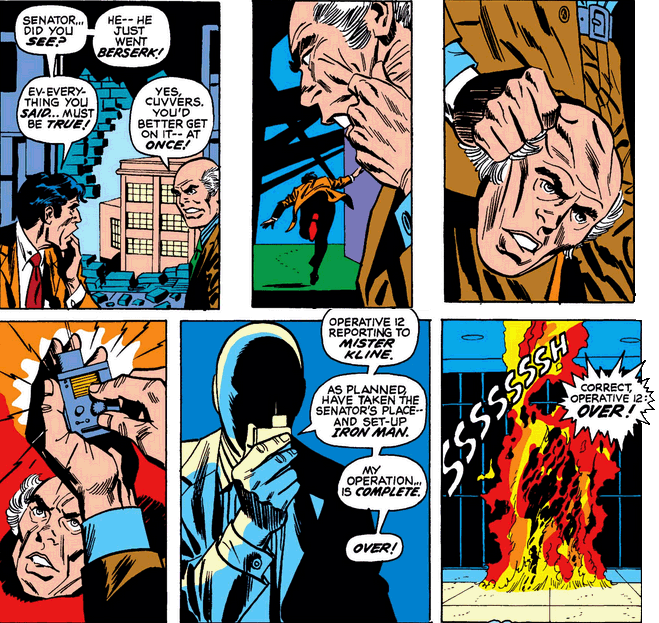
We've been looking at the roughly six-month period of stories from 1971-72 which introduced the figure-in-shadows known as Mister Kline, whose agenda was to disrupt the lives of both Tony Stark and Matt Murdock for reasons unknown. To that end, he involved a number of criminal operatives to do his bidding, until finally turning to more dependable androids of his own construction--at which point Kline himself pulled back the curtain to reveal that he was also an android, in the service of another figure who was just as mysterious in regard to their ultimate goal.

And now, we come to see the situation somewhat resolved in the pages of Daredevil (the key word here being "somewhat"), where writer Gerry Conway brings an anticlimactic conclusion to this storyline that mostly fast-tracks closure for the character and story of "Mister Kline" (now designated "the Assassin" by his superior, Baal) by way of a bare minimum of explanation which may nevertheless satisfy those readers who are ready to move on. Oddly enough, it's made clear by story's end that those sentiments are also shared by Daredevil and the Black Widow.


Thursday, September 29, 2022

The Many Operatives of Mister Kline!


From late 1971 to early 1972, writer Gerry Conway introduced the nefarious Mister Kline, a character who for reasons unknown sought to upend the lives of Matt Murdock, Tony Stark, and Franklin Nelson, and whose hidden agenda would by extension draw in Daredevil and Iron Man. It's hard to say whether Kline's primary focus on Murdock and Stark had anything to do with Marvel's soon-to-be-launched large format books that would offer an increase in story length for selected titles at a cost of 25¢, given that both Invincible Iron Man and Daredevil were reportedly to be merged into a single book; otherwise, Murdock and Stark would seem to be worlds apart as far as gaining the interest of a figure in shadows who would go to any lengths to cause them trouble, to say nothing of the time and effort taken to conscript others to do that figure's dirty work.

And speaking of which, since Kline himself is due for a PPC post of his own, let's spend our time here running down the list of those whom he enlisted to further his plans--some willingly, some not so much, but all in one way or another complicating the lives of our heroes.

Which calls for a not too complicated


Marvel Trivia Question


Which characters were compelled to serve the enigma named... Mister Kline?

Monday, September 26, 2022

Attack Of The Nega-Man!


Fantastic Four #108 is a story spawned from loose ends--specifically, a number of pages of unfinished art by Jack Kirby meant for issue #102, but shelved for a time due to Kirby's resignation from Marvel Comics in 1970 and Stan Lee reportedly having issues with the story as submitted.


Kirby's story has Reed and Sue hosting an archaeologist who has unearthed a statue of Janus, the Roman god of transitions and dualities--which by coincidence coincides with the appearance of a super-powered threat named Janus, who begins raids on banks for cash and who bullies his physically afflicted twin brother into covering for him with the promise of using his new power to mend his crippled legs.

Fast-forward to March of 1971, where Lee has reshaped Kirby's premise and finally given this story legs with the help of artists John Buscema and John Romita to supplement Kirby's original work, while bringing the character of Janus new depth as a former college classmate of Reed's whose experiments with "nega-power" produced an evil side of himself which sought to bring New York City under his control.

Yet the first we learn of Janus is when the character approaches Reed in present-day--a man who has gone on to use the nega-power to mend his legs but who now seeks the wellspring of negative power to be found in the Negative Zone. That meeting takes a violent turn when Janus sees that Reed has no intention of helping him--and so Reed gathers his team to recount the story of Janus in flashback form (more for our benefit than theirs, since the FF vividly recall those events), with the addendum that Janus has breached the entry to the Negative Zone and is on the brink of achieving ultimate power.


Thursday, September 22, 2022

The Cover That Failed!


Following a launch in early 1972 that saw its first four issues apparently competing with Marvel's Greatest Comics as a reprint title for older Fantastic Four tales, Marvel Triple Action then shifted its focus to offering reprints of The Avengers--its covers for the most part mimicking MGC in retaining the original cover art of a story, interspersed with new covers drawn by contemporary artists of the '70s. Arguably, there may have been no Avengers cover more in need of a makeover* than that of the December 1966 issue, rendered by artist Don Heck and pictured here with Rich Buckler's interpretation of its events nine years later.


*Though I'd put the cover to issue #38 in the running.

As we can see, there are two schools of thought as to where the Avengers' fight with the Living Laser comes to a head. On the right, we see a deadly struggle taking place on a bridge in New York City--while on the left, our heroes are on the defensive with the Laser in the Central American country of Costa Verde (a locale which may sound familiar to you from another '70s story). Both covers retain the captions featured on the original--the title referring to Goliath sabotaging the Laser's powerful laser cannon, while Goliath's big change has him regaining his size-changing powers after becoming trapped at ten feet not long after rejoining the team.

While both covers have their peculiarities, it's the original which seems most in need of improvement. Even those behind the scenes in production seemed to recognize that, with what appears to be a last-minute substitution of the Captain America figure with one drawn by Jack Kirby, taken from an issue of Tales Of Suspense published in the same month:


As for the other figures, little thought has been given to what everyone is supposed to be doing (with the exception of the Laser's aggression). Even the Kirby figure's positioning is poorly chosen, having been dislodged (presumably by the Laser) from the cliff, with the Laser either opening fire on Cap's shield or Cap blocking the blast, both superfluous at this point. In the Laser's case, he's already sent Cap plummeting--why continue to fire at his target, much less at the wrong angle? And why should Cap worry about blocking a blast that would miss him?

And speaking of angles, who or what is Hawkeye aiming at? This marksman isn't going to hit the Laser at the angle he's positioned--maybe goons unseen off to the left? That leaves Goliath, who makes a great target for the Laser with his back turned to him; but at the moment, we can't be sure whether he's trying to save Cap, or if he's the one who threw Cap off the ledge in the first place.

On the MTA cover, Buckler's depiction is actually representative of the events taking place in the prior issue's story. But while the activities of the Laser and the Avengers are in the vicinity of the bridge, our motorists are only in the line of fire insofar as an attack by the Laser from miles away, and Buckler taking just a tad of artistic license with presenting a battle scene (and a bridge disaster) that never occurred.


Obviously Buckler is making better use of Cap's shield--but since we've already spent a good deal of time piling on and detracting from the merits of each of these covers, this may not be the time to mention the fact that Cap really has no shield to use at this point, given that his one-of-a-kind, indestructible shield was earlier destroyed by the Laser. (Buck up, Cap! Is that why you're jumping off a cliff?)


Monday, September 19, 2022

To Die Anew!


At the end of its run in the fall of 1998, X-Factor lost its leader, Alex Summers (aka Havok, the brother of the X-Man Cyclops), presumed dead from an explosion of the airborne ship he had boarded in an attempt to stabilize its systems. Yet the following month, a new series began that took advantage of the ruptured craft having space-time properties to merge Alex's essence with the body of his counterpart in an alternate reality, a man who had just met his own death at the hands of the Sentinels--and subsequently, Alex fell in with the Havok-led group of mutants named The Six, whose history and whose world were dramatically different from his own.

The first issue of the new series has already received its due in the PPC--yet now we jump ahead over 2½ years to its final issue, the one story missing from my collection of Mutant X which I'm now going to take a look at for the first time. Writer Howard Mackie has helmed this series from beginning to end--and we arrive at a time of crisis for this world, for its heroes, and certainly for Alex Summers, who doesn't appear free from the capricious whims of whatever fate brought him to an Earth for which he alone holds the key to its survival.


As far as world-ending threats go, who or what could be responsible for such a doomsday scenario on a global scale? How about this universe's version of the Beyonder--who has broken free of his imprisonment at the Earth's core thanks to a battle with a mutated version of Captain America, and who takes a crash course in getting up to speed with current events before setting his sights on one person in particular. [Images taken from the third and final Mutant X Annual.]


Thursday, September 15, 2022

A New Life, A New World--The Coming of Mutant X!


I couldn't tell you exactly why this is, but, in the spirit of full disclosure, I collected and read nearly the entire run of Mutant X fresh from the comics rack during its nearly 2½ years of publication, an admission that seems puzzling to me today considering that I can make the same claim about a number of Marvel titles sold during the years 1998-2001. I can state for a fact, however, that my curiosity got the better of me where Mutant X was concerned, given its focus on Havok, the leader of X-Factor who was killed off in the closing pages of that title's final issue, which served to pave the way to the new Mutant X series.

The circumstances involved Havok's attempt to stop Devlin Greystone, a member of X-Factor who constructs a space-time distortion vehicle in order to return "home" (i.e., the same future as Bishop hails from)--yet it turns out Havok has boarded a highly volatile aircraft that doesn't react well to his attempt to disarm it, seemingly killing both men.


I can't say that Greystone thinks much of Mr. Summers' promises right now (assuming the man survived to mull it over). As for Havok, he's subsequently shunted to the new book, where we'll find there are a lot of new things and people to concern him, as a house ad for the series that appears in the X-Factor issue teases:


That book's letters pages had otherwise kept coy about its plans--even up to this point, where they break the news that anyone with X-Factor subscriptions will see them transferred to X-Men. The following month, Mutant X is launched--bringing along Howard Mackie, who had scripted the last thirty-five issues of X-Factor and who would steer the course of Mutant X for the duration.


Monday, September 12, 2022

Skrull Special Ops: The Attack of the Prime Ten!


Written by Doug Moench, the story for the 1980 Fantastic Four Annual would have taken place sometime during the eleven-issue run of Moench and Bill Sienkiewicz on the main title.  Like Sienkiewicz, the annual's artist, George PĂ©rez, would restrict his work to breakdowns for the issue's finishers (in this case, Chic Stone, Jon D'Agostino and Mike Esposito), which gives us some idea of the time-sensitive nature of the creative process on Fantastic Four during this period; indeed, other pencillers on the book such as Keith Pollard, John and Sal Buscema, and PĂ©rez himself (around the fall of '77 until his departure) often did the same. Those who minded the store on inks, taking the layouts they'd been given and subsequently bringing an issue's story to life, weren't responsible for setting the direction or pacing of that story, but for much of Marvel's Bronze Age they contributed a great deal every month to finish the job the layout artist began and meet those deadlines--and, of course, the benefit to the pencil work that greets our eyes is obvious.

Pérez returns to our foursome here after turning in full pencils for the prior year's annual (collaborating with writer Marv Wolfman), the two annuals comprising his final work with the characters following his brief return to The Avengers earlier in the year and, from there, transitioning to DC Comics. As for the annual's contents, which include a backup feature that details the return of Dr. Doom from the fate he met in the FF's 200th anniversary issue, the page count for this annual's FF story tops out at twenty-four--and so the threat the FF and guest-star Captain Marvel face from a "Prime" assault of ten Skrulls may come off as being wrapped up fairly quickly for the primary story of an annual.

Its premise: Reed Richards invents a wireless "gateway" transmitter of energy across virtually any distance which can send power to receiving cells placed in (for example) vehicles, negating the need for batteries. But unknown to Reed, his research parallels the work of Skrull scientists seeking to create a matter transmitter to use as a weapon against their enemies, the Kree--something that the Skrulls learn when Reed's device forms an accidental link between both gateway terminals. The Skrulls come to realize that Reed's successful gateway can be adapted for their use--and so it isn't long before we find a Skrull agent, after disguising himself to get the drop on Reed's three partners, confronting Reed and delivering his demands.


Uh-oh. Who's going to blink first?