Friday, December 8, 2017

Ben Grimm ller s. rgo!


The cover to issue #92 of Fantastic Four was yet another that was duplicated for the FF reprint title, Marvel's Greatest Comics, as a near-copy of artist Jack Kirby's original effort, but with a number of alterations that are conspicuous considering that there's relatively little imagery on the original to worry about clashing with the MGC masthead or the lower UPC box. In fact, the only elements of note on the cover, but which stand out nonetheless, are (a) the promotional poster itself, with its bold announcement of the upcoming event and featuring (b) the Thing's likeness, with (c) the Thing's hand ripping it off the wall in a moment of irritation (or worse).


The most glaring two revisions have to do with perspective. For one, there's the fact that the images are flipped horizontally, which makes identifying the other changes a deceptive process. For instance, at first glance, the Thing's likeness in the original poster comes across as a more threatening expression because of the additional shadowing underneath his right eye (that is, on our left). Also, the revised image is slightly tilted--which initially seems more of an artistic choice, since the masthead would merge with the poster either way. (But more on that in a moment.)

So why don't we flip the image back to conform more with the original, in order to get a better look at what's been adjusted:


As we can see, the previous MGC revision, tilted to the right, results in a more pleasing balance for the cover, since the Thing's image ends up closer to the center of the page--whereas in the second revision, it falls slightly to the left, just as it does in Kirby's original. Another difference is that Kirby illustrates the Thing's hand in movement in the original, shredding the poster from the wall, while the revised copy is more of a "snapshot" representation of the hand's placement.

Also new is the change from monochrome to color for the Thing's "mug shot," perhaps to distinguish it more from the the altered hue of the poster, which is now blue. The photo's height has also been reduced--while flipping the image back has returned the Thing's threatening glare. In addition, there's a bit less "wall" to see on the MGC version, with its coloring also changed to coincide with the masthead background and its jagged detailing near the Thing's hand significantly altered.

Perhaps the main reason the entire image was flipped has to do with the UPC symbol, which apparently must remain in the left corner of the cover. It presents no problem for the original cover, of course; but had the image not been flipped on the MGC version, the symbol would have blocked some of the wording that probably contributed a great deal to selling the issue:


Finally, with the poster lowered on the MGC cover, some of the Thing's arm also had to be sacrificed, in order to avoid having his hand end up partially covering his face in the photo. The poor guy's visibility really took a hit, thanks to the MGC masthead--maybe that's what he should really be shredding.

If you're curious, you can check out Kirby's dramatic cover image of the actual match between the Thing and Torgo, from the comparison cover review appearing in an earlier post.

Wednesday, December 6, 2017

Alone... Against The Defenders!


THE HULK IS ON THE RAMPAGE! After losing his love, Jarella, as a result of his battle with the Crypto-Man, the Hulk has lashed out in grief and anger while searching for the Master of the Mystic Arts, Dr. Strange, desperately hoping that the magician will be able to restore Jarella to life. And now, after fierce clashes with the forces of both Gamma Base and the N.Y.P.D., the Hulk suddenly finds that Dr. Strange has at last come to him--but after observing the Hulk's path of destruction, both Strange and the rest of the dynamic Defenders make it clear that they mean to bring a halt to the Hulk's actions, however they must.


Fortunately, Strange and the others have fought beside the Hulk often enough to avoid the face-off that appears to be taking place here, and instead attempt as comrades and friends to discern the cause of the Hulk's violent outburst. But due to his grief which still gnaws at him, combined with all of the recent unprovoked attacks against him aimed at stopping his potential threat, the Defenders have their work cut out for them.


In effect, the Hulk has sabotaged his own objective of soliciting Strange's help--his unabated rage making it impossible for him to focus on or even voice his immediate problem concerning Jarella, while the Defenders see only their friend's threat endangering lives while having no idea of the true root of his anger.

And so, at least for the time being, battle it must be--and while Strange initially takes a different approach, the Hulk is mentally equipped to take Strange's actions only one way.


With this issue's cover*, we can reasonably surmise how things will go once the Defenders locate the Hulk again. But once the story fulfills the task that sold the comic book, the greater drama awaits.


*More nice work by Dave Cockrum. (Did you recognize the license number on that car's front plate?)

Tuesday, December 5, 2017

A Man-Brute Berserk!


The shelf life of the woman known as Jarella--the woman who ruled a sub-atomic world and encountered the incredible Hulk as first an ally and then, with Bruce Banner's mind in control, as a lover--was extended well beyond her debut in the title in mid-1971, lasting until her tragic death in late 1976 and even posthumously, with a two-issue follow-up that explored the reaction of a grief-stricken Hulk whose rage engulfed both himself and those unfortunates around him. As spotty as Jarella's appearances were in Incredible Hulk (she existed on a planet smaller than an atom, after all, necessitating that her stories appeared only on rare occasion), it's fairly easy to bring anyone unfamiliar with the character up to speed on the circumstances which led to her death.

Following the Hulk's abrupt departure from Jarella's world due to the machinations of Psyklop, we see the Hulk reappear there after an unstable reducing serum developed by Henry Pym causes the Hulk to plummet again through the microverse until he eventually arrives on her planet*, where a traitor, Visis, wages war against her. Eventually, his forces are suppressed--but Pym's serum wears off, causing the Hulk to grow again, with unfortunate results for Jarella's world.


*The odds are nothing short of incredible that, time and again, the Hulk manages to zero in on Jarella's world, despite having an entire universe of worlds, moons, asteroids, comets, and stars to end up on.


Much later, when Banner (as the Hulk) is reduced in size and surgically implanted in the brain of Maj. Glenn Talbot in order to save his life, the destruction of a controlling mechanism causes the Hulk to begin growing before the extraction process can begin, forcing those monitoring the "operation" to hurriedly shrink the Hulk further. That has him arriving you-know-where, where he finds Jarella's world rocked from earthquakes caused by the Hulk earlier kicking it from orbit. Psyklop, meanwhile, has used the quakes to convince Jarella's superstitious people that a false "god" he's manufactured wishes Jarella to be destroyed.


Meanwhile, Talbot's team is able to remove the atom containing the Hulk from his brain, and prepare to restore the brute to his normal height--the ramifications of which will become apparent shortly.


Once Psyklop is destroyed, Doc Samson's retrieval procedure is initiated--only this time, because of Jarella's close proximity to the Hulk, her people are witness to their queen being taken along with the Hulk. And due to the most incredible "oops" moment of all time, Jarella will find that she no longer has a world to return to.


So, for all intents and purposes, Jarella becomes a resident of planet Earth. And with both herself and Banner now free to enjoy their relationship without being separated again, Jarella certainly bounces back from the loss of both her people and her entire world in record time.


But an old menace, reactivated by a villain in the shadows, threatens to shatter the couple's joy, particularly when its gaze falls on Jarella:


Which receives the response you might expect from the easily-alarmed Banner.


The resulting battle takes its toll on the area, especially when you consider that the Crypto-Man once tangled with Thor--so it's no surprise to see innocent bystanders suffer in this clash. And because this battle occurs in a comic book, and in the midst of happiness, it's also no surprise to see tragedy strike, as Jarella pulls a Captain Stacy on us and finally makes her exit from the book.


Accordingly, the Crypto-Man is fatally dealt with--as is its mysterious master, when its destruction sends a deadly surge back to the villain's lair and overloads its control panel. The Hulk, of course, is left clueless as to why this has happened and why he's suffered the loss of the one who held his heart. But he won't stay in shock for long--and you can be sure the awe won't be far behind.


Monday, December 4, 2017

From Scientific Pariah to Scientist Supreme


OR: "I'll Show You!"


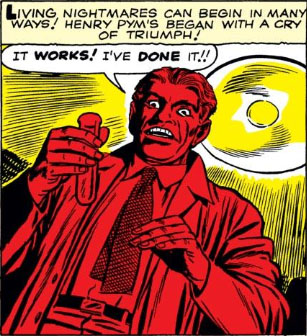
Over the years, while being witness to his colorful and at times unstable career, there's probably one thing we can all reach consensus on when it comes to Henry Pym, a/k/a [INSERT FAVORITE COSTUMED IDENTITY HERE]: his time in the laboratory hasn't exactly been without incident. Put another way: to say that Pym has had his share of mishaps in the lab is like saying that Michael Phelps only picked up a couple of medals in his Olympics sweep. Even before Pym developed the two serums that would alter his life forever, his peers in the scientific community had reached their limit with him, as they tried once more to dissuade him from pursuing his unorthodox experiments and instead apply himself toward more mainstream research.

Given his disturbing response, it seemed clear that Pym's motivations were more self-serving than altruistic.


Nor do you have to look much further than this man's crazed expression following the testing of his shrinking serum to realize that he really shouldn't even be allowed near a bunsen burner, much less a fully stocked lab. Is Henry Pym a scientist more driven than dedicated? A man who strives to break new ground--or one whose methodology in the lab veered toward seeing how bad bad can get?


Friday, December 1, 2017

When A Legend Falls!


In the 1974 saga which followed Steve Rogers' efforts to crack open the conspiracy that would ultimately lead to the abandonment of his identity as Captain America, we watched as the power of advertising instigated Cap's decline in the eyes of the public and pushed the message that Captain America was no longer a man to be trusted--a campaign of revenge begun by the villain known as the Viper and facilitated by his former associate, Quentin Harderman. The idea of an ad agency bringing down Captain America, whose reputation and record of service are as irreproachable and untarnished as it gets, would seem to be a concept that would be dead on arrival--"...something that absurd is bound to blow itself out when it comes up against my record...", as Cap later reflects--but Captain America #170 presents us with a cover that puts both Cap and the reader on notice, and formally begins a journey that will turn this once-proud hero into a virtual outcast.


Yet we would have to go back one issue to see this smear campaign begin to gain momentum--and the best place to start would be the ads in question. It's unclear in the story just how widespread this campaign is or how many ads are in play, though we can assume that they're appearing in both print and television media; but after helping the Falcon out of a jam, it's a television set that catches Cap's attention as he passes by a storefront window where a TV is broadcasting a message regarding his activities.  A message of twisted words that leaves him aghast.


(No, I don't know how Cap or passers-by could hear television commentary through a store window, or why the store owner wouldn't mute a TV placed behind one. But Harderman isn't likely to complain, eh?)

Harderman obviously knows his business. Rather than pontificate, he simply stirs the pot, allowing the masses to make up their own minds while providing them with a front organization--the "Committee"--which promotes the illusion that the announcer isn't alone in his views. After noting the reactions of those stunned bystanders who also were within earshot of the ad and who fail to respond favorably to his words of reassurance, Cap departs with annoyance and frustration--probably not the best image he should be projecting right now.

To get some answers, Cap visits Harderman's office, where we learn about the "Committee To Regain America's Principles" (having the unfortunate albeit appropriate acronym of "C.R.A.P.")--a committee of one.


You may have noticed how Cap's speech seems much more intense and how he takes things more personally since Steve Englehart took over the book--a style that's inflamed more by the addition of a co-scripter for this issue, Mike Friedrich, who in Invincible Iron Man often has Tony Stark flying off the handle at the slightest rough patch or provocation. The Captain America that handles this situation resembles more the aggressive stance of the Cap of the 1950s, who saw enemies around every corner--and a cornered Captain America, which is uncharacteristic of the hero who's set such a high standard for his peers until now, is what we're seeing more and more of here.

With Cap's exit in a huff from Harderman's office, Harderman appears to have much more than a charity exhibition in mind for Cap--and it starts with a run-in that Cap soon has with the Tumbler, who, unknown to Cap, is taking his marching orders from Harderman. The Tumbler, who escapes from Cap's pursuit in this initial encounter, is kept in the dark as to Harderman's plans for Cap, for reasons which will soon become evident; but imagine Cap's surprise when his charity event partner turns out to be a familiar foe who only recently slipped through his fingers.


An unfortunate word for Cap to shout, given what happens next:


The shock of those who witnessed the scene is no doubt exacerbated by Harderman's calculated ad campaign which has had time to affect public opinion of Cap. It's clear that the Tumbler's death was arranged by Harderman; and we learn in the story's closing panels that a hidden assassin was responsible for the act. But no one but Harderman is the wiser--nor are the police, who move in to make an arrest. Harderman has done his work well--but will Cap go quietly?

Wednesday, November 29, 2017

Among Us Hide... The Inhumans!


One of the aspects of Fantastic Four that helped to advance its early development was the fact that writer Stan Lee and artist Jack Kirby knew the value of laying a little groundwork in order to build anticipation for a significant story waiting in the wings. And though at times you would find in such a "transition" issue a mixture of the trivial and even the mundane, there were still enough diverse elements present to hold the reader's interest as well as move the four title characters forward in ways that pleased those who plunked down 12¢ a month to catch up on their lives. A perfect example was the landmark story from late 1965 which saw the Human Torch's social life in the dumps--and the emergence of a new super-powered race that would continue to draw interest nearly sixty years later.


Tuesday, November 28, 2017

The Fall of Hogun The Grim!


In order to retrieve the mighty Thor from Earth so that his power could be used to augment the forces of Asgard in battling the invasion of Seth, the Egyptian god of death, Hogun the Grim has volunteered to be sent across the dimensions to Midgard in an effort to locate the Thunder God and inform him of the crisis. But with the destruction of Bifrost, the rainbow bridge, the journey to Earth was perilous and fraught with risk--and so it is that Hogun is injured on arrival and beset by hallucinations, seeing enemies all around him. And wielding the power of Asgard, Hogun is a clear and present danger to the mortals who cross his path.


Unknown to Hogun, Thor is currently indisposed battling the villain known as Quicksand--and so, in a spotlight that's rarely turned on him for any extended length, Hogun all but receives second billing as he shares two issues with his fellow Asgardian, with both of them battling mortals. In Hogun's case, his opponent turns out to be none other than:


Sure DD is outmatched--beyond outmatched. But that's where the "Without Fear" part comes in!

Monday, November 27, 2017

Hell ls A Very Small Hulk!


You'd think the insidious organization known as Hydra would have learned from their previous debacle to never again tangle with the incredible Hulk, but you'll understand in a moment why they were confident they would be in the driver's seat when the green behemoth is literally handed to them. Having developed the deadly biological weapon known as Virus Nine*, Hydra is almost ready to make their move to deploy it. But there are certain individuals who are both necessary to their plans and who would each also prove to be obstacles--charter Avengers who reunite as allies for the first time, though the mightier of the pair would find himself doing his smashing from a little lower in stature.


*Isn't it comforting to know that Hydra's scientists had eight failures in cultivating this virus before succeeding. They're not exactly A.I.M., are they.

Friday, November 24, 2017

The X-Ceptional Artistry of Dave Cockrum


Taking a look at X-Men #97 couldn't help but remind me of artist Dave Cockrum's initial stay on the title--an assignment which, in tandem with writers Len Wein and Chris Claremont, helped to reignite the team and define the "new X-Men" not only for those readers who rediscovered the book after its overlong hiatus, but also for new readers who responded to a diverse, secluded group of heroes and their struggle to exemplify and defend one man's dream of coexistence.

As I reacquainted myself with Cockrum's work on that issue, I found myself sifting through my memories of his contribution as a whole during those formative two years--and it seemed appropriate as a follow-up post to gather a few samples that, for me, highlighted his outstanding work on X-Men during that time that contributed so definitively to the imprint he left on Marvel Comics.

Mr. Cockrum passed away eleven years ago to the month, at the young age of 63. His legacy includes not only the respect and admiration of his peers, but a body of work that more than speaks for itself.

Mr. Cockrum's portrait by Michael Netzer