Monday, December 22, 2014
And Death Shall Come!
You wouldn't exactly pin the guy as a bruiser--but from the beginning, Dr. Octopus had apparently been groomed to be Spider-Man's toughest, deadliest foe:
Just look at those captions peppering the cover. "His most powerful foe..." "The power of Doctor Octopus is far greater than yours!" "...the world's most dreaded super-villain!" "Can anything that lives defeat the mighty Doctor Octopus?" Granted, all to help sell this new spider-character with only 2.1 issues under his belt--but throughout Spider-Man's history, "Doc Ock" has lived up to his rep, turning into a villain who not only is one of Spidey's toughest customers, but who almost relishes in beating up on him. Ock's style of brutalizing Spider-Man was taking shape even at their first meeting:
Spidey managed to prevail against Ock in that issue, if barely. And, with perhaps the exception of their battle in the first Spider-Man Annual, it set the pattern for their future encounters, with Spidey mostly fighting defensively and desperately against this aggressive menace who savagely whaled on him.
Octopus is particularly out for blood in a three-part story from late 1970, which begins when the villain escapes from prison and all but hijacks a plane hosting a high-level State Department meeting. Spider-Man manages to avert an incident, and Ock appears to meet his end when the plane is destroyed during his escape attempt--but he shows up again in the following two issues, where he comes after Spider-Man looking for a little payback. Spider-Man, for his part, is barely keeping alive against Ock's offensive, unable to really do anything against his power, particularly when their battles are taking place in the city and endangering civilians. And by the end of the second issue, Ock literally has the upper hand--er, arms:
Which sets up Amazing Spider-Man #90--and a development that becomes a turning point for both Spider-Man and Peter Parker, when a major supporting character meets their end. But first, Spidey had better think about surviving a multi-story plunge to his own death.
Sunday, December 21, 2014
Saturday, December 20, 2014
Inbetween Posts
Yes, I see those puzzled looks you've been throwing my way. You have that "Sayyyyy--whatever happened with...?" expression on your face caused by various items mentioned in prior posts but just left dangling there like laundry on a clothes line. I can't take it anymore. The pensive looks--the furrowed brows--the constant drumming of your fingers on the desk. You've managed to wear me down--though I must say, threatening to sic the Sony hackers on me really wasn't necessary.
So let's tie up a few of those loose ends here and now, shall we? (And call off the dogs!)
First up: Surtur hacking the Rainbow Bridge of Asgard to pieces with his sword, "Twilight." Was that colorful dimensional pathway ever rebuilt? And how?
Well, if you're Odin, and you're about to retire to your Odin-Sleep, you delegate--by making Heimdall, the bridge's guardian, interim ruler of Asgard, and handing him your scepter to do construction work you really didn't want to roll up your Odin-sleeves and do yourself:
If Heimdall has indeed been stuck on that bridge and guarding it for "eons without number," I wouldn't be surprised if he took advantage of Odin's slumber to fill that post with some eager vassal who's looking to score a few points with the nobility. I also suspect that, if Heimdall has his way, Odin may be snoozing for a lonnnng time. Eons, even.
Next--you probably remember when Magneto was captured by Reed Richards, using a device called an electronic converter (try to cut Reed some slack--he was in a hurry when it came time to name the thing) to trap the Master of Magnetism within a containment cone powered by the villain's own energies. How, you're wondering, did Magneto escape from that type of confinement?
Perhaps the military's mistake was in releasing Magneto from the cone, in order to transfer him to a plastic prison cell. Because anyone who knows anything can tell you that the way to break out of a prison cell your powers can't affect is by ...
Of course. Mastering the disciplines of Zen and Yoga.
I don't know--that transport Magneto's cone is riding on looks metal to me, so he could have just taken control of it and levitated out of custody before his guards tossed him in that cell. But as for his ultimate solution--I think if I had busted out of a cell by becoming a human projectile, I would have been smashed to pulp on impact. A truckload of yoga wouldn't have helped me then.
The Magus left us all a little frustrated recently when he alluded to some being called the In-Betweener who was going to set Warlock on the path to becoming his darker self:
The In-Betweener is a pretty cool character design, courtesy of Jim Starlin. In the Warlock story, though, he boiled down to little more than a catalyst for what Warlock was to become:
Though when he was met in battle by Dr. Strange, they fought in earnest:
So how did Warlock escape his fate? As simple as it sounds, by accomplishing his mission--to commit a type of suicide before the In-Betweener can touch him. Seems a little like curing the disease by killing the patient, doesn't it.
Finally, remember when Dr. Doom laid out Odin? The villain goes on to conquer the world! What's got more power than Odin to save the day?
The Cosmic Cube, which Reed dislodges from Doom and uses to put everything and everyone back the way they were:
We can all be thankful that the Cube understands Latin, otherwise Reed would be looking pretty foolish about now.
Friday, December 19, 2014
Follow The Leader
By now it's probably easy to dismiss an invasion of the surface world by the forces of Atlantis, given all the times that it's really amounted to little more than brief incursions that ran out of steam for one reason or another. (Though in 1941, Namor was on the verge of actually declaring victory.) But in late 1970, there were still twists to be found in the concept. After artist Jack Kirby left his long-time FF gig (as well as Marvel Comics itself), Atlantis launched yet another invasion--only this time, through a series of careful manipulations, look who's calling the shots:
Yes--this time, Magneto commands the Atlantean military machine, supplementing it with his own magnetic powers. Magneto makes his move in Fantastic Four #103, my first FF issue ever--and now it's time for the exciting conclusion, as the FF and the Sub-Mariner combine forces to find:
Thursday, December 18, 2014
The Deadliest Woman in the Whole Galaxy!
A new flock of comics enthusiasts have come to know Gamora as a member of the trouble-making, hell-raising Guardians of the Galaxy--yet this knife-wielding, lethal woman dates back almost forty years, to her first appearance in Strange Tales and writer/artist Jim Starlin's revival of Warlock. When we encounter her, Gamora happens to be looking for Warlock, for reasons unknown--and while Warlock is seeking answers to the threat of the Universal Church of Truth and its leader, the Magus, Gamora closes in by tapping Warlock's friend (and unofficial sidekick), Pip the Troll, for information:
(Sidebar: What did you notice about Gamora here that would be absent from her future appearances?)
Gamora is coy with Pip as to her identity, though she's certainly blunt (if vague) about her intentions for Warlock. Regardless, Pip decides to tag along as she makes inquiries about Warlock's current location. And those answers aren't long in coming, since it seems her reputation precedes her. As for her named introduction to us, Starlin gives her one that makes for one hell of a calling card, as well as serving as a warning.
If Gamora indeed goes by "many names," it's news to me. "Dagger"? "Vixen"? "Margaret"? Perhaps she's referring to the names she's been called by those unfortunate enough to cross her path.
I've stated before that Pip has become one of my favorite characters--and, as it turns out, Pip and Gamora make quite the team in a scrap, though only one of them seems to think so.
Yet, when the two finally locate Warlock, after he's freed himself from a mind-weapon of the Church, it's still a toss-up for Gamora whether Warlock actually has a chance against his other self:
At his point, we really need more information on Gamora and why she's inserted herself into this affair. From what we've seen of her so far, she appears to be working independently; but when the Magus describes to Warlock his deadly plans for him, we see that she's actually acting as an agent for someone else, as part of a mysterious plan to assassinate the Magus.
Eventually, that moment comes, when the Magus begins a countdown to summon a being who will set in motion Warlock's transformation to his mad, future self. And Gamora acts--but is the Magus doomed? Or Warlock?
With the failure of Gamora's strike, her "master" decides to make his appearance in order to take personal control of the situation. And unlike Gamora, there's no mystery about this character's identity.
With the involvement of Thanos, who reappears here for the first time since his attempt to use the Cosmic Cube to become all-powerful, the Magus decides to send a large army of "black knights" to take out this foursome. And while the outnumbered group fights well, Warlock and the others decide to withdraw and consider their options:
During the down time, we finally learn the details of Gamora's origin, and how she came to be associated with Thanos. It's an origin with distinct differences from the one where we're told the Badoon wiped out her species.
Thanos then decides to make use of a time probe to initiate his plan with Warlock--and the Magus, realizing his danger, invades Thanos's stronghold, leading to a battle royale between the two, while Warlock seeks to destroy the timeline leading to the Magus's creation.
As for Gamora, she's seasoned enough to know when she's out of her league:
(No, I don't know why that entire chamber didn't depressurize with the opening of that airlock, unless everyone present is battling in a vacuum. And no, I don't know how Gamora can walk out into space as if she's stepping out onto the lanai. Often the environments Starlin has his characters casually move back and forth among involve the suspension of disbelief.)
When the dust settles and Warlock's situation is resolved, Gamora finds herself back with her "master," who clearly hasn't taken her into his full confidence.
Gamora, despite really only being a bit player in this conflict, has still assuredly made enough of an impression to warrant further appearances. Yet, from what we've seen of her modus operandi, as well as the reputation we've learned she's established among various species in her travels, it's difficult to believe that she would be so subservient to Thanos--indeed, to believe that she would call anyone "master." When we explore this character further, we'll see that her ties to Thanos aren't necessarily the kind that bind.
Tuesday, December 16, 2014
Patriotism Trumps Protocol
Captain America is usually so cooperative with and respectful of those he interacts with--whether they be S.H.I.E.L.D. agents, or his fellow Avengers, or those in various branches of the military, or ordinary civilians--that it's a little shocking sometimes to see him become cranky, or lose his temper, or throw his weight around. Jack Kirby's Cap worked fluidly with both civilians and figures of authority, while John Byrne's Cap tackled his missions calmly and kept a clear head--and the film version of Captain America seems generally unflappable. As a result, we're not used to seeing Cap ride roughshod over others, and it's a little disconcerting when he does.
For instance, I wasn't thrilled that Cap thinks that "Captain America" doesn't need to bother with an appointment or a waiting room--or politeness:
And he certainly doesn't need to ask to see someone, when a demand will do. After all, might makes right, when you're Captain America:
SHIELD particularly rubs Cap the wrong way, since they're not crazy about the latitude he feels he's due within the organization:
(Granted, this loudmouth needs to be on a leash. I don't think you need to use the butt of your weapon to arrest a helpless prisoner.)
But let's not stop with one guy. Let's make sure every SHIELD agent either backs off--or bows, right, Cap?
Y'know, Cap, would it hurt you to occasionally wear that badge that Fury once gave you? Not every agent realizes you have carte blanche when you're at SHIELD H.Q.:
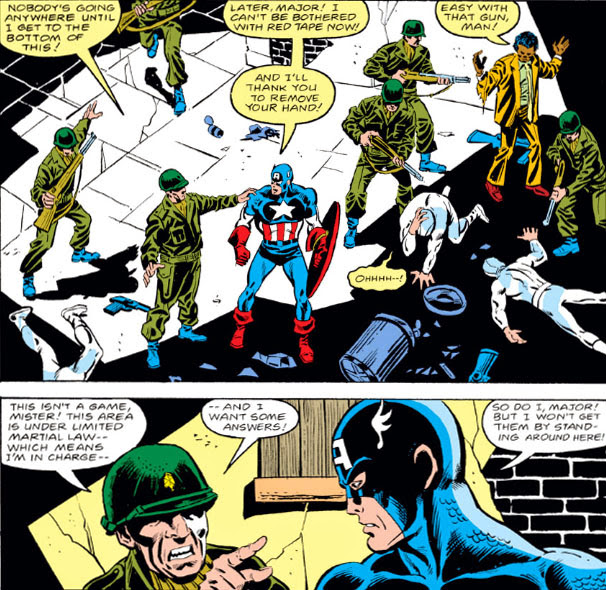
But, let's try other branches of authority, where a crisis situation is in play. Why bother reaching for your Avengers Priority card, when you can just blow off the ranking officer in charge, in front of his men?
And if you're feeling the need to explain yourself, doing so after you've escalated the situation is a little condescending, isn't it?
Or, put another way: What would you be telling any Avenger who acted like you just did?
Subscribe to:
Posts (Atom)