Thursday, September 27, 2012

Better Dust Off That SHIELD Manual, Colonel


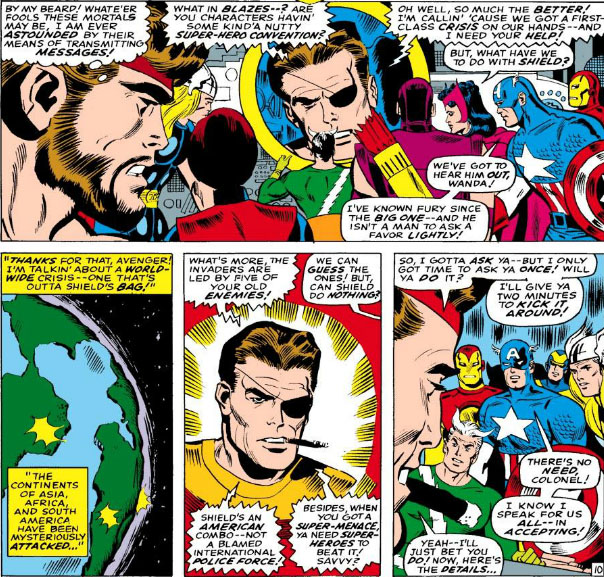
Can any of you sharp-eyed readers find the goof that Nick Fury makes
in this scene from Avengers Annual #1?


Given that the letters of the name "SHIELD" stand for separate words, this declaration from Fury sticks out like a sore thumb:

"SHIELD's an American combo--not a blamed international police force!"

Fury is actually wrong on two counts here (though you'll have to find a braver man than I am to bring it to his attention). SHIELD's initials at this point in time stood for Supreme Headquarters, International Espionage, Law-Enforcement Division--which meant that not only did it have law enforcement authority, but it also indeed operated on an international level. SHIELD may have an American department--but it was by no means limited to operations on American soil.

Though maybe the Avengers helped out anyway because they didn't want to embarrass the big guy.

This Bridge Isn't Big Enough For Both Of Us


Brawl of the Gods


A Series Profiling the Battles between the God of Thunder and the Prince of Power


I don't know what it is with these two. They have either fierce fights or full-blown battles--shake hands at the end, agree how juvenile they've acted, and vow to be brothers from that point on--and then somewhere down the road, start throwing punches at each other at the drop of a hat. You'd think they were Avengers or something.

More like brothers-in-arms--at least when the fists stop flying and the dust settles. The irony is that it's usually been Zeus who puts a stop to it--and isn't that a laugh. Zeus--a brawler from way back (way, way back), who's quick to anger and known for brutally attacking his foe(s)--Zeus being the cooler head and peacemaker. That's like saying that Asgardians are pacifists. But perhaps the main reason why Zeus and Odin let these two go at it is to give each of them a dose of well-earned humility. They're both arguably the cream of their crop in terms of their respective worlds, which has given each of them a swelled head. Thor's time on Earth (and as Donald Blake) has taught him a lot about humility--though declaring himself a god at practically every encounter clearly demonstrates he's not likely to be the Humble God of Thunder anytime soon. Hercules, by contrast, revels in his ego and power, so it usually doesn't take much to rile him.

A lot of comics readers think that Thor and Hercules had their first throw-down in the first and only annual of Journey Into Mystery:


And the answer to that would be "yes and no." Technically, this was their first meeting, considering that it happened literally ages ago in their immortal lives. But readers first saw a clash between Thor and Hercules in the pages of The Avengers, when Immortus summoned various figures from history to battle individual team members. And guess who was called forth to battle Thor?


This story from The Avengers was published about eight months before the Journey Into Mystery annual, so from a continuity standpoint it has no relevance to the "history" between the two characters. And writer Stan Lee wouldn't have referenced that story here, since he literally hadn't yet written it.

As you can see, this Hercules is worlds apart from the powerhouse we've come to know--though Thor, I suppose for the sake of the story, describes his foe's strength level as "the greatest I have ever faced on Earth." That makes this Hercules more powerful than the Hulk--which is simply absurd, given how easily Thor deals with him. Nor would the Hulk surrender from the threat of a fall--or surrender under any circumstances, for that matter. (You could say the same for the "real" Hercules.) So this little clash should probably be filed away under "oops." (Though I'd love for a writer to take a whack at explaining this Hercules and the later one as being one and the same.)

As for the fight in Journey Into Mystery, I wish I could say it takes place under far more dramatic circumstances. Unfortunately, it begins because--brace yourselves--neither was willing to let the other cross a bridge first.


Well, at least they're not wrecking half of New York--that's something.

Wednesday, September 26, 2012

The Punch Heard 'Round The Rooftops


You've no doubt been gripping your seats, waiting to see how that fight with Daredevil and Spider-Man turns out--especially after Part One left things so up in the air.

Well, hang onto those seats even tighter, because this is the wrap-up:


Tuesday, September 25, 2012

Planet Attacking? No Problem


Writer/artist John Byrne may have had his moments when he took over the reins of Fantastic Four:


...but this story wasn't one of them.


The problem with Byrne's "back to basics" approach to Fantastic Four was that he took us back to the days when the group's stories read less complicated than they actually were. Comics were much simpler when the Fantastic Four book began being published. Stories could more likely be fit into just one issue--which meant that whatever problem the FF faced, no matter how potentially world-shattering, it needed to be solved in that issue. So not only did things move along at a quicker pace, but exposition was at a bare minimum.

As a result, some of Byrne's stories tended to fall flat, because the threat was over before you knew it--and the FF, like those original early stories, were none the worse for wear. Just another day at the office.

Nor was Byrne in the habit of letting prior stories in other books stand as canon for what he could or couldn't do. That was something of a disturbing choice in comics, particularly when books reached issue numbers so high that it became either difficult to backtrack to be sure of prior events, or inconvenient to do so considering how much the characters had evolved since then. It became much easier to just disregard what came before. After all, we're talking about events that happened thirty or forty real-time years ago--why drag those forward into current stories?

Why, indeed. You might as well ask yourself, why bother with precedent at all when writing a story? Why not just make comics "what if" scenarios? Who's going to care?

The story in Fantastic Four #235 is a textbook example of both Byrne's writing style for the group, and his penchant for treating prior events as unimportant in the scheme of things. "Let's just make a fun story like they used to be," many of his stories seemed to say. For readers, it meant biting the bullet for the occasional Byrne story that adopted this mindset--for there were certainly stories when Byrne stepped up and delivered truly fine fiction in the lives of the FF. Take the prior issue's story, "The Man With the Power!", which not only elaborates in more detail on the attack the FF face in the next issue, but is also a decent story about a man who could inadvertently alter the very fabric of reality.

When read today, FF #235 is almost excruciating to get through. It's understandable that Ego, the Living Planet, is in search of Galactus and wants revenge--but it's never made clear why he would want to destroy Earth. The only reason, of course, is to provide a basis for the FF to battle him. And, believe it or not, they defeat an entire living planet, if only circuitously. The details would make your eyes glaze over--but basically, they cobble together an explosive device out of some hardware that Galactus had left on the planet, and the Thing travels to the planet's core where Ego's "brain" resides, in the hope of tossing the bomb into the brain and blowing it up. But the Thing misses (misses something that he himself calls "big as the moon"--he must aim like a Stormtrooper), and Ego, in a rage, inadvertently veers off course and sends himself towards the sun, where its gravity destroys him. And the happy-go-lucky FF head home.

Wasn't that fun, kids?

In the process, Byrne also cavalierly gives an origin of Ego that takes up a mere four small panels, and completely disregards the carefully thought out backstory which took place in another title:


Thor #228--where, six years earlier, Gerry Conway takes a more serious approach to Ego, detailing his origin for the first time. Egros, as he was known then in humanoid form, had thought of and implemented "Project: Worldcore," which was designed to shelter his planet's population before their sun went nova. Yet he had miscalculated the time factor, and wasn't able to reach safety and seal the project before the star exploded. Thus, Egros becomes Ego:


This origin, which Byrne was clearly aware of since he includes other elements of the same story within his own, took almost the entirety of the issue it appears in--yet Byrne, with just a few panels, sweeps it away as if it never happened, and replaces it with this unimaginative, one-size-fits-all origin:


Yet this knowledge, imparted to the Thing just before his pitch, is of no real use to him or to the reader, so it's not clear why Byrne includes it. It's but one confusing part of a confusing issue which takes the excellent setup in the prior issue and squanders it. Arguably, just a few issues into his FF run, you could say that Byrne was just finding his legs with the series. I've posted in more detail on my impressions of his work on Fantastic Four, and for the most part I think it's a fine body of work to remember. But I don't think I'm alone in saying that I'm glad this particular issue wasn't a portent of things to come.

Reach For The Stars


I'll grant you that Galactus was always mammoth, in comparison to humanoids--


...but he was drawn to be about the size of the Watcher, right?


And at times, liberties have been taken with his height.
For instance, he's certainly since outgrown the roof of the Baxter Building:


But when did he shoot up to stand toe-to-toe with Celestials?


Because, seriously?
Someone who can step on Manhattan isn't going to let a little thing like the FF stop him next time.


Monday, September 24, 2012

Aunt May vs. Iron Fist--It Could Happen


Marvel 100th Anniversary Issues

FEATURING:


X-Men #100


Despite this issue of X-Men being published with nine, count 'em, nine different covers, there's nothing particularly distinguishable about its story. It's still business as usual for the team, Claremont style--and I speak of course of Chris Claremont, who has been writing the adventures of the X-Men, off and on, for over 20 years. The "style" I'm referring to consists of writing elements which every reader is well familiar with, elements which always tip you off that you're reading a Claremont story. Heroes and villains alike speak in abridged sentences, apparently as a way to make them appear tougher and with more of an edge. The villains have absolutely no doubt of their superiority or ability to defeat the X-Men, and in a particularly ruthless style. Character exposition out the wazoo. And there's usually a "darkest before the dawn" approach with the heroes--having their situation hit rock bottom, before they pull things out and regain the advantage. I could go on, but you get the general idea. The pacing in a Claremont X-Men story is near-dizzying, with a lot to keep track of during a battle.

That's not to say Claremont's doting upon dialogue isn't without its good side. For one thing, he's one of the few writers at Marvel who actually cares about characterization--and with as many characters who pass through the pages of X-Men, he has his hands full in that regard. For another, certain artists he works with--Salvador Larroca and, in this case, Leinil Francis Yu--have styles which display some fine and distinctive artwork, but don't necessarily lend well to storytelling in a team book. It's very difficult to follow their trail of thought as the story is laid out, and equally difficult sometimes to figure out what's happening on any given page--and it's only because Claremont has a tendency to jam his pages with character dialogue (and often monologue) that we're able to actually follow the story. There are times when I wish Claremont would just, you know, shut up--but when the action picks up, his writing style is a necessary evil when accompanied by Yu's art.

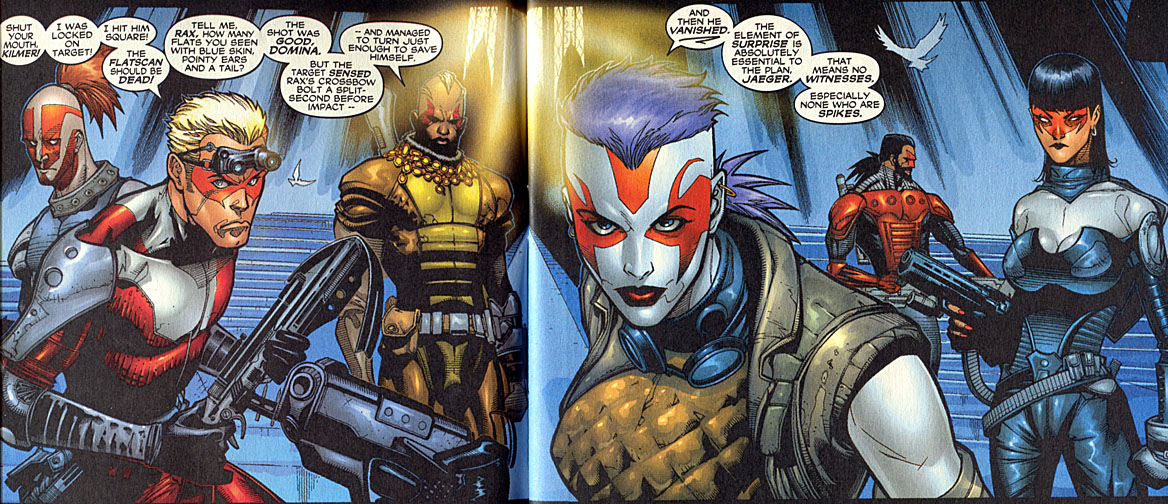
In this particular battle, the X-Men face off against select members of the Neo, a separate species of mutants who are up in arms over a recent attempt by the High Evolutionary to "erase" the mutant gene from humanity (earlier and more successfully than the Scarlet Witch's effort). For the most part, the X-Men are trying to deal with the aftermath of a series of explosions that were meant to bring down the Evolutionary's orbital station that was used to launch his plan. A battle with one of the Neo takes place in the midst of that--while in a second battle elsewhere, Nightcrawler attempts to escape another Neo's assassination attempt. Here we see a fair representation of the Neo sect, after the botched attempt on Nightcrawler:


As you an see, another staple of Claremont's writing is that his female characters are strong personalities that often take the lead. It's one of the things I appreciate, and makes for a nice change at Marvel where the women have usually played more supportive roles. Unfortunately, Claremont simply doesn't know when to rein it in. It's one thing to have assertive female characters--it's quite another to ram it down the reader's throat. Are all strong female characters as hard-edged as Domina? Do Shadowcat, Psylocke, the Invisible Woman, and Storm need to be ninjas? This man would have Aunt May in a Tae Kwon Do class, given half a chance.

And take a look at Kitty Pryde in this full-page declaration of independence. How distinctive is she now from Rogue, or Illyana, or Psylocke, or Mirage, or Colleen Wing, or almost any female character whom Claremont has gotten his hands on?


"I got no interest..."--where is Kitty from now, Brooklyn?


By the way, this "giant-sized special"? It's not because this title has reached issue #100, though that would have been a nice thing to do for the reader who's stuck with the book for the past 99 issues. No, the padding comes from an eight-page insert called "Fast Lane," a four-part story dealing with drugs and alcohol use--a segment placed smack-dab in the middle of the issue's X-Men story, in a way that's meant to discourage the reader from simply skipping past it. If you're attempting to build momentum for your title's 100th issue, inserting a separate story in the middle of it is probably not the way to go about it.

In short, X-Men #100 is a fine battle issue--a fine Claremont issue--but boils down to a day in the life of these brittle, hard-edged X-Men whose world has moved further away from the influence of Charles Xavier and more toward the kick-ass mindset that dominated Marvel comics at the turn of the century. These days, either someone is out to get the X-Men, or the X-Men are out to get someone. As Domina notes, this is war--and ever since this spin-off X-Men book began being published, the X-Men have seemingly been at war. But in another fourteen issues, the book will inexplicably change its look and title, to New X-Men--and the difference in both look and direction takes some getting used to. So I suppose you could say issue #100 of X-Men--while otherwise pretty much status quo in comparison with prior issues--is, in a way, a turning point, even if not recognized as such. With this issue, Marvel winds down not only the direction of the X-Men which this second title began--but also its nod to 100th issues in general, now that its flagship characters have all passed that mark.

Sunday, September 23, 2012

A Boy And His Droog


Can YOU


Name This Marvel Villain??

The Redacted Adventure


This could be your first mega


Marvel Trivia Question


How did this character play a part
in an unpublished Fantastic Four story drawn by Jack Kirby?

Artistry, Guaranteed


If you've ever wondered how artists stack up against writers in the minds of those who run the comics business, this cover of an old issue of Daredevil should give you a good idea. At first glance, it looks like a typical comic book issue:


But wait--what's that conspicuous blurb near the bottom?


Which prompted a little placating on page 1 of the issue:


My guess is that this odd "splash marketing" was done to spur sales on Daredevil--which, now four issues old, may not have been selling as well as hoped. But it came off as extremely odd--almost knee-jerk. For one thing, I wonder if Everett, Orlando, and Colletta thought the "personal note" something of a backhanded compliment? Let's say for the sake of argument that they indeed were only doing fill-in work until a permanent artist could be set up; let's even overlook how unlikely that sounds, given that you're ideally going to have a title's regular artist already in place before you decide to launch the first issue of a new comic book. "Three of comicdom's all-time greats" were apparently still not of "sufficient stature"?

In any event, Wally Wood's stiff style would hardly set Daredevil's world on fire, nor was his name likely to light a fire under readers and have them excitedly tell their friends about his coming aboard Daredevil. As it turned out, his tenure on the book lasted just seven issues. But Wood's arrival did set something of a precedent: an unheard-of cover announcement of a title's new artist (followed by an announcement as inker on an Avengers story)--and a rather gushing one, at that. I don't think even Jack Kirby received such heralding on a book's cover.

And then there's John Byrne--who, just seven issues into his run on Fantastic Four as both its writer and artist, begins taking steps to establishing his legacy with this self-promotion on issue #238's cover:


The unobtrusive shirt button which this very obtrusive image of himself is wearing reads "Artist Writer," perhaps for the benefit of those who were wondering who this guy was on the cover and, more importantly, wondering why he's on the cover. Well, apparently because he's the artist/writer, that's why. And it looks like the artist/writer not only has bragging rights, but also gets to give credit on the cover to anyone else on staff that they feel readers should take note of--as opposed to, you know, the actual characters of the comic book. At the bottom of this FF comic, the usual signature of the cover artist now has wording added: "...and Austin--guest inker of a story in this crazy book!"

Comic books are arguably a visual medium, given that their artwork is unquestionably what first draws your attention to them. The artwork is also what generally sets the pace and tone of the story, even when the artist's work has been done in close association with the writer's ideas and direction. These two very odd examples with Wood and Byrne make clear what's generally unspoken in the industry, if for no other reason than tact--that it's the artist who is perceived to drive both sales of and interest in a comic book. That's a perception that, in my opinion, can do a disservice to the writer--who not only can be responsible for one hell of a story but also, at times, finds they must bring order to the chaos of artwork that is confusing or not up to the demands of the story.

It's a sword that can sometimes cut both ways. Any comic book reader can tell you of instances where they're seen lousy art accompanied by excellent writing, or vice versa. I've seen entire runs of a person's stay on a book where it's been true--where, let's say for 20 or so issues, the writing has been top-notch but an artist has been totally unsuitable. (An example that comes to mind for me is artist Frank Robbins' arrival on Captain America after Sal Buscema left the book. Cringe-worthy.) So no cover blurb or clever promo is going to establish that person's reputation in a reader's eyes--nor was it apparently enough to endear fans to Wood's "brilliant artistic craftsmanship." There's no substitute for word-of-mouth where publicity is concerned.

When I hear the name of John Buscema, or John Romita, or Jack Kirby, a virtual tidal wave of memorable artwork comes to my mind. The quality of that work is what sold me on those artists--and it's what has people still talking about them to this day. You were impressed by what you saw of their amazing talent--not by something trying to coax your impression of their talent before it was even formed. Perhaps an artist's most effective stamp on a comic book cover--and on their run on a book--is in work that speaks for itself.


Saturday, September 22, 2012

Rumble On The Rooftops


A comic book reader's delight about seeing two heroes slug it out with each other must say something about the human race--some message in there that we ought to be paying more attention to. Something like, "We don't care who's fighting--we just want to see a good fight!"  I'm shamed to admit I'm one of those people, at least where comic books are concerned. The "who's stronger?" argument may or may not be settled during such a battle--nevertheless, when it comes to a matchup between characters who for whatever reason have at it in a knock-down drag-out, we generally want to see both contestants be in peak condition and give it all they've got.

One of the earliest such battles in Marvel comics was actually a pretty good one--the matchup between Spider-Man and Daredevil. Spider-sense against radar sense. Billy club against web shooters. Spider-strength against--well, regular gym workouts. These two in battle, despite only one of them being able to pick up a car and hurl it, obviously made for good sales for the Daredevil title--and it made far more sense to hold the fight in Daredevil's mag, since he was the underdog.

Though the proper venue was chosen only after their first fight was held in Amazing Spider-Man #16:


Despite their meeting being so strongly billed on the cover, the issue simply had Spider-Man being hypnotized by the Ringmaster and commanded to battle Daredevil, who was trying to stop the Ringmaster's Circus of Crime during a heist. So the fight wasn't really no-holds-barred; it was also fairly brief, because Daredevil soon found a way to break the hypnosis and the two then joined forces to take down the Ringmaster. "The Tussle Under The Big Top," I suppose we could bill it.

Well, get ready to rumble, because in Daredevil #16 we get the real thing.


(And just take a look at the similarity in issue numbers.)